Don’t You See I Have Work to Do?

Originally published on stylewise-blog.com on November 6, 2020.

Photo by Micah Boerma on Pexels.com

At that very hour some Pharisees came and said to him, ‘Get away from here, for Herod wants to kill you.’ He said to them, ‘Go and tell that fox for me, “Listen, I am casting out demons and performing cures today and tomorrow, and on the third day I finish my work. Yet today, tomorrow, and the next day I must be on my way, because it is impossible for a prophet to be killed away from Jerusalem.” Jerusalem, Jerusalem, the city that kills the prophets and stones those who are sent to it! How often have I desired to gather your children together as a hen gathers her brood under her wings, and you were not willing! See, your house is left to you. And I tell you, you will not see me until the time comes when you say, “Blessed is the one who comes in the name of the Lord.” – Luke 13:31-35

A Homily Given on November 6, 2020

Over the summer, I served as a chaplain intern at the VA Hospital, where a number of my Catholic patients announced to me that they believed themselves to be in purgatory. Long, painful hospital stays in the midst of a pandemic, being prodded with needles and forced into embarrassing interactions with a parade of hospital staff, made these vets feel like they had suddenly been assessed, and considered not good enough to enter the Kingdom of God. They were just waiting for the suffering to end.

Even if we had clear news about the election this morning, the fact would remain that many of us feel like we’re just waiting for the suffering to end. Does that mean we’re in purgatory, too?

In Catholic thought, purgatory is not always conceived of as a place of passive waiting. Joseph Ratzinger, aka Pope Benedict the 16th, suggests that purgatory is not a “supra-worldly concentration camp where man is forced to undergo punishment in a more or less arbitrary fashion. Rather it is the inwardly necessary process of transformation in which a person becomes capable of Christ, capable of God, and thus capable of unity with the whole communion of saints.”

The hard, uneven places between certainty and uncertainty, safety and danger, justice and malice, supremacy and equity, are not places of passive suffering either. Time has not stilled, breath is not bated, even though it often feels that way.  Jesus knows something about this. In today’s passage from Luke, he tells off the Pharisees who cry: “Danger is coming! A decision is about to be made, and you’re in trouble.”

But Jesus doesn’t freeze like a deer in the headlights. I can imagine him wildly gesticulating with his hands: “Don’t you see I have work to do?” Jesus lives in the purgatorial space between violent Roman supremacy and the Kingdom of God, and yet his work remains the same: he presses on to advocate for the marginalized and drive demonic evil out.

All week I’ve been asking myself what is required of me, what it means to be a Christian in a partisan empire, not realizing that Jesus has been wildly gesticulating to get my attention all along.

Our lives are lived – not just now, but entirely – in the uneven place where demonic evil like white supremacy bleeds together with the Kingdom of God. And so, we are in purgatory, but we’re doing it wrong.

Many of us in more progressive circles take for granted that social justice is a call of our shared faith. And yet, while we proclaim that we’re doing the work, we’re often sitting in our own self-designed purgatories. It may look like waiting for someone else to pick up the pieces while evading the harder work of ushering in the Kingdom of God. It may look like self-flagellation, a belief that punishing ourselves will somehow right the wrongs of the world. Or, it could look a bit like standing on a soapbox in the city center declaring our piety for the world to hear.

But the process of becoming “capable of Christ” is not fostered through our nihilism, self-loathing, or performative allyship. Our exterior actions must instead accompany us in our inner purification. Following Christ’s lead, our shared work defies the voices that cry out DOOM! Instead, we listen for the hymns of praise sung on the path to the Kingdom. We find the song and join the march.

We are not being called to “win” something for God, as if God primarily desires to live within the unimaginative narratives of our political systems. Neither are we being called to patiently wait for the suffering to end. We are being called to press on, in the novel and defiant path of the Gospel, to enter into the true story – which is more confounding and more just and more bright with unquenchable love than anything we have known before, the one in which all the saints of God dwell.

Homily: Abide Here

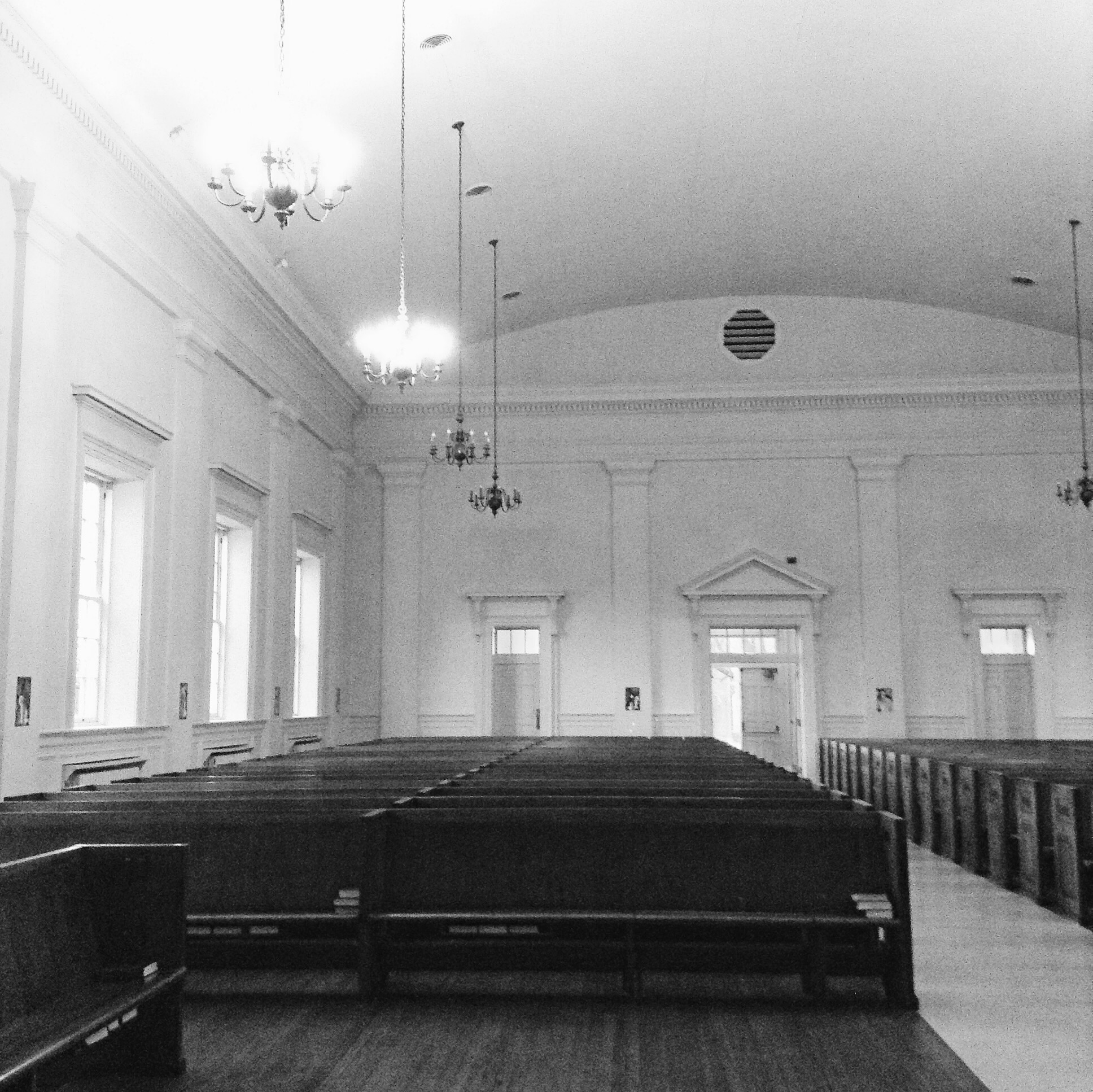
church pews

The Reading (John 15:1-11):

‘I am the true vine, and my Father is the vine-grower. 2 He removes every branch in me that bears no fruit. Every branch that bears fruit he prunes to make it bear more fruit. 3 You have already been cleansed* by the word that I have spoken to you. 4 Abide in me as I abide in you. Just as the branch cannot bear fruit by itself unless it abides in the vine, neither can you unless you abide in me. 5 I am the vine, you are the branches. Those who abide in me and I in them bear much fruit, because apart from me you can do nothing. 6 Whoever does not abide in me is thrown away like a branch and withers; such branches are gathered, thrown into the fire, and burned. 7 If you abide in me, and my words abide in you, ask for whatever you wish, and it will be done for you. 8 My Father is glorified by this, that you bear much fruit and become* my disciples. 9 As the Father has loved me, so I have loved you; abide in my love. 10 If you keep my commandments, you will abide in my love, just as I have kept my Father’s commandments and abide in his love. 11 I have said these things to you so that my joy may be in you, and that your joy may be complete.

Homily: 

In John 15, Jesus uses an agricultural metaphor to describe the Christian life. He tells us that he is the “true vine” planted and tended to by God. He goes onto say that we are offshoots, or branches, of that “true vine” and that we only live abundantly through our connection with Him, saying “Apart from me you can do nothing.”

Well, that’s all well and good, but, practically speaking, what does it look like to “abide” in and with Jesus when he’s not exactly walking around on earth waiting to come to our dinner parties and church services?

Though it may not be immediately clear, I think this passage is rooted in a simple concept:

Growth happens in relationship.

I’m not presenting a new theological idea here, but I think it’s one we often take for granted. Paul helps us understand what relational faith looks like in 1 Corinthians 12, when he tells the people of Corinth that God’s church acts as the “Body of Christ” on earth.

He says: “For just as the body is one and has many members, and all the members of the body, though many, are one body, so it is with Christ. For in the one Spirit we were all baptized into one body—Jews or Greeks, slaves or free—and we were all made to drink of one Spirit.” He ends this section with this: “Now you are the body of Christ and individually members of it.” I love the phrasing of that last verse – though I read this passage over and over in my daily devotions as a young Evangelical, I’d taken it for granted. We don’t lose our individuality when we join a community, but we do become something different – and better – as a collective. Like the human body, we work together to survive and thrive. But we’re not just any body – we’re the Body of Christ – and we do His work when we band together.

That understanding helps clarify John’s passage – it helps us find a way to put into practice what Jesus suggests. Jesus is not present on earth as an individual entity – we can’t hold onto him like branches on God’s vine – but we do have the church. Through the church – Christ’s Body – we may find a life source, and a connection to God our planter and sustainer, while simultaneously offering the love of Christ to others.

A rewording of John 15:1-11, replacing the pronouns for Jesus with “the church,” becomes a powerful statement of the church’s relationship to us:

“Abide in the church as I abide in you. Just as the branch cannot bear fruit by itself unless it abides in the vine, neither can you unless you abide in the church. The church is the vine, you are the branches. Those who abide in the church and the church in them bear much fruit, because apart from the church you can do nothing.

…if you abide in the church, and my words abide in you, ask for whatever you wish, and it will be done for you

…abide in the church’s love

…I have said these things to you so that my joy may be in you, and that your joy may be complete.”

God can work through you or me on any given day, but the work God does is always relational. God’s children must join together for the work of the Kingdom to be done. We prune off the bad fruit in each other’s lives when we ask hard questions and hold each other accountable. We bear new fruit by creating welcoming spaces for everyone – not just the people who are easy to get along with – and by joining together to solve issues within our congregations and the larger community. Conversely, when we resist relationship, we stunt our growth.

I thought for a long time that I could go off by myself with my beliefs and convictions and be just fine, but that mindset fails to grasp the awkward, fulfilling, annoying, life-giving power of church. And I don’t just mean the formal church – I mean the miraculous spaces that allow us to be seen for who we are, to hurt and to hurt others in our confusion, to just be – that don’t give up on us. We cannot fully participate in the Christian life – we cannot build a Kingdom! – apart from Christian community.

My own life is a testament to the church’s work. I attended a highly patriarchal evangelical church through much of college. Though I majored in Religious Studies, I was barred from teaching Sunday School classes if men were in attendance. It was a congregation that privileged the opinions and perspectives of men over even the informed perspectives of women. It tore me apart. I had decided to major in Religious Studies precisely because I wanted to understand my tradition and share it with the church, but everywhere I turned, I saw people who once seemed to love and welcome me slam the door in my face.

I wanted the church, but it didn’t want me. It was a horrible loss; the worst kind of break up. I wasn’t wanted, so I left.

When my husband and I moved to Charlottesville in 2012, we hadn’t been attending church for over a year. We haphazardly church hopped once we arrived in town, but I knew there was still a lot of pain and bitterness in me and I wasn’t sure I was ready to come back.

Ultimately, it was the newly formed Women’s Prayer Group that restored my soul. For the first time in a long time, I was experiencing Church. Not the smug, scared, resistant face of some organization calling itself church, but the welcoming, intentional, safe haven I needed to come back to life. I was free to ask hard questions or say nothing at all. I was allowed to be vulnerable, to be human. But I was also a part of this tiny Body of Christ in the basement of the Canterbury House, and that meant I was called to give the same love and offer the same restoration to other members. We couldn’t do it alone. We had each come as individuals to be healed by one another, but we had also become something different, and better. We had become church.

The church is why I left and the church is why I came back.

There will be pain in this place. There will be hurt feelings and rash decisions and ignorance. But we are called to ABIDE here, in each other, in Christ. We wither and die when we go it alone. In her book, Searching for Sunday, Rachel Held Evans says it this way: “Like it or not, following Jesus is a group activity, something we’re supposed to do together.”

I need you to be Christ for me and, though you may not always feel it, you need to have access to the tangible, living Christ on earth, here in this community and in the universal church.

March 3 Homily

I was asked to do the homily for March 3rd’s evening service at the church I attend here in Charlottesville. Now that it’s done (and I managed not to faint or run away from the podium), I thought I’d share it here. 

moses and the burning bush

Readings: Exodus 3:1-15, Luke 13:1-9

In today’s biblical texts, we can trace a clear progression. It has to do with human responsibility. But it’s not an obligation we place on ourselves. It’s one God has compelled us toward since his first meeting with Moses in the burning bush and maybe even before.

It’s a responsibility to personal growth that turns to action.

The Exodus passage begins with Moses going about his daily tasks. In the Old Testament’s typically understated fashion, the text tells us that Moses is suddenly quite curious about a burning bush that is not consumed: “I must turn aside and look at this great sight.”

The commentary in the New Oxford Annotated Bible notes that the motif of Divine Fire is common in this period and that it: “arouses dread, for divine holiness is experienced as a mysterious power that threatens human existence.”

So we can assume that Moses approaches with some understanding of what he’s seeing. When God tells him, “You will set your people free,” he doesn’t need to waste time figuring out if it’s God; he doesn’t doubt. He knows.

And he is so in awe of the Divine that he is afraid to look at God.

Though many of us have heard this passage before, it struck me this time in that it shows an incredible measure of trust on God’s part. Though he has seen the pain and struggle of his people himself, though he has the power to show himself in a bush that isn’t consumed, he tells Moses that HE will do it. God, knowing that perhaps he is unsuitable to act as liaison to Pharaoh considering a general “DREAD” of the Divine, in a sense needs a human to implement his plan. And Moses doesn’t seem to be a random choice. He is the right person for the job.

The first step we take in living within God’s will is one we don’t take at all. It’s an acceptance to let the blazing fire – the passion – of God be kindled in us and the moral diligence to not let it be consumed by doubt, apathy, worry, or self absorption. It’s also the confidence that this passion will lead us forward in ways that suit us, even if not in ways that make us feel comfortable.

And that brings us to Luke.

In the first part of chapter 13, Jesus addresses our human tendency to turn a blind eye to those we perceive as the Other. He confronts a bias born of privilege, one that states that My life is good because I’m a good person and gets reiterated every time someone other than us or our loved ones suffer.

Jesus extends the work of his father in Exodus, who insisted that mere humans feel the passion of his people’s pain and DO SOMETHING about it. He says, “unless you repent you will all perish as they did.”

You’re not better. You’re not more righteous. You got out for now, but you have to do something with that.

His parable ties it all together. God expects great things from us, but we’re just as led astray as a sterile fig tree. Jesus comes to us with grace. He gives us a second chance. He opens our eyes by coming not in the form of a burning bush that makes us turn away, but in the recognizable, comforting form of our own species. It had become clear that we were too consumed in fear to be consumed in God’s loving justice, so God became one of us to show us we could succeed. We see Christ and his mission and we don’t have to turn away – we can embrace it.

God came first with passion, with fury and movement and an impatient drive to protect his people. And he let one of us in. He gave us the power to do something and the motivation to do it. But, just like the disciples and Jesus’ listening crowds, we got lost again in our own concerns. And we saw suffering and only felt lucky not to be suffering, too. And we repeat the cycle daily.

But we aren’t better. We aren’t better because we’re Americans or Episcopalians or Liberals or Conservatives or Charlottesvillians or UVA students. We see suffering and do nothing. We aggressively consume products presented to us through slave labor – we ignore the bullying, prejudice, and apathy in our own communities and in our own hearts – and we consume ourselves in the process of curating and collecting things and experiences, gluttons to our wants. And we think it’s ok because we’ve told ourselves other people are worse than us. All the while, the burning fire God presented us with is burning out.

We know through today’s texts that we are no better than anyone else. We all come to this life as equals in both merit and guilt. We need this humility to see suffering and empathize with it. We also learn through Moses that God shows us suffering in the places where we have influence, where we can take action.

For instance, our lives as consumers have the power to change or destroy lives. Human beings – people like us – suffer long hours, poor wages, and poor working conditions in the futile attempt to make ends meet at the hands of American corporations fueled by American consumers. Instead of feeling lucky to be here, we should recognize that we aren’t better, that we are the same. And once that hits us, we should realize that WE have the collective power – and the moral obligation through the Bible’s teachings – to make changes to set the suffering free. We can only liberate ourselves when we liberate others.

If we shut down from the important moral responsibilities laid out before us, we deserve to perish. But we’re given a second chance because Jesus believes in us, believes that with a little prodding, we can bear fruit again, and stands by us as we turn away, as we deflate our egos, as we press on to equality and progress.

As Christians, we are tasked to do something with the fire of God in front of us, and through Christ, we can face it head-on and not turn away. We are commanded to “turn aside [from the things that distract us] and look at this great sight” of suffering on earth and change our habits, our minds, our hearts. To set the slaves of unethical values, consumption, trafficking, patriarchy, hatred, and false conceptions of God free. We can only do that if we see that we are all the same, and that God is with us as we move toward equality under the banner of Christ’s grace and love.

I encourage you to assess your values and priorities during the remainder of the Lenten season and to make positive, visible, DIFFICULT changes in your own life.

Image source: Illustration from the 1897 Bible Pictures and What They Teach Us