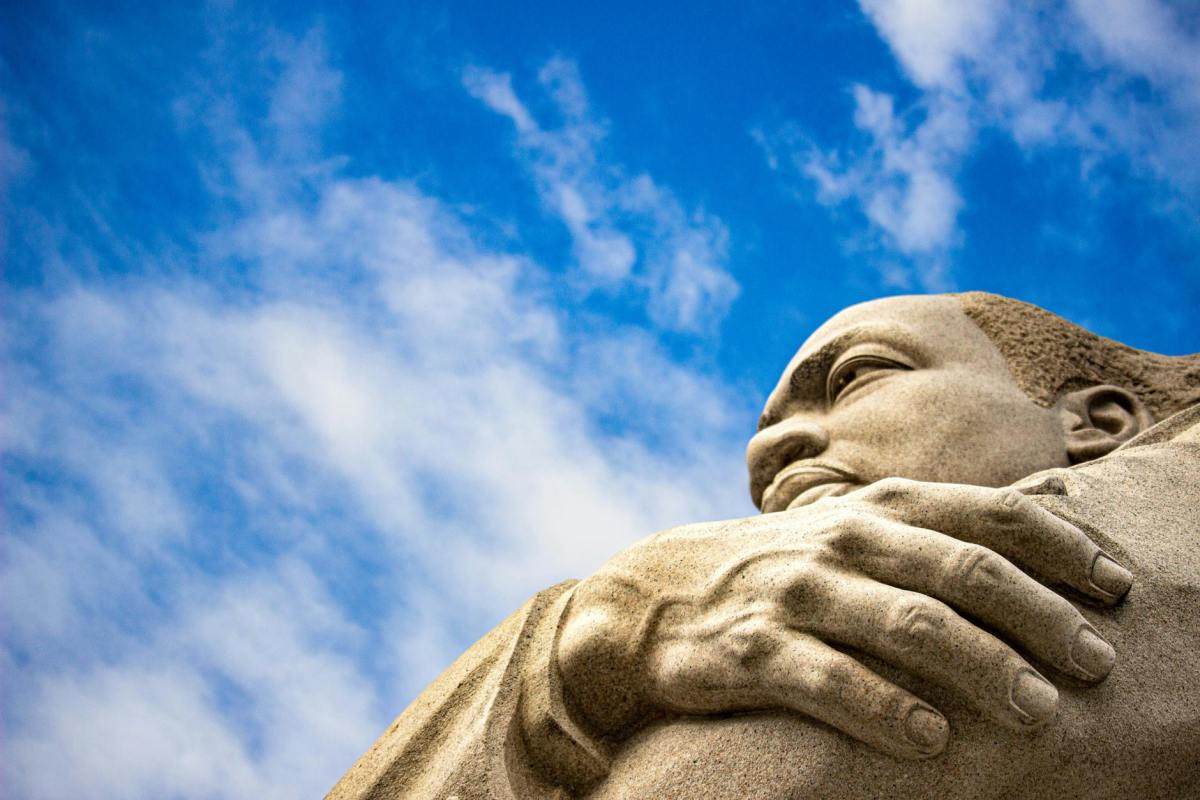
In our Collect and our Readings, the theme of the day is “illumination.” As I prepared for this service, celebrating the life of Martin Luther King, Jr., I kept coming back to a certain phrase in our Psalm: “in your light we see light.”
It reminded me of Easter Vigil. At the very beginning of an Easter Vigil service, which occurs at sunset on Holy Saturday, a new Paschal candle is lit.
The Celebrant says this prayer over the candle: O God, through your Son you have bestowed upon your people the brightness of your light: Sanctify this new fire, and grant that in this Paschal feast we may so burn with heavenly desires, that with pure minds we may attain to the festival of everlasting light; through Jesus Christ our Lord.
The gist of this candle ritual plays out a little bit later in the darkened church when, at the Easter proclamation, all the lights are turned on, shocking sleepy parishioners into wakefulness, and making the church shine like a beacon in the dark midnight of Easter. People ring bells, greet one another other, and joyfully sing “He is risen.”
If Christmas is about the light of the world becoming incarnate, then Easter is about the light of the world becoming permanent, refracting endlessly in the world’s dark night until everything is illuminated. Christ’s glory has been revealed for all time, and now the People, illumined by Christ’s Word and Sacraments, carry that light with them, beacons in the dark.
“In your light we see light.”
For as long as I can remember, I have loved Martin Luther King, Jr. It was a standard part of elementary school curriculum to talk about the Civil Rights Movement the week leading up to MLK Day. We learned how this one man stood up to bigotry, racism, and injustice with nothing but the strength of his ideals and a whole lot of persistence.
Of course, as adults, we know that King’s story – and indeed, the reality of the Civil Rights Movement of the mid-20th century – was much more complicated. King was not a perfect saint – we know he had affairs. And, like anyone else, he made choices that didn’t always pan out and claims that weren’t always quite true. But those things can’t negate the power of his ministry, or the movement he was a part of. Because it wasn’t one man – it was a movement.
Thousands of courageous people took a stand for their own dignity and the dignity of others, at great risk to their lives and livelihoods. They were united in their goals, but they weren’t all the same. Not all of them got along. Not all of them agreed on tactics, or were motivated by the same experiences. But all of them knew the stakes were too high to keep silent.
Some of them, like Mamie Till, were simply proclaiming their child’s human sacredness in the midst of a culture of violence.
In 1955, Mamie insisted on an open-casket funeral for her son, Emmet Till, who had been tortured and murdered by white men for allegedly flirting with a white woman. The men received no punishment for their crime. But the horrifying spectacle of Emmet’s funeral forced the world to confront the violence of racism. Mamie’s prophetic belief that injustice could not prevail is often credited as the beginning of the Civil Rights Movement.
The light inside of Mamie lit a match that started a fire of justice. In Mamie’s light we see light.
Among King’s followers was a young, white Episcopal seminarian named Jonathan Myrick Daniels.
In 1965, he journeyed to Selma, Alabama to register new voters after the passing of the Voting Rights Act. While walking to a convenience store with a group of young, Black activists, a white man pointed a shot gun at 17-year-old Ruby Sales. Daniels pushed the man down and took the bullet. He died on the scene.
When King heard about it, he said, “one of the most heroic Christian deeds of which I have heard in my entire ministry was performed by Jonathan Daniels.”
The light inside of Jonathan burned so bright it saved someone’s life. In Jonathan’s light we see light.
And, of course, there is King himself.
A Christian, pastor, and preacher, King’s engagement in civic life was an extension of his faith and vocation. His commitment to non-violence stemmed from his desire to emulate Christ, who rejected a violent overthrow of the Roman government and insisted that revolution started with good principles and sound theology sustained and negotiated in a “beloved community.”
King was an intentional movement builder, and he was good at it because he knew how to be a community and congregation builder. Following the example of Jesus, he understood that any movement must be built, first, on unwavering principles regarding the sacredness of human life. There could be no question that human dignity was an intrinsic and God-given right that applied to all people, equally.
And second, King understood that successful movements require coalitions, of different kinds of people, from all walks of life, doing what they can where they can. United, but not all the same. In his Letter from a Birmingham Jail, King wrote, “injustice anywhere is a threat to justice everywhere.” That meant anyone bogged down by unfairness, want, and oppression could find a reason to join hands, link arms, and do the work.
On the night before he died, King was giving a speech to striking sanitation workers in Memphis. Now known as the “Mountaintop Speech,” it reads like a sermon, conveying scriptural moments of deliverance and counter-cultural connection, and connecting them to the specific trials of the age.
At the very end of the speech, it becomes clear that King knows there are credible threats on his life. He knows he might not live to see the end of the movement, or even the end of the strike.
But he concludes with this:
“Like anybody, I would like to live a long life. Longevity has its place. But I’m not concerned about that now. I just want to do God’s will. And He’s allowed me to go up to the mountain. And I’ve looked over. And I’ve seen the Promised Land. I may not get there with you. But I want you to know tonight, that we, as a people, will get to the promised land! I’m not worried about anything. And, so, I’m happy, tonight. I’m not fearing any man! Mine eyes have seen the glory of the coming of the Lord!”
The light inside Martin smoldered like incense. They could kill the body, but they could not kill the soul. In Martin’s light, we see light.
Martin and Jonathan and Mamie saw the glorious light of God and refracted it out in so many directions, it began to overcome the darkness. Their lives became beacons, interrupting the dark night of the world.
Two of them were martyred.
Which forces the question, why does the world hate light so much?
The glorious light of Christ that illumines his people is persistent, pervasive, and exposing. It eliminates the shadowy places where evil can persist. “It will not keep silent” when injustice rules the day.
Symptoms of Christ-light include fearlessness, boldness, and an unwavering commitment to principles of human sacredness and dignity. This light insists on honesty above etiquette, inconvenience above order, and love above all else.
It is agitating and loud and overbearing. It wakes up the sleepers and forces us out of our apathy. It makes us remember that everything God created he declared good, and we must declare it, too.
Light cannot tolerate injustice – it must act, proclaim, and respond. And this means, the light of Christ is like a pebble in the shoe of injustice: Worldly powers and dominions hate people who challenge them on their ego trips and power grabs. Worldly rulers and their allies will kill to keep the world in darkness.
But we are not like them. We are light-bearers. In Christ’s light, we see light. And we carry that light as beacons in the dark world.
It is our task to be honest, and to speak up in the face of injustice. It is our duty to stay the course of our faith: to care for the poor, the orphan, the outcast, and the marginalized, to love our neighbors near and far, no matter who they are, and no matter what other people say about them. No matter the cost to our reputations, livelihoods, and maybe even our lives. And it is our calling to be bold and bright, to refract light until the whole world is covered in it.
United but not the same, we bring different experiences and different skills for the movement that we might call Christ’s “way of love.” But we all have work to do. We all have light to bear.
By God’s grace, illumined by Christ’s light, in the way of Martin, we will be able to say that we are not afraid, because we have seen Christ’s glory. And in our light, the world will see light.
Amen.
 Leah Wise