
“Jesus, looking at him, loved him and said, “You lack one thing; go, sell what you own, and give the money to the poor, and you will have treasure in heaven; then come, follow me.”
In Florida and North Carolina and places in between, our fellow Americans are grappling with the aftermath of Hurricanes Helene and Milton. Though the floodwaters and storm surges have subsided, there are over 1,000 people missing across several states. People are still without access to water and power, and some are still stuck in isolated, waterlogged homes.
My husband and I, who grew up in Florida, kept vigil Wednesday night as Milton made landfall, anxiously waiting for family to respond to our text messages: Are you safe? Is everyone accounted for? Do you have what you need? How can I help?
Fortunately, our family is safe.
The physical storms have passed, but the wounds remain. These wounds are social, physical, and financial. And they cut like jagged lines through neighborhoods and towns: disrupting relationships, destroying the comforts and norms of communal life, and compounding grief.
It’s enough to break a person. And I think that’s why we tend to assume that things will devolve into dystopia after a storm – we expect looting, marauding, and spats of violence. Under conditions of want, we expect people to give up on the whole social project. Now, it’s every man for himself.
But surprisingly, this isn’t the case. While the road to recovery is complicated, it happens at a quicker pace than we might expect. And it’s all because people rocked by the impoverishing aftermath of disaster become more generous, not less generous.
In her book, A Paradise Built in Hell, Rebecca Solnit set out to understand what happens to communities after disasters, by studying real-life disasters throughout American history.
Her findings disprove the dominant story that, in the face of scarcity and suffering, people will become selfish, violent, and uncollaborative. Across time, location, and demographic, the opposite proved true. She found utopia.
Solnit writes:
“In the wake of an earthquake, a bombing, or a major storm, most people are altruistic, urgently engaged in caring for themselves and those around them, strangers and neighbors as well as friends and loved ones. The image of the selfish, panicky, or regressively savage human being in times of disaster has little truth to it. Decades of meticulous sociological research…have demonstrated this. But belief lags behind, and often the worst behavior in the wake of a calamity is on the part of those who believe that others will behave savagely and that they themselves are taking defensive measures against barbarism.”
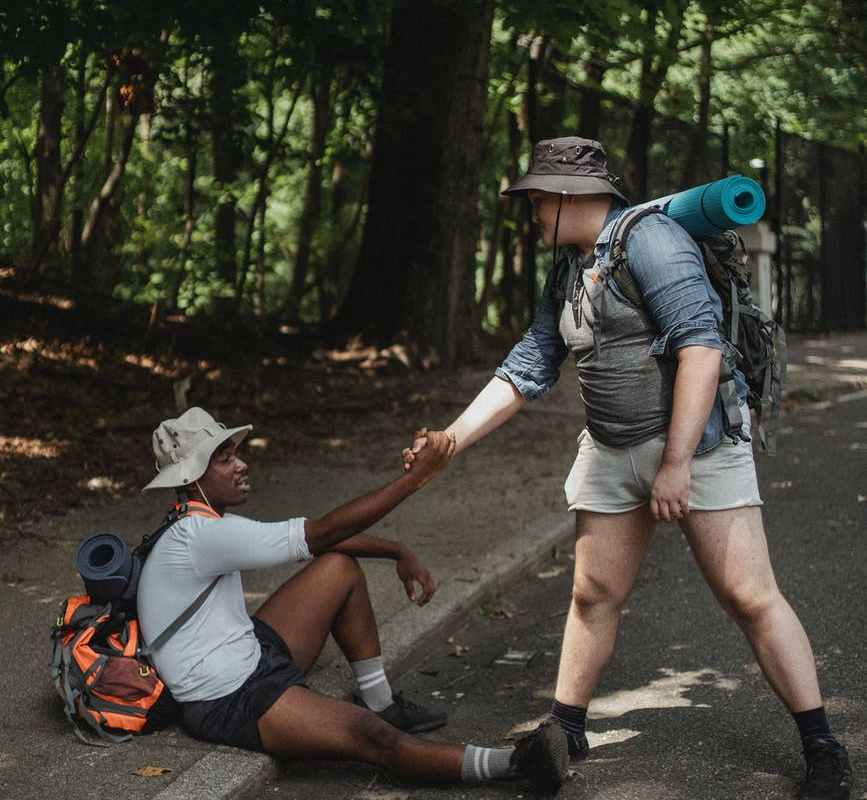
In other words, when a community loses everything, all at once, our human impulse is to care for one another. Social standing, past hurts, personal quirks, and property lines cease to matter when we’re all equally vulnerable, when we’re all aware of our own fragility and need.
The only questions that matter are these: Are you safe? Is everyone accounted for? Do you have what you need? How can I help?
All that matters is finding a reason to hope. And it turns out, the reason to hope is, very often, looking back at us – it’s the family bond and reciprocal care of other humans. As one makeshift restaurant put it, after the San Francisco Earthquake: “one touch of nature makes the whole world kin.”
And haven’t we all experienced this?
After 9/11 or Harvey or Helene or Milton, hasn’t the shock forced us to reach out to others, to find reassurance in one another’s company, and to reexamine what really matters?
Haven’t we prayed a little more, and lingered a little longer while hugging a loved one? Haven’t we looked up at the clear blue sky with a renewed sense of wonder to be here at all? Haven’t we been moved to donate our time and money, and open up our homes, because we suddenly understood that we need each other?
It’s no wonder that one of God’s first acts of love toward humankind was creating another human. When things get urgent and raw enough, we remember that the whole world is kin.
And when we remember that, anything feels possible.
—
It may seem like a strange juxtaposition, but Jesus’ command for the rich young man to sell all of his possessions, places him in a context similar to post-disaster communities. It asks him to place people above possessions and says something about Christ’s vision for the Kingdom of God.
Let me be clear that, when Jesus tells the man to give up everything, he is not calling him to suffering. Jesus does not want us to hope for disaster, as if suffering will make us more holy. Jesus does not delight in suffering and death – his resurrection testifies to that fact.
But, when he tells the man to choose a life of poverty, he is pointing him to the root of hope that is buried under the rubble of our material dependency.
His possessions, and the accumulation of those possessions (1), are a distraction from real living (2). They keep him from recognizing the generous love of God, found most richly in relationships with his fellow human.
He is trying to get the man to consider that abundant life is not a thing that can be accumulated or possessed. Abundant life is found in reciprocal generosity, caring for and receiving care from others.
If you had the choice, why wouldn’t you try to live in that blessedness – that place in which the whole world is kin? Choosing it instead of waiting for the inevitable disaster. Choosing it now, because disaster has already struck somewhere, and hope only grows in the context of mutual care.
—
In the end, the man couldn’t fathom making such a sacrifice. And Jesus wasn’t surprised. But, Jesus’ words still ring in our ears, and we should consider them, too.
Material possessions will not be the marker of our success, and they will not ultimately determine whether the Kingdom of God will survive and flourish.
Because, God’s kingdom is not built with stone, silver, and stained glass, but as a family system of reciprocal generosity. It is predicated, not on financial liquidity, but on the liquidity of love. Which is to say, it is a place of radical trust and radical dependency.
We give and receive in equal measure, to be reminded that true and lasting wealth is the bond we share with one another, and with God.
As kin to one another, we are to open our hands and hearts now, not waiting for someday when it feels like we have acquired “enough,” because that day will never come.
We are to quit judging ourselves and others by material and financial possession. And reject social forces that pressure us to look, act, consume, and invest according to the logics of wealth, power, and control.
If disasters have anything to teach us, it is that control is an illusion. All that we possess could be gone tomorrow.
Our true wealth lies in giving up control to Jesus Christ, who alone can bring about the transformation of the world, who exemplifies generosity, even to the point of giving himself to death on the cross, who, in his earthly ministry, had no money of his own, but brought prosperity of health, spirit, and love to all he encountered on the road.
Jesus is not asking us to give up “everything” to follow him. He is directing our attention to “everything” that actually matters.
So that we can strengthen the bonds of love, building utopia right here, birthing new life in the rubble.
Amen.
(1) Thanks to Dean McGowan for making this point.
(2) Martin Buber, in his book I and Thou, says “All real living is meeting.”









 Leah Wise

