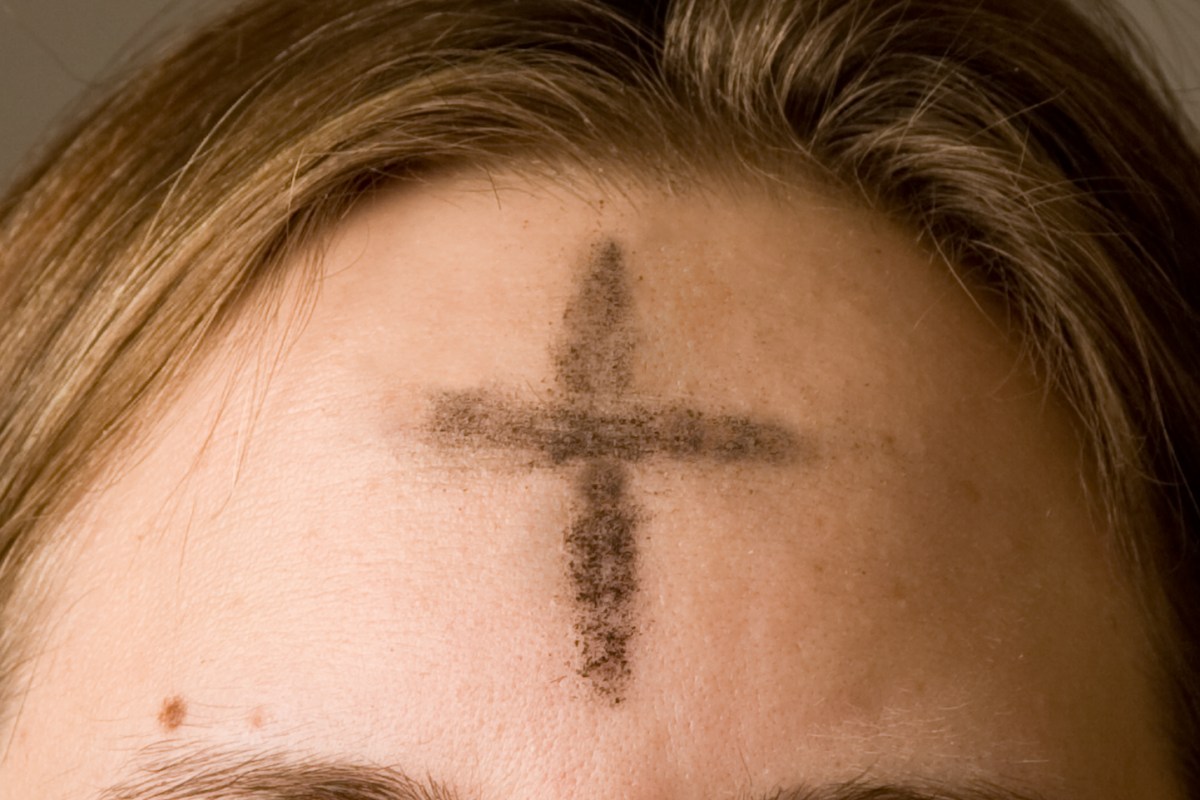
It’s that time of year again…the time for news websites all over the Internet to share think pieces about Ash Wednesday.
In an article for The Living Church, the Reverend Matthew Olver, a lecturer at Nashotah House, argues AGAINST putting ashes in the form of the cross on the forehead. He says that, in the earliest form of the English prayer book, published in 1549, the imposition of ashes was taken out of the Ash Wednesday service. Instead of ashes, the reformers added prayers and psalms that served as a form of “public confession.”
Ashes were not re-instituted in American practice until the 1979 revision to our Book of Common Prayer. In England, they didn’t start up again until 1986. That wasn’t that long ago, but for many of us in the church today, we never had an Ash Wednesday without ashes.
And Reverend Olver does not suggest that we remove ashes altogether. Instead, he suggests that we should sprinkle dry ashes over the head instead of marking our foreheads with them. That way, he says, we could participate in the symbolic act of recognizing our mortality without drawing attention to ourselves for the rest of the day.
His suggestion is a creative one – most people would just unceremoniously get rid of the ashes. But it stems from the same discomfort that many of us feel on this day…
It is more than a little weird that we mark our foreheads with a dramatic black cross on the very day that we read these words from Jesus:
“Beware of practicing your piety before others in order to be seen by them…and… do not look dismal, like the hypocrites, for they disfigure their faces so as to show others that they are fasting.”
Can we honestly say that we are avoiding that kind of pious vanity project when we go around town with ashes on our faces all day?
Well, lucky for us, Reverend Olver isn’t the only person writing think pieces.
In an article for the New York Times, former atheist Christoper Beha makes an argument FOR the imposition of ashes. Beha, who is Catholic, points out that ashes are one of the few truly public rituals of the church, open to anyone, anywhere. While you’ll probably have to chat with a priest or take a class before getting baptized or taking communion, you can literally get ashes-to-go outside of a Starbucks these days.
Beha says that receiving the ashes was his entryway back into the church. After years spent as a skeptic and atheist, it gave shape to his yearning – to be held and guided by a God – and a faith – that was more than words could express. It helped him accept his own imperfection, and admit that he couldn’t fix himself on his own. And it allowed him to walk humbly toward God even as he continued to ask questions.
For Beha, the fact that the ashes are visible enhances the prayers and psalms we recite today. This “outward and visible sign” is what makes our confession public beyond the church walls. In this way, ashes are not about being showy, or telling everyone that you’re a good person. They are a way to humble yourself, by serving as a reminder that no matter where you go or what you do, you are called to be Christ-like.
As a person who spends much of my life walking around in a clergy collar, I have to say that, in the “think piece” wars, I side with Christopher Beha. While there is always the temptation for a visible symbol of our professed faith to make us feel entitled, I have to say that the second that I walk into an H-E-B with a collar on, the thing I feel isn’t pride – it’s more like discomfort.
Confused stares, averted eyes, existential questions in the checkout line; without fail, the cashier asking me if I’m a nun. It’s enough to overwhelm even the most extroverted extrovert. And all the while I know that, simply by the way I am dressed, I am representing the church in the world – for good or for ill.
Ashes do the same work.
Maybe there was a time in history when sporting a big black cross on your forehead would get you more respect. We are not living in that time now. Whether we leave them on all day or wash them off after the service is over, ashes make visible the invisible commitments of our faith, a faith that has increasingly fallen out of fashion.
First and foremost, they make these commitments visible to the us, the ones who wear the ashes. Because if someone is going to watch us be Christians, we’re going to have to act like Christians, all the time. We are compelled to ask ourselves if our professed beliefs are reflected in our lives: Do I show respect to my colleagues? Do I cuss too much in Austin traffic? Do I really care for my neighbors? Am I too impatient with my family?
If we wear these ashes well, we are at no risk of being called hypocrites by Jesus. What will happen is that we will have to reckon with the hypocrisy of all those days we live without ashes on our foreheads – when we can hide who we are meant to be in Christ, and ignore his calls to grace, mercy, and love.
Throughout this Lenten season, I pray that we will develop practices that align with these ashes on our foreheads. That we will have the courage to admit we can’t fix ourselves on our own. That we will return to God, and that in our returning, we will be able to re-enter our daily lives beaming – not with our own pompous pride – but with the marvelous light of God.
Amen.
 Leah Wise