You open wide your hand
and satisfy the needs of every living creature.
Ever since the start of the start of the pandemic, I have been a member of my neighborhood’s “Buy Nothing Group.” The Buy Nothing Project is a national organization with one goal in mind: forge community connections by giving and receiving, without exchanging any money.
To join one, you simply find your neighborhood group on Facebook and verify with the admin that you actually live there. From there, you start interacting with your neighbors in a “gift economy.”
During the pandemic, I was part of a large Buy Nothing group that included nearly all of New Haven, Connecticut, from scrappy grad students in falling-apart duplexes to rich people in Victorian mansions to residents in subsidized housing.
In a Buy Nothing Group, none of these economic categories mattered. The only thing that mattered is that you were willing to give and receive without judgment.
When we adopted a kitten who was destroying all our house plants, I gave them away to my neighbors for a better chance at survival. When my French Press coffee maker broke, a neighbor gave me hers. And when we were getting ready to move to Texas, I was able to give away three bags full of groceries to a woman whose refrigerator had just broken down, spoiling all her food.
But these were just the small things.
Being in a Buy Nothing Group wasn’t just about what I could offer or receive. It was about witnessing other people’s generosity.
Someone offered up their car on loan so a neighbor could get to doctors’ appointments. People painted each other’s houses, moved heavy furniture up and down third-floor walkups, and shared backyard garden harvests. They offered their skills, like carpentry, and their time as babysitters.
In some ways, I think I mentally survived those dark days of lockdown because I was in a Buy Nothing group. That group gave me more than hope. It gave me proof that goodness was already in the world.
In the middle of an apocalypse, we were still living in beatitude.
—
At a basic level, the Buy Nothing Project is just a common-sense way to get rid of things you don’t want. But it’s transformative because it is principled – community connection matters more than transactional exchange.
One of the primary principles is that: “We come from a place of abundance ~ not scarcity.”
It asks its participants to behave as though there is more than enough to go around.
Which is actually a big deal, considering our entire economic system runs on “scarcity.” The idea that “supply is limited” is good for business, because it convinces us that we should spend now and spend more to get what we want or need.
But economic scarcity impacts more than the bottom line. It forms our social world, too. Scarcity thrives on a dichotomy between the haves and have-nots, and on the power differential between the “self-made” success stories and the naive poor. It implies there’s not enough to go around. It makes every person on this planet our competition.
Scarcity discourages us from being generous. Because we feel like we will never have enough. And in all this, it keeps us from building meaningful, dependent relationships with our neighbors and communities.
We keep everyone at arm’s length, either to protect our assets or protect our pride. We can’t risk giving or receiving in a world of scarcity.
—
Over the years, I have often returned to an article written by Hebrew Bible scholar and theologian Walter Brueggemann, entitled “The Liturgy of Abundance, the Myth of Scarcity.”
In the article, he rejects the idea of scarcity by tracing a theme of “abundance” in the Bible. He starts from the beginning, when God creates the lush and bountiful earth and all its creatures, calling it “very good.”
He talks about God’s promise to the chosen people of Israel – how, even in hardship, war, and slavery, God ultimately provides for their need.
- God gives them manna in the wilderness, and quail when they complain it’s not enough.
- God promises them a land flowing with “milk and honey,” a phrase that points toward, not just sustenance, but an overabundance of good things.
- God raises up radicals and prophets who constantly remind them to turn away from idols and kings that promise them the world’s riches in exchange for their freedom.
- God folds foreigners, women, the poor, and the ostracized into the ongoing story of God and his people, widening the boundaries of the Kingdom of God.
In all this, God reveals that scarcity, with all its hoarding, boundary-making, withholding, and harsh judgment is not the ethic of the Kingdom of God.
Today’s story continues that theme of abundance…
The message of Jesus has been spreading, and now over 5,000 people are gathered to catch a glimpse of him. They have come for healing and hope. But right now, they are hungry.
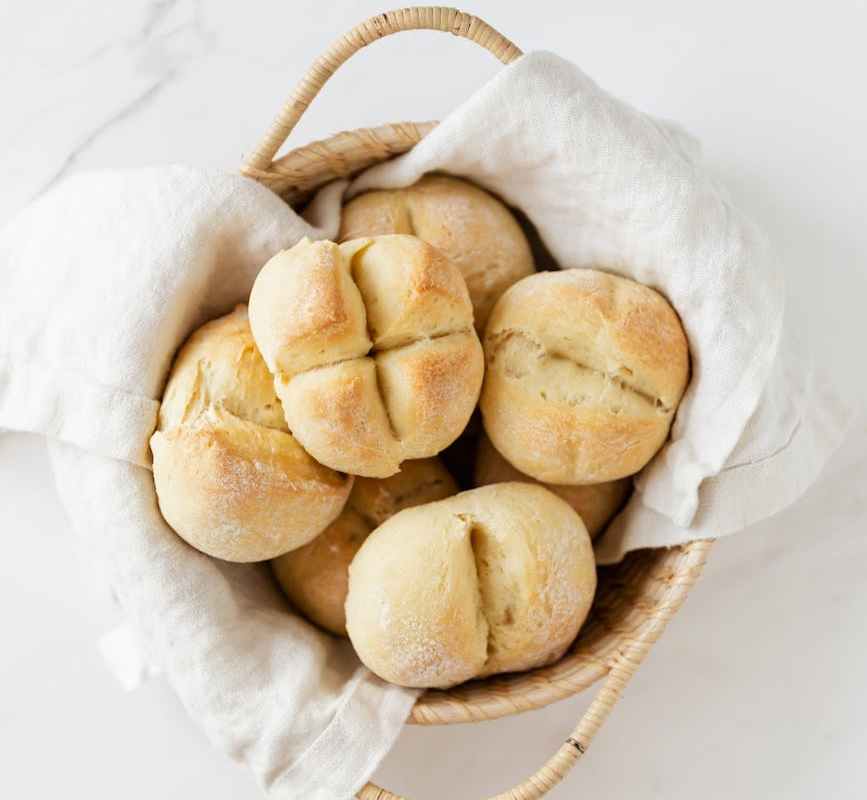
And apparently only one boy remembered to pack a lunch. And it’s the lunch of a peasant: bread made from cheap barley and two fish.
Jesus begins distributing the food and miraculously, everyone is fed, with twelve baskets of food left over. Here, in the most obvious way, our Scriptures reveal that God is a God of abundance. He not only provides for the basic needs of those surrounding him, his generosity overflows.
This miraculous act of feeding shows the 5,000 that God’s act of abundant creation in Genesis never stopped. Now, it is being lived out in the person of Jesus Christ. More than providing hope, it was proof that goodness was still active in the world.
—
But notice that this miracle of abundance was not solely an act of God.
The Feeding of the 5,000 was kind of like a Buy Nothing Group, if Jesus was your neighbor. The people were hungry. The disciples facilitated. A boy offered what he had. Jesus opened his hands and spread it around. And the people willingly received.
Giving and receiving required participation from the people in the crowd. It required a willingness to try from the skeptical disciples, deep trust from the boy, and an honoring of that trust from Jesus.
And it required a different economic principle – where the entire point was community flourishing. Each person’s open heart and open hand was acknowledged there on that hillside, and then multiplied exponentially in the hands of Jesus.
Those who bore witness to the Feeding of the 5,000 – as we do now – were reminded that God’s economy is one of abundance, where even the passive desire to care for one another can lead to a miracle.
—
We live so much of our lives with our fists closed tight around what we have, afraid that if we lose it, we won’t have what we need. But our scriptures reveal a God who is continually working to gain our trust, and to pry our fingers open.
God “opens wide his hand” and shows us how to live into abundance. True freedom comes when we trust him enough let go of our pride and accept the gift he is handing to us, take what we need, and then keep passing it on.
Even the smallest act of letting go and receiving can destabilize the myth of scarcity that poisons our society. Even the most meager resource, offered with open hands, can meet the need and change the hearts of those who witness the exchange.
And so, we pray that God will pry open our fingers and open our hands, to receive his abundant gift and to pass it on to others until the whole world is not only fed, but full. Amen.
 Leah Wise