The Pinnacle Epiphany: A Sermon on Transfiguration

Readings here

Early last week, I wrote an entire 1,200 word sermon.  

But this weekend was Diocesan Council. And it wasn’t just any Council Meeting. This year, the Episcopal Diocese of Texas is celebrating 175 years. 

Over 600 of us – lay and clergy – listened to story after story of lives being changed, and people doing incredible things in the name of the Gospel, over the Diocese’s 175-year history.  

  • Three religious leaders who blocked the bridge to Galveston to keep the KKK from rallying there.  
  • A white Episcopal priest who risked being lynched to stop the lynching of a Black man.  
  • The first woman priest ordained in Texas, at nearby Epiphany, in spite of a protest in the middle of the service.  
  • And then, the recent news, of millions of dollars being distributed to support scholarships, health access, and community programs.  

These were stories of people putting their bodies on the line, and their money where their mouth is. 

— 

I don’t know how y’all have been feeling lately, but I really needed to hear stories of hope. 

I had a breakdown on Thursday night, thinking about the death toll in Gaza, and the drowned mom and kids at the border, and all the other scary, terrible, evil things humans do to one another.  

I kept asking:  

  • What should I do?  
  • How should I act?  
  • How will I know when God is calling me to risk everything for the sake of what’s right?  

I was thinking of all those heroes and martyrs who came before me.  

The Christians who hid Jewish families during the Holocaust, the Civil Rights leaders who persisted through death threats.  My neighbors in Charlottesville who held the line in the face of white supremacists.  And even the Hebrew prophets, who yelled and yelled the words of God, even when everyone called them crazy.  

Sometimes I worry that my practice of religion is too sanitized.  

That I’m too comfortable.  

I can talk the talk, but what good is that, if I’m not living like a person who believes in resurrection?  What good is sound theology if I’m more worried about my reputation than the new creation?  

I don’t think I have a martyr complex, but I do revere the martyrs.  I do think there are things worth risking everything for.  

But what does that matter if I’m not the one willing to put my own body on the line? 

I say all this to give you some taste of the real agony I was feeling.  The guilt, the inadequacy, that sense that I want to do the right thing. But I’m not sure how to even know what the right thing is.  

When are we called to be prophets? When are we called to be pastors? When are we called to be…people? 

— 

With all this in my head, I listened to these diocesan stories, of lives being changed and people doing incredible things in the name of the Gospel. 

And during Hour 5 of yesterday’s 6-hour meeting, I realized I would need to re-write my sermon.  You could say I had an Epiphany about an Epiphany. 

— 

The Transfiguration reading we just heard is the bookend to the Season of Epiphany, that begins with the Wise Men finding the human God in the form of a toddler in a working class family. 

This first Epiphany is that God came down from glory and became human. Not a king, but a carpenter. 

Then, in the Transfiguration, we follow this human God up a mountain for another surprise.  This time, the man Jesus is revealed as the glorified Christ. The eternal Son of God, shining with an other-worldly glow. 

The Transfiguration is generally thought of as a pre-cursor to Christ’s final appearance after the resurrection. Here, in the middle of his earthly ministry, Jesus has invited three of his most trusted disciples to witness the full truth of his nature. 

Some scholars suggest that the optics of the Transfiguration are so similar to Jesus’ appearance after the resurrection, that this event was actually written back into the story after the fact.  

— 

But there’s a more interesting story to tell about the similarity between the Transfiguration and the Resurrection. 

While the Gospels don’t name the mountain Jesus and his friends climb, we often assume it’s Mount Horeb, which is the same as Mount Sinai.  

Christians associate the Transfiguration story with Mount Horeb, because of the text’s mention of Moses and Elijah:  

  • Moses encountered God and received the Ten Commandments on Mount Horeb. 
  • And Elijah flees to Mount Horeb to escape his call, when God shows up and speaks to him in a whisper. 

My friend Ora explained to me that, in Jewish theology, these encounters with God on the mountain are thought to exist outside of time, in God’s eternal timelessness. 

This means that you could think of every divine encounter on Mount Horeb as simultaneous events. God is always present there and always speaking – and the message is always the same. 

So, in this passage, when we are invited to encounter Jesus on the mountaintop, what we are witnessing is neither a story about a past event nor a pre-cursor to a future one.  

In a reality beyond our understanding, the Transfiguration is, and has always been, happening, now

When we bear witness to the Transfiguration, we are having an epiphany in the truest meaning of the word. 

  • We are “perceiving the essential nature of a thing.”  
  • The thing, in this case, being God.  

We are seeing the full glory of the eternal and always resurrected Christ, who was and is and is to come.  

Our eyes are fixed on hope incarnate, in the flesh. On the living sacrifice.  On the Word who spoke Creation into being, and still whispers new creation all around us. 

“Suddenly when they looked around, they saw no one with them any more, but only Jesus.” 

This is the Epiphany to end all Epiphanies. The pinnacle epiphany.  

Not only that God was a baby in a manger, or a man on the move.  But that God, in Christ, is bigger than the whole human story. And yet, he is an eternal and ever-present part of the human story. 

— 

The Epiphany I had during Diocesan Council was that you and I ask a lot of very good questions about the world’s suffering, and our responsibility to alleviate it. 

But the answer doesn’t arrive in words. It arrives in an Epiphany.  

It arrives in God made flesh, and flesh transfigured as God. It arrives as the person of Jesus Christ. 

— 

If we want to do brave and risky things for God, we already have the action plan we need.  

“Suddenly when they looked around, they saw no one with them any more, but only Jesus.” 

If we don’t know what to say or how to act or when to do risky things for the Gospel, we look to Jesus.  We might be asked to follow stars or hike up mountains – to take beatings, leave our nice things behind, and journey to places far beyond our comfort zone.  

But we’ll know when it’s right, because we’re looking to Jesus.  We have witnessed him there, in the timeless place of God, in his full resurrected glory.  We are assured that he is with us, has always been with us, is present in primordial winds that still blow through the streets. 

Evil creeps in, but it can’t win. Because we have seen Christ’s glory face to face.  

We know what hope looks like and no one can convince us otherwise. 

When we get back down the mountain, we’ll know what to do.  Because the Transfiguration is the pinnacle epiphany, eternally revealing the truth of things.  

And maybe the world will kill us for it. It killed Jesus, after all. 

But God whispers an epiphany on that mountaintop that echoes through eternity: 

Have you not seen? Have you not heard?  

We’re a resurrection people. 

Amen. 

Transfiguration Sermon: Carried up the Mountaintop

Readings here

The Transfiguration is an experience of Christ’s glory, and the disciples’ vulnerability

While Jesus is “wonderfully transfigured, in raiment white and glistening,” the disciples are exhausted from the long hike. While God’s voice booms from a cloud, “This is my Son,” the disciples are “terrified.” 

In the presence of Christ’s divinity, the disciples are more aware than ever of their fragility.  

And this is a very good thing. 

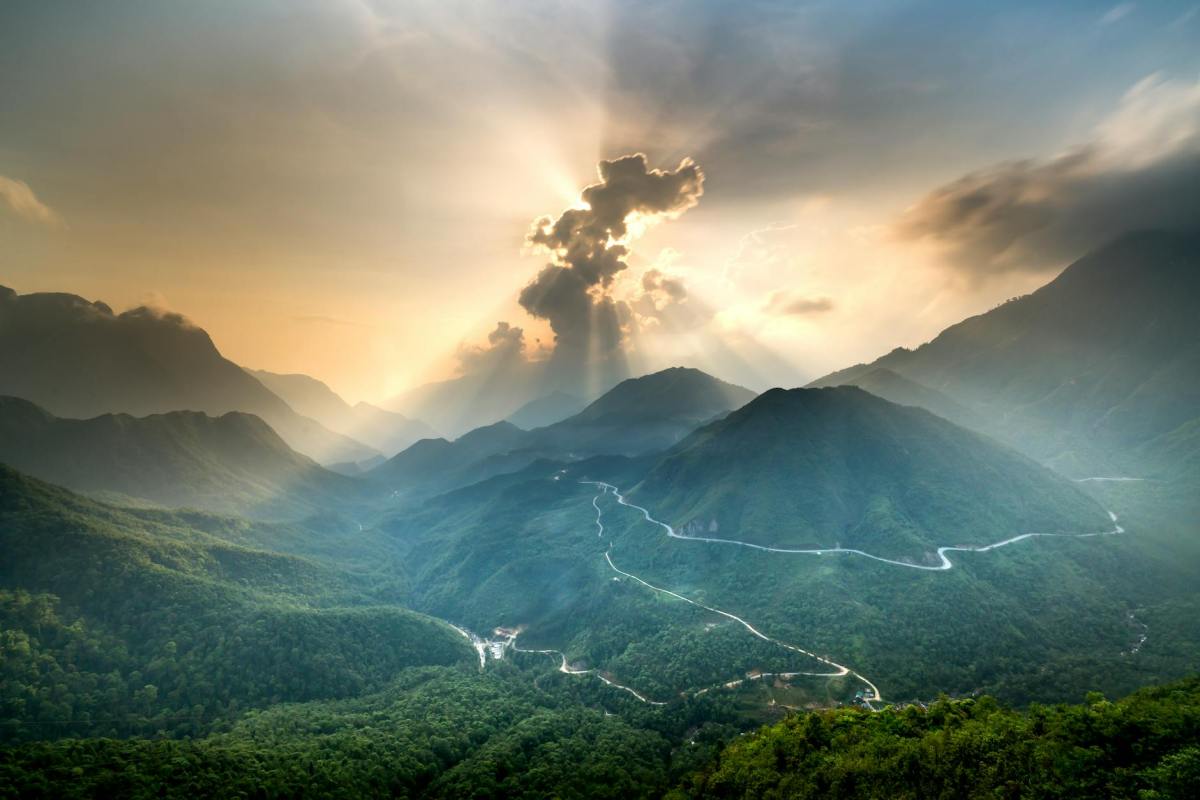
mountains and tree range during golden hour
Photo by Artem Sapegin on Unsplash

And it isn’t the only time something like this happens. God seems to have a thing for the mountains. Several times in our Scriptures, vulnerable humans are compelled to follow God onto steep and difficult trails.  

They are called to experience God on the mountaintop

God appears to Moses to give the Ten Commandments, and Moses’ face literally shines like the sun for days afterward. Elijah runs away from a blood-thirsty king, and God whispers peace to him in a gentle breeze. The disciples, of course, see the glory of God in Jesus Christ. 

These mountaintop stories help define what it means when people talk about having a “mountaintop experience.” 

When we talk about “the mountaintop,” we tend to mean: a moment of clarity, abiding peace, and often, a direct experience of God. When we’re on the “mountaintop,” we may feel that we have a birds’ eye view all of a sudden. We have a sense of who we are and what we are meant to do. We may also feel a sense of relief or wonder.

Importantly, though, the mountaintop moment is never an occasion for OUR glory. We don’t get to an experience of God by our own efforts. And it’s not about the adrenaline rush of a job well done

In fact, the mountaintop moment almost always comes in the midst of hardship, when things aren’t going well at all. After all, Moses had been wandering around the desert with a whole bunch of complainers for years, Elijah was fleeing certain death, and the disciples had inadvertently taken up with a rabble-rouser. 

And down the mountain, there’s no guarantee that we won’t find ourselves in hardship again. 

Still, the mountaintop experience stays with us, because it is a place of God’s glory and our vulnerability. Up there in the clouds, we find our greatest peace, because we surrender to the fact that we are not in control. And when we look back on the experience, we are comforted to remember that God sometimes feels very close. 

Though we are terrified, we can say, like Peter, “It is good for us to be here.” 

— 

In the interest of vulnerability, I think it’s time to tell you about my own mountaintop experience. Now, anyone who witnessed it would say I was in the valley of the shadow of death. Or – at least – Daniel was. 

But I know that Christ was revealing himself to me. 

Early last year, my family and I took a leap of faith, when I signed the contract to become Grace’s curate.  

I had never been to Houston, I have no immediate family in Texas, and we had always thought we would move back to Virginia, after I finished seminary. 

But the Lord works in mysterious ways… 

— 

April turned to May, and I graduated. 

A month later, we loaded up the U-Haul and started the 2,000 mile journey from Connecticut to Texas.  

Daniel hadn’t been feeling well for weeks, but we didn’t think it was anything serious. But, two days into the three-day journey, he woke up in the middle of the night, doubled over in pain. He could barely tell me what was wrong.  

I rushed him over to the hospital in Slidell, Louisiana and, after hours of waiting and dozens of tests, the nurse looked at Daniel with concern and said: “You are very sick.” 

Daniel had a perforated colon. We didn’t have health insurance. The U-Haul was due back tomorrow. The cats were tearing up the curtains in our hotel room. Daniel might have to have surgery. There might be complications. I was supposed to meet the movers at our house. Daniel was very sick. How would we pay for all this?!! Why would God make me move to Texas, if this was going to happen?! 

At this moment, we were not on a mountaintop. 

We were six feet above sea level in Slidell, Louisiana…

But then, like Ezekiel’s dry bones, God started re-membering the Body of Christ. And the body started moving.  

Like diligent worker bees, people started descending on us from near and far.  

Without even asking, the local Episcopal priest showed up at Daniel’s bedside. It turned out that a friend in New Jersey sent him our way.  

Within hours, hundreds of people were praying. Within days, dozens had given us money to tide us over. 

The people of this congregation – total strangers at the time – had already raised enough money to pay our up-front medical bills. Two bishops from the Diocese of Texas called to check in. 

A parishioner and his family spent Father’s Day driving from Houston to Slidell to pick up the U-Haul. The rector coordinated with the movers, and pretty much everything else. 

The diocese figured out how to backdate my insurance, so that it would cover our hospital bills. 

While all of this was happening, the surgeon was insistent that Daniel would need surgery, which in hid case, could lead to sepsis, and even kidney failure. 

But, the air around his hospital bed was buzzing with the voices of prayer warriors, near and far. The surgeon let him wait one more day. And one day later, the infection was clearing, and the perforation was closing. A day after that, he was discharged.  

On the sixth day after his hospitalization, we were at home in Houston. 

On the seventh day, we rested.  

It was good for us to be here. 

— 

While we were in the valley, without us even noticingthe Body of Christ had carried us, up and up, until we were on the mountaintop. 

A place of God’s extravagant glory and our profound vulnerability. A place of healing, and fear, and peace, all mixed in together. A place of bounty, a place of grace. 

Everything in our life was suddenly transformed and transfigured, not because we had done anything to “get right with God,” but because the Body of Christ – in the people of God – had done everything to lay us at the feet of Jesus, where healing could be found. 

— 

Through months of transition for my family, not to mention for this parish, the mountaintop has sometimes been hard to hold onto. 

But then I remember the way we were carried. 

And I thank God for teaching me, at the beginning of ordained ministry, that my vulnerability is for God’s glory. That I don’t need to be perfect or put together to do the work of God. And neither do you

And this is the lesson of the mountaintop, I think: 

That Christ calls us into his body to use our own bodies to care for one another,  to advocate for the oppressed, the grieving, and the overburdened. to keep tender hearts in the midst of the world’s hardness

That Christ calls us to share the good news that a transformed and transfigured world is coming, and is already here, present in the prayer warriors and prophets and sages. In other words, all of us – regular, vulnerable people called to come down the mountain and shine with the light of God’s glory. 

And, the lesson of the mountaintop is that Christ calls us to go to the valleys. He calls us to carry the valley-dwellers through the desert and over the rivers, away from death-dealers and liars and abusers and cartels, into the warmth of one another’s arms, as we seek higher ground together. 

Together, we climb the mountain.

And when we get to the mountaintop, we lay ourselves at the feet of the Jesus, where healing is happening every day.