Five years ago, I journeyed to the diocesan offices in Richmond, Virginia to undergo several hours of interviews for “postulancy.” Postulancy is the first step, of many, on the path to ordination in the Episcopal Church.
I have heard some people call postulancy the “narrow gate.” Because, for many people, this is the most critical step in an ordination process. In these interviews, the aspiring priest is compelled to describe their call with clarity and conviction to a roomful of strangers.
That day in Richmond, I was finally at the end of my interview, and they asked the closing question: “Is there anything else you’d like to tell us?”
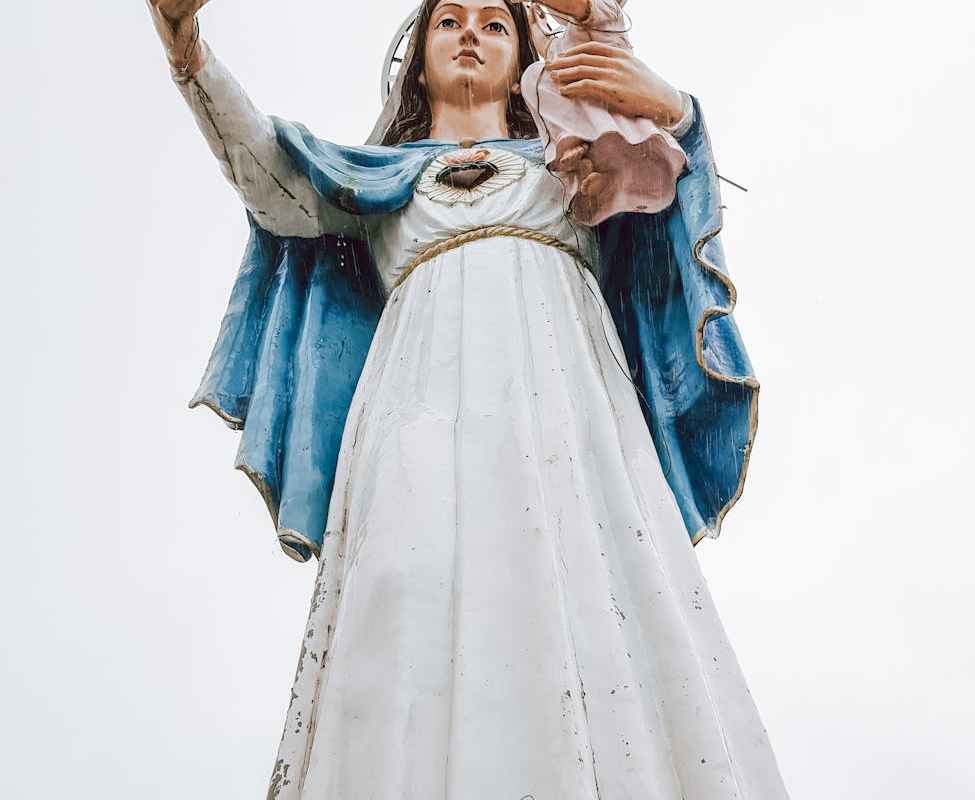
To everyone’s surprise – including my own – I blurted out some garbled sentence about Mary. Whether compelled by the Holy Spirit or by the delirium of anxiety, in that moment, I needed to talk about Mary. It suddenly felt urgent to tell them that Mary’s call by God to mother the Savior of the World meant a whole lot to me.
As a kid growing up in churches that didn’t let women teach or preach, Mary had become my friend. She was a reminder that women could also be a part of God’s story. And not only that: in the story of Jesus, especially Luke’s telling, women are the first to be called.
Mary, and her cousin Elizabeth, are prophets and apostles in the first chapter in the story of Jesus. In the most literal terms, they grew, nurtured, and birthed good news into the world, Elizabeth, as the mother of John the Baptist, and Mary, as the mother of Jesus.
Jesus’ ministry with and for us on earth occurred, because Mary took the risk of saying, “Here am I, the servant of the Lord.”
I told the committee all of these things as I pondered them in my heart. I pondered a little too hard, because I started crying from the beauty and weight of it all.
My rector, who had accompanied me to the meetings, had an amused expression on his face. Later, we laughed together as he recounted how I had made myself cry during an optional question at the very end of a long interview. But, I’m glad Mary showed up during that intense moment in my life.
Because, in many ways, she is the template of the life of faith, not one defined just by having the will to believe, but by moments of surprise, inspiration, and bold proclamation that lead to sustained trust in God.
In today’s Gospel reading, Mary is inspired by Elizabeth’s Spirit-filled blessing to view her strange and miraculous pregnancy within the whole history of God’s persistent goodness. As soon as Elizabeth calls her “blessed,” she starts up with an original song we now call the Magnificat…
He has mercy on those who fear him
in every generation.
He has shown the strength of his arm,
he has scattered the proud in their conceit.
He has cast down the mighty from their thrones,
and has lifted up the lowly.
He has filled the hungry with good things,
and the rich he has sent away empty.
He has come to the help of his servant Israel,
for he has remembered his promise of mercy.
Though her words are spoken with the boldness of a prophet, Mary is not foretelling the future. With sudden urgency, she is actually sharing what has already, and always, been true about this loving, generous, just, and merciful God.
She says: God has already fed the hungry; freed his people from slavery; dethroned tyrants; sustained orphans, widows, and refugees; and brought the lost back to their homes, back to the flock, and back into the arms of God.
Maybe Mary surprised herself when she blurted all that out. Maybe God’s promises had felt far away for awhile. Maybe on that long journey to visit Elizabeth, the initial joy of her miraculous pregnancy had given way to fear, confusion, and even doubt.
But then, the Holy Spirit prompted Elizabeth to say exactly what Mary needed to hear: “Blessed is she who believed that there would be a fulfillment of what was spoken to her by the Lord.”
Elizabeth’s words rang true. They hit her like a bolt of lightning that illuminated the dark night of Mary’s strange circumstances. It helped for someone else to say, out loud, that she had already been called, and that meant she could rise to the challenge of God’s continued call on her life, no matter where it took her.
This realization compelled her to sing! She had professed God’s goodness, she had seen the proof of that goodness throughout time, and now it was time to trust it.
This is how she embodied the life of faith: as a cycle of memory, inspiration, and bold proclamation, with each one necessary to reviving and sustaining the other.
This week, New York Times columnist David Brooks, wrote a piece on his own life of faith, entitled The Shock of Faith: It’s nothing like I thought it would be (gift link). In it, he shares the non-linear path that led him from atheism to whole-hearted participation in Jewish and Christian communities.
He talks about coming to faith, not as single moment of conversion, but as “an inspiration” that occurs at various times throughout life. He says that the first time he felt this inspiration, it was “as though someone had breathed life into those old biblical stories so that they now appeared true.”
In particular, Brooks shares a story about being startled by God on a hiking trip, as he read a Puritan prayer:
Let me learn by paradox that the way down is the way up,
That to be low is to be high,
That the broken heart is the healed heart,
That the contrite spirit is the rejoicing spirit,
That the repenting soul is the victorious soul.
Suddenly, it hit him that these paradoxical sayings were true. He says he was “seized by joy” and suddenly aware of the beauty all around him.
In a paragraph that recalls Mary’s Magnificat, Brooks goes on to say:
“That contact with radical goodness, that glimpse into the hidden reality of things, didn’t give me new ideas; it made real an ancient truth that had lain unbidden at the depth of my consciousness. We are embraced by a moral order. What we call good and evil are not just preferences that this or that set of individuals invent according to their tastes. Rather, slavery, cruelty and rape are wrong at all times and in all places, because they are an assault on something that is sacred in all times and places, human dignity. Contrariwise, self-sacrificial love, generosity, mercy and justice are not just pleasant to see. They are fixed spots on an eternal compass, things you can orient your life toward.”
Brooks suggests that faith may be born in the will to believe, but it is sustained in transcendent moments of awe, in nudges from the Holy Spirit that lead us to recall God’s faithfulness in history, and trust in his goodness, in all times and places.
Through the witness of their lives, Mary and other people of faith remind us that goodness is intrinsic to God’s nature, and that love, generosity, mercy, and justice are God’s intended order of the universe.
Yet, even as we will ourselves to believe, we cannot guarantee that the life of faith will prevent fear, confusion, or even doubt. We may not always feel like a part of God’s story. We may need someone to bless us and remind us of how God sustained his people in the wilderness. We will need to be inspired, in quiet moments and lightning bolt shocks, over and over again.
My hope in these last days of Advent is that we take heart and find moments of joy in our life of faith, unburdened by worries that we’re not holy or good enough to be called by God.
Like Mary, we can embrace this journey with God as a cycle of memory, inspiration, and bold proclamation, with each one necessary to reviving and sustaining the other.
God calls us, and God will come near to us again. Amen.
 Leah Wise
The life of faith requires persistence, persistence in knowing that God is there no matter what even when we don’t feel him. He is always there supporting us, leading us, correcting, us and always loving us.
❤