And the Word became flesh and lived among us, and we have seen his glory, the glory as of a father’s only son, full of grace and truth.
As a lifelong choral singer, I have always been a bit of a Christmas-song snob. And it’s only gotten worse since I became an Episcopalian, and learned about the Season of Advent. Because, as the snobbiest of Christmas-song snobs know, it’s simply *not done* to sing Christmas music before December 25th.
So, when Christmas songs start playing on the radio in November, I simply refuse to indulge in the merriment. Instead, I try to stop up my ears and ignore all the clatter about rocking around the Christmas tree, kissing Santa Claus, and filling the world with cheer. But this year, something shifted…
It has been a hard year. I think I can say that without needing to qualify it. Many of us have borne witness to unimaginable loss and lived with prolonged grief. We have seen our neighbors struggle. Some of us have lost jobs, or struggled to get one. Many of us have lost much more.
This fall, when the Christmas music started playing, I noticed my ears perking up. In the midst of the world’s heaviness, I found myself wanting to entertain the idea of Christmas cheer, even if the songs were silly and it was, strictly speaking, not Christmas yet. I was desperate for something that would pull me out of my wallowing.
So, with cautious hope – or perhaps desperation – I began really listening to Christmas songs, both secular and sacred. And I noticed that songs that had seemed silly and naive before were starting to sound different in my ear.
But one in particular stood out…
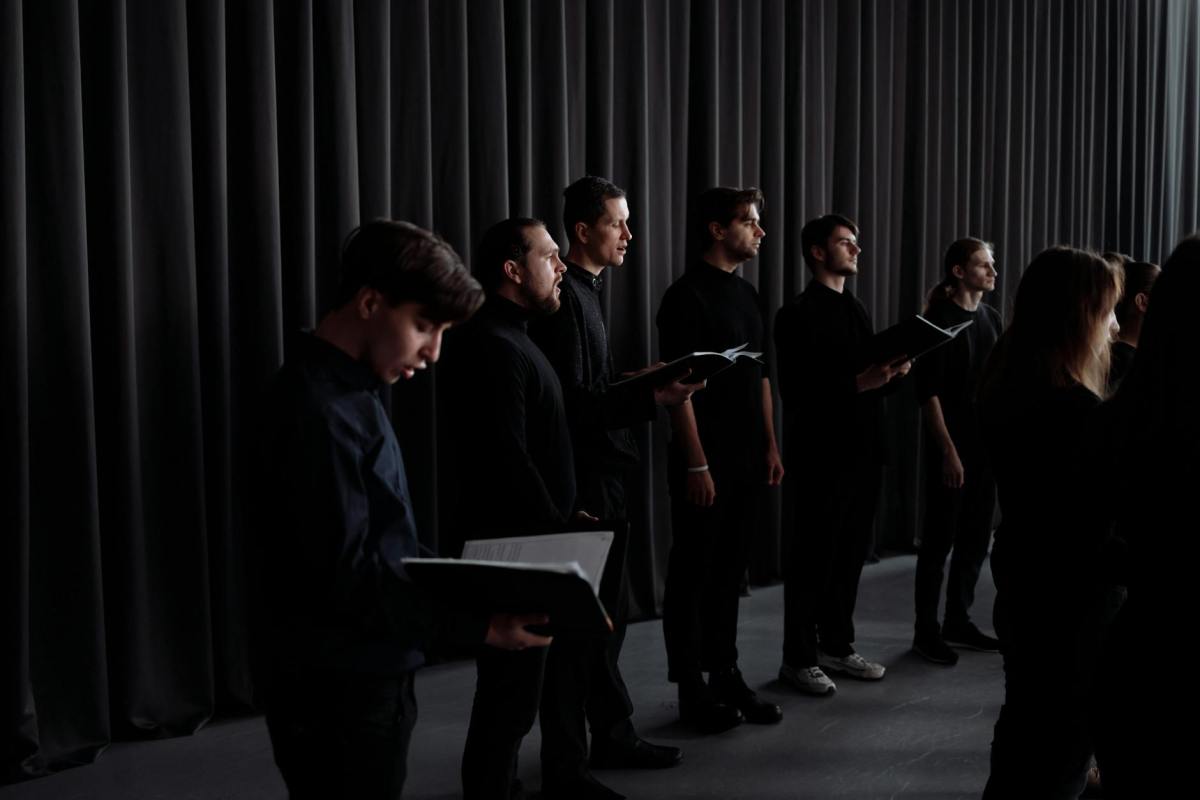
At a community choir concert earlier this month, I was fortunate enough to hear an arrangement of the Christmas classic, “Someday at Christmas.” Released by Stevie Wonder in 1967, this song was part of the soundscape of Christmas before I was born. But, I had never really paid attention to the words, until this year, when 200 men began to sing in the big sanctuary of a church downtown:
Someday at Christmas men won’t be boys
Playing with bombs like kids play with toys
One warm December our hearts will see
A world where men are freeSomeday at Christmas there’ll be no wars
When we have learned what Christmas is for
When we have found what life’s really worth
There’ll be peace on earth
In the unified voice of 200 men, among the crowd of 300 concert goers, this shmaltzy pop song that has whined over the din of Christmas shoppers for 50 years, became something more. Each verse expanded a vision of the world just as big and beautiful as the prophecies of Isaiah:
“Break forth together into singing,
you ruins of Jerusalem;for the Lord has comforted his people,
he has redeemed Jerusalem.The Lord has bared his holy arm
before the eyes of all the nations;and all the ends of the earth shall see
the salvation of our God.”
And yet, at first, the choir sang from a tentative place: a place of desperation, or of hope nearly gone. They seemed to speak of a far-off someday. It seems that their hope had dimmed with each new grief and tragedy in our world, just as mine had.
For awhile, I closed my eyes and listened to those hushed voices sing. But then, something caused me to open my eyes and re-focus my gaze. I looked up and noticed that there was a cross at the front of the sanctuary. It had been there the whole time, taking up the whole back wall behind where the singers stood.
Suddenly, the cross and the music all came together, hitting me like a flash of light. It was as if the full spectrum of faith was being revealed in that room. The desperate prayers whispered in hard times, the cautious hope of someday, the comfort of kind voices filling the room with song. And the empty cross, rising above it all.
The tone and tempo of the music shifted then, and those 200 voices crescendoed into a bold and forceful sound that made the wooden pews vibrate:
Someday at Christmas man will not fail
Hate will be gone and love will prevail
Someday a new world that we can start
With hope in every heart
Quiet desperation had given way to a tangible proclamation of hope. And someday had transformed from passive prayer to bold certainty. As the sound reverberated through the room, all 500 of us gathered there could literally feel hope resonating in our bodies. In the ringing out of unified voices, over the course of many verses, hope had become incarnate.
Words had become flesh.
What was this, if not the miracle of the incarnation, playing out in our time and place? That words of hope could fill up a room and inspire everyone to believe. That things hoped for could be made real through living, breathing, singing humanity.
This is the miracle of the incarnation, on that Christmas long ago: Jesus Christ, the Word and Lyric that made the world, came to us as a lowly human to be united with us. And to make the world around us vibrate with his tangible presence,
In the face of life’s suffering and loss, the incarnation reminds us that a young mother was so close to God, she could hold him in her arms, and a cross could not keep holding him. And, because of this, we will be held forever in the arms of God.
And this is the miracle of the incarnation still: Christ came down to earth – and hope now has a fighting chance. Because the fulfillment of all our hopes lives among us, and in us.
Against all odds, and against common sense, the hope of the world was born this day in a little, hill country town called Bethlehem. Sleeping in a food trough for animals, delivered in the usual way, and arriving without pomp or glory.
But, the air was thick with the singing of angels. Their glorias made the wood of that little barn vibrate. And tired shepherds carried the tune as they ran like fools to the manger.
As time went on, the singing got louder. Until, on every tongue, in the presence of Jesus Christ, the hope of “Someday” was changed to “Today.”
Amen.
 Leah Wise