Divine Reassurances and Difficult Questions: A Sermon on Mary

Advent 4, Year BReadings here

For the past couple of months, I’ve have been slowly making my way through a book series about Jesuit priests who travel through space to meet singing aliens.

While these books, The Sparrow and Children of God, sound pretty lighthearted in their premise, they are actually extremely intense. They follow a Jesuit and linguist named Emilio Sandoz through the thrill of discovering alien life, the tedium of the long journey to another planet, the awe of taking that first step into completely foreign territory, and the surprising joy of engaging meaningfully with another sentient species.

Throughout the books, Sandoz is depicted as a person of wavering faith. Though he has devoted his life to God, he still grapples with life’s most difficult existential questions.

Questions like: Am I really doing what God wants me to do? Where is God in all this suffering? How can beauty and pain exist simultaneously?

But here’s the question the story seems to ask more than any other: If I had known what I know now, would I have followed God’s call on my life?

Early on in the first book, Sandoz has an experience of God so profound that those witnessing it say his face was shining like a saint. But that moment of spiritual certainty is overshadowed by years of tragedy, loss, and physical disability. Sandoz spends the rest of his life wondering what it could mean to have received divine reassurance that God has a plan for him, but to still be grappling with the confusion, doubt, and discomfort of not really knowing what will happen next.


Because I have been living in this alien world with Emilio Sandoz for so long, I can’t help but imagine Mary grappling with the same divine reassurances, and the same difficult questions.

But before I get into that, let me give you a bit of background on what we might call the “Mary Discourse.”

For the past few years, it has been trendy for preachers to riff on the popular Christmas song: “Mary, did you know?”

The song, which we’ll actually hear during the Offertory, goes like this:

Mary did you know
That your baby boy
Would one day walk on water?
Mary did you know
That your baby boy
Would save our sons and daughters?

Did you know
That your baby boy
Has come to make you new?
This child that you’ve delivered
Will soon deliver you.

Though the song was released in 1991, a parody called “Yes, I freaking knew” was shared online in 2019. That song uses all the same words from the original, except each repetition of “Mary did you know?” turns into an exasperated declaration: “Yes, I freaking knew.”

The parody song set off an ongoing conversation about what, exactly, Mary knew when she consented to God’s call on her life. We know that almost immediately after Gabriel’s visit, Mary sings a song about empires falling, and God keeping God’s promises. We call it the Magnificat.

But even though her words are forceful and prophetic, we often talk about Mary as meek, mild, and mostly silent. In other words, there is a disparity between her own words and the church’s historical characterization of Mary.

I mean, look at the hymn we just sang (“The angel Gabriel from heaven came”):

Out of 4 verses, Mary only gets one verse with a speaking part. This, despite being the one who bore Jesus Christ, the Savior of the World, in her own body! The fourth verse has the nerve to give us a speaking part, which doesn’t really seem fair to Mary, since we weren’t there for any of it.

I think the “Yes, I freaking knew” parody is right to point out that Mary wasn’t just a passive part of the story. At some level, of course she knew that saying yes was a big responsibility, with world-changing repercussions.

For us today, Mary is not a “most highly favored lady” because God sent the angel Gabriel to have a little chat with her. We remember her today because she boldy said YES to God’s call on her life.


Today’s passage is all about what it looks, sounds, and feels like for God to call us to something, and for us to respond.

The narrative follows the structure of a classic call narrative. Like the Old Testament prophets and patriarchs, Mary is brought into the terrifying presence of God’s messenger, who shares a bewildering and improbable message:

You will bear the son of God. You, little old Mary, from a region about the size of Houston, Texas, are being asked to consent to something that will risk your future, for the sake of the whole world.

This experience must have been unlike anything Mary could have imagined for herself, a young, poor woman from a marginalized religious group. Like Emilio Sandoz encountering an alien world for the first time, I imagine that Mary felt equal parts joy and wonder as Gabriel told her that the story of salvation was, at last, coming to pass.

She knew, in that moment, that God was at work in the world. And everything would be different.

In the near presence of God, of course she said yes: “Here am I, the servant of the Lord; let it be with me according to your word.”

So, it seems clear that Mary freaking knew, at the moment of her call, that she would play a part in God’s plan. Jesus was coming and nothing would ever be the same.


But could Mary have possibly known…everything?

Could she have known the jumbled beauty and pain of childbirth? Could she have known that Jesus, once he was grown, would put her own people at odds with one another, almost immediately? Could she have known the intricacies of his ministry, and the difficulty of navigating the needy crowds? Could she have known the intense horror and grief she would feel when her son was murdered by the empire?

As Mary sat at the foot of the cross, her son gasping his presumed last breath, do you think she really knew what saying yes to God would mean? Do you think she wondered if she had lost the plot somewhere along the way?

Indeed, even after Jesus’ resurrection, the fledgling church looked nothing like the empire-destroying world Mary sang about in her Magnificat.

Are you there, God? It’s me, Mary.

At the end of Christ’s earthly ministry, I wonder if Mary secretly pondered a question she dared not say out loud: If I had known what I know now, would I have followed God’s call on my life?


I don’t mean to be bleak, but in this last reflective moment of Advent, I do mean to be honest.

When we, like Mary, say yes to where God is leading us, we can never really know what that means for our future. In following Jesus, we are not promised a roadmap. We are not guaranteed glory or safety or a simple life. We are not even promised rational answers to our existential questions.

But, what we are promised is that everything will change, for the better.

As we look forward to celebrating God coming near to us, in the form of a human named Jesus, what we can know is this: It wasn’t enough for God to be at work in the world, in a vague and distant way. It wasn’t enough for God to be just out of arm’s length.

No! For our sake, God wanted to be a baby we could hold, a person we could embrace, a fellow citizen in an unjust empire, a cousin who cries with you at your kitchen table, a friend who tells jokes and calls you on your crap, a son who loves his mom.

We worship an incarnate, em-bodied Savior who calls us, like Mary, to use our own body, mind, and spirit for the sake of the transformation of the world.

He reminds us that, even in our human frailty, we are stronger than we know. Empires will be toppled, and the lowly will be lifted up. And God is, truly, with us.

When we answer the call of the Gospel, we can never really know where Christ will lead us.

But I hope, when Jesus’ tiny hands reach out to you from the manger this Christmas, you can hold him close to your heart, and say: YES.

Amen.
The Kingdom of God, the Kingdoms of this World

A sermon given on the second Sunday of Advent – Readings here

The story of Isaiah takes place over 2,500 years ago. But, because Isaiah’s ministry takes place within a complicated and violent political drama, it still resonates with us today.

Rabbi Abraham Heschel says that:

“the years in which Isaiah began his prophetic activity were the beginning of a most critical period for both Israel and Judah.”i

The threat of military invasions from multiple nations loomed at every border. Vigilante groups took up arms, overstepping the political hierarchy, and stirring up resentment and rage in the population. The Northern Kingdom of Israel had already been suppressed. And now, parts of Judah had been taken over by Edomites and Philistines, who had taken advantage of the chaos to bolster their own political influence.

And then things got even worse. Jerusalem was under siege.

As King Ahaz tried to figure out a way to save his people, and his land, from increasing devastation, Isaiah asked for a meeting.

In chapter 7, Isaiah gives the king a prophetic message:

“Take heed, be quiet, do not fear, and do not let your heart be faint, because of these two smoldering stumps of firebrands…It will not come to pass…If you do not stand firm in your faith, you will not stand at all.”ii

Isaiah tells King Ahaz that the invading armies will leave, and the influence of these antagonistic nations will decrease in time, but Ahaz has to be patient, and wait. He has to believe that God won’t abandon his people.

It’s simply not enough for Ahaz.

He allies with the powerful Assyrians, asking them to send troops and supplies to Judah to help them win the war. He chooses military might over God.

Heschel responds:

“No other ruler would have acted differently. The state was in peril, so he appealed to a great power for military aid. Isaiah offered words; Assyria had an army…

The future of the country was in peril. The king would have had to justify to his people a refusal to ask for help.

So Ahaz decided that it was more expedient to be “son and servant” to the king of Assyria than son and servant to the invisible God. He took refuge in a lie.”iii

The lie was that military power, and not God, could save his people.


The consequences were devastating.

While Ahaz did achieve temporary peace in Judah, it was at a cost to his own personal faith and, eventually, to the survival of his kingdom. Caught up in the thrill of his political alliance with Assyria, he continuously failed to listen to Isaiah’s warnings of destruction.

By the time Ahaz’ son, Hezekiah, took the throne, Assyria was demanding more and more tribute in exchange for their protection. And in the following years, Hezekiah broke ties with Assyria. He allied with Egypt and Babylon, in an attempt to reduce Assyria’s influence.

This was the fatal flaw.

In the coming years, the Kingdom of Judah lost every last bit of its freedom. God’s people were in exile.


This history matters, because it is the context from which today’s Isaiah reading comes to us.

In fact, most of Christianity’s messianic prophecies take place, not in a context of peace, but of utter destruction.

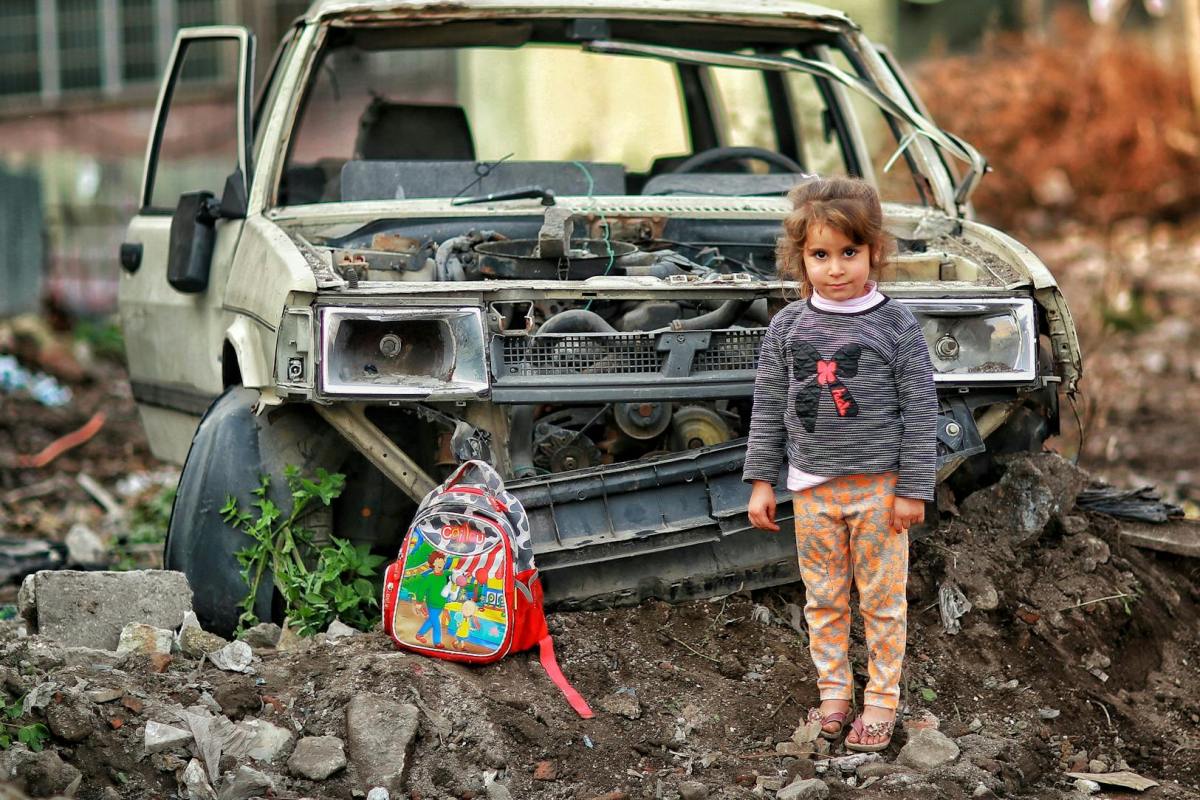
Burned out buildings, streets filled with rubble, air filled with the cries of dying children, and weeping parents. Hostages taken; futures taken. Rage and despair everywhere you turn.

This image of war hits close to home. We can see with the eyes of Isaiah, because we have been inundated with these scenes for two months in Israel and Palestine, nine months in Sudan, and two years in Ukraine.

In fact, the violence is happening all over, every day, and has always been happening, since the beginning of human history.

We continue to live in a world where rulers, civilians, and people of faith are being asked to make impossible decisions, sometimes for our own survival.


But, even while recognizing that there is a real threat, Isaiah asks us: will we choose God or political power?

When we justify the death of civilians, we are not choosing God. When we choose to ignore the suffering of God’s beloved children, we are not choosing God. When we convince ourselves that might makes right, we are not choosing God.

In times of war, we are justified in being afraid.

But Isaiah insists that being afraid can’t justify “taking matters into our own hands.” Because that kind of fear denies the power of God.

Our streets are full of the blood, and the cries of people who bear the image of God. And we are, all of us, complicit. Because we have forsaken our own prophesies. We have forgotten that only God can bring lasting peace, in a kingdom where Christ’s eternal light erases every shadow.


Advent is a time of reckoning with the reality that we are caught between the Kingdoms of this world and the Kingdom of God.

The prophets call us back to this reckoning, even as they sing songs of future peace.

In the beautiful passage we read today, Isaiah reminds us that God yearns to make all things beautiful. He tells us there’s a voice that calls us to clean up the rubble, and make the path straight, so that we can walk, as refugees, to the paradise God has for us.

This voice is personified, in the Gospels, by John the Baptist. He declares that God is speaking “peace to his people,” but we can’t hear it over the bombs. He dares to call people to get ready, repent, and turn away from the kingdoms of this world, so we will notice when Jesus shows up.


Jesus is on his way, and when he gets here, the distance between Heaven and earth comes crashing down into a single plane. When God shows up, everything is different. Everything is made new. Thank God, the prophets are getting us ready!

And thank God for Advent, the season that’s meant to shake us up.

This season reminds us: there is no peace if we keep choosing violence. There is no garden if we keep choosing grenades.

It’s time to say no to the kingdoms of this world, and choose the Kingdom of God instead.


Our prophetic texts tell us that God is ready for us to return.

Jesus Christ, the incarnate God, will scoop us up in his arms and give us a hug. He will stroke our hair and tell us he understands – deep in his bones – what it feels like to fear, what it feels like to be displaced, what it feels like to yearn for peace.

But our prophetic texts also ask us a very important question. And now is the time to answer it:

Are we ready to repent?

Amen.

Hear, Read, Mark, Learn, Inwardly Digest

A sermon given on the 25th Sunday after Pentecost – Readings here

Blessed Lord, who hast caused all holy Scriptures to be written for our learning; grant us that we may in such wise hear them, read, mark, learn, and inwardly digest them; that by patience and comfort of thy holy Word, we may embrace, and ever hold fast the blessed hope of everlasting life, which thou hast given us in our savior Jesus Christ.

What I just read is the original version of today’s Collect. The “Collect,” which is really the same word as “collect,” is the gathering prayer that the Celebrant reads at the beginning of each service.

This particular Collect was written by Thomas Cranmer, the first Archbishop of the Church in England, after it split from the Catholic Church.

Cranmer lived and died during a significant moment in the church’s history. Not only did he write and compile the first liturgies written in English, he was also among the first generation to have access to printed copies of the Bible.

Before the invention of the printing press, laypeople sometimes had access to Psalms and selected Gospel readings in their own language, and they had probably memorized some scripture. But services were in Latin, and most people were totally dependent on their parish priest to provide religious instruction.

So, when Cranmer sat down and wrote today’s Collect, he wasn’t just saying something everyone already knew about the importance of reading the Bible.He was making an argument that very few people could have made before the sixteenth century.

It wasn’t so much that people of his time didn’t understand that “all scriptures were written for our learning.”

After all, the Scriptures themselves say that in Second Timothy:

“All scripture is inspired by God and is useful for teaching, for reproof, for correction, and for training in righteousness, so that the person of God may be proficient, equipped for every good work.”

So, people understood that Scripture was an important tool for accessing the story of God. But, for the first time, they actually had access to ALL scriptures, in the context of the whole Bible, translated in a language they could understand.

And, as literacy increased throughout the sixteenth century, they could even READ them.

Knowing this gives us a better appreciation for the significance of Cranmer’s words. It’s not simply a reminder that Scriptures are a nice thing that we have. It’s a revolutionary argument that we have a responsibility to engage with them.

To hear them, read, mark, learn, and inwardly digest.

And through this practice, we expect God to speak.

Now, expecting God to speak is an easy thing to do when the Scriptures are pleasant. When it’s the angel saying, “Do not fear” and Jesus saying, “You are blessed. In other words, it’s easy to hear the voice of God when the Scriptures sound like a lullaby.

But what do we do with scriptures like today’s Gospel reading?

As Deacon Dawn pointed out last week, this reading – as well as the one before and after it – are disturbing. In fact, the genre is literally apocalyptic. With all this talk of outer darkness, and weeping and gnashing of teeth, they sound very inconsistent with a God whose primary trait is love.

Today’s reading, the Parable of the Talents, is pretty well-known, because preachers like to use it as a reminder to give money to the church. But, I had a hard time getting over its ickiness…

First, there’s the disturbing language of a “Master” and his “slaves.” Then, there’s the impatience and cruelty of the Master. And maybe I should also point out, that the most obvious moral is that we are all supposed to invest in the stock market? If you’re not sure what the heck is going on here, you’re not alone.

In reading my trusty commentaries this week, I actually laughed out loud a couple times, as the scholars went in circles trying to make perfect sense of the story.

They could say a few things with authority: Context clues suggest that we’re supposed to think of the Master as Jesus and the slaves as the Christian community. The scholars also point out that the amount of money – or “Talents” – given to each slave was enormous, up to 15 years’ worth of wages.

But in the end, they don’t exactly know what to do with all the ins and outs.

For example:

Why was the slave who buried his talent, entrusted with less in the first place?

Why didn’t the Master tell anyone what his expectations were?

Why was he so mad with that poor guy who didn’t actually lose any of the money?!

And maybe, most significantly, why does the text completely contradict Jesus’ words, “the last will be first, and the first will be last”?

Instead, it says:

“For to all those who have, more will be given, but from those who have nothing, even what they have will be taken away.”

It is at the end of all these questions that Cranmer’s words should come back to us. If it’s true that all scriptures are written for our learning, that means that we don’t have to clean up the messy parts of our Scriptures to benefit from them.

They don’t have to be perfectly clear to teach us something.

Cranmer suggests that when we’re confused or disturbed by certain Scripture passages, which he calls “dark mysteries,” the thing to do is: hear them, read them, take notes, learn from others, and inwardly digest.

In other words, we should spend more time with them. We should stay with them. We can treat the Bible like an old friend. We can talk it out, fight it out, ask lots of questions, settle into the silences, and find our way out to the other side.

We can trust that there’s something good and life-giving in the relationship we have with the Bible.

This week, I decided to put Cranmer’s advice to the test…

I spent quite a bit of time reading, marking, and learning, and I’m happy to tell you that I have digested something. That’s not to say that I won’t hear something completely different the next time I encounter the passage. And it’s also not to say that I have discovered the true meaning of these apocalyptic words.

But, for today, this is what stands out:

“I was afraid, and I went and hid your talent in the ground.”

What resonates, for me, in this story is the fear. Just like the man who buried his talent, I live with so much of it. The fear that I’m not enough, and don’t have enough. The fear that I’ll be misunderstood, and that all my Jesus talk is making it hard to make friends. The fear that living into the subversive values of a God who walked toward death in order to gain life, is too great a sacrifice for me to bear. The fear that maybe I’m wrong, about a lot of things.

I am afraid to take what Jesus has given me, and do something with it.

Does that mean that Jesus is going to, just, discard me like the man in the story?

Well, here’s where the digestion comes.

I remember that this passage is a parable. Nothing happened to the guy who buried his talent. Because he never existed.

This is a moral story, a warning, but it’s not a historical fact.

And that leads me to the next realization: None of us are the guy who gets chewed out by the Master. Because, unlike the Master, Jesus has provided us with instruction for how to live.

We’re not being left in the dark – we know that Christ has called us to love God, and love our neighbors as ourselves.

We know that we have been called to share that love, until the whole world is made new.

We know that we’re not supposed to suffocate love by burying it, silencing it, and never mentioning it again.

By the very nature of him telling the story in our Scriptures, Jesus is not the unjust Master. Like a good coach, Jesus is telling us that it’s imperative that we rise to the challenge of the Gospel. And the time is now.

With that in mind, the overwhelming cry of this story isn’t that we’re all gonna be tossed into outer darkness, because we’re not great with money. The overwhelming cry of this story is actually a lullaby, disguised as a command:

“Do not fear!”

The story is telling us in the strongest terms that when everything gets apocalyptic, we can no longer afford to fear.

Love doesn’t grow if we bury it. Love only grows when we spread it around.

In the face of the world’s brutality, we are understandably impatient. Sometimes it’s hard to find comfort.

But Cranmer reminds us that the Scriptures are always there, just like an old friend. If we give them a chance, they will find a way to comfort us. They will speak the honest truth when no one else will. They will challenge us on our crap, stop us in our tracks, and command us to pull our heads out of the sand.

Hear them, read, mark, and learn.

At first, you might experience a little indigestion. But trust the process. With God’s help, you will digest.

Amen.

The Parable of the Pumpkin Patch

A Sermon given on the 20th Sunday after Pentecost

My brothers and sisters, whom I love and long for, my joy and crown… 

For the past few weeks, we’ve been slowly reading our way through Paul’s Letter to the Philippians.  And, while I have often noticed how beautiful the theology is, I also kinda felt like…there’s the Apostle Paul being Paul again:  being a little dramatic, using way too many words,  and going on and on about himself, blah blah blah

— 

But this week’s passage felt different. 

The first thing I noticed about it, is that Paul mentions two women by name: Euodia and Syntyche. Paul refers to these women, along with a man named Clement, as co-workers in the “work of the Gospel.” 

But it’s not all compliments.  It seems that Euodia and Syntyche have had some kind of practical or theological disagreement that was impacting their community.  And Paul is gently reminding them to find common ground and to remember that they are united in the Body of Christ. 

Still, the overall tone is warm and intimate.  These people are his friends.  It is clear here, and throughout the whole letter, that Paul really loves this community. 

The second thing I noticed is the lightness and joy that comes across:  “Rejoice in the Lord always; again I will say, Rejoice!” 

One commentary suggests that “joy is the principal theme of the letter,”  with some variation on the word joy appearing 16 times in only 4 chapters. 

It’s interesting to note that Paul is in prison while he writes this.  Imagine having all that joy in a prison cell! 

And yet, Paul is joyful,  because, when he looks at the church in Philippi, he sees Christ fully alive and at work in the world. He sees the Kingdom of God being made a reality through the hard and humble work of its people. 

— 

Inspired by the Letter to the Philippians,  I thought about spending my sermon prep time this week writing my own letter.  I was going to call it “A Letter to the Gracians.” 

But I think a parable will serve all of us better. So, without further ado, here’s:  The Parable of the Pumpkin Patch. 

The Kingdom of Heaven is like a pumpkin patch.

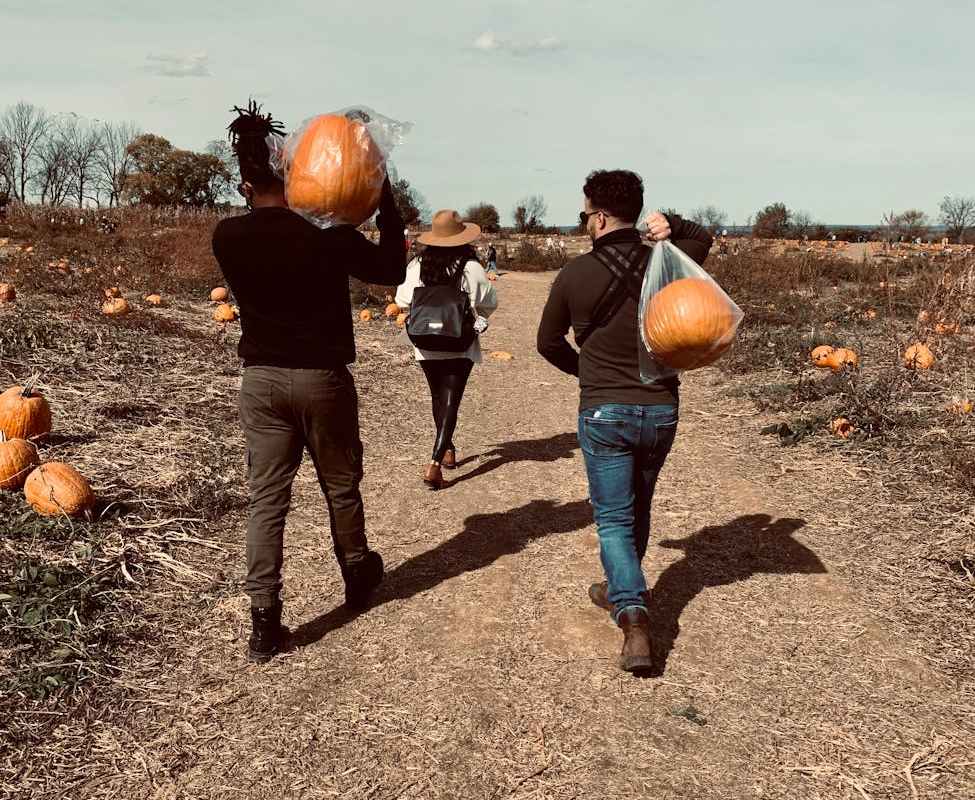
On Tuesday evening, a significant number of parishioners, neighbors, and friends showed up in Grace’s front yard to unload pumpkins for our first annual pumpkin patch. 

It is safe to say that we did not know what we were in for. 

When Gail and I schemed up a plan to launch a pumpkin patch fundraiser, we truly did not understand that we were signing up to receive, like, 2,000 pumpkins! We were mostly thinking about how CUTE the front yard would look, scattered with gourds.  I was thinking about the chance to meet and mingle with our neighbors.  And Gail, good treasurer that she is, was thinking about the bottom line. 

But there we were, faced with a literal truckload of pumpkins, with no choice but to get them off the truck. 

The first hour was rough.  

We didn’t have much of a system, and we didn’t know how to organize ourselves.  The people handing down pumpkins from the truck were doing literally back-breaking work.  And there was no end in sight. 

At one point, some of us panicked and tried to come up with a magic alternative. 

What if we waited and did it in the morning?  Mmm, how would that actually solve the problem? 

What if we hired people?  Uh, sort of counterproductive to the point of a fundraiser! 

What if we…had more friends? I quickly texted my local clergy friends with an SOS!  A few others did the same.  

Then we put our phones away and got back to work. 

Faced with collective anxiety about the horrible situation we had landed ourselves in,  we were forced to make a game plan. 

First, we needed to face our individual limitations.  No one should end up in the hospital over a pumpkin patch. 

Next, we needed to work together.  We couldn’t afford to operate as individuals anymore.  We had to be a united, and disciplined, super organism – acting as one Body. 

We started an assembly line – a human chain that extended to the middle of the front yard.  First, a person on the truck would hand a pumpkin to someone on the ground.  That person would hand it over to the person to their left.  Then it would be handed off to the next person, and the next person, until it got to the end of the line,  where it would be gently placed in the grass. 

This process repeated like that until all 1,151 bulk pumpkins were out of the truck. 

As we worked together:  

  • People on the sidelines offered encouragement and good humor. 
  • The mechanic across the street sprinted over, and helped us move pallets. 
  • My friend and her son showed up, and joined the assembly line.  
  • Former school parents and neighbors quietly appeared, and took their place in the process. 
  • One person, noticing how late it was getting, came back with pizza and drinks for everyone. 
  • And, at one point, a complete stranger walked off the sidewalk and offered to help. 

The people on the truck continued in their back-breaking work, and we kept passing pumpkins.  But now there were more of us. 

As the hours wore on, our muscles ached. Our feet hurt from standing.  Our backs would never be the same.  

But for some reason, as time went on,  the laughter increased. The frustration subsided. The assembly line joyfully counted off, as the pumpkins were passed down.  And kids skipped around the growing patch. 

— 

We were burdened by this task of unloading an ungodly number of pumpkins.  And yet, “joy had become the principal theme” of the evening. 

Like Euodia and Syntyche and Clement, and so many others at the church in Philippi, we, at the church of Grace, had become co-workers, struggling beside one another in the work of the church. 

In taking on that work, we were noticing the miracle of helping hands,  showing up just when we needed them. 

We were feasting on slices of pizza, that had appeared like manna in the wilderness. 

We were aching and bruised and tired, and maybe a little annoyed.  But together, we had made something happen that we never could have accomplished by ourselves. 

And we rejoiced, because, we had seen what was possible when we lived into our baptismal response: “We will, with God’s help.” 

We had done it, together, with God’s help. 


Beloved, the world is overcome with hatred, disaster, violence, and death.  

But we can rejoice.  

Because we know what’s possible when the Body of Christ acts like a Body.  When we work together as a super organism, we can accomplish insurmountable tasks.  

We’ve seen it with our own eyes! And if a few dozen people can transform a front yard into a pumpkin patch, just imagine what the whole church can do to transform the world’s ugliness into beauty, and its barrenness into bounty.  

Amen. 

Walk the Little Way

A Sermon for the Feast Day of St. Therese of Lisieux

Gracious Father, who called your servant Therese to a life of fervent prayer, give to us the spirit of prayer and zeal for the ministry of the Gospel, that the love of Christ may be known throughout all the world; through the same Jesus Christ, our Lord. Amen. 

Today is the feast day of St. Therese of Lisieux. 

Therese isn’t very popular in Episcopal circles, but the Catholic women I know tell me that she was an important part of their faith formation. I first learned about her in 2021, from a lay preacher at my summer internship. 

But, good news for all of us!  Therese was officially added to the Episcopal festival calendar in 2022.  

I like to think of her as my unofficial patron saint, because her feast day was the day before my ordination to the priesthood last year. But that was just the icing on the cake. Therese keeps showing up in my life. So much so, that I was surprised that I hadn’t already talked about her in a sermon! 

In my experience, sometimes the saints seem to follow us around, and it’s a good idea to try to figure out what they’re trying tell us. So, think of this sermon as a bit of sleuthing on my behalf. 

What is Therese trying to tell us? 

— 

Before I get there, I just want to say that the lives of saints are interesting to me,  because even though they get lumped together as VIPs in God’s kingdom, their stories are really more about how GOD works in our messy humanity. 

And no one story follows the same path. Some saints are from wealthy families,  others come from poverty. Some are known for their mystical visions, and others for their peculiar ways of life. Some are famous during their lifetimes, and others become popular after their deaths. 

But all of them have one thing in common: at some point, they get infected by the Jesus bug, and it leads them to places they never could have imagined.  

Through danger, illness, abandonment, and every kind of complication, the saints become saints, because no one can deny that God is working in their life. 

In that sense, sainthood directs us to notice God at work in every kind of person and in all kinds of ways. 

The lives of the saints show us that faithfulness, and not status, is what matters to God. 

St. Therese of Lisieux

— 

So, what’s Therese’s story? 

Therese became a discalced Carmelite nun in 1888. She was 15 years old.  

(The word “discalced” literally translates to “without shoes.” The discalced Carmelite order practices extreme simplicity of living. They devote their lives to prayer and contemplation.)

Therese was born into a wealthy merchant family, but things were far from good. When she was 4 years old, her mother died of breast cancer. As a young child, she was frequently bullied by a girl at her school. When her older sister entered the convent, Therese began to suffer from tremors and other anxiety symptoms. If she were alive today, we would probably say she lived with depression and anxiety. 

Before becoming a nun, Therese suffered from years of spiritual doubt, as she continued to grieve the death of her mother. She describes the hopelessness she felt in her autobiography. One Christmas Eve, she sat down to open presents, and was overcome with what she describes as the “joy in self-forgetfuless.” She was finally able to move forward. 

Therese entered the convent shortly after. 

In the convent, she struggled to make friends. She described these experiences as deeply painful. But she was determined to pray for those who persecuted her, and even spent extra time with people she didn’t like. 

Her humility and endurance in the face of difficult relationships puzzled people. But it ended up shaping her life toward sainthood. 

— 

Therese is best known for developing a spiritual practice called “the little way.” When you walk the little way, you think of each little act as an offering to God. You don’t worry about trying to impress others, or apologize for not being perfect. 

Therese described it this way: 

“The only way I can prove my love is by scattering flowers and these flowers are every little sacrifice, every glance and word, and the doing of the least actions for love.” 

Because of the little way, Therese had no patience for ego-driven choices. She rejected opportunities to rise through the ranks at the convent, and focused on reading the Gospels, instead of the popular theology of the day. 

Over time, she came to understand that her shortcomings “did not offend God.” She said: “My way is all confidence and love.” 

Therese died from tuberculosis at the age of 24. But thanks to her spiritual autobiography, many people were compelled to practice the little way. 

— 

Now that I’ve said all that, I have to admit that I have been avoiding Therese. 

That’s because, in Catholic imagery, Therese is often represented as a dainty young woman surrounded by pink roses. For more than a century, the strength of her life has often been misrepresented by the church. 

Instead, she has served as a symbol of female meekness and juvenile ignorance. She has been depicted as the opposite of empowered. 

On the surface, she is everything I reject in my life, as a Christian and a priest, who happens to be a woman. 

If the churches I grew up in respected the saints, I’m sure I would have been force-fed Therese as a way to keep me in line. As a way to remind me that a woman’s place is among chubby-cheeked babies, humming a sweet hymn, and wearing a pink ribbon in my long hair. 

But I think this is part of the reason Therese has been following me around.  

Not because I need to learn a lesson about femininity from Therese. But, so I will be forced to soften that judgmental impulse to condemn her for boxing me in. 

Therese’s personality and teachings may have aligned with the gender politics of the church, but she wasn’t boxing anyone in! Therese was the way she was, because God had transformed her grief and rejection into a path to spiritual liberation. 

She lived and ministered exactly as she was, because she was confident that Christ loved her and fully welcomed her. She was actually fully empowered, because she wasn’t trying to impress anyone. 

Her gift to the church is not that she was quiet and sweet, though there’s nothing wrong with those traits.  

It is that she spent her ministry being honest. 

— 

In the Gospel today, Jesus reminds the chief priests and elders that their intellect and fancy titles don’t give them special access to the Kingdom of God. 

No, the inheritors of the Kingdom are simply the faithful ones. They are the prostitutes and tax collectors, who don’t deny their need for grace. Like Therese, they understand that their “shortcomings do not offend God.” 

Those who have lived with grief, illness, abandonment, and bullying don’t really have the luxury of putting on airs. When you’ve been through Hell and back, you no longer have the patience to pretend like everything’s ok. 

This radical honesty leads to incredible clarity. Those who have lived in the valleys of life are often the first to notice that Jesus is the Savior. They are the first to believe that the Kingdom of God is near. 

While the privileged and unburdened ones are talking the talk, the survivors are actually walking the walk, even if they come limping. 

There are so many who have walked the walk, along the little way. Some of them are in this room today. 

And, through your little acts of kindness, patience, and endurance, you have been invited into the Kingdom of God. You are taking part in the healing of the world. 

— 

So, what is Therese trying to tell us? What is Jesus trying to tell us? 

Maybe…Keep the faith. Live your life with the confidence that Christ loves you, that he welcomes you for who you are, and has a way of transforming your suffering into love. 

Believe that every small step toward Christ builds the kingdom. Your faithfulness makes a difference, even if nobody else notices. You may not have much to give, but YOU are enough.  

You are not being asked to contort who you are to fit the expectations of the world. You are being invited into the fullness of all Christ made you to be. 

Walk the little way.

Jonah, Road Rage, Uncomfortable Reckonings

A Sermon for the 17th Sunday after Pentecost

Lectionary Readings here

I recently saw a post on social media that said, “If your preacher always makes himself the hero of the story, stop going to that church.” 

In that case, after I tell you this story, I hope you’ll realize that you can definitely stay at this church…

Last week, I was leaving Meyerland Plaza and heading back over to Grace with the altar flowers. As I’m sure some of you know,  they have been doing construction on West Loop South for what feels like forever. 

To get back through town, I needed to continue straight through the intersection,  so I dutifully took my place in the middle lane: (pregnant pause) the CORRECT lane.  

But I noticed that whenever the light turned green, the lane was inching forward at a glacial pace. After sitting through two stop lights and getting nowhere, I started to become agitated. That’s when I realized that people were getting into the left turn only lane and the right turn only lane, then cutting people off IN THE INTERSECTION, in order to proceed straight through the intersection. 

Let me say that again: THESE TERRIBLE, HATEFUL PEOPLE WERE CUTTING OFF GOOD PEOPLE LIKE ME, FOR THEIR OWN SELFISH CONVENIENCE!! 

When I finally got to the intersection, I adopted a defensive posture.  No one was going to cut me off!! 

Unfortunately, I am not actually an aggressive driver. So, the car in the left lane, and the car in the right lane BOTH managed to cut me off,  then proceeded to cut each other off while I watched. 

At that moment, I did the only thing I could do: I LAID ON MY HORN.  

I yelled at them and called them names. I insulted their intelligence and wished for their suffering! 

And then, I congratulated myself for being the only righteous person on the road in Houston. 

— 

Why are these kinds of situations so infuriating? 

It’s because the whole thing is deeply unfair! Why should I be penalized for doing the right thing? Why should they be able to do something illegal, and even dangerous, and just…get away with it? 

Actions are supposed to have consequences, but no one seems to care about that anymore. 

— 

aerial view of person swimming in the sea
Photo by Dmitry Osipenko on Unsplash

See, this is why I love Jonah. Jonah gets it. 

At the beginning of his story, God tells Jonah to go to Nineveh and warn them that the city is going to be destroyed because of its wickedness.  

Jonah feels good about this message.  

He is being asked to tell this to the capital city of Assyria, the most powerful and cruel empire in the region. 

And this isn’t just ancient gossip. 

By the time the Book of Jonah is written, Assyria has destroyed the Northern Kingdom of Israel and exiled thousands of Israelites, who will never get home again.  

For Jonah and his readers, it is obvious that Nineveh deserves to be destroyed. And Jonah, a man with a strong sense of fairness, is the perfect man for the job. 

The only problem is, Jonah knows God too well.  

He knows God is “a gracious God and merciful, slow to anger, and abounding in steadfast love.” So, he knows that once he gets to Nineveh, God will let them get away with it, at the teenist, tiniest sign of self-awareness. 

So, Jonah runs away.  

But, by God’s grace,  a big fish swallows him to save his life, and spits him out on dry land. 

Jonah gets to Nineveh, he says his piece, and God spares the whole city. 

— 

In light of Israel’s suffering, God’s pardon of the Ninevites is so unfair it makes my stomach turn.  

I’d like to get back in my car, lay on the horn, and never let up. 

Jonah himself is so upset that he throws up his hands and asks God to kill him.  

Jonah is having a real existential crisis. One commentary says that “the prophet prefers death to living in a world with no recognizable order of justice.”1

— 

(Sigh.) That’s it. 

It is difficult to live in a world with no recognizable order of justice. Where bad things happen to good people and good things happen to bad people. Where the ones who are RIGHT don’t get any recognition, and the ones who are WRONG seem to flourish.  

Where innocent people are let down, pushed down, and shot down. Where we are collectively burdened by pain, addiction, and trauma.  

And still, God seems to keep pardoning the perpetrators! 

“Yes, God, sometimes we are angry enough to die.” 

— 

But, God is begging us to stay! God keeps calling us back to Nineveh. God keeps calling us back to the vineyard. We have a vital role to play! 

— 

At the end of Jonah, God asks the question:  

“And should I not be concerned about Nineveh, that great city, in which there are more than a hundred and twenty thousand persons who do not know their right hand from their left, and also many animals?”  

Near the end of the Gospel reading, Jesus poses some questions, too:  

“Am I not allowed to do what I choose with what belongs to me? Or are you envious because I am generous?’” 

It’s true. Life isn’t fair, and that fact is infuriating at times. 

But, across the scriptures, God reminds us, gently but firmly, that we are not the arbiters of justice in this world that God has made. 

— 

But let me make something clear. God isn’t saying it’s wrong to recognize injustice. 

We all know that this world is full of profound suffering. We have witnessed the oppression of our fellow human beings, and the degradation of the whole creation. We have felt the effects of carelessness and malice in our own lives. 

God agrees with Jonah that Ninevah’s behavior deserves punishment.  

Just as Jesus, in telling his parable, knows it’s not fair that all the laborers were paid the same wage. 

As disciples of Christ, we have a responsibility to carefully attune ourselves to injustice. We do the work of God when we protest, advocate, and respond.  

— 

But, the Book of Jonah makes it clear that we are called to name what is unfairnot so that God can destroy the bad people, but so God can redeem the whole creation! 

After all, we know that God is a creative and creating God. God is in the business of making all things new. 

A divine response to unfairness does not look like scorched earth. It looks like a vineyard in harvest. It looks like grace. And we have ALL been given undeserved and excessive grace. 

When we recognize grace in our own lives, we are humbled to understand that all of us have been unkind, unfair, and even unjust. 

Maybe we’re not always Jonah. Maybe, sometimes, we’re Nineveh. 

Maybe it’s time to repent. 

— 

In our quest for fairness, it is time for us to ask ourselves, honestly, if we want our enemies to be destroyed, or if we want the world to be transformed. 

Because we don’t get to have both. 

If our guiding ethic is for bad people to suffer, we will always be fleeing Nineveh. We will always be living in the dark and claustrophobic belly of the big fish. 

From that vantage point, we will never get to see the world transformed. We will never get to be a part of the beauty of the new creation. We will have settle for the lonely company of our own self-righteousness. 

The only way out of our darkness is to accept that life in God is deeply unfair… We may not understand it, but we know that God has called us to the work of transformation.

So, there’s only one question left to ask: Where is God calling you that you don’t want to go?  

Amen. 

Where Keys Are About Opening Doors

A Sermon for the 13th Sunday after Pentecost 

This week’s lectionary is a treasure trove of stories and lessons.  

We have baby Moses being sent down the Nile in a basket after two midwives named Shiphrah and Puah lie to Pharaoh in protest of an unjust law.  

We have the Romans passage about being members of the Body of Christ, which has, probably, been the number one image that has informed my understanding of the church. 

And then we look again, and we get to the Gospel passage, which is basically the moment that Jesus founds the church, with Peter as its first minister! 

So much glorious theological content!  

— 

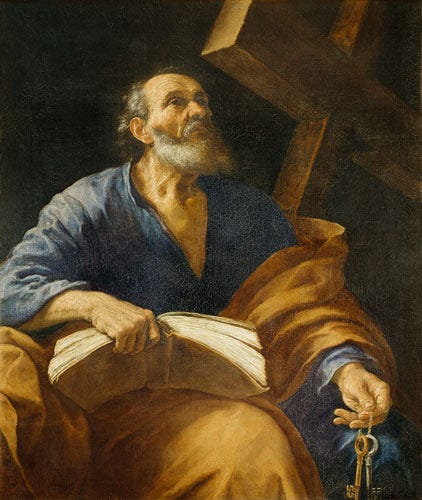
Paolo Emilio Besenzi: Saint Peter, Creative Commons License

And yet, this whole week, I have been fixated on the fact that Peter is a nickname. 

Maybe this has been obvious to you when you read your Bible. But for me, I think I have always kind of glossed over the fact that when “Simon, who is called Peter,” is labeled that way, this isn’t some ancient naming system that I simply don’t understand. 

This is just your normal nickname…Which is to say, it’s basically an insult cloaked in intimacy. Like my nickname growing up – Leah Whiner – it’s a name that describes your worst quality. 

And this is the reality: Peter is not a complimentary nickname. (My apologies to any Peters in the room.) 

In fact, it’s not really a name, strictly speaking. Peter comes from the Greek word for rock or stone: petros. And in other places, we’ll sometimes see it translated as Cephas, which is simply the Aramaic word for stone or rock.  

While today’s Gospel passage seems to suggest that being called “the rock” is a good thing – after all, Jesus says, “upon this rock I will build my church” – there seems to be near universal-consensus among biblical scholars that being called rock is more like being called rocky. Rough around the edges, unpolished, and difficult. 

I picture what a person must look and act like to be given this name by the Son of God, and I don’t see a man with nicely coiffed hair and smooth skin, wearing a tie and a Sport coat. 

To be honest, what I picture is my old friend in Charlottesville, who lived outside, and who hadn’t held down a job in at least a decade.  

This is a person who is disruptive to polite society. Someone who has sunbaked skin and dirty clothes, and doesn’t think too much before he acts. A person who always seems to be saying and doing the wrong thing at the wrong time. 

Someone nicknamed Peter would disturb those of us who want to live “respectable” lives.  

I have a hunch that he wouldn’t pass a background check. So why in the heck is Jesus giving him keys? 

In naming Peter as the first apostle and the foundation of the church, Jesus is making a rather bold statement, and I would argue that it hearkens back to the Beatitudes. 

“Blessed are you, Simon son of Jonah!” 

When Jesus calls this leather-skinned fisherman, uneducated, rough-and-tumble, Peter, “blessed,” and when he hands over the keys to the kingdom, he is proving that he was serious when he called the poor, the persecuted, and the grieving “blessed.” 

In naming Peter as the rock and the cornerstone of the church, we are to understand that the church that Christ is building is not a polite, genteel place where nice, middle-class people bless the huddled masses outside their door.  

No! The church IS the huddled masses! With rocky Peter holding the key. 

This means that the church is only the church because sloppy, unsophisticated, outsiders are named as the blessed ones of Christ! 

— 

Those first Christians were called to be proud of the fact that their lives and their bodies did not reflect the values of polite society. 

They were called to build a world where keys are about opening doors, not closing them. 

I think we get so hung up on slick branding and marketable programs that we forget that the church was never meant to be a sparkling diamond in Jesus’ heavenly crown. It is meant to be rocky and rough around the edges. 

And “Christian living” was never meant to make us more palatable or polite. It is meant to make us ungovernable. 

— 

In a society obsessed with decorum, with not rocking the boat, the church has too often become a willing partner.  

  • We have cut off the hair of indigenous children and forced them to learn English.  We have moved our soup kitchens into church basements, hidden from the sight of stained glass and polished stone altars.  
  • We have segregated our worship. 
  • We have cooperated with the authorities.  
  • We have allowed our siblings to suffer,  
  • while we thank God we’re not like them. 

I mean, think about it:  

If a weirdo like Peter walked into churches across America today, how many Christians would call the police on him? 

It’s a sobering thought. 

— 

And yet, where the Holy Spirit moves, the church has also been sanctuary…. 

Here are the stories that give me hope: 

In Nashville in 1985, Catholic priest Charles Strobel noticed people sleeping in their cars in the church parking lot.  

He invited them into the church every night that winter. With other local churches, he founded a winter shelter called Room in the Inn. Today, there are dozens of similar programs across the country. 

In Martha’s Vineyard in 2022, an Episcopal church provided emergency shelter to migrants caught up in a cruel political stunt. The church had access to cots, because they participated in a program modeled after Room in the Inn

Across the country, churches are defying city ordinances and feeding their hungry neighbors, while absorbing thousands of dollars in fines. 

And in my former home of Charlottesville, VA, Maria Chavalan-Sut, an undocumented asylum-seeker fleeing violence in Guatemala, sought sanctuary in a Methodist church.  

Federal officials threatened her with over 200 thousand dollars in fines. But she, and the church, persisted. Maria lived inside the church for three years before Customs Enforcement granted her a temporary stay. 

After years of advocacy, in 2022, her children traveled like Moses on the Nile, as unaccompanied minors.  They were reunited with her there in the church. Maria and her kids now have their own home, and she sells tamales at the City Market. 

Here is the church, acknowledging blessedness. 

— 

How often have we considered the fact that we’re here, in church, today, because 2,000 years ago rocky Peter opened the door to let us in? 

By the same token, how often do we remember that you and I are not named as the keyholders of the Kingdom of God? That it is, in fact, not up to us to offer sanctuary?  

The doors have already been unlocked, and the people have already been called blessedChrist has already invited everyone in.  

The question is: are we going to figure out how to see it through, or are we going to try to stop it? 

— 

Thanks to our friend, Peter, we know that the church is a place for outcasts, not insiders. It will always be messy in exactly the way humanity is messy. 

And this Body, with its many members, will always be caught up in the struggle of admitting that our good, respectable, “Christian names” don’t mean anything to a Savior who prefers nicknames

When we, really understand that, it becomes common sense to make room for anyone else who walks through these open doors. 

Through our baptismal vows, we have followed Peter through the unlocked doors of the Kingdom.  

We now claim to live according to the values of the Kingdom of God: to proclaim the Gospel, love our neighbors, and respect the dignity of every human being.  

To do life together. Even though it can get pretty rocky. Amen. 

Transfiguration Sermon: Carried up the Mountaintop

Readings here

The Transfiguration is an experience of Christ’s glory, and the disciples’ vulnerability

While Jesus is “wonderfully transfigured, in raiment white and glistening,” the disciples are exhausted from the long hike. While God’s voice booms from a cloud, “This is my Son,” the disciples are “terrified.” 

In the presence of Christ’s divinity, the disciples are more aware than ever of their fragility.  

And this is a very good thing. 

mountains and tree range during golden hour
Photo by Artem Sapegin on Unsplash

And it isn’t the only time something like this happens. God seems to have a thing for the mountains. Several times in our Scriptures, vulnerable humans are compelled to follow God onto steep and difficult trails.  

They are called to experience God on the mountaintop

God appears to Moses to give the Ten Commandments, and Moses’ face literally shines like the sun for days afterward. Elijah runs away from a blood-thirsty king, and God whispers peace to him in a gentle breeze. The disciples, of course, see the glory of God in Jesus Christ. 

These mountaintop stories help define what it means when people talk about having a “mountaintop experience.” 

When we talk about “the mountaintop,” we tend to mean: a moment of clarity, abiding peace, and often, a direct experience of God. When we’re on the “mountaintop,” we may feel that we have a birds’ eye view all of a sudden. We have a sense of who we are and what we are meant to do. We may also feel a sense of relief or wonder.

Importantly, though, the mountaintop moment is never an occasion for OUR glory. We don’t get to an experience of God by our own efforts. And it’s not about the adrenaline rush of a job well done

In fact, the mountaintop moment almost always comes in the midst of hardship, when things aren’t going well at all. After all, Moses had been wandering around the desert with a whole bunch of complainers for years, Elijah was fleeing certain death, and the disciples had inadvertently taken up with a rabble-rouser. 

And down the mountain, there’s no guarantee that we won’t find ourselves in hardship again. 

Still, the mountaintop experience stays with us, because it is a place of God’s glory and our vulnerability. Up there in the clouds, we find our greatest peace, because we surrender to the fact that we are not in control. And when we look back on the experience, we are comforted to remember that God sometimes feels very close. 

Though we are terrified, we can say, like Peter, “It is good for us to be here.” 

— 

In the interest of vulnerability, I think it’s time to tell you about my own mountaintop experience. Now, anyone who witnessed it would say I was in the valley of the shadow of death. Or – at least – Daniel was. 

But I know that Christ was revealing himself to me. 

Early last year, my family and I took a leap of faith, when I signed the contract to become Grace’s curate.  

I had never been to Houston, I have no immediate family in Texas, and we had always thought we would move back to Virginia, after I finished seminary. 

But the Lord works in mysterious ways… 

— 

April turned to May, and I graduated. 

A month later, we loaded up the U-Haul and started the 2,000 mile journey from Connecticut to Texas.  

Daniel hadn’t been feeling well for weeks, but we didn’t think it was anything serious. But, two days into the three-day journey, he woke up in the middle of the night, doubled over in pain. He could barely tell me what was wrong.  

I rushed him over to the hospital in Slidell, Louisiana and, after hours of waiting and dozens of tests, the nurse looked at Daniel with concern and said: “You are very sick.” 

Daniel had a perforated colon. We didn’t have health insurance. The U-Haul was due back tomorrow. The cats were tearing up the curtains in our hotel room. Daniel might have to have surgery. There might be complications. I was supposed to meet the movers at our house. Daniel was very sick. How would we pay for all this?!! Why would God make me move to Texas, if this was going to happen?! 

At this moment, we were not on a mountaintop. 

We were six feet above sea level in Slidell, Louisiana…

But then, like Ezekiel’s dry bones, God started re-membering the Body of Christ. And the body started moving.  

Like diligent worker bees, people started descending on us from near and far.  

Without even asking, the local Episcopal priest showed up at Daniel’s bedside. It turned out that a friend in New Jersey sent him our way.  

Within hours, hundreds of people were praying. Within days, dozens had given us money to tide us over. 

The people of this congregation – total strangers at the time – had already raised enough money to pay our up-front medical bills. Two bishops from the Diocese of Texas called to check in. 

A parishioner and his family spent Father’s Day driving from Houston to Slidell to pick up the U-Haul. The rector coordinated with the movers, and pretty much everything else. 

The diocese figured out how to backdate my insurance, so that it would cover our hospital bills. 

While all of this was happening, the surgeon was insistent that Daniel would need surgery, which in hid case, could lead to sepsis, and even kidney failure. 

But, the air around his hospital bed was buzzing with the voices of prayer warriors, near and far. The surgeon let him wait one more day. And one day later, the infection was clearing, and the perforation was closing. A day after that, he was discharged.  

On the sixth day after his hospitalization, we were at home in Houston. 

On the seventh day, we rested.  

It was good for us to be here. 

— 

While we were in the valley, without us even noticingthe Body of Christ had carried us, up and up, until we were on the mountaintop. 

A place of God’s extravagant glory and our profound vulnerability. A place of healing, and fear, and peace, all mixed in together. A place of bounty, a place of grace. 

Everything in our life was suddenly transformed and transfigured, not because we had done anything to “get right with God,” but because the Body of Christ – in the people of God – had done everything to lay us at the feet of Jesus, where healing could be found. 

— 

Through months of transition for my family, not to mention for this parish, the mountaintop has sometimes been hard to hold onto. 

But then I remember the way we were carried. 

And I thank God for teaching me, at the beginning of ordained ministry, that my vulnerability is for God’s glory. That I don’t need to be perfect or put together to do the work of God. And neither do you

And this is the lesson of the mountaintop, I think: 

That Christ calls us into his body to use our own bodies to care for one another,  to advocate for the oppressed, the grieving, and the overburdened. to keep tender hearts in the midst of the world’s hardness

That Christ calls us to share the good news that a transformed and transfigured world is coming, and is already here, present in the prayer warriors and prophets and sages. In other words, all of us – regular, vulnerable people called to come down the mountain and shine with the light of God’s glory. 

And, the lesson of the mountaintop is that Christ calls us to go to the valleys. He calls us to carry the valley-dwellers through the desert and over the rivers, away from death-dealers and liars and abusers and cartels, into the warmth of one another’s arms, as we seek higher ground together. 

Together, we climb the mountain.

And when we get to the mountaintop, we lay ourselves at the feet of the Jesus, where healing is happening every day.

Steadfast Faith

Keep, O Lord, your household the Church in your steadfast faith and love, that through your grace we may proclaim your truth with boldness, and minister your justice with compassion; for the sake of our Savior Jesus Christ, who lives and reigns with you and the Holy Spirit, one God, now and for ever. Amen.

Across the nation, churchgoers are faithfully showing up for worship, and clergy are faithfully attending to their flocks.

After years of pandemic disruptions, many of us are finally starting to feel like we’re “back to normal.” And if you walk into most any church on Sunday morning, it certainly looks that way.

But, under the loud proclamations of Amen and Alleluia, you can hear the whispers. People are talking…about church decline.

Since 2010, the Episcopal Church has lost about 350,000 members. Historic parishes face closures, while others find new ways to worship in the midst of an ongoing clergy shortage.

Many of our congregations have yet to bounce back from pandemic declines. And we continually wonder how to bring people back to the church, as 3 in 10 adults now identify as nones – or those with no faith practice at all.

Church statistician Ryan Burge goes so far as to declare that “the death of the Episcopal Church is near.”

But others argue that our new reality presents possibility. In his book, People of the Way, Episcopal priest Dwight Zscheille argues that our context today looks much more like the world Jesus walked in, than the established “Christian nation” of the last two-hundred years.

Our neighbors are struggling, and many are deeply skeptical that the church could offer anything at all.

Maybe resurrection is just around the corner?

No matter where you land, there is no doubt about it: These are uncertain times for the church.

And I think we need to let ourselves feel the anxiety that comes with admitting this to ourselves. It’s ok to admit that we’re scared.

But it’s also good to remember that God isn’t in the business of abandoning people. And I can say this with confidence, because it’s written throughout our Scriptures.


When we immerse ourselves in the story of our ancestors of our faith, we realize that we’re not alone. When we encounter the Bible and enter the story, we end up finding a whole cast of characters who understand what it feels like to be scared.

And, we come to learn that there was never a time in the history of God and God’s people, that faithful people didn’t whisper and worry about their future.

This uncertainty is immediately obvious in the story of the Exodus, as the people of God face hardship and hunger in the wilderness. In fact, in today’s reading, we encounter the Israelites at a rare moment of clarity and peace.

But it’s also apparent in today’s Gospel reading…

The section begins with an observation:

“When he saw the crowds, he had compassion for them, because they were harassed and helpless, like a sheep without a shepherd.”

Jesus looks into the downturned faces of his followers and immediately understands their distress. He decides that he is going to do something about it…

He calls twelve apostles for an important mission: they are commanded to “Go!” Go out and proclaim that the Kingdom of God is near!

In other words, Jesus responds to the uncertainty of his followers with the certainty of the Kingdom.

Especially in light of church decline, I think it’s worthwhile to consider what this passage may be teaching the church today.

What can we learn about the church’s call by studying the apostles’ mission?

I want to focus on three attributes of Jesus’ instruction: power, place, and relationship.

First, let’s talk about power. Who empowers the apostles to do the work of the Kingdom?

Matthew is clear that they have been empowered by Christ. They didn’t get together, discuss it among themselves, and then launch mission programming. Their authority comes directly from Christ, who calls them, provides them with diverse and miraculous gifts, and lays out the framework for their journey.

In the church today, it is easy to think we get our power from the institution – or perhaps from various experts inside and outside the church. It calms our anxiety to get the ball rolling ourselves.

But Jesus reminds us that he is the one who empowers the church. We must spend time in discernment and prayer so that we know where the Holy Spirit is leading us.

The work of the church depends on our understanding that Christ is the one who calls, equips, and sends us.

Ok, so now let’s talk about place. Where are the apostles instructed to go?

Matthew is unique among the Gospels in that Jesus instructs the apostles to go only to “the lost sheep of Israel.” In other words, their fellow Jews.

Scholars note that this is just as much a geographical instruction as it is a religious one. They are to stay in a certain place. Jesus isn’t asking the apostles to go on an international mission trip, or waste time trying to convert people with whom they have little in common. He is telling them to go to their neighbors – to the people who live nearby and share some context.

With that in mind, the church today might ask: “Who is my neighbor?”

When it comes to living out the mission of the church, we can remember that it is good to focus on those who live in close proximity to us. In the Book of Jeremiah, God instructs his people in exile to “seek the welfare of the city where I have sent you.”

We build the Kingdom of God right where we are, seeking to provide for the needs of all who live among and around us.

The work of the church is local, inclusive, and attentive to our neighbors.


Finally, relationship. How do the people in this story relate to one another and to Jesus?

The apostles are empowered because they are deeply connected to Jesus, not just as followers but as friends. And they are sent to a particular place so that the community of the Kingdom can take root.

But, even more telling is that Jesus tells them to travel light, and not request payment. This is because their mission isn’t transactional, it is relational. When the apostles are sent out empty-handed, they are granting others the dignity of showing up for them. They are making it clear that even though they have been empowered and equipped by Jesus, they are still vulnerable and in need of good food, and a place to lay their heads.

They are still human. The apostles and the “lost sheep” are part of the same flock and Jesus is the shepherd.

When we think about what it means to be the church, we must prioritize relationship. Christ’s kingdom is one in which all people are beloved – it’s not an us-versus-them. Kingdom-building requires the humility to know that we need other people.

So, being the church is about expecting our neighbors – regardless of what they look like, how they act, or who they love – to become our friends.

The work of the church transforms us through the hard and beautiful work of loving one another.


Of course, all that being said, we know that our Scriptures aren’t merely prescriptive. They’re not a rulebook for life. They’re the first part of the story of how God-incarnate disrupts our normal life, because God loves us too much not to intervene.

They tell of the eternal story we enter through our Baptism, and within which the Holy Spirit whispers.

Like those first Jesus-followers, Jesus reaches out to us and offers the certainty of the Kingdom of God. Like those first apostles, we have received power through the Holy Spirit to foster communities that are being transformed by the hope of the Gospel.

So, when someone says “The death of the Episcopal Church is near,” we can counter with, “The Kingdom of God is near.”

Because, even in these uncertain times, there’s no doubt about it: We are still being called. No matter what comes our way, the work continues. In Christ, we are continually being empowered to proclaim good news, cure the sick, raise the dead, cleanse the lepers, and cast out demons.

So, let the Amen and Alleluia ring out over the doubt! The church is alive because Christ is alive!

Amen! Alleluia!

A Sermon for Pentecost: Fire

We Carry the Flame

Readings available here

“And suddenly from heaven there came a sound like the rush of a violent wind, and it filled the entire house where they were sitting.  

Divided tongues, as of fire, appeared among them, and a tongue rested on each of them. All of them were filled with the Holy Spirit and began to speak in other languages, as the Spirit gave them ability.” 

When I shared this story with the day school kids on Wednesday, the first question out of their mouth was,  

  • “Why is there fire on the disciples’ heads?” 
  • And in that moment, I realized I didn’t actually know. 

The only answer I could come up with was that fire is a symbol for the Holy Spirit. 

  • It’s, presumably, related to other stories about the presence of God, like when God speaks to Moses through the burning bush. 

But that doesn’t really answer the question, does it? 

  • The question still remains, “Why fire?” 

— 

To answer the question, I really needed to know more about fire. So I got to researching… 

Here are a few things I learned: 

First, fire is more than its visible flame.  

Fire occurs when something is ignited by intense heat and combines with oxygen.   This creates combustion, which produces heat and light.  

The visible effect of this chemical process is the flame.  But beyond our sight, fire emits the same kind of radiation as the human body. 

In other words, the transformation of elements that we call fire is both a visible and invisible process. 

Second, though fire is often associated with destruction, it is vital to the flourishing of ecosystems. 

Fire actually creates micro-habitats within the same landscape, as different life forms adapt to different stages of wildfire life-cycle.

One really cool example of this is the fire chaser beetle,  which can detect infrared radiation from forest fires more than 80 miles away.  It lays its eggs on charred wood, which makes nutritious food for its larvae. 

Because different plants and animals are adapted to phases of fire, recovery, or re-growth,  fire actually makes room for a greater diversity of creatures to thrive within the same landscape. 

And third, fire is an extremely powerful tool. 

On the positive side, fire’s ability to cook our food, keep us warm, and stave off predators, makes it responsible for human civilization as we know it.  On the negative side, fire has been used to commit horrific violence. 

Whether used for good or for ill, fire gives humans access to power beyond ourselves. 

— 

With all of that in our minds, maybe we can get back to that question:  

Why is there fire on the disciples’ heads? 

Well, our scripture readings for today show us that fire and the Holy Spirit share some common traits: 

  • They spur both invisible and visible transformation. 
  • They make room for greater diversity. 
  • They give humans access to power beyond ourselves. 

The Holy Spirit truly is the FIRE of the incarnate God, a living flame that never stops burning. It touches people and ignites a spark – we can’t help but be changed. 

When we are attuned to the Spirit, everything feels like it could combust at any moment.  There is palpable energy in the room. 

When we feel the Spirit moving, we sense the possibility for peace and harmony among people who have nothing in common. 

When we look for the Spirit, we are swept up in the beauty and pain of life as God sees it. We see the truth of things so that we can be transformed. 

And when we call on the Spirit, we receive the power of Christ that is now let loose in the world and coursing through our bodies. 

No, I’m not a Pentecostal. But I believe the Spirit moves.  

I believe this, because I have seen, heard, felt, and sobbed the Holy Spirit.  

In this last month of baptisms, I have witnessed the Spirit spur us to clapping and dancing and laughter. 

In moments of sadness and anxiety, I have connected heart-to-heart with the Spirit of God in you. 

I have gotten the goosebumps of the Spirit when I have suddenly noticed beauty in the cracked and broken things. 

— 

The Holy Spirit landed like fire on those first disciples. And the combustion still hasn’t stopped. 

One thousand, nine hundred, and ninety years ago, the Holy Spirit came in like a wildfire and cast the anxious disciples out into the busy streets, where they suddenly stood up straight and started preaching! 

And we stand here today, in 2023, in Houston, Texas, because that wildfire of the Holy Spirit could not be contained. 

Church, you are the evidence that the Spirit moves in our midst. 

  • Because you are the descendants of those who left the upper room, and started testifying in the street.  
  • You are here today because the Spirit of the Living God caught the world on fire.  
  • You have been empowered by Christ to transform, welcome, and empower all of creation to live for the joy and peace of His kingdom! 

— 

Ok, I have one last story: 

A few weeks ago, the altar party noticed that the top of the Paschal Candle had burnt to a crisp.  

The fire, normally contained in the wick, had attempted to spread.  It managed to scorch the top of the plastic pillar.  It is lit today only by the grace of God, and the persistence of our sexton, Mario. 

I keep thinking that maybe the paschal candle was trying to remind us that the fire of Christ can no longer be contained

On the day of Pentecost, when the fire of Christ engulfed the world, the church became the church. We no longer need the paschal candle to remind us that Christ is in the world.  

(Extinguish candle.) 

Because we are in the world. And the Spirit of Christ is in us. In other words, we are the fire. 

What would it be like if we really acted like people with fire on our heads? 

I think we would run toward the darkness of this world knowing: 

  • We carry the flame.  
  • We enlighten the truth.  
  • We radiate good news. 
  • We ignite the movement.  
  • We love with the all-consuming love of God. 

The church is alive! The Kingdom of God is here! Combustion and transformation keep happening! 

Church, it’s time to set the world on fire. Amen. 

Sermon for Easter: The Florida Snail Kite

A Sermon on Unexpected Hope

Readings available here


Snails, Kites, and an Empty Tomb

In 1964, the U.S. Government published the very first official list of endangered species. The list included the now-extinct Ivory Billed Woodpecker and the critically-endangered Florida Panther. But there’s one species whose story has taken a surprisingly hopeful turn, nearly 60 years later…

This is the story of the Florida Snail Kite.

Related to hawks and eagles, the Snail Kite is a large, bird-of-prey that lives in Florida’s wetlands. The males are charcoal gray and the females are dappled with brown and white. They have large, round, red eyes; bright yellow talons; and, a nearly 4-foot wingspan.

In ancient Egyptian mythology, the Kite is said to appear when the gods are resurrecting someone. But it looked like the Florida Snail Kite was the one in need of resurrection…

You see, Florida Snail Kites feed on one thing: the Florida Apple Snail. And that’s where the problem started.

By the end of the 1990s, much of the Florida Everglades had been drained, or disrupted by industrial agriculture. This caused a significant decline in the native apple snail population. And this, in turn, threatened the survival of the Snail Kite, whose long, hooked beak is uniquely adapted to hunt and eat the snail.

By the early 2000s, there were fewer than 800 birds remaining. And progress was slow.

In 2011, the governor of Florida cut Everglades restoration funding by over 120 million dollars. The next year, the National Research Council gave Florida an “F” rating for their progress in conserving the Snail Kite population. Without significant changes at the state level, it seemed that nothing was going to save the Snail Kite.

…Meanwhile, when no one was looking, someone quietly released their pet snails into the Everglades.

While politicians slashed funds, conservationists shook their heads, and nature-lovers mourned, the island apple snail was on the move.

Like any invasive species, the island apple snail was never supposed to be there. And conservationists tell us that invasive species are almost always bad news. They signal the slow death of an ecosystem, as fragile food chains are disrupted, and natural resources get knocked out of balance.

Once an invasive species really takes off, this normally signals the end of an ecosystem’s harmonious story; the death knell of abundant life…the proverbial stone being rolled across the tomb.

Maybe you’ve heard some of these terrible, awful, no-good invasive stories:

  • The aggressive gray squirrel starves out the red squirrel.
  • The Burmese Python eats the wood storks.
  • The European starling spreads disease, to livestock and humans.

Violence and death are everywhere when invasive species roll in.

And once they get a foothold, there is no future for the habitat, without somebody or something making a way where there seems to be no way.

Without something that makes HOPE possible.

So, you can imagine my shock when I read this headline:

In Florida, an invasive snail is helping save an endangered bird.

In March 2022, conservationists reported that there are now over 3,000 Snail Kites living in Florida’s wetlands, compared to less than 800, 20 years ago. And their numbers are on the rise!

All because someone dumped their pet snails in the Everglades. And the snails decided to make the best of it. All because something that never should have happened DID happen. And it made hope possible.

Today, on Easter Sunday, we make the most daring and strange declaration of our faith.

We declare that something that never should have happened DID happen. Jesus was dead, and now he is alive. Jesus was in a tomb, and now the stone is rolled away. Mary was weeping, and now she is running, and shouting the news: “I have seen the Lord!”

As Christians, our story is now marked forever, not by death, but by abundant life. The death knell became Easter bells.

If that first Easter had a headline, maybe it would read:

“In Judea, an invasive resurrection is saving the world.”

Bishop N.T. Wright notes the invasive nature of the Easter story by calling it “strange.” Strange because, throughout most of the Gospel stories, the writers nearly constantly draw on Hebrew scriptures to legitimize Jesus’ ministry.

But when they get to Easter, all the theological commentary suddenly falls away. And they let the resurrection speak for itself.

The disciples were just as surprised as we are that Jesus, dying as a human in a mortal body, could rise from the dead. The bodily resurrection of one person was never part of the Messianic narrative. The Messiah was supposed to come back at the very end of time and resurrect all people. Not roll out of a tomb three days after being murdered.

For the disciples, the death of Jesus was never meant to signify anything other than the world’s cruelty. They couldn’t see the resurrection coming, because it defied everything they understood about the natural world, and everything they believed about God.

So, in the moments before the resurrection, Jesus’ community was grieving not only the death of a friend, but the death of hope.

They were witnesses and victims of extraordinary oppression and violence. They thought that Jesus was going to start a revolution. That he would create a habitation in which all could thrive. As long as Jesus could just stay alive, abundant life was on the horizon.

His crucifixion was the death of a dream. In those days and nights before resurrection, the disciples were an endangered species with no hope in sight.

But something was happening in the shadows. An invasive resurrection disrupted the old story of death and grief.

Something that never should have happened DID happen.

Through his death, Jesus defeated death and mortality for all time. The stone was rolled away. The screeching of the Kite was heard again above the marshes.

And in his rising, Jesus brings us all back to life. We have a future, because Jesus is alive!

Jesus calls us to hope when all seems lost. He calls us to hope when our leaders aren’t making it possible to thrive, the money has dried up, our tears have dried up, and our voices are cracked from shouting.

Jesus’ love reproduces and grows in the murky swamps, even when we can’t see it.

The Risen Christ descended into Hell and defeated evil. Rose to heaven and sits at the right hand of God. Stands with us in the garden as we weep for all that is lost.

He is the one who brings us out of our tombs into the bright light of day, and tells us that he is building something new. He will give us good things to eat, and friends on our way.

We are called to abundant life, because Jesus is alive. We are called to harmony with our siblings, because Jesus is alive. We are called to love with an invasive and persistent love, because Jesus is alive.

We are called, today, to dare to hope for resurrection in the graves and murky swamps and dark valleys, of our world, and of our lives.

“O death, where is thy sting?
O Hell, where is thy victory?”

Snails, kites, and an empty tomb remind us that things that defy the odds can also be true. A future is possible.

An invasive snail made conservationists rejoice. And a God whose death defeated death changed everything.

Christ is alive! Hope is alive! Alleluia!

Sermon: Beatitudes & Heptapods

A Sermon for the Fourth Sunday after the Epiphany

Readings available here

If you were to rank Bible passages by popularity, I’m pretty sure the Beatitudes would be in the top 5, after the Golden Rule, Psalm 23, John 3:16, and maybe Paul’s reflection on love in 1 Corinthians. 

It’s not surprising that this passage is popular. On its face, the Beatitudes are comforting words. They’re a reminder that Jesus has blessed us in our lowest places. Even when the world is cruel and punishing, we know that God can see what we’re dealing with. 

But I think the Beatitudes have become so commonplace that we can easily forget that these words are more than words: they are literally revolutionary. They change the world. 

This is because Jesus’ words are not wishful thinking. They are true. When Jesus speaks, he makes them true. 

Let me digress for a moment…For the last month, I’ve been reading the collected works of science fiction author, Ted Chiang.  

One of my favorite stories is called The Story of Your Life. It was adapted into a movie called Arrival.  

The story follows a linguist as she encounters the language of aliens. 

These aliens, called Heptapods, don’t use speech the way humans do. Their sentence structure isn’t linear. It doesn’t make a series of connecting points all in a straight line. 

Instead, it’s a three-dimensional web, with parts of meaning interconnecting and going off in many directions. In order to write down the sentence, you have to know where the sentence is going from the first pen stroke.  

It’s hard to visualize, but what it means is that, in order for the heptapods to communicate anything, they have to have the complete picture already. To begin a thought, they already have to know how the story ends. 

Humans use sentences to arrive at meaning, eventually. But because heptapods already know what the end of their sentences are, their language isn’t about thinking through things or negotiating meaning.  

The narrator concludes that the only reason the heptapods use language at all is because their speaking is a “form of action.” 

This concept is a real one used by linguists. It’s called speech act theory. Let me quote from the story for a second: 

“According to speech act theory, statements like “You’re under arrest,” “I christen this vessel,” or “I promise” were all performative: a speaker could perform action only by uttering the words.  

For such acts, knowing what would be said didn’t change anything. Everyone at a wedding anticipated the words “I now pronounce you husband and wife,” but until the minister actually said them, the ceremony didn’t count.  

With performative language, saying equaled doing.” 

Ok, now back to the Bible. What does speech act theory have to do with the Beatitudes? 

It turns out, everything. Because when Jesus speaks of blessedness, his speech is an action. He is speaking the Kingdom of God into existence. Don’t just take my word for it: Biblical scholars point out that the Beatitude form and syntax are associated with prophecy. 

Like heptapod language, one scholar says that “the Beatitudes are written as unconditional performative language. They do not merely describe something that already is, but bring into being the reality they declare.”  

In other words, they are true because the God who knows the end of the story has declared them. 

When Jesus speaks of Beatitude, he is turning the world upside down. These are not words of comfort – they are a challenge to every assumption we make about who is blessed and who is not.  

Blessed are the poor in spirit, the mourners, the meek, the innocent, the weary, the angry, the ones who keep trying to make the world a better place even when they can’t see any proof that it’s possible. 

It’s not the wealthy, the happy, the attractive, or the powerful who are blessed. It’s the ones on the margins. The ones who are heavy-laden. The ones who are at risk of being gunned down and beaten.  

The ones who carry each other’s burdens. The ones who aren’t sure a better world is possible, but know without a doubt that the one we’re living in isn’t nearly good enough. 

The Beatitudes are not just words: they are Christ’s action, now and forever. 

And this isn’t just a theory.  

We can see the fruits of this action. Because of the words of Jesus, we have churches and monasteries, hospitals and charities. We have liberation theology and Black Civil Rights movements. We have martyrs and civil disobedience and civil war.  

We have light in darkness and hope where hope has no business showing up. 

Political regimes have fallen because people with no earthly power took the Beatitudes seriously. 

Jesus speaks, and the whole world changes. Jesus speaks, and the Kingdom of God breaks through. 

– 

The mistake we make in reading the Beatitudes as comforting is that we turn Jesus’ eternal and irrevocable blessing into something closer to the saying, “Bless your heart.” 

But, unlike those who say “Bless your heart,” Jesus isn’t frowning and shaking his head in pity for people who suffer in this world. He’s not merely letting us know he cares about us.  

Like God’s voice booming into the void at the beginning of time, Jesus’ voice is the voice of creation. 

The Beatitudes make hope possible. Which means they show us the way. 

They are Christ’s vision of new creation. To live into them, we need to follow his gaze.  

Our job is to notice where the kingdom breaks through. Not in places of glory, but in places of neglect. Not in places of calm, but places of chaos. Not in places of wealth, but in places of poverty.  

The cracked and broken places of this world are where the light of the Kingdom is breaking through. 

So, no matter where you see yourself in the Beatitudes, I encourage you to remember that Jesus is already acting. Jesus has always been acting and creating and renewing, and he will never stop. 

Thanks be to God! Like the heptapods, we already know the end of the story, too. And because of that, we are empowered to speak and act without fear of the future. We walk the path with God, by faith, with assurance that every small act of justice, mercy, kindness, love, and solidarity makes the Kingdom a little more visible. 

Jesus has covered us in blessedness, in beatitude.  

Where do you see the light of his kingdom breaking through? 

Amen. 

Ponder Anew: A Sermon for Christmas Day

A Sermon for Christmas Day

Readings available here | Watch the recording here 

But Mary treasured all these words and pondered them in her heart. 

Ever since I was a kid, if anything exciting or life-affirming or unbelievably good happened to me, I kid you not, I would say to myself, “But Leah treasured all these words and pondered them in her heart.” 

Now, I didn’t spend a lot of time as a nine-year-old analyzing what this passage might actually mean.  

But I think there was something about Mary’s reaction that just made sense to me. It felt honest. It felt real

That’s because the juxtaposition of those two words – Mary treasured and she pondered – seems to accurately summarize a common response to a particular human experience: 

The experience of receiving good news. Think about a time when you’ve received good news. You got the job you wanted. Or the surgery went well. Or the person you like, likes you back. Or you hear the piercing cry of your newborn baby for the first time. 

You are elated as you realize that life is better than you could have imagined even a moment ago. 

And you’re suddenly caught up in this urgent need to remember this moment, this moment that everything changed for the better. “Of course,” you say to yourself, “life is precious. How could you not have noticed this before?”  

You want to treasure what’s in front of you. 

And then, that observation of your own joy leads to another feeling: hope. All of a sudden, the whole world seems bigger and brighter.

You think: “if this one thing could work out, then maybe it could all work out. Maybe your life could be different than you imagined.”  

You piece together the old losses with the good news. You ponder anew what God is doing in your life. 

Because of this good news, your future is more unpredictable than ever, but in the best way. Everything feels possible now.

But Mary treasured all these words and pondered them in her heart. 

Mary does what any of us would do when we receive good news beyond our expectation. She holds the words close to her heart, and she ponders what they could mean for the rest of her life. 

— 

Now, some of us might feel uncomfortable with the idea that Mary doesn’t already know the whole story. We sometimes try to impose a kind of stagnant perfection on Mary, making her into the perfect, all-knowing disciple.

But if Mary already knows everything – if there’s no need to ponder – her complicated and relatable humanity is downplayed by a cliché. We turn her into someone who doesn’t get to ask any questions about the nature of her call. 

Still, it’s fair to ask how Mary got to this point today, with the shepherds, acting as if she’s hearing good news for the first time.

— 

After all, just nine months ago, a literal angel showed up at her house and told her she would give birth to the Son of God. She even wrote a daring song about the experience, which we call the Magnificat

But nine months is a long time. And a lot has happened since then. The fear of being rejected by her fiance, Joseph. The morning sickness. The rocky journey to Bethlehem. Not to mention the labor and delivery.  

And now, she’s looking into the face of crying newborn. Maybe she’s wondering if she heard the angel right. The good news from nine months ago didn’t need a lot of pondering when it was just a hypothetical.  

But now the good news is real. There’s a baby to feed and raise. If this is the Savior of the world, how is she supposed to get him from point A to point B? From infancy to empowered deity? Who could really feel prepared for this? 

— 

It is important that the shepherds show up at precisely this moment. They assure Mary that she’s not imagining things. 

The good news – “the Savior is born today in the City of David” – is true. What the angel told Mary is true. What she and her people have been hoping for, for generations, is true.  

Life is better than she could have imagined even a moment ago. Because the good news is finally real. And, by some miracle, she is a part of the story. 

Jesus, the Savior – Christ, the Anointed One – is no longer a thing wished for, but a person.  

With the shepherds’ confirmation and affirmation, Mary is suddenly caught up in that familiar human experience: the need to treasure this gift, and to ponder anew. 

She still doesn’t know what the future holds, but she knows she has a future. 

Mary cherishes the reality that she gets to participate in the grand design of God. She allows herself the hope of imagining how beautiful her future will be because Jesus Christ is a part of it. 

Everything is now possible, because with God all things are possible. And God, in human form, is right here. 

— 

During Christmas, we, like Mary, receive the good news we’ve already heard. But, the fact is, we need to hear it again. We need confirmation and affirmation that the Gospel is true. That God is here. That we have a future.  

If the good news hits us just right, we get the chance to hold it close to our hearts. We get the chance to treasure the fact that we are participating in the unimaginably big story of Jesus Christ. And we get to ponder anew what the Almighty can do. 

Receive this news with hope: “to you is born this day in the city of David a Savior, who is the Messiah, the Christ, the Lord.” 

Amen. 

Sermon: Immanuel

A Sermon for the Fourth Sunday of Advent

Readings may be found here

Through the written word and the spoken word, may we know your living Word, Jesus Christ our Savior. Amen.

I’m about to hit the six-month mark of my ministry here at Grace. These first months have been full of unexpected experiences.

  • I’ve danced to Cuban music in the parish hall. 
  • I’ve tried, and failed, to capture stray cats. 
  • I’ve repeatedly asked God to bless noses, ears, and tummies with the day school kids. 
  • And I’ve participated in a Brubeck Jazz Mass, of all things.

But if someone were to ask me which experience has shaped me the most so far, I could easily sum it up in one word: funerals.

Since July 1st, I have participated in seven funerals. And that’s not even counting the many I have missed.

This number says a lot about the scale of the grief that our community is holding right now. We have lost so many people this year.

And that loss is tangible: Each beloved person who has died leaves an empty seat. Things feel different without their singing and their laughter ringing through the building. 

I imagine that many of us are living in the tension between wanting to “get back to normal” and knowing that we can never really go back to how things were before. Because grief changes us.

And I am far more sensitive to this now, because I have become a student of funerals.

Here are some things I have observed about funerals…

First, funerals create a space for authenticity. Unlike most other public events, at a funeral, no one expects you to act like you’re doing fine. There’s no point pretending.

Second, the liturgy does a lot of the legwork so that we can simply be. It anticipates that each of us responds to loss in highly personal ways. But it also creates sacred space for us to be together in our grief. The funeral service carries us through the tides of sadness, memory, and joy – we are allowed to feel it all, together.

And the biggest lesson of all, funerals are a reminder that simply being there makes a difference. 

In fact, in my particular role, I’m learning that the only way to do a funeral is to be with the people at a funeral.

By being with, I mean to focus on what it means, not just to be present, but to have presence: Pay attention. Ask people what they need. Listen to stories. Speak with reverence. Protect sacred spaces. Acknowledge the value of feeling it all.

Above all, open your heart as wide as possible.

As I reflected on today’s scriptures, I realized that my time at funerals has helped me to feel, in my gut, that it really does make a difference that Jesus is called “Immanuel,” God with us.

Isaiah prophecies that a child will be born to save the people of Judah. He will be called Immanuel. The prophecy claims that this holy child will witness the defeat of the violent and exploitative rulers of the day.

Of course, as we know from our Matthew passage, this prophecy is directly linked to the Christian belief that Jesus is the Messiah, the savior of the world. When a messenger of God appears to Joseph, Matthew’s narrator argues that Jesus’ birth was the fulfillment of the prophet’s words:

“Look, the virgin shall conceive and bear a son,

and they shall name him Emmanuel…”

Now, I should mention that Jewish interpretations of the Isaiah prophecy vary significantly from Christian ones, as might be expected. 

Biblical scholars suggest that Isaiah was speaking of events that would happen within the lifetime of his listeners. This was an uncertain period when ancient Judah was threatened by Syria and the Northern Kingdom of Israel.

So, we see that the Gospel writers use Hebrew prophecy in unexpected, and even contested ways. I mention this only because I don’t want to suggest that everything in the Christmas story is straightforward. 

But if we believe, as I do, that the Gospel writers were speaking to the real experience of early Christian witnesses, then it’s important for us to figure out why these prophecies and stories about Jesus were so important that they needed to be written down.

Jesus’ story is linked to ancient prophecy because there is something happening here that speaks powerfully of who God is…

“Immanuel.” 

For early Christ followers and for us today, everything hinges on the promise that we worship a God whose central quality is “being with us.”

I mean, this is what Christmas is about: the incarnation! God came to earth in human form because it mattered for God to show up. It mattered for the Creator of the universe to be in solidarity with our full humanity: with our laughter and our weeping, our joy and our pain. 

And it matters that he can feel that bodily ache of loss and grief, in just the same way we do. Because God became flesh in the person of Jesus, he identifies with the full spectrum of our experiences, and remains with us when everything feels too hard to bear.

And when you think about it, so much of Jesus’ doing on earth was mostly being with people. On hillsides, in boats, and at dinner tables – even on the cross – he pays attention, asks people what they need, listens to even the smallest voices, protects the vulnerable, and models unconditional love.

To the disappointment of many, he didn’t show up in the way anyone expected – people thought he was going to start a bloody revolution that would signal the end of the world. 

But Jesus’ revolution – this being with revolution – was even more significant than a war. Jesus was killed for claiming that the love of an incarnate God could change everything. In his life, death, and resurrection, he opened his heart so wide that the world, with all of its grief and suffering, could be cradled inside!

Christ, Immanuel, flings out his arms and tells us that all human experience is and will be permeated by the presence and love of God. All things will be redeemed. All suffering will have its ultimate end in the comforting arms of God.

As followers of Jesus, Immanuel, our own work is straightforward:

It is being with: opening our hearts to others, and making room for Jesus to enter into the damaged and grieving caverns of our spirit. 

It is being like Joseph, who decided to stay in the uncertainty and vulnerability of being with Mary and his divine stepson, Jesus, trusting that his presence mattered.

But, alas! I’m getting ahead of myself. After all, it’s still Advent, and we’re still waiting. 

So I’ll share one last image. 

A few years ago, while on a retreat, I prayed with an icon of a very pregnant Mary. Her rounded stomach contained a surprising scene. Instead of a child, she carried the Milky Way galaxy in her womb. 

This abstract representation of the Christ-child reminded me that Christ has always been here, since the beginning of things. The baby we are waiting for already holds the whole world.

My hope for us today is that, in being with one another, holding Christ in our own hearts and bodies, we can make Immanuel fully known. Amen.