
Jesus at Your Dinner Table

Readings here

When I was a teenager, I spent three summers on the road in a touring worship band called New Way. Auditions were held every fall at the state youth convention. Then, the following July, after a week of rehearsal bootcamp, the band – teenage singers, brass players, a drummer, guitarist, bassist, and keyboard player – packed into a charter bus – and the tour began.

For two or three weeks, our friendly bus driver hauled us over more than a thousand miles of Florida highway. One year, we even went all the way up to Nashville to participate in the national youth convention.

Our venues were churches. We played at little churches in the swampland of central Florida; big churches in West Palm Beach and Sarasota; old churches in Jacksonville and Tallahassee; and the school cafeterias and auditoriums of church plants in Tampa, rural Alabama, and beyond. The premise seems pretty glamourous for just a regular kid from Florida. But there were many cost-saving measures.

For one, kids were split into work committees: Some unloaded baggage, some were roadies, some ironed the concert uniforms, some organized the snacks, and still others were on a prayer team. One year I was the head of the ironing committee…and that’s why I don’t iron anymore!

But the most impactful thing we did on the road was rely on the “hospitality of strangers.” At each venue church, a group of parishioners prepared the welcome meal. Then, after the concert, we were split into small groups to be housed at the parishioners’ homes.

The number one rule of New Way was to accept hospitality without complaining. No matter if the food tasted like mothballs, or the bedding was scratchy. Whether the parishioner talked your ear off, smelled funny, woke you up too early, or made you your least favorite breakfast – the only acceptable response was, “thank you.”

We were at their mercy – and sometimes it felt like a sacrifice. But in the end, what I learned from all these peculiar people with their peculiar lives was that accepting hospitality is just as important as giving it. Because, in the act of accepting hospitality, you humble yourself for long enough to really honor the giver’s intention – their heart, their sacrifice, and their dignity.

“Thank you” says, “You have been a blessing to me.” Warts and all.

In today’s Gospel reading, Jesus invites Matthew, a tax collector, to join his new way. Unlike many of Jesus’ followers, Matthew is not poor or marginalized in the typical sense. As an employee of Rome, he has higher civic status than most of his Jewish community. And the nature of his job means that he can set his own fee when he collects taxes and that commission he collects likely makes him a rich man. But these two aspects of his job make his community distrust him.

As scholar Danny Zacharias points out:

“…tax collectors were viewed as traitors within Jewish society. Working for Rome, they were associated with economic oppression, often collecting excessive taxes to benefit the empire and themselves. Matthew’s presence at a tax booth signifies his active role in this system—yet Jesus sees him, calls him, and invites him into his circle” (Working Preacher).

As Christians, we talk a lot about welcoming everyone and caring for everyone. But, oftentimes, I think the “everyone” in our mental image is someone who looks nothing like Matthew. When we think about who needs to be cared for, we often think of the sick, the poor, and the homeless.

But Jesus makes clear in his calling of Matthew that “all are welcome, no exceptions.” In other words, you don’t have to have the right identity or credentials in order for Jesus to seek you out. He will always seek you out – the way the world sees and judges you doesn’t change his mind.

Matthew’s identity as a tax collector is already a remarkable part of this story. But it doesn’t stop there…

As soon as Matthew drops everything to follow Jesus, the narrative jumps ahead to a shared dinner at someone’s house. While the text isn’t super clear on exactly whose house it is, most scholars believe that Matthew isn’t dining at Jesus’ house. Jesus is actually dining at Matthew’s house.

It would have been scandalous enough for Jesus to simply hang around Matthew. But receiving food and drink from Matthew is a bridge too far for their community.

As scholar Andrew McGowan puts it:

“…in dining with prosperous sinners, Jesus takes the more vulnerable position of guest. Scrupulous, observant Jewish diners would have been concerned about receiving food or drink from those liable to be impure, because their own ritual status would be at risk. It was not problematic in the same way to share one’s own (pure) food” (Andrew’s Version).

Because Matthew was involved in a lifestyle seen as impure by his community, they thought this impurity would basically “rub off on” others. In choosing to go to Matthew’s house anyway – and in choosing to accept his peculiar hospitality – Jesus is not just saying, “I tolerate you” or even “I accept you.”

He is looking at this lonely rich man and saying something no one ever says to a tax collector: “Thank you. You are a blessing to me.”

Can you imagine the sheer relief Matthew must have felt in Jesus’ acceptance of his dinner invitation? That this holy man would dare to have something of Matthew “rub off on” him? That Jesus would look past the gossip and the dirty glances, risking his own reputation, to be at the mercy of a lonely tax collector?

I imagine that Matthew’s initial acceptance of Jesus’ invitation to “follow him” was a self-conscious one. What if those who witnessed his faithful response thought he was doing it just for show? What if they dismissed him the way we sometimes dismiss people as “not a real Christian” – because his life was so different from their own?

When Jesus “deigns to be his guest” – as the Easter hymn says – he frees Matthew from self-consciousness, by taking him seriously. He becomes a part of Matthew’s household. And, in this, he recognizes his God-given dignity.

And this is what Jesus still does for us.

…Where do you see yourself in this story?

Are you like Matthew, beaten down by others’ judgment, but still working up the courage to say “yes” to his call? Are you like his community, trying to protect a God who doesn’t need protection, by determining who is in and who is out? Are you like Jesus, ready to humble yourself to accept love and care from someone who is different from you?

Do you trust that God will make you family anyway?

The beauty of God’s family is that everyone is invited to the table. Rich and poor, young and old – no matter your gender, your appearance, your profession, your identity, or your language. Jesus sees your heart, open in hospitality, and he wants to come to the potluck.

He wants to join you. He wants bless you, so that you may be a blessing. Don’t let anyone tell you otherwise. Amen.

Be salty. Stay lit.

Readings here

Last weekend, I was at a community choir event when I saw an older man wearing a sweatshirt that read: “Be salty. Stay lit.” My first thought was, “I wonder if he knows that passage is coming up in our lectionary next week!”

It’s always fun to see the Bible “out in the wild.” When I was in seminary, an author – I can’t remember who – talked about reading scripture in random parts of town just to see if the context changed the meaning. For instance, I imagine that reading about Jesus’ trial before Pontius Pilate in front of a courthouse would be an interesting experience.

During the pandemic, one of my fondest memories was reading Psalm 84 during an outdoor service, as the birds sang around us in the trees:

Even the sparrow finds a home
and the swallow a nest for herself,
where she may lay her young,
at your altars, O Lord of hosts,
my King and my God.

When I saw that man’s sweatshirt – “Be salty, stay lit” – I was in a warehouse venue space singing with a bunch of musical theatre nerds. But only a day earlier, I was outside a very different warehouse. And I couldn’t help but think about it then.

On that day, I went to pray with a group of other Christians in front of a warehouse-turned-immigrant detention center. Though we were on public property, as we sang and prayed, we were increasingly being surveilled by federal officers. And by the time I opened my eyes and turned toward the building, the anti-terrorism agents had arrived. When our service ended, we quietly scrambled back to our cars; but I spent the next few days worrying that they were coming for me.

When I read, “Be salty, stay lit,” on a man’s sweatshirt the next day, I was in a context of raising my voice in song. But I couldn’t stop thinking about raising my voice in song at that other warehouse – about what it meant to live my faith boldly and in public.

What do these words call us to? Let’s see if we can figure it out…

Our Matthew reading today is just a little piece of a much bigger teaching, which we often refer to as the Sermon on the Mount. It comes immediately after the Beatitudes, which we talked about last week. And what follows it, is a series of teachings that expand the Ten Commandments.

A Torah scholar in my Bible study group points out that the Sermon on the Mount is a direct reference to Exodus, with Jesus paralleling Moses and the “crowds” paralleling the Israelites. In addition to the Exodus reference, the “city on a hill” language in our passage is a direct reference to Isaiah. In Isaiah chapter 2, the prophet reveals God’s vision for all people:

In days to come
the mountain of the Lord’s house
shall be established as the highest of the mountains
and shall be raised above the hills;
all the nations shall stream to it.
Many peoples shall come and say,
“Come, let us go up to the mountain of the Lord,
to the house of the God of Jacob,
that he may teach us his ways
and that we may walk in his paths.”

In these subtle and not-so-subtle parallels, Jesus is revealing himself as the fulfillment of the story of the God of Israel. He is in the direct line of its patriarchs and prophets, and intends to follow its ethical and religious commands.

Up to this point in the Sermon on the Mount, Jesus has been focused on his own identity and call. But in these verses about salt and light, we receive his first instruction to “the crowd,” This crowd includes all of us, who gather before the altar of Christ today.

How he phrases his first call to action is surprising. Instead of telling us to “do” something, he tells us that we “are” something.: “You are salt, and you are light.” In other words, you are called to rise to who you were made to be, to use your intrinsic properties – your gut, your conscience, your mind, your body, and your soul – for the good of the Gospel.

You are the salt of the earth. As a matter of who you are, you have the power to preserve and sustain those around you; to make things good or to make things rotten; you have the power to make the roadway safe or slippery; you have the power to bring healing.

You are the light of the world. Like a spotlight in a darkened theater, you have the power to make meaning for others; to direct their gaze to where the real story is taking place; you expose what was in shadow; how you move and what you focus on shows others what really matters.

So…will you be discerning? Pouring out your life-sustaining salt to provide for those around you? Or will you be careless? Using too much or too little in ways that cause rot and bitterness?

Will you be bold? Shining a light that casts away the dark shadows of sin and death in this world? Or will you be distracted? Putting a spotlight on unimportant things that distance you and others from the love of God?

You are salt, and you are light – you were made to share the good news of God’s freedom, abundance, and love. Your choice is not to become, but to properly use your intrinsic call.


In the earliest versions of our strategic plan, our mission statement said that we wanted to be a “community lighthouse.”

As a congregation literally sitting “on a hill,” we want to be like a light that pulls people away from danger, and toward safe harbor. When we workshopped this, a few people noted that the image of a lighthouse made no sense in our landlocked context. So, you’ll see our current form of the mission statement reads a little bit differently:

Rooted in Christ’s vision of reconciliation, mutual care, and love of neighbor, the Hill is a beacon of God’s love in southeast Austin.

A beacon can be a lighthouse, but it’s broader than that…The basic definition of a beacon is: “a fire or light set up in a high or prominent position as a warning, signal, or celebration.” But I came across an alternate meaning online. A beacon can also describe “a hill suitable for a beacon of fire or light.”

I believe the desire of all of our hearts is to make this church on the hill suitable for a beacon of fire or light. We want this place to be a home to the Holy Spirit, so often depicted as fire. We want it to be as life changing as the burning bush, from which God called Moses to deliver his people from slavery.

We want the light of Christ to remind us that we are salt, and we are light. So that we can act as beacons that shine a light on the lost and endangered, and help them find safety. And, so we can invite others “to taste and see that the Lord is good.”

As we let our strategic plan guide us in the coming years, today’s scripture reminds us that God has already made us exactly who we need to be for this world, in this moment.

Our choice is not about becoming a beacon. It is about turning our spotlight on the story of God, as it is revealed to us through the patriarchs, prophets, and commandments. And in the incarnate Christ – whose first act of ministry was to heal the sick, the suffering, and the lost.

Be salty. Stay lit. Amen.

Thanks to Andrew McGowan’s substack, Warren Carter for The Working Preacher, my colleagues, and my Bible Study group for the insight.

A Sermon for Pentecost: Fire

We Carry the Flame

Readings available here

“And suddenly from heaven there came a sound like the rush of a violent wind, and it filled the entire house where they were sitting.  

Divided tongues, as of fire, appeared among them, and a tongue rested on each of them. All of them were filled with the Holy Spirit and began to speak in other languages, as the Spirit gave them ability.” 

When I shared this story with the day school kids on Wednesday, the first question out of their mouth was,  

  • “Why is there fire on the disciples’ heads?” 
  • And in that moment, I realized I didn’t actually know. 

The only answer I could come up with was that fire is a symbol for the Holy Spirit. 

  • It’s, presumably, related to other stories about the presence of God, like when God speaks to Moses through the burning bush. 

But that doesn’t really answer the question, does it? 

  • The question still remains, “Why fire?” 

— 

To answer the question, I really needed to know more about fire. So I got to researching… 

Here are a few things I learned: 

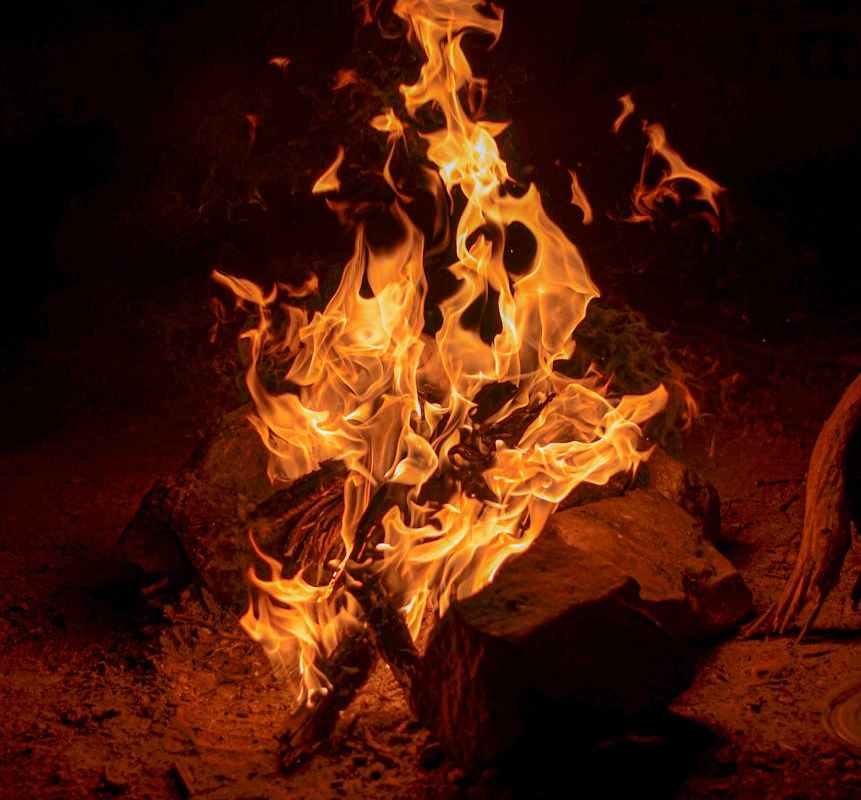
First, fire is more than its visible flame.  

Fire occurs when something is ignited by intense heat and combines with oxygen.   This creates combustion, which produces heat and light.  

The visible effect of this chemical process is the flame.  But beyond our sight, fire emits the same kind of radiation as the human body. 

In other words, the transformation of elements that we call fire is both a visible and invisible process. 

Second, though fire is often associated with destruction, it is vital to the flourishing of ecosystems. 

Fire actually creates micro-habitats within the same landscape, as different life forms adapt to different stages of wildfire life-cycle.

One really cool example of this is the fire chaser beetle,  which can detect infrared radiation from forest fires more than 80 miles away.  It lays its eggs on charred wood, which makes nutritious food for its larvae. 

Because different plants and animals are adapted to phases of fire, recovery, or re-growth,  fire actually makes room for a greater diversity of creatures to thrive within the same landscape. 

And third, fire is an extremely powerful tool. 

On the positive side, fire’s ability to cook our food, keep us warm, and stave off predators, makes it responsible for human civilization as we know it.  On the negative side, fire has been used to commit horrific violence. 

Whether used for good or for ill, fire gives humans access to power beyond ourselves. 

— 

With all of that in our minds, maybe we can get back to that question:  

Why is there fire on the disciples’ heads? 

Well, our scripture readings for today show us that fire and the Holy Spirit share some common traits: 

  • They spur both invisible and visible transformation. 
  • They make room for greater diversity. 
  • They give humans access to power beyond ourselves. 

The Holy Spirit truly is the FIRE of the incarnate God, a living flame that never stops burning. It touches people and ignites a spark – we can’t help but be changed. 

When we are attuned to the Spirit, everything feels like it could combust at any moment.  There is palpable energy in the room. 

When we feel the Spirit moving, we sense the possibility for peace and harmony among people who have nothing in common. 

When we look for the Spirit, we are swept up in the beauty and pain of life as God sees it. We see the truth of things so that we can be transformed. 

And when we call on the Spirit, we receive the power of Christ that is now let loose in the world and coursing through our bodies. 

No, I’m not a Pentecostal. But I believe the Spirit moves.  

I believe this, because I have seen, heard, felt, and sobbed the Holy Spirit.  

In this last month of baptisms, I have witnessed the Spirit spur us to clapping and dancing and laughter. 

In moments of sadness and anxiety, I have connected heart-to-heart with the Spirit of God in you. 

I have gotten the goosebumps of the Spirit when I have suddenly noticed beauty in the cracked and broken things. 

— 

The Holy Spirit landed like fire on those first disciples. And the combustion still hasn’t stopped. 

One thousand, nine hundred, and ninety years ago, the Holy Spirit came in like a wildfire and cast the anxious disciples out into the busy streets, where they suddenly stood up straight and started preaching! 

And we stand here today, in 2023, in Houston, Texas, because that wildfire of the Holy Spirit could not be contained. 

Church, you are the evidence that the Spirit moves in our midst. 

  • Because you are the descendants of those who left the upper room, and started testifying in the street.  
  • You are here today because the Spirit of the Living God caught the world on fire.  
  • You have been empowered by Christ to transform, welcome, and empower all of creation to live for the joy and peace of His kingdom! 

— 

Ok, I have one last story: 

A few weeks ago, the altar party noticed that the top of the Paschal Candle had burnt to a crisp.  

The fire, normally contained in the wick, had attempted to spread.  It managed to scorch the top of the plastic pillar.  It is lit today only by the grace of God, and the persistence of our sexton, Mario. 

I keep thinking that maybe the paschal candle was trying to remind us that the fire of Christ can no longer be contained

On the day of Pentecost, when the fire of Christ engulfed the world, the church became the church. We no longer need the paschal candle to remind us that Christ is in the world.  

(Extinguish candle.) 

Because we are in the world. And the Spirit of Christ is in us. In other words, we are the fire. 

What would it be like if we really acted like people with fire on our heads? 

I think we would run toward the darkness of this world knowing: 

  • We carry the flame.  
  • We enlighten the truth.  
  • We radiate good news. 
  • We ignite the movement.  
  • We love with the all-consuming love of God. 

The church is alive! The Kingdom of God is here! Combustion and transformation keep happening! 

Church, it’s time to set the world on fire. Amen.