You are his body

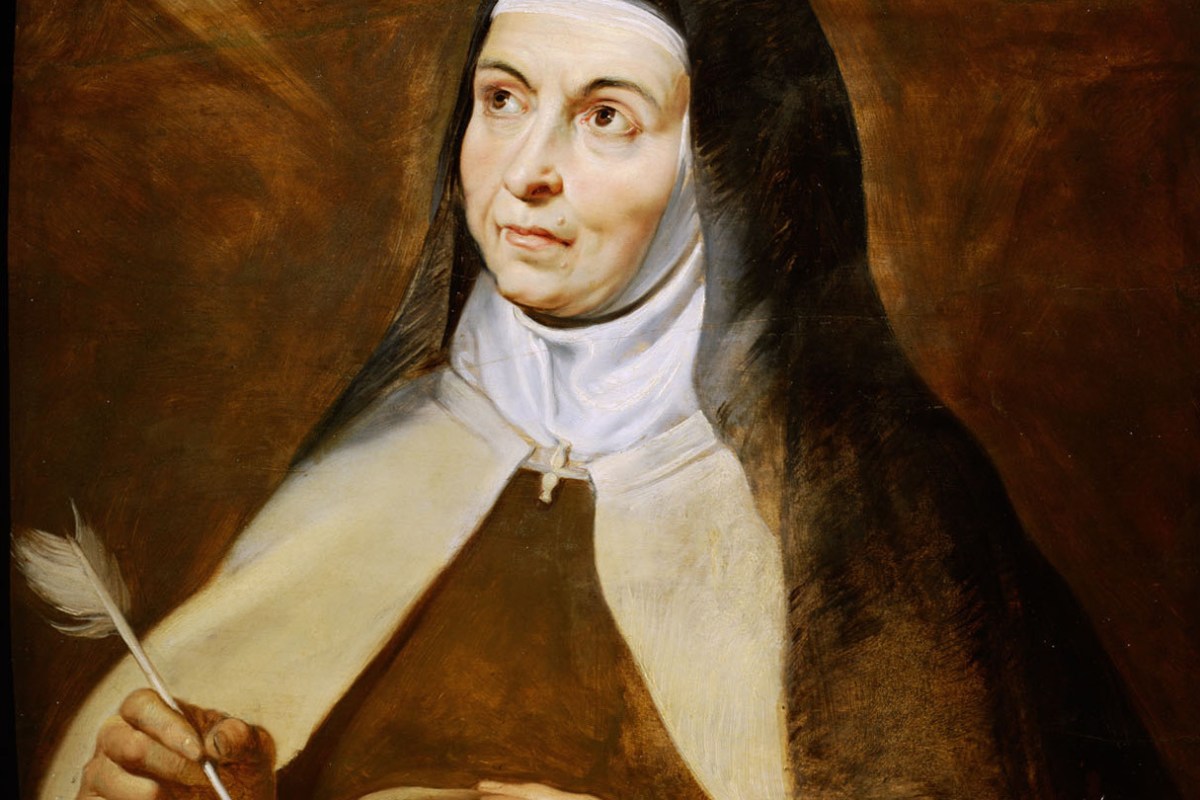
Rubens painting of Teresa of Avila, public domain

“And after you have suffered for a little while, the God of all grace, who has called you to his eternal glory in Christ, will himself restore, support, strengthen, and establish you. To him be the power forever and ever. Amen.”

Today in the church year, we find ourselves living, again, in the absence of Jesus. As our Acts passage describes, after his resurrection and his appearance to the disciples, Jesus leaves earth and goes up to heaven. We call this event “The Ascension.” It is commemorated with a feast day that takes place 40 days after Easter Sunday – if you’re doing the math, that was last Thursday.

If you remember the events of Good Friday and Easter, you’ll recognize the pattern in this story…

When Jesus departs – first by death and then by ascension – the disciples are initially thrown into confusion. Strange messengers appear to remind them that Jesus will be back. The disciples – both men and women – regroup in the upper room of a house. They pray and wonder about all that has occurred. In the absence of clarity about the future, all they can do now is wait for something to happen…

In the first case, the risen Lord appears to them less than 48 hours after he died. The women run with joy from the tomb and Thomas touches the wounds on Jesus’ hands and side.

In the second case, the Holy Spirit descends on them. According to my rough calculation, the day of Pentecost arrives about a week after Christ’s ascension. This time, Jesus doesn’t show up in human form. But through the Spirit, God becomes present in the hearts, minds, and bodies – in the humanity – of his followers and friends.

But let’s not get ahead of ourselves…We haven’t gotten to that part of the story yet – and we won’t for another week. So, let’s wait here with the disciples for awhile.

Since we are living well after the arrival of the Holy Spirit, our faith teaches us that the Spirit lives in us today. In that sense, our wait is over. But, honestly, it can be hard to know what that even means. What comfort is it to us to know that some wispy “vibe” of God lives in us when we know that Jesus once walked alongside his disciples? What comfort is it to know that Thomas touched his scars, but we cannot?

It’d be so much easier to endure the suffering of this life if Jesus was here, in the flesh, grabbing our hand and pulling us in the right direction. In the absence of Christ’s body, it can feel like we’re living in the absence of God. Or, if not exactly absence, maybe something like benign negligence.

Sure, maybe the emptiness of Good Friday is behind us. And maybe we trust that Christ is alive, and seeking us out, and advocating for us. But life can be demoralizing. It’s not always easy to keep the faith when a loved one dies or a family member gets shipped off to war. When the diagnosis rolls in. When the bills pile up. When things don’t go the way we planned.

It’s not easy to keep the faith when we are faced with an unknowable future – and Jesus’ own response to our concern is “because I said so.” Or rather, as he says in Acts: “It is not for you to know the times or periods that the Father has set by his own authority.”

We may not always feel that our lives are filled with the glory of Pentecost: all flame and wind and possibility. There are seasons of life that feel like this week in our liturgical year, when Christ has gone up and the Spirit has not yet come down. There are Sundays when we huddle together in this room and pray – not because we know what’s coming, but because we don’t.

What I’m saying is: it’d be nice to see Jesus every once in awhile.

In John, Jesus prays to God the Father, describing his absence in this way:

“All mine are yours, and yours are mine; and I have been glorified in them. And now I am no longer in the world, but they are in the world, and I am coming to you. Holy Father, protect them in your name that you have given me, so that they may be one, as we are one.”

This is a remarkable claim for Jesus to make. He is saying that his glory – which is the very power of God – has now been passed on to his followers.

“It’s ok,” he says, because even though Jesus is no longer in the world, his God-(em)powered people are in the world.

And after that remarkable claim, he prays that our lives will reflect the full glory made evident in the inseparable relationship between God the Father and God the Son – that we will be folded into that relationship “as one.” In other words, even though we are still earthbound, he is inviting us into the identity and relationship of the Triune God.

Which means God is here, because YOU are here. Even when it feels like God is absent, our beating hearts, discerning minds, and moving bodies ever proclaim his presence. His presence is not a feeling or “vibe,” it’s simply reality.

One of my favorite descriptions of this reality comes from a sixteenth century poem by Spanish nun, Teresa of Avila:

Christ has no body but yours,
No hands, no feet on earth but yours,
Yours are the eyes with which he looks [with]
Compassion on this world,
Yours are the feet with which he walks to do good,
Yours are the hands, with which he blesses all the world.
Yours are the hands, yours are the feet,
Yours are the eyes, you are his body.

You are his body.

To be Christ’s body is different from working on behalf of Christ.

Jesus doesn’t say that you’re a paid employee of the Kingdom of God, who got the job despite your lack of qualifications. It’s not your job to make a list of “Christian obligations” and then strain to check all of them off. It’s not your job to ignore the hard parts of life. It’s not your job to keep it together when your world is falling apart. It’s not your job to try to convince yourself that you can make it work.

It’s ok if it feels like Jesus is absent, and the Holy Spirit doesn’t feel like enough. You are Christ’s body anyway.

And to be Christ’s body is to let God root around and take root in you. To know that the light is already lit. And to take a deep breath in and remember that the Spirit of God is ruah – it is the air you breathe.

To be Christ’s body is simply to trust that Christ lives and moves in you. You don’t have to grin and bear it. You only have to pray “Thy Kingdom Come” and respond to the Spirit that is already working in you.

Yes, in some ways, we are still waiting. We are waiting for the second coming of Christ. We are waiting for the perfect paradise of God. We are waiting for answers to our questions. We are waiting to hold onto Christ’s hand. But we are not waiting for Christ to be known to us, here, in the flesh. Because we are his body. It is not a job we take on. It is who we are.

So, we gather in this room and we pray that what is closed in us will open. We pray that light will break through, and peace will fill our hearts. We pray that we will inhale God and exhale love. That Our eyes will be full of compassion. Our hands will be open in blessing. And our feet will take us in the Way that leads to the Kingdom of God.

Amen.

I highly recommend the Teresa of Avila quote set to music, particularly this version

The Scandal of Suffering

A Sermon on the Beheading of John the Baptist

Readings available here.

The beheading of John the Baptist.  

The mere thought of beheading is so gruesome that I want to avert my eyes as I read the story. 

Reverend Brin assured me that they did not read this passage during kids’ church this morning. Now, I’m normally not an advocate for censorship, but the moral ickiness and graphic violence of this event made me wonder, at first read, why the writer of Mark wanted it to be shared at this point in the story, and in this way. 

The story is disruptive, in more ways than one. 

For the last five-and-a-half chapters, we have been moving at a steady clip with Jesus and his disciples, as they have sought out the marginalized, healed the sick, and restored people to community. 

The narrative has become almost predictable: Jesus goes somewhere, he tries to take a nap or eat lunch, and then a great need arises to which he must respond.  So, he performs a miracle.  

Person by person, bit by bit, the culture of death in the ancient near-East is being covered by new buds of hope.  The Kingdom of God is spreading. 

Now, word of his deeds has reached the regional Jewish ruler, “King Herod.” This Herod is the son of the other Herod, who tried to kill baby Jesus. A Jew himself, Herod works for the Roman authorities, and lives the lavish lifestyle afforded to him by his compliance. Many in his religious community consider him a sell-out. 

By this point in Jesus’ ministry, John the Baptist has already been dead several months.  Mark tells us that John was arrested way back in chapter one. But something curious happens when news of Jesus’ “mighty deeds” reaches Herod:  His guilty conscience can’t help but think that John the Baptist has been raised from the dead. 

Herod’s shock seems to bend space and time, and the narrative suddenly takes a turn. We find ourselves in a flashback, watching horror unfold in the decadent courts of Herod and his family. 

— 

Herod didn’t want to kill John.  

While John had disapproved of his marriage to his brother’s sister, the story doesn’t suggest there was any danger in John voicing that opinion. After all, Herod knew, as well as John, what religious law mandated.  And the story even tells us that Herod “liked to listen to John.”  

But John’s insistence that Herod’s marriage to “Herodias” was unlawful disrupted Herodias’ game plan. She couldn’t risk having her husband change his mind. In a time when the only way for a woman to gain power was through a favorable marriage, she was determined to hold onto what she had. 

So, when Herod throws himself a big birthday party and promises the world to Herodias’ daughter – in front of powerful guests – Herodias knows exactly what to do. When her preteen daughter comes to her for advice, she instructs her in the ways of power: Exploit the fragile ego of the man who controls your future.  Make him kill the man who would put that future at risk. 

“Deeply grieved,” Herod has John killed. His head is paraded on a meat platter at Herod’s birthday party. In his power-drunk bragging, Herod backed himself into a corner. He murdered a holy man. There is blood on his hands. 

— 

This flashback, though only 14 verses long, is like a punch in the gut.  

Corruption and exploitation are oozing from the seams. Herod and Herodias’ self-involvement refuses righteousness at every turn. And they use their own daughter as fodder, training her up in the ways of power, and making her complicit in the death of an innocent man. 

The brutal violence and stomach-turning exploitation in this story are disruptive. The flashback doesn’t fit in with the hope that’s spreading, as Jesus meets and heals people across Judea and Galilee. It’s a crack in the story of the growing Kingdom of God, a near-halting of the narrative.  

So why would Mark place it here? 

Perhaps Mark includes it at this moment to remind us that, though our lives are relentlessly disrupted by cruelty and violence, these are not meant to be things we accept as part of the story of God. The story of God, in Christ, is the story of life. 

Theologian Henri Nouwen spoke of this when he wrote: 

“A life with God opens us to all that is alive. It makes us celebrate life; it enables us to see the beauty of all that is created; it makes us desire to always be where life is… If anyone should protest against death it is the religious person, the person who has indeed come to know God as the God of the living” (from A Letter of Consolation).

For those of us who have experienced even a taste of Jesus’ life-giving love, cruelty, violence, and suffering should feel disruptive. We should never accept them as inevitable or unavoidable or good. 

When they show up in our own stories – or the stories of others – they should stop us in our tracks, just like John’s beheading does in the Gospel of Mark. 

It is good for us to feel “deeply grieved” in the face of the world’s death-dealing. It shows that we have internalized the hope of the resurrection. 

It shows us that God is still working in us. God is still on the move. 

But beyond disruption, this story serves as a cautionary tale. By observing Herod and his family, we see that making decisions to protect ourselves or retain worldly power won’t save us, in the end. Because these desires are based in the fear of death, they have no power to bring about flourishing. 

Herod and Herodias “looked out for number one,” but it didn’t protect them from suffering. Herod was wracked with guilt after murdering John. And, in the end, he was deposed by family members. He and Herodias died in exile. 

Their self-involvement couldn’t ultimately save them. What it did do was help them justify other people’s suffering. 

When we focus too much on ourselves, it is easy to become complicit in other people’s suffering. It’s easy to justify violence if that’s what it takes to retain control. We make it our business to police, imprison, and do away with those who threaten our access to resources or our social position. 

We quickly forget that Jesus proclaims abundant life for all of us, not only a select few who know how to play the game. 

Herod teaches us that self-involvement, taken to its natural conclusion, causes more suffering than it quells. It is an impulse in direct contrast with Jesus’ other-centered, open-hearted, life-giving love. 

— 

The disruptive story-within-a-story of the John’s beheading reminds us that death-dealing does not belong in the redemptive, joyful story of the growing Kingdom of God. 

Our first task is to believe that. Our next task is to act like it

In our own lives, my prayer is that we are so steeped in the hope of the resurrection that we experience suffering, violence, and exploitation as disruptive to the story of God, of which we are a part. 

My prayer is that we have the persistence to resist the cycle of violence, the courage to risk embarrassment, punishment, and social standing by speaking out, and the open-heartedness to stop politicking long enough to love our neighbor. 

In a world marked by so much exploitation and brutality, my prayer is that we lead lives of loving disruption, always pointing to the righteous and peaceful Kingdom of God. 

Amen.