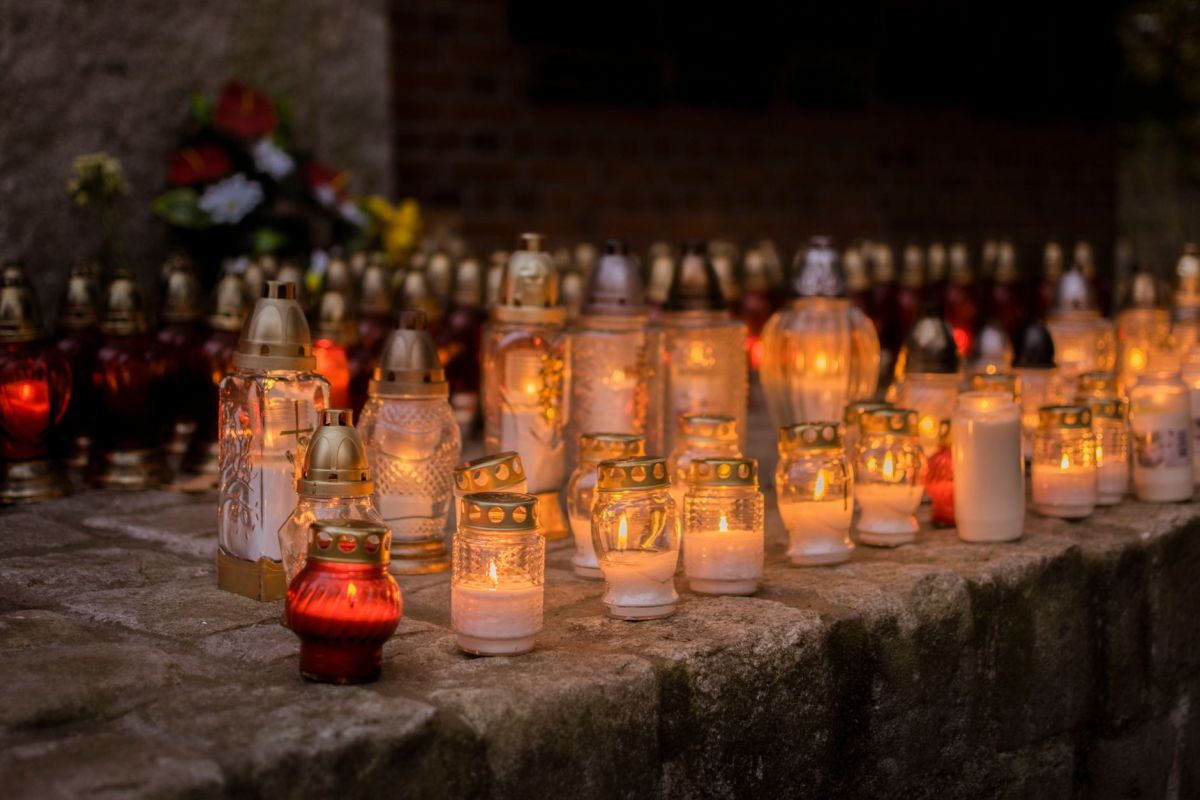
Today is All Saints’ Day, a day that draws us into the mystery of Christ’s body and reminds us that we are eternally bound to all members of the church across time, space, and even death.
Today’s theme feels like a fitting day for poetry. So, I’d like to share some poetic verse with you, written by Elizabeth Barrett Browning in 1856:
“…Natural things
And spiritual,—who separates those two
In art, in morals, or the social drift,
Tears up the bond of nature and brings death,
Paints futile pictures, writes unreal verse,
Leads vulgar days, deals ignorantly with men,
Is wrong, in short, at all points…Earth’s crammed with heaven,
And every common bush afire with God.
But only he who sees, takes off his shoes—
The rest sit round it and pluck blackberries,
And daub their natural faces unaware.”
We’ll talk more about the poem’s meaning later. But first, a bit about the poet…
Browning grew up in England and was baptized and raised in the Church of England, which is the tradition that we Episcopalians stem from. She was a scholar: she learned and translated Hebrew, and many of her writings were influenced by Christian writings like Dante’s Inferno.
She was also a lifelong activist. Though she came from a slave-holding family, Browning advocated for abolition, even when this put her at odds with her father. But, she is best known as a poet that rivaled her male colleagues in a time when it was hard for women-writers to break through.
Because of all this, you might think that Browning would show up in our commemoration calendar for the saints, but she doesn’t. Though she’s not formally acknowledged by the church, she is undoubtedly a spiritual ancestor to the many people who benefited from her faithfulness, moral courage, and artistry.
In fact, we’re benefiting from her today. Because, in the section of Aurora Leigh that I shared, Browning describes the theological core of All Saints’ Day. She starts out by saying that there is a common misunderstanding that the “spiritual” and “natural” are separate realities that don’t influence one another. We tend to operate as if God and the saints are up in heaven singing. And, meanwhile, we poor creatures are down below, struggling through life without any help.
In Browning’s day, this wasn’t simply a theological belief. It was used as a convenient excuse for unjust behavior. The industrial revolution suppressed wages for the poor. Slavery was still legal. And global expansion gave England political and economic safety, while the communities that they pillaged suffered.
People like Browning’s own father would have suggested that this was just the way the world works. God had nothing to say about it. And people had no reason to do anything about it. But, at least if you got right with God, you could go to heaven when you died.
But Browning disagreed with the entire premise. In her poem, she says that “earth’s crammed with heaven.” God is interrupting the status quo with the signs of his kingdom. And any suggestion that our “real lives” are somehow separate from the life of God is a lie.
She says, God is always acting on the world, turning ugliness into beauty and darkness into light. Our world is enchanted with the inbreaking of Heaven. We just have to notice it. And this is why we celebrate All Saints’ Day: because it makes us pay attention to the heaven-enchanted world we actually live in.
This is what we know to be true: The saints of God, in heaven and on earth, are united in the Body of Christ and participate in that same body, even across the boundary of death. Heaven is imposing itself on our mortal lives, calling us to the work and worship of the Kingdom of God. And we are never separate from the love and presence of God, who gives us the courage to hope for better amid so much brokenness.
Earth is full of signs of heaven. And our faith, even earth-side, draws us into heaven’s choir, where we join our voices in the eternal song of God. We are never alone, in this great jostling crowd of the faithful.
Lest you think I’m being metaphorical, I want to share a story with you about a time that the saints of God in heaven “crammed” themselves into my little, earthly life. Maybe you’ll think I’m crazy; maybe you’ll say, “me too.” In any case, I hope you’ll receive it with an open mind…
When I was in seminary, I did my internship at a little country church in Cheshire, Connecticut. By the time I started my internship, we were many months into the pandemic lockdown, and so we couldn’t worship inside the church building. The good news was that the church had already voted to renovate the sanctuary. And the pandemic gave them the perfect excuse to go ahead with construction while we worshiped in a field next to the parking lot.
For the first year or so of my internship, I only caught glimpses of the sanctuary when I went to the sacristy to prepare the symbolic elements of our “spiritual communion.” But in the winter of 2021, the lockdown was starting to lift, and sanctuary renovations were complete. When the time came to invite the congregation back into the sanctuary, a liturgy was carefully crafted to re-dedicate the space as a place of worship.
Now, Saint Peter’s was one of the oldest Episcopal churches in Connecticut. The original worshiping community started before the Revolutionary War, as evidenced by headstones in the cemetery that surrounded the church. Because of this, the congregation was pretty comfortable with the idea that the ancestors in the faith might still have some presence with us today.
On the day of the dedication service, I was sitting in the choir loft and my supervisor, the rector, was preaching. As she spoke about the centuries of faithful parishioners who had made that congregation their home, I felt a sudden heaviness in the air, almost like smoke, or a barometric pressure drop before a rainstorm. It was overwhelming and strange, and I couldn’t explain it. So I kept it to myself.
But, after the service, a widow who had been sitting near the front of the room told the rector that, during the sermon she had felt a hand softly rest on her shoulder, Without a second thought, she knew it was the invisible hand of her dead husband.
When the rector told me that, I fessed up and told her about the heaviness in the air. When we compared notes, we realized that both events had happened at the same time in the service… The time, coincidentally, that the rector’s cell phone had gone off, showing the caller ID of a parishioner who had just died.
Over the following days, others told similar stories of presence, of wonder, and a feeling that time had stood still as the rector regaled us with stories of those old saints. It seemed that all the saints of that place – both living and dead – were together again; and our prayers were rising and intermingling in the air, floating like smoke past the high vaulted ceilings of that little country church, as they had been for hundreds of years.
We were all Moses at the burning bush, on the mountain of God where time stands still. We all were singers in the heavenly choir, worshipping around the throne of God. That experience convinced me that our theology of All Saints is really real. That nothing is lost or forgotten, that our prayers leave a lasting impression on this earth, and that God – and the saints – will never leave us alone.
As Elizabeth Barrett Browning said, “Earth’s crammed with heaven.” And nowhere is that more apparent than when we join together in worship here, or at any altar of the church. In our worship and communion, the veil is thin between life and death; between heaven and earth; between the God who created us and God’s beloved creation; between Christ who was one of us, and us, who are part of him.
And our experience here compels us to believe that the love we share continues after we walk out these doors. And it continues across the boundary between life and death.
What if we really believed that? What if we lived our lives knowing that the millions who have gone before us are with us, that they are not just examples to us, but friends to us in our time of need? That even in death, they can sustain us in hope?
What if we really believed that we could be saints to others? What if we lived our lives as exemplars of prayer and worship, of kindness and mercy? And we let our actions, whether simple or grand, be a sign of heaven interrupting the sorrow and suffering of our mortal lives?
“Earth’s crammed with heaven.” Our lives are a testament to the Kingdom of God come near. This is a powerful call, and it is a great responsibility. Joined with all the saints in the Body of Christ, we can no longer live only for ourselves. We must live for the wellbeing of all of God’s children, knowing that the saints are always praying for us and guiding us along the path that leads to eternal life.
Amen.

