“Convicted”: Lazarus and the Rich Man

a man lies on the street with a clothesline in the background

Readings here

I grew up in an Evangelical denomination. My husband, Daniel, grew up Lutheran. When Daniel and I first met, it’s like we spoke a different language of faith.

One day, while eating lunch together in the Student Union, I told Daniel that “I felt convicted” to make a certain change in my life. As I kept describing what I had been thinking about, I could tell he was no longer able to listen. To my surprise, he blurted out, “what do you mean, you were…convicted?”

“You know, convicted…God ‘laid it on my heart’ to understand something differently than before. For example, to forgive my roommate, to give money to an important cause, to trust in God more.”

Daniel was struggling, not with the concept, but with the word itself. Because, if you’re not coming from a faith context that uses that word, the only place you hear the word “convicted” is in a criminal context. And no one on a police procedural is being convicted to give money to the poor. They are being convicted of… murder.

Why was I taught to apply such serious language to relatively minor circumstances of my faith? Couldn’t I have used softer, more positive language? Couldn’t I have said that I felt the Holy Spirit guiding me to do something good, rather than “convicting” me about what I wasn’t doing?

One reason I joined the Episcopal Church was because of that shift in tone. Instead of feeling like a moral failure all the time, I could rest in the assurance that God didn’t see me that way. Instead of wasting away as a “convict,” I could be guided and led, like a little sheep, to better pastures, by the Good Shepherd who had sought me out. It’s amazing what one little shift in language can do…

Still, looking back on that conversation with Daniel, in light of today’s Gospel reading, I wonder if there’s something salvageable in the idea of “being convicted.”


Not always, but sometimes…

Today, Jesus continues his teachings on wealth and the Kingdom of God by sharing another parable, a fictional story meant to convey a moral reality. Like I mentioned last week, parables are often “multivalent.” This means they can have multiple interpretations, values, and meanings. While there might be a central theme, your life experience, and the way you place yourself in the story, impact what you get out of it.

That’s what I love about Jesus’ parables. They never get old. Every time we encounter them, there’s an opportunity to think differently.

In this parable, we learn that a poor man, Lazarus, has spent years outside the well-appointed gates of a rich man’s house. Covered in sores and on the edge of starvation, he sits among the dogs, He survives on the rich man’s trash. Meanwhile, the rich man wines and dines, thinking nothing of Lazarus or his circumstances.

Eventually, both of the men die. While Lazarus goes to paradise, the rich man goes to “Hades.” While Hades doesn’t perfectly map onto our modern sense of Hell, there is no question that Jesus is making a clear judgment call. The poor man Lazarus, who suffered all his life, now receives comfort among the angels and the patriarchs of the faith. The rich man, who had access to every creature comfort, now suffers in the afterlife.

Over the years, he distanced himself from the “riff-raff” on the streets; and in doing so, distanced himself from the central tenets of his faith. Now, there is no one who can come to his aid. There’s no other way to put it: the rich man was “convicted” of his past wrongdoings – in the literal sense.

Of course, we remember that a parable is a fictional story that speaks to a moral reality. And this story is a warning for the crowd – very much still living – that surrounds Jesus as he tells it. Jesus’ audience is “convicted,” in the spiritual sense now, toward right action, faithfulness to God, and love for their neighbors. They are reminded that the God of Abraham and Moses commanded these things, not to punish, but to protect, in order to lead them to a rewarding life in the here and now, that continues for eternity.

The moral of the story isn’t just about personal, financial giving – though that’s certainly a part of it – but about seeing our fellow humans through the eyes of God, and then acting on that vision. The rich man failed to see Lazarus as a person – he was just another dog on the street. And both of them suffered from that affront to human dignity. The life God calls his people to is one where physical, spiritual, and relational suffering is acknowledged so that it can be alleviated.


But I am also struck by another lesson:

And that is: “You already know how to live righteously.”

The rich man begs Abraham to send word to his brothers about their coming fate…

‘He said, Then, father, I beg you to send him to my father’s house– for I have five brothers– that he may warn them, so that they will not also come into this place of torment.’ Abraham replied, They have Moses and the prophets; they should listen to them.’ He said, No, father Abraham; but if someone goes to them from the dead, they will repent.’ He said to him, If they do not listen to Moses and the prophets, neither will they be convinced even if someone rises from the dead.'”

The rich man argues that only a supernatural intervention could convince his brothers to live in the promise of God. But Abraham sees this for the misguided notion that it is. He says that the ancestors in the faith have already conveyed the truth. With the authority of God himself, they proclaimed God’s love and justice. They proclaimed, like the Psalmist, that God is the one who saves. They proclaimed, like Jeremiah, that those who suffer are held in high regard by their Creator, and restored to lands of abundance.

And beyond proclamation, the history of God’s people revealed the truth of God, over and over again. In slavery, exile, and persecution, God remained with his people, asking only that they remain with God, and see the face of God in all people.

If the rich man’s brothers can’t understand the proclamation of patriarchs, poets, and prophets – and the history of their own people – then a divine intervention won’t change their minds now.


In our own struggle to live faithful lives, how often do we find ourselves hoping for a divine intervention?

When I’m trying to make a decision or solve a complicated problem, I know I have asked for signs and miracles. I have complained to God that the path forward is unclear. I have insisted, with great drama, that I can’t move forward without the confirmation of a booming voice from Heaven.

But Jesus now proclaims:

“You already know how to live righteously…”

“He has told you, O mortal, what is good,
 and what does the Lord require of you
but to do justice and to love kindness
 and to walk humbly with your God?” (Micah 6:8)

‘You shall love the Lord your God with all your heart and with all your soul and with all your mind.’ This is the greatest and first commandment. And a second is like it: ‘You shall love your neighbor as yourself.’ On these two commandments hang all the Law and the Prophets.” (Matthew 22:36-40)

If we are convicted, let us be convicted of this:

We don’t have to wait for God to tell us how to be, or how to live. Because God has been here all along, waiting for us. In scripture, history, and experience, we have all the proof we need of God’s faithfulness. We have all the knowledge we need to make faithful choices that lead to abundant life, in the here and now, and for eternity.

We don’t need to fear Hades. We don’t need to wait for God to tell us what to do. In every generation, our call is the same:

Run into the arms of the God of mercy, who is not far away. And remain in his grace, showing that same mercy to others.

Amen.

Closer to Jesus, Closer to Each Other

Readings here

You might remember that a couple of weeks ago, we talked about Jesus’ first sermon in the Temple. First, he read from the scroll of the Book of Isaiah: 

“The Spirit of the Lord is upon me, 
because he has anointed me 
to bring good news to the poor. 
He has sent me to proclaim release to the captives 
and recovery of sight to the blind, 
to let the oppressed go free, 
to proclaim the year of the Lord’s favor.”  

Then, he sat down and declared: “Today, this Scripture has been fulfilled in your hearing.” 

Scholar Luke Timothy Johnson referred to this brief, but powerful teaching as a “programmatic prophecy,” an announcement of Jesus’ gameplan for ministry. 

Three weeks later (for us, not Jesus), now assisted by the twelve apostles, we are seeing Jesus put that “programmatic prophecy” into action. In today’s Gospel reading, which is often referred to as the “Blessings and Woes,” Jesus acts on the call of his life to “bring good news to the poor.” 

(It’s helpful to know that the word used for “poor” in Luke doesn’t just refer to financial lack. As Johnson explains, it refers to anyone without power in society, those without respect, and those who get deprioritized and ignored, because they are seen as embarrassing, burdensome, or even dangerous. 

And maybe most importantly, when Jesus refers to “the poor” in the Gospel of Luke, he means it literally – he is referring to the flesh-and-blood marginalized people of this world.) 

Jesus comes with very good news for these lowly ones: “Blessed are you.” 

Unlike saying “Bless you!” after a sneeze or “Bless your heart” to soften criticism, this blessing is not just a social nicety. The grammatical form of “blessed” suggests that these words, when spoken by God in Christ, actually bring about that reality at the very moment in which they are spoken. 

So, when Jesus declares that the poor, hungry, grieved, and hated ones – the ones without power and respect – are the blessed ones of God, he changes their station in life. Once rejected, they are now the earth’s blessed ones. 

At the same time, those who have always lived secure and respectable lives are now the ones asked to take a hard look at themselves and see whether or not they’re really following God. 

The divine words of Jesus turn the world upside down. Recalling his mom, Mary’s, Magnificat, “He has put down the mighty from their seat: and has exalted the humble and meek.” 

Of course, Jesus isn’t saying something entirely new. But, he is now making real the oldest promise of God to His people: that blessedness is determined solely by our identification with the image of God that is found in all people, not by popularity, status, confidence, or control. 

If this is really true, then it forces everyone gathered there to reconsider what, and who, they follow. Because it forces them to reconsider who is worthy of respect. 

So, let’s look at the people gathered there… Who is Jesus’ audience? Who makes up the crowd? And what do these blessings, and their opposites, mean for how they order their lives? 

“Jesus came down with the twelve apostles and stood on a level place, with a great crowd of his disciples and a great multitude of people from all Judea, Jerusalem, and the coast of Tyre and Sidon…And all in the crowd were trying to touch him, for power came out from him and healed all of them….” 

He’s not in the Temple or the town square, and he’s not talking to a particular group of people who share his views, his status, or his ethnicity. Instead, he is standing on level ground on an open plain, eye-to-eye with the great multitude who have joined him there, jostling, chaotic, and pushing in on one another in hopes of touching him. 

Jesus literally and figuratively levels the playing field as he declares blessedness, as he prophesies and heals in and among a diverse crowd. 

In his book, “After Whiteness,” on the theology of seminary communities, Dr. Willie Jennings talks about “the crowd” that surround Jesus as the centering image that should inform our ethic and our lives as Christians. He says: 

“The crowd is everything. The crowd is us. People shouting, screaming, crying, pushing, shoving, calling out to Jesus: “Jesus, help me;” “Jesus, over here.” People being forced to press up against each other to get to Jesus, to hear him and to get what they need from him. People who hate each other, who would prefer not to be next to each other. Pharisees, Sadducees, zealots, rebels, insurrectionists, terrorists, murderers, tax collectors, sinners, all widows, the orphans, the poor, the rich, sex workers. Wanderers, magicians, musicians, thieves, gangsters, centurions. Addicts and magistrates, city leaders, people from all over the Roman Empire, all pressing to hear Jesus…The crowd is not a temporary condition on the way to something else. The crowd is the beginning of a joining that was intended to do deep pedagogical work” (After Whiteness, 18-19). 

I think Jennings is really getting at this: Though we are all different, the work of Jesus Christ is to gather us into the “great multitude of people” gathered around him. As we fix our eyes on Jesus, himself poor and marginalized, we push closer, seeking healing and wholeness. And, as we do, we find ourselves drawing ever closer to each other. 

Among the crowd, on level ground with Jesus and his apostles, we are on equal footing with rich and poor, friend and enemy, and we become something other than our worldly titles and status would suggest. We become a ragtag, misfit, diverse, and dynamic single entity: the crowd. 

And all of us are here because we are looking toward Jesus, as he centers us on words that turn the world upside down. This poor man Jesus, who will be rejected, ridiculed, and crucified by those he came to save, is the blessed one. And those like him are blessed, too. 

But there’s more. Like Jesus and the apostles, we who are here in the crowd become prophets compelled to proclaim that the poor and hungry have been the closest to God’s righteousness all along. And blessedly for us, we don’t have far to go to get close and learn from these righteous ones. They are here: they’re among us and with us in the crowd that follows Jesus. Perhaps they are us. 

But, if the poor and oppressed are not in the crowd that surrounds us – in our lives, in our churches, or in our communities – it is time to ask ourselves why not. And, if we are not living with and among those forsaken ones Jesus calls blessed, it is time to ask ourselves if we are actually following Jesus, or if we accidentally ended up in a different crowd, following someone else. 

Because Jesus always makes his home among the gathered people who yearn for healing, among the crowds, churches, and communities that are messy, diverse, and rough around the edges, where people disagree and figure out how to be together anyway, with people who have all they need, and people who don’t know what that feels like. 

Jesus longs for us to join him in finding that level ground, in finding that equal footing that leads all of us into the blessedness of God. Eye-to-eye with one another, pushing ever closer to Jesus and, therefore, ever closer to each other. 

Friends, I am thankful to be smushed into the crowd that contains such blessed ones as you. May we seek God’s blessedness together. 

Amen. 

In Your Light, We See Light

Readings here

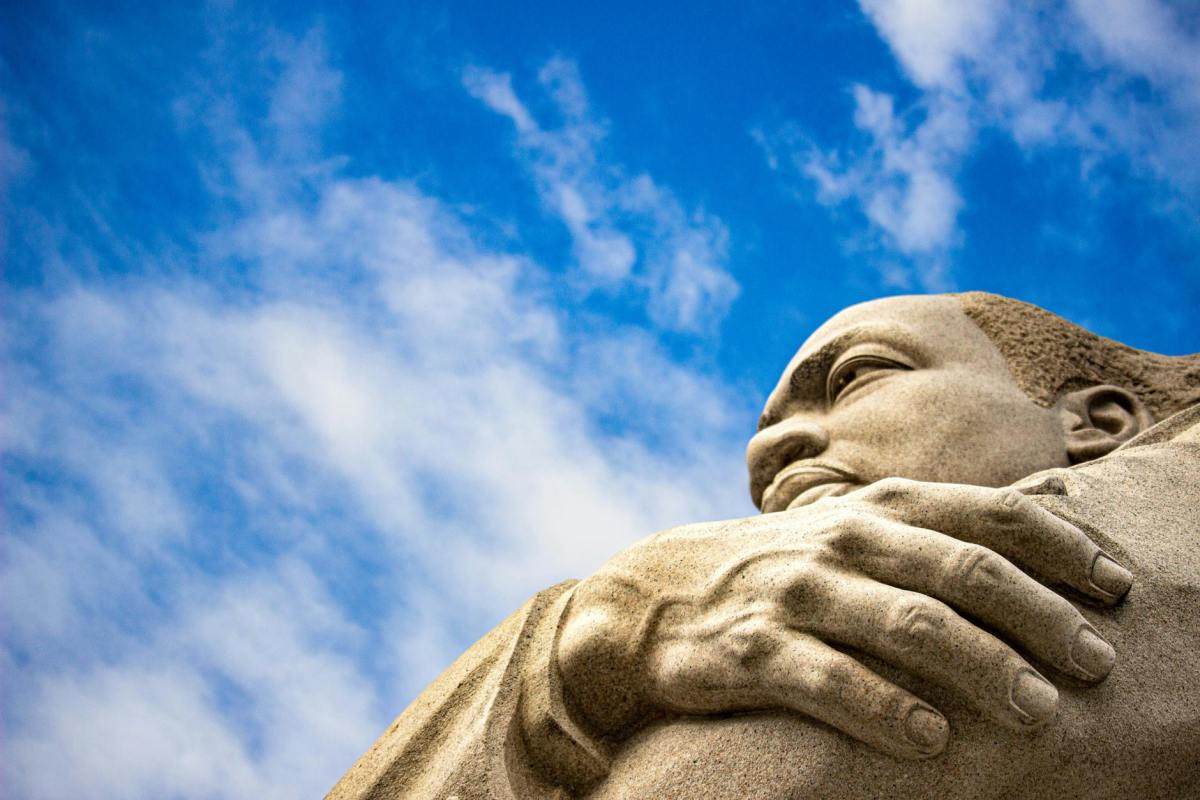
In our Collect and our Readings, the theme of the day is “illumination.” As I prepared for this service, celebrating the life of Martin Luther King, Jr., I kept coming back to a certain phrase in our Psalm: “in your light we see light.”  

It reminded me of Easter Vigil. At the very beginning of an Easter Vigil service, which occurs at sunset on Holy Saturday, a new Paschal candle is lit. 

The Celebrant says this prayer over the candle: O God, through your Son you have bestowed upon your people the brightness of your light: Sanctify this new fire, and grant that in this Paschal feast we may so burn with heavenly desires, that with pure minds we may attain to the festival of everlasting light; through Jesus Christ our Lord. 

The gist of this candle ritual plays out a little bit later in the darkened church when, at the Easter proclamation, all the lights are turned on, shocking sleepy parishioners into wakefulness, and making the church shine like a beacon in the dark midnight of Easter. People ring bells, greet one another other, and joyfully sing “He is risen.” 

If Christmas is about the light of the world becoming incarnate, then Easter is about the light of the world becoming permanent, refracting endlessly in the world’s dark night until everything is illuminated. Christ’s glory has been revealed for all time, and now the People, illumined by Christ’s Word and Sacraments, carry that light with them, beacons in the dark. 

“In your light we see light.” 

For as long as I can remember, I have loved Martin Luther King, Jr. It was a standard part of elementary school curriculum to talk about the Civil Rights Movement the week leading up to MLK Day. We learned how this one man stood up to bigotry, racism, and injustice with nothing but the strength of his ideals and a whole lot of persistence.  

Of course, as adults, we know that King’s story – and indeed, the reality of the Civil Rights Movement of the mid-20th century – was much more complicated. King was not a perfect saint – we know he had affairs. And, like anyone else, he made choices that didn’t always pan out and claims that weren’t always quite true. But those things can’t negate the power of his ministry, or the movement he was a part of. Because it wasn’t one man – it was a movement.  

Thousands of courageous people took a stand for their own dignity and the dignity of others, at great risk to their lives and livelihoods. They were united in their goals, but they weren’t all the same. Not all of them got along. Not all of them agreed on tactics, or were motivated by the same experiences. But all of them knew the stakes were too high to keep silent. 

Some of them, like Mamie Till, were simply proclaiming their child’s human sacredness in the midst of a culture of violence. 

In 1955, Mamie insisted on an open-casket funeral for her son, Emmet Till, who had been tortured and murdered by white men for allegedly flirting with a white woman. The men received no punishment for their crime. But the horrifying spectacle of Emmet’s funeral forced the world to confront the violence of racism. Mamie’s prophetic belief that injustice could not prevail is often credited as the beginning of the Civil Rights Movement.

The light inside of Mamie lit a match that started a fire of justice. In Mamie’s light we see light. 

Among King’s followers was a young, white Episcopal seminarian named Jonathan Myrick Daniels.  

In 1965, he journeyed to Selma, Alabama to register new voters after the passing of the Voting Rights Act. While walking to a convenience store with a group of young, Black activists, a white man pointed a shot gun at 17-year-old Ruby Sales. Daniels pushed the man down and took the bullet.  He died on the scene.  

When King heard about it, he said, “one of the most heroic Christian deeds of which I have heard in my entire ministry was performed by Jonathan Daniels.” 

The light inside of Jonathan burned so bright it saved someone’s life. In Jonathan’s light we see light. 

And, of course, there is King himself.  

A Christian, pastor, and preacher, King’s engagement in civic life was an extension of his faith and vocation. His commitment to non-violence stemmed from his desire to emulate Christ, who rejected a violent overthrow of the Roman government and insisted that revolution started with good principles and sound theology sustained and negotiated in a “beloved community.” 

King was an intentional movement builder, and he was good at it because he knew how to be a community and congregation builder. Following the example of Jesus, he understood that any movement must be built, first, on unwavering principles regarding the sacredness of human life. There could be no question that human dignity was an intrinsic and God-given right that applied to all people, equally. 

And second, King understood that successful movements require coalitions, of different kinds of people, from all walks of life, doing what they can where they can. United, but not all the same. In his Letter from a Birmingham Jail, King wrote, “injustice anywhere is a threat to justice everywhere.” That meant anyone bogged down by unfairness, want, and oppression could find a reason to join hands, link arms, and do the work. 

On the night before he died, King was giving a speech to striking sanitation workers in Memphis. Now known as the “Mountaintop Speech,” it reads like a sermon, conveying scriptural moments of deliverance and counter-cultural connection, and connecting them to the specific trials of the age. 

At the very end of the speech, it becomes clear that King knows there are credible threats on his life. He knows he might not live to see the end of the movement, or even the end of the strike.  

But he concludes with this: 

“Like anybody, I would like to live a long life. Longevity has its place. But I’m not concerned about that now. I just want to do God’s will. And He’s allowed me to go up to the mountain. And I’ve looked over. And I’ve seen the Promised Land. I may not get there with you. But I want you to know tonight, that we, as a people, will get to the promised land! I’m not worried about anything. And, so, I’m happy, tonight. I’m not fearing any man! Mine eyes have seen the glory of the coming of the Lord!” 

The light inside Martin smoldered like incense. They could kill the body, but they could not kill the soul. In Martin’s light, we see light. 

Martin and Jonathan and Mamie saw the glorious light of God and refracted it out in so many directions, it began to overcome the darkness. Their lives became beacons, interrupting the dark night of the world. 

Two of them were martyred.  

Which forces the question, why does the world hate light so much? 

The glorious light of Christ that illumines his people is persistent, pervasive, and exposing. It eliminates the shadowy places where evil can persist. “It will not keep silent” when injustice rules the day. 

Symptoms of Christ-light include fearlessness, boldness, and an unwavering commitment to principles of human sacredness and dignity. This light insists on honesty above etiquette, inconvenience above order, and love above all else. 

It is agitating and loud and overbearing. It wakes up the sleepers and forces us out of our apathy. It makes us remember that everything God created he declared good, and we must declare it, too. 

Light cannot tolerate injustice – it must act, proclaim, and respond. And this means, the light of Christ is like a pebble in the shoe of injustice: Worldly powers and dominions hate people who challenge them on their ego trips and power grabs. Worldly rulers and their allies will kill to keep the world in darkness. 

But we are not like them. We are light-bearers. In Christ’s light, we see light. And we carry that light as beacons in the dark world.  

It is our task to be honest, and to speak up in the face of injustice. It is our duty to stay the course of our faith: to care for the poor, the orphan, the outcast, and the marginalized, to love our neighbors near and far, no matter who they are, and no matter what other people say about them. No matter the cost to our reputations, livelihoods, and maybe even our lives. And it is our calling to be bold and bright, to refract light until the whole world is covered in it. 

United but not the same, we bring different experiences and different skills for the movement that we might call Christ’s “way of love.” But we all have work to do. We all have light to bear. 

By God’s grace, illumined by Christ’s light, in the way of Martin, we will be able to say that we are not afraid, because we have seen Christ’s glory. And in our light, the world will see light.  

Amen. 

Surprise, Inspiration, Bold Proclamation: Advent 4

Five years ago, I journeyed to the diocesan offices in Richmond, Virginia to undergo several hours of interviews for “postulancy.” Postulancy is the first step, of many, on the path to ordination in the Episcopal Church.  

I have heard some people call postulancy the “narrow gate.” Because, for many people, this is the most critical step in an ordination process. In these interviews, the aspiring priest is compelled to describe their call with clarity and conviction to a roomful of strangers. 

That day in Richmond, I was finally at the end of my interview, and they asked the closing question: “Is there anything else you’d like to tell us?” 

To everyone’s surprise – including my own – I blurted out some garbled sentence about Mary. Whether compelled by the Holy Spirit or by the delirium of anxiety, in that moment, I needed to talk about Mary. It suddenly felt urgent to tell them that Mary’s call by God to mother the Savior of the World meant a whole lot to me. 

As a kid growing up in churches that didn’t let women teach or preach, Mary had become my friend. She was a reminder that women could also be a part of God’s story. And not only that: in the story of Jesus, especially Luke’s telling, women are the first to be called. 

Mary, and her cousin Elizabeth, are prophets and apostles in the first chapter in the story of Jesus. In the most literal terms, they grew, nurtured, and birthed good news into the world, Elizabeth, as the mother of John the Baptist, and Mary, as the mother of Jesus. 

Jesus’ ministry with and for us on earth occurred, because Mary took the risk of saying, “Here am I, the servant of the Lord.” 

I told the committee all of these things as I pondered them in my heart. I pondered a little too hard, because I started crying from the beauty and weight of it all. 

My rector, who had accompanied me to the meetings, had an amused expression on his face. Later, we laughed together as he recounted how I had made myself cry during an optional question at the very end of a long interview. But, I’m glad Mary showed up during that intense moment in my life. 

Because, in many ways, she is the template of the life of faith, not one defined just by having the will to believe, but by moments of surprise, inspiration, and bold proclamation that lead to sustained trust in God. 

In today’s Gospel reading, Mary is inspired by Elizabeth’s Spirit-filled blessing to view her strange and miraculous pregnancy within the whole history of God’s persistent goodness. As soon as Elizabeth calls her “blessed,” she starts up with an original song we now call the Magnificat… 

He has mercy on those who fear him
in every generation. 
He has shown the strength of his arm,
he has scattered the proud in their conceit. 
He has cast down the mighty from their thrones,
and has lifted up the lowly. 
He has filled the hungry with good things,
and the rich he has sent away empty. 
He has come to the help of his servant Israel,
for he has remembered his promise of mercy. 

Though her words are spoken with the boldness of a prophet, Mary is not foretelling the future. With sudden urgency, she is actually sharing what has already, and always, been true about this loving, generous, just, and merciful God.  

She says: God has already fed the hungry; freed his people from slavery; dethroned tyrants; sustained orphans, widows, and refugees; and brought the lost back to their homes, back to the flock, and back into the arms of God. 

Maybe Mary surprised herself when she blurted all that out. Maybe God’s promises had felt far away for awhile. Maybe on that long journey to visit Elizabeth, the initial joy of her miraculous pregnancy had given way to fear, confusion, and even doubt. 

But then, the Holy Spirit prompted Elizabeth to say exactly what Mary needed to hear: “Blessed is she who believed that there would be a fulfillment of what was spoken to her by the Lord.” 

Elizabeth’s words rang true. They hit her like a bolt of lightning that illuminated the dark night of Mary’s strange circumstances. It helped for someone else to say, out loud, that she had already been called, and that meant she could rise to the challenge of God’s continued call on her life, no matter where it took her.  

This realization compelled her to sing! She had professed God’s goodness, she had seen the proof of that goodness throughout time, and now it was time to trust it.  

This is how she embodied the life of faith: as a cycle of memory, inspiration, and bold proclamation, with each one necessary to reviving and sustaining the other. 

This week, New York Times columnist David Brooks, wrote a piece on his own life of faith, entitled The Shock of Faith: It’s nothing like I thought it would be (gift link). In it, he shares the non-linear path that led him from atheism to whole-hearted participation in Jewish and Christian communities.  

He talks about coming to faith, not as single moment of conversion, but as “an inspiration” that occurs at various times throughout life. He says that the first time he felt this inspiration, it was “as though someone had breathed life into those old biblical stories so that they now appeared true.” 

In particular, Brooks shares a story about being startled by God on a hiking trip, as he read a Puritan prayer: 

Let me learn by paradox that the way down is the way up,  
That to be low is to be high,  
That the broken heart is the healed heart,  
That the contrite spirit is the rejoicing spirit,  
That the repenting soul is the victorious soul. 

Suddenly, it hit him that these paradoxical sayings were true. He says he was “seized by joy” and suddenly aware of the beauty all around him. 

In a paragraph that recalls Mary’s Magnificat, Brooks goes on to say: 

“That contact with radical goodness, that glimpse into the hidden reality of things, didn’t give me new ideas; it made real an ancient truth that had lain unbidden at the depth of my consciousness. We are embraced by a moral order. What we call good and evil are not just preferences that this or that set of individuals invent according to their tastes. Rather, slavery, cruelty and rape are wrong at all times and in all places, because they are an assault on something that is sacred in all times and places, human dignity. Contrariwise, self-sacrificial love, generosity, mercy and justice are not just pleasant to see. They are fixed spots on an eternal compass, things you can orient your life toward.” 

Brooks suggests that faith may be born in the will to believe, but it is sustained in transcendent moments of awe, in nudges from the Holy Spirit that lead us to recall God’s faithfulness in history, and trust in his goodness, in all times and places. 

Through the witness of their lives, Mary and other people of faith remind us that goodness is intrinsic to God’s nature, and that love, generosity, mercy, and justice are God’s intended order of the universe. 

Yet, even as we will ourselves to believe, we cannot guarantee that the life of faith will prevent fear, confusion, or even doubt. We may not always feel like a part of God’s story. We may need someone to bless us and remind us of how God sustained his people in the wilderness. We will need to be inspired, in quiet moments and lightning bolt shocks, over and over again. 

My hope in these last days of Advent is that we take heart and find moments of joy in our life of faith, unburdened by worries that we’re not holy or good enough to be called by God.  

Like Mary, we can embrace this journey with God as a cycle of memory, inspiration, and bold proclamation, with each one necessary to reviving and sustaining the other. 

God calls us, and God will come near to us again. Amen. 

Eternal Word, New Beginnings

Readings here

Today is the first Sunday in Advent.  The word Advent means arrival. But we’ll get back to that later. Today also marks the beginning of a new year for the church.  So, Happy New Year! 

When we think about typical new year’s festivities, we probably imagine raucous celebration. The ball drops, couples kiss, and fireworks go off around the world.  People crowd into streets, bars, and houses in sparkly clothing. And strangers drink and even sing together like old friends. 

The next day, people make and eat special New Years’ food, thought to bring good luck: black-eyed peas, tamales, goose, and even pickled herring make the list.  In my family, we eat corned beef and cabbage. 

All of these traditions seem to be a way to conjure optimism out of thin air. They encourage us to perform reckless and unjustified hope. The drinks and debauchery help us literally forget the old year, with its old sorrows and annoyances. And in the hazy glow of midnight, we can look forward to a limitless future. 

We tell ourselves: this year is gonna be different.  We’ll finally become who we always wanted to be. We’ll finally get the job, mend the relationship, make the move, start the workout, and get the good news.  

We have no reason at all to believe any of these things are influenced by the fact that it is a new year. But, we decide to believe things will change…at least until the end of January. 

— 

In Christian tradition, our Advent new year is also a season of hope.  But our hope looks a little different. And, unlike new year’s resolutions, it’s a pretty bad conversation starter at holiday parties. Because, Christian hope is apocalyptic. Which is to say, it has a lot to do with the end of the world. 

By now, we are well-acquainted with the apocalyptic literature of the Bible. Our scripture readings have been tracking with the apocalypse for a couple of weeks now. In Daniel, Jeremiah, Revelation, the Gospels, and even the Psalms, we have heard prophecies proclaimed about the end times. Today, we hear news of a mysterious “Son of Man” who is coming to judge the world. 

These apocalyptic predictions are kind of like New Year’s Resolutions – in that they help us imagine the future. But there’s one big difference: these scriptural resolutions are not about hoping for things you can put on your resume or brag about on Facebook. 

And they are not about forcing unjustified optimism that only lasts a month. At their core, they seek to legitimize and justify hope, and to make it more than a game of personal willpower. 

On its surface, apocalypse can seem grim. But it’s not supposed to be traumatic. It is meant to be just alarming enough to wake us up and turn us around, so we can see the big picture. 

It draws us into the mystery of our faith. And this mystery dwells in paradox. Appearing to be about the future, predictions of the final judgment are actually the story of everything, reaching back to the farthest past.  

They compel us to look forward to the final days, but when we do that, we end up being drawn back to the very beginning, when the breath of God moved over the waters before time began. With a word, God created the world. And at the end, the same Word, the Word made flesh in Jesus, “will come to judge the living and the dead.” 

The creative presence of God imbues all things, at all times and in all places. This is big news! And it is the cause for our hope. 

— 

But still, the fact remains that we are in the middle of things, and the middle is an unsettling place. What do we do with ourselves in the present tense? How do we read the signs? How do we know that Christ is coming near? 

Let’s take a closer look at today’s reading from Luke: Jesus starts with a pretty typical apocalyptic message.  There will be weird shifts in the planets, eclipses, weather events, and terrible tidal waves. A collective sense of foreboding will fall upon the face of the earth. Then, the “Son of Man,” the long-awaited Messiah, will descend from on high.  

We assumed all these signs were pointing to a terrible end. But it turns out, this Son of Man, Jesus, has come to redeem the world. 

And what does redemption mean? It means someone pays all of your debts and sets you free from bondage and obligation.  It means everything that was taken away is now given back to you and you have everything you need. 

Jesus clarifies his words with a parable… 

‘”Look at the fig tree and all the trees; as soon as they sprout leaves you can see for yourselves and know that summer is already near. So also, when you see these things taking place, you know that the kingdom of God is near. Truly I tell you, this generation will not pass away until all things have taken place. Heaven and earth will pass away, but my words will not pass away.’ 

Jesus says, this is how you know that Christ is coming near: the things you took as signs of death are being transformed into new life. 

Like fig trees sprouting new leaves, just in time for summer.  You’ll have delicious fruit to eat by August. 

The signs of Christ’s coming, even when they are foreboding, are not intended to be understood through a lens of death and destruction. Like winter turning into spring, signs of death ultimately lead to new life: the branch springing up, the new leaves on the fig tree, freedom and fresh starts. These signs of life are already present with us, and they’re just as real as death. Christ is already near. 

It is good for Christian apocalypse to be central to our faith, because it is an antidote to atrophy. We don’t accept death as the end of the story. And this means we live our lives with persistence., taking care of our neighbors, praying for restoration, and abounding in love for another. 

— 

The trials and tribulations endemic to this world wear on us. We are tired and afraid. We’d like to forget about our troubles for a little while. I think people have probably felt this way since the world began. 

But Jesus shouts, now is not the time!  Now is the time to “be alert” and pay attention!  If you don’t pay attention, you’ll miss the buds on the branches. You’ll miss the joy of the sweet, sticky figs. 

You’ll miss the fact that the Word of God is speaking into darkness, and always doing a new thing. 

— 

And that’s what Advent is really about. Whether we’re looking back to creation, or the incarnation, or looking ahead with fear and trepidation, God is always interrupting time to do a new thing. 

Advent means arrival, after all. And what is arrival but an interruption, an abrupt end of one thing and the start of a new thing? The arrival of a baby that will save the world. The arrival of a King that will make our winter spring.  

In Advent, timelines merge, worlds collide, and life on earth takes on the afterglow of Heaven. Here, darkness is always muddled with light, and endings are always new beginnings. 

Here, hope is always justified by the glorious, persistent goodness of the eternal Word, surprising us with redemption, over and over again. Happy New Year! 

Love is Lord of Heaven and Earth | Christ the King

Readings here

On November 11, 1918, World War One finally ended, after four long years. World War One is often called the first modern war. The National Park Service says: “Machine guns, poison gas, rapid-fire artillery, aerial bombardment, tanks, and submarines were all new innovations that brought about horrors never before seen on the battlefield.” 

As many as 22 million people were killed, more than any war in recorded history, up to that point. That kind of destruction doesn’t just impact one family or one community – it affects the world. The result was one big existential crisis.  

Many people asked: How could God permit this suffering? There was no easy answer. 

By 1925, countries long-considered “Christian nations” were allowing new worldviews to take root. In the communist Soviet Union and fascist Italy and Germany, God was no longer part of the equation. God was too abstract and too far away. The people wanted a king.  

Or, rather, they wanted a strongman, a no-nonsense politician who could lead people, scarred by modern war, to a modern promised land. This promised land wasn’t concerned with peace, and it wasn’t imagined through a lens of hope.  Hope was frivolous in times like these. 

Instead, it was all brute force, brute speech, fear of foreigners, scorn of minorities, fences, and locked doors. 

In large numbers, the people of Europe decided that liberty and justice for all was an old-fashioned value after all.  They had become accustomed to rationing, casualties, and adrenaline coursing through their veins.  And the strongmen told them these things were good, and right, and true – signs of their virtuous endurance. 

It was within this context that Pope Pious the Eleventh began a new tradition of the church: Christ the King Sunday. Within a few years, many other denominations had taken up the cause, including Episcopalians. 

Declaring Christ as King in that particular moment was not random. Pope Pious was making a subversive political statement against the politicians and dictators vying for the world’s thrones.  

He was reminding the church that they already had what, and who, they needed, in the person of Jesus Christ. And he was declaring that God still had something to say in these modern times: The Kingdom of God had not died on the battlefield.  God had not gone AWOL. 

Against the powers and principalities, Christ had not been moved, and would not be moved: 

His dominion is an everlasting dominion 
that shall not pass away, 
and his kingship is one 
that shall never be destroyed. 

Christ was and is and will be on his throne. 

The world’s rulers might win the day, but they had no power to bring about the kind of promised land their citizens were really looking for, beneath all their fear and despair. 

I like doing a deep dive into history, because it reminds me that the trials of our current day are not greater than those of the past. In many generations and many places, the people of God have struggled with existential crises. In hard times, we have wondered where God is. And we have desperately looked for someone to save us. 

It is hard to answer the questions of our suffering. The world’s corruption can’t be justified by trite reminders that “God is in control.” 

And, I’m sorry to say that I have yet to find a justification for suffering that provides a quick fix. 

But what I can say – because it is what our Scriptures say – is that there are spiritual realities bigger and wilder than we can understand, here on the ground. I can say that the Kingdom of God is breaking through the cracks of earthly decay, showing up now in flashes, but ever-growing toward the ambient light of paradise. 

I can say that, if the world is actually doomed, it has no business being as beautiful as it is, and people have no reason to be as kind as they often are. 

I can also say that, in my darkest moments, when I have asked God “why?” the answer has not always come in words.  But in time, hope has, eventually, come.  

And isn’t that also worth asking about? How is hope still a possibility in a suffering world? How is hope still alive? 

Our scriptures tell us hope is alive because Christ is alive. Even now, he is situated as King on his throne.  

But what makes this king so different from the crude and failing rulers of this earth? And where is the evidence of his kingdom in the middle of life’s sorrow? 

The answer arrives in the life and person of Jesus… 

In his weekly newsletter on the Gospel reading, scholar Andrew McGowan talked about the dialogue between Jesus and Pontius Pilate, the Rome-appointed governor of Judea. 

McGowan says: 

‘Pilate already knows the answer to the first fateful question, “Are you the King of the Jews?”, at least on his own terms.  This question is verbally identical in all four Gospels, which is remarkable. There is no serious possibility, however, that the homeless Galilean itinerant Jesus, is a “king” of any kind, at least in the sense that Pilate would understand that term—or how we would, normally.’ 

On Christ the King Sunday, the church proclaims that this Jesus, this homeless man, is the only true and wise king. In his humble ministry on earth and in his arrest, trial, and death, he exhibits few signs of kingship

He isn’t charming, he doesn’t grandstand, and he doesn’t make political alliances. He doesn’t rally his followers to take up arms, surround himself with “yes men,” or bribe Roman representatives to cut him a deal. Any gift he has received he has already given away. He has no possessions and no permanent home. 

Neither an effective politician nor social reformer, Jesus provides the one thing no earthly ruler has ever been able to offer without coercion: the Truth, unburdened by moral and mortal decay. 

In his humble life, self-sacrificial death, and shocking resurrection, the Son of God reveals himself as the answer to all our questions. The Truth is that worldly power will not save us – only love beyond our reckoning will save us. 

And God is Love. And Christ’s kingdom is “not from this world.”  And this is why we can have hope. 

As McGowan goes on to say:

‘“…the love of God…is the real order of the universe.  

To celebrate Jesus’ kingship is not to look away from the world we know, but to see it as it might be, ruled by the true power of love.’ 

No matter what they tell you, the kings, presidents, bishops, and rulers of this earth will never bring us to the promised land. We are not one election, one war, or one succession away from a resolution to the trials and griefs of this life. 

But, as we are reminded throughout our Scriptures, and in our history books, we are not the first generation to confuse brutality with hope. We are not the first people to be duped into believing we needed a strongman.  

We want our earthly rulers to take care of us, so we don’t have to work so hard to take care of one another. We want them to fix things for us. And too often, we accept the lie that fixing things means some people will stay broken. 

But, when we expect these things, we give them too much power. We cannot afford to make them kings, because we risk making them gods. And these false gods – these earthly rulers – will never be able to bring about the life-altering, darkness-shattering, hope-bringing, joy-giving transformation of the world we long for.  

Only Christ can do that.  Only the Kingdom of God can do that.  

Even in these modern times, in our deepest despair, the light of Christ is breaking through. In defiance of all who would justify cruelty, violence, and dehumanization as means to an end, we proclaim love as our salvation, because Christ is the only true king. Amen.

Transfiguration Sermon: Carried up the Mountaintop

Readings here

The Transfiguration is an experience of Christ’s glory, and the disciples’ vulnerability

While Jesus is “wonderfully transfigured, in raiment white and glistening,” the disciples are exhausted from the long hike. While God’s voice booms from a cloud, “This is my Son,” the disciples are “terrified.” 

In the presence of Christ’s divinity, the disciples are more aware than ever of their fragility.  

And this is a very good thing. 

mountains and tree range during golden hour
Photo by Artem Sapegin on Unsplash

And it isn’t the only time something like this happens. God seems to have a thing for the mountains. Several times in our Scriptures, vulnerable humans are compelled to follow God onto steep and difficult trails.  

They are called to experience God on the mountaintop

God appears to Moses to give the Ten Commandments, and Moses’ face literally shines like the sun for days afterward. Elijah runs away from a blood-thirsty king, and God whispers peace to him in a gentle breeze. The disciples, of course, see the glory of God in Jesus Christ. 

These mountaintop stories help define what it means when people talk about having a “mountaintop experience.” 

When we talk about “the mountaintop,” we tend to mean: a moment of clarity, abiding peace, and often, a direct experience of God. When we’re on the “mountaintop,” we may feel that we have a birds’ eye view all of a sudden. We have a sense of who we are and what we are meant to do. We may also feel a sense of relief or wonder.

Importantly, though, the mountaintop moment is never an occasion for OUR glory. We don’t get to an experience of God by our own efforts. And it’s not about the adrenaline rush of a job well done

In fact, the mountaintop moment almost always comes in the midst of hardship, when things aren’t going well at all. After all, Moses had been wandering around the desert with a whole bunch of complainers for years, Elijah was fleeing certain death, and the disciples had inadvertently taken up with a rabble-rouser. 

And down the mountain, there’s no guarantee that we won’t find ourselves in hardship again. 

Still, the mountaintop experience stays with us, because it is a place of God’s glory and our vulnerability. Up there in the clouds, we find our greatest peace, because we surrender to the fact that we are not in control. And when we look back on the experience, we are comforted to remember that God sometimes feels very close. 

Though we are terrified, we can say, like Peter, “It is good for us to be here.” 

— 

In the interest of vulnerability, I think it’s time to tell you about my own mountaintop experience. Now, anyone who witnessed it would say I was in the valley of the shadow of death. Or – at least – Daniel was. 

But I know that Christ was revealing himself to me. 

Early last year, my family and I took a leap of faith, when I signed the contract to become Grace’s curate.  

I had never been to Houston, I have no immediate family in Texas, and we had always thought we would move back to Virginia, after I finished seminary. 

But the Lord works in mysterious ways… 

— 

April turned to May, and I graduated. 

A month later, we loaded up the U-Haul and started the 2,000 mile journey from Connecticut to Texas.  

Daniel hadn’t been feeling well for weeks, but we didn’t think it was anything serious. But, two days into the three-day journey, he woke up in the middle of the night, doubled over in pain. He could barely tell me what was wrong.  

I rushed him over to the hospital in Slidell, Louisiana and, after hours of waiting and dozens of tests, the nurse looked at Daniel with concern and said: “You are very sick.” 

Daniel had a perforated colon. We didn’t have health insurance. The U-Haul was due back tomorrow. The cats were tearing up the curtains in our hotel room. Daniel might have to have surgery. There might be complications. I was supposed to meet the movers at our house. Daniel was very sick. How would we pay for all this?!! Why would God make me move to Texas, if this was going to happen?! 

At this moment, we were not on a mountaintop. 

We were six feet above sea level in Slidell, Louisiana…

But then, like Ezekiel’s dry bones, God started re-membering the Body of Christ. And the body started moving.  

Like diligent worker bees, people started descending on us from near and far.  

Without even asking, the local Episcopal priest showed up at Daniel’s bedside. It turned out that a friend in New Jersey sent him our way.  

Within hours, hundreds of people were praying. Within days, dozens had given us money to tide us over. 

The people of this congregation – total strangers at the time – had already raised enough money to pay our up-front medical bills. Two bishops from the Diocese of Texas called to check in. 

A parishioner and his family spent Father’s Day driving from Houston to Slidell to pick up the U-Haul. The rector coordinated with the movers, and pretty much everything else. 

The diocese figured out how to backdate my insurance, so that it would cover our hospital bills. 

While all of this was happening, the surgeon was insistent that Daniel would need surgery, which in hid case, could lead to sepsis, and even kidney failure. 

But, the air around his hospital bed was buzzing with the voices of prayer warriors, near and far. The surgeon let him wait one more day. And one day later, the infection was clearing, and the perforation was closing. A day after that, he was discharged.  

On the sixth day after his hospitalization, we were at home in Houston. 

On the seventh day, we rested.  

It was good for us to be here. 

— 

While we were in the valley, without us even noticingthe Body of Christ had carried us, up and up, until we were on the mountaintop. 

A place of God’s extravagant glory and our profound vulnerability. A place of healing, and fear, and peace, all mixed in together. A place of bounty, a place of grace. 

Everything in our life was suddenly transformed and transfigured, not because we had done anything to “get right with God,” but because the Body of Christ – in the people of God – had done everything to lay us at the feet of Jesus, where healing could be found. 

— 

Through months of transition for my family, not to mention for this parish, the mountaintop has sometimes been hard to hold onto. 

But then I remember the way we were carried. 

And I thank God for teaching me, at the beginning of ordained ministry, that my vulnerability is for God’s glory. That I don’t need to be perfect or put together to do the work of God. And neither do you

And this is the lesson of the mountaintop, I think: 

That Christ calls us into his body to use our own bodies to care for one another,  to advocate for the oppressed, the grieving, and the overburdened. to keep tender hearts in the midst of the world’s hardness

That Christ calls us to share the good news that a transformed and transfigured world is coming, and is already here, present in the prayer warriors and prophets and sages. In other words, all of us – regular, vulnerable people called to come down the mountain and shine with the light of God’s glory. 

And, the lesson of the mountaintop is that Christ calls us to go to the valleys. He calls us to carry the valley-dwellers through the desert and over the rivers, away from death-dealers and liars and abusers and cartels, into the warmth of one another’s arms, as we seek higher ground together. 

Together, we climb the mountain.

And when we get to the mountaintop, we lay ourselves at the feet of the Jesus, where healing is happening every day.

open arms

church

I stopped going to church for nearly a year for a variety of reasons. I didn’t feel that my academic knowledge was appreciated, I was limited by my gender, I wasn’t at all comfortable with opening up about real struggle, I didn’t fit in. I think Daniel and I feared that we would never really feel at home in any church despite wanting to fellowship with other Christians, despite having chosen our majors because of our faith, despite it being a daily topic of conversation and reflection.

When we got to Charlottesville, we went to a few churches and sat in on a few small groups and just didn’t feel it. I grew up in various evangelical churches, so I know the whole rhetoric about not leeching off the church, about how “feeling” it isn’t enough. But, honestly, after struggling so much to fit into a church in college, I think that mentality covers up a real problem. People in the church, very often, are exclusive in their friendships, judgmental, and afraid to engage issues they deem too controversial. Even for two, born-and-raised Christians, the church began to feel foreign.

But we put in the effort to stick it out somewhere. We started going to an Episcopal Church, a denomination neither one of us grew up in. Known for its progressive/liberal (you choose the connotation) policies, we didn’t really consider it until we sort of fell into it. We found a group of young people who are willing to deal with controversy, doubt, and all the complexities of Christian thought head-on. We found thoughtful, compassionate, loving people who welcomed us in. We found community.

I realized last weekend, as a large group of us sat around the table at a local restaurant sipping drinks and talking about theologians, Russian television, feeling accepted, and avoiding cynicism, that I feel unencumbered – accepted – at last. Really, I laugh without inhibition, I listen, I reply, I learn something new, I think about things in a different light. I feel weightless and unimposing. I become a part of the moment instead of an acutely self-aware bystander. I realize that I’m finally fitting in. I’m at home. I don’t have to fight anymore.

The church needs to stop crossing its collective arms and start opening them to embrace all who enter in. I really believe that there is a place for doubt and skepticism in the church, that it’s a part of everyone’s spiritual journey. Without transition and struggle and stagnancy, there is no incentive to push forward and keep developing as a follower of Christ. I’ve found a group of people who know that, who walk with me in that, who lead me forward to hope and faith again.

I encourage you to seek out a community of followers who love without inhibition.