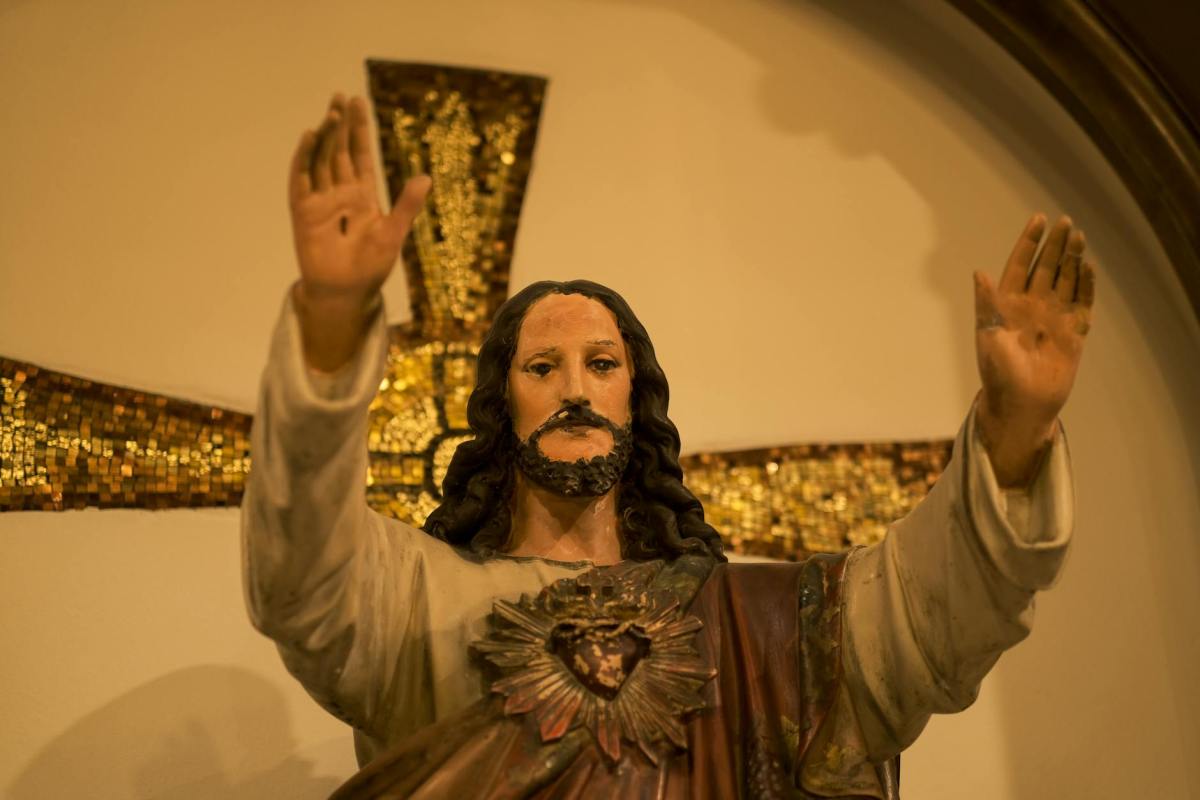
‘When it was evening on that day, the first day of the week, and the doors of the house where the disciples had met were locked for fear of the Jews, Jesus came and stood among them and said, “Peace be with you.”’
In today’s Gospel reading, we get an inside look at the disciples’ doubt, joy, and faith as the resurrected Jesus greets them with a word of peace. One Anglican priest sharing online noted that Jesus’ introduction here – rooted in the Jewish greeting of “shalom” – is essentially the same as our tradition of “passing the peace.” (Which, of course, we got from Jesus.)
Jesus basically says, “The peace of the Lord be always with you.” But instead of mumbling a dutiful, “And also with you,” the disciples are completely transformed by this greeting. They are in the presence of the Prince of Peace, and so peace has become more than a greeting – it is real. Heartened by this new reality, they are about to change the world.
Jesus knew that this would happen. In fact, he promised it only a few days before.
In John 14-17, in what some call his “farewell discourse,” Jesus says:
“Peace I leave with you; my peace I give to you. I do not give to you as the world gives. Do not let your hearts be troubled, and do not let them be afraid.” – John 14:27
And later in that passage, he says it more bluntly:
“I have said this to you, so that in me you may have peace. In the world you face persecution. But take courage; I have conquered the world.” – John 16:33
Still, the disciples had reason to doubt. In the space between his farewell discourse and his greeting in the locked room, a lot has happened. In fact, we re-lived most of it last week during our Holy Week services:
Jesus is arrested while praying, ridiculed by his own people, and charged with heresy against God and treason against the Roman emperor. He is assaulted by soldiers, spat on by passersby and finally, killed in a public execution.
His body is prepared for burial. And he lies dead in a tomb. And then, a couple of disciples come weeping to the tomb and find it empty. Finally, Mary Magdalene rushes to the house where the rest of the disciples are staying and announces, “I have seen the Lord.”
In the time after Jesus’ promise of peace, his followers, friends, and family have experienced everything but peace. Fear, yes. Horror, yes. Grief, of course. Existential despair, everywhere.
In the felt absence of Jesus Christ, life has been, well, Hell. In the chaos of those days, I wouldn’t be surprised if not one disciple remembered Jesus’ promise of peace. Their nervous systems were short-circuiting. They were afraid of being arrested as accomplices by the local authorities.
But maybe even worse, their lives had lost a sense of purpose. After all, they had hitched their wagon to a grand cause: the salvation and transformation of the world. They had abandoned fishing boats, families, social norms, and even common sense – and now their leader had died in shame. And they were hiding behind a locked door.
Though Mary Magdalene insisted she had seen the risen Lord, the disciples weren’t sure what to think or do. And can we blame them?
But that evening, Jesus showed up again. We don’t know if he walked through a wall or poofed into the room. But there he was, standing among them, with visible wounds in his hands and his side where the nails and spear had punctured his skin.
It’s probably for the best that he showed up like this, as weird as it was. The terrified disciples probably wouldn’t have let him in if he had knocked on the door, afraid that it was some kind of terrible trick.
And the first thing he says is “Peace.” And as he utters the word of peace, his disciples let out the breath they have been holding since he died and they breathe in the Holy Spirit. And they rejoice, because they know that Jesus kept his promise.
Peace is Jesus’ calling card. It was made real in the upper room by the presence of the living, breathing Jesus Christ. And it is made real today by the Holy Spirit that lives in us. It is the thing that enlivens us to pursue the path of life, and the way of Christ.
But what does Jesus mean when he says he gives us peace?
The scriptures reveal that Christ’s peace is not merely the absence of conflict. It is a transforming presence that calms fear, steadies the nerves, and makes people courageous beyond their own potential. It is an active force that propels trembling and tired people out of their locked rooms and into the light of day. It is stable ground that – like a loving parent – motivates us to go out into the world seeking better things for ourselves and our neighbors.
In drawing people to look toward the living Christ, this peace puts our disagreements into perspective. It leads us to recognize that resentment, conflict, and violence are distractions that keep us from living lives of purpose and transformation.
Importantly, Christ’s peace is not the same as “keeping the peace.”
This is obvious in Jesus’ own life. In every act of love – in every shared meal, invitation, and miraculous healing – the family of God got bigger and his enemies grew more numerous. Though he rejected violence, he became a target for violence. He proclaimed peace, and got killed for it.
And this is evident in the disciples’ lives. As soon as they encountered Jesus in that room, they threw caution to the wind, ran outside, and told everyone the good news. Christ’s peace had emboldened them, and many around them would dismiss them as crazy.
This is the paradox of the peace Jesus gives: It doesn’t make all our problems go away; in fact, by emboldening us, it might put us in situations of increasing conflict. But, Christ’s peace also puts our problems in their proper place, which is in view of the risen Lord, whose path leads to abundant and beautiful life.
Throughout our lives, we may find ourselves hiding behind locked doors. For many of us, this time contains real threats to our lives, livelihoods, and wellbeing. And there are real costs to insisting on peace in a world corrupted by war and conflict. Who wouldn’t be afraid?
But, even in the isolation of our hiding places, Jesus will find us. He will poof into the room or walk through walls if he has to. And the first thing he will offer is real “Peace.”
So, when we greet one another with “peace” today, I think we should really take it seriously. Because “the peace of the Lord” isn’t just a cute little thing we say to one another on Sunday morning. It is a sign that Jesus is really here with us. Jesus Christ, through the Holy Spirit, is really living in each of us. And even in our fear, we can become each other’s cause for joy.
This peace we offer one another is the stuff that will embolden us to lead lives of purpose. Because we know and feel and rejoice – that Jesus lives.
Amen.
 Leah Wise