Putting Out Fires One by One | 4th of July

“O God, deliver us from the presumption of coming to this Table for solace only, and not for strength; for pardon only, and not for renewal. Let the grace of this Holy Communion make us one body, one spirit in Christ, that we may worthily serve the world in his name” (Rite II, Prayer C, Book of Common Prayer).

If you read the e-news this week, you’ll know that I went down a rabbit hole about disasters that endangered church buildings. The whole thing was triggered by a photo that was floating around social media this week. In the photo, a crucifix hangs on the wall above the altar of St. Mary’s Catholic Church in Highmore, South Dakota. In an otherwise dark room, Jesus and the cross are perfectly illuminated by a light streaming in from above.

According to the story that was shared with it, a tornado damaged the roof of the nave, causing it to split in a nearly straight line across the length of the room. Through that crack, sunlight beamed through, spotlighting the suffering Christ. It is a powerful image. And, to my great relief, it has been verified as authentic since my email went out on Thursday.

There are other reports of storms destroying communities, but leaving crosses and steeples curiously untouched. For example, when a tornado hit a church school in Illinois in March, only the chapel was left undamaged. A school employee commented to local news:

“…today, with all the damage and destruction around us, Christ continues to be at the center of our building, untouched, and being the shining light of hope and faith in our…community.”

In other cases, the church itself was destroyed, but there were still signs of Jesus there. In one case, after the bombing of Coventry Cathedral during World War II, the roof caved in, and two charred beams fell into the nave, forming the shape of a cross. That cross now rests on an altar constructed from the rubble of the original building.

Perhaps all of these stories are “making mountains out of molehills”… It would be reasonable to chalk them up to mere coincidence. After all, for every miracle, there is its opposite – a time when nothing remained, no phoenix rising from the ashes, no “proof through the night that the flag was still there,” as it were.

But there is still power in these images, because they convey something that is true, no matter what the damage looks like after the battle is over. When disaster comes for us, Jesus Christ is here. He will not flee when the going gets tough. He will remain, and help us rebuild.

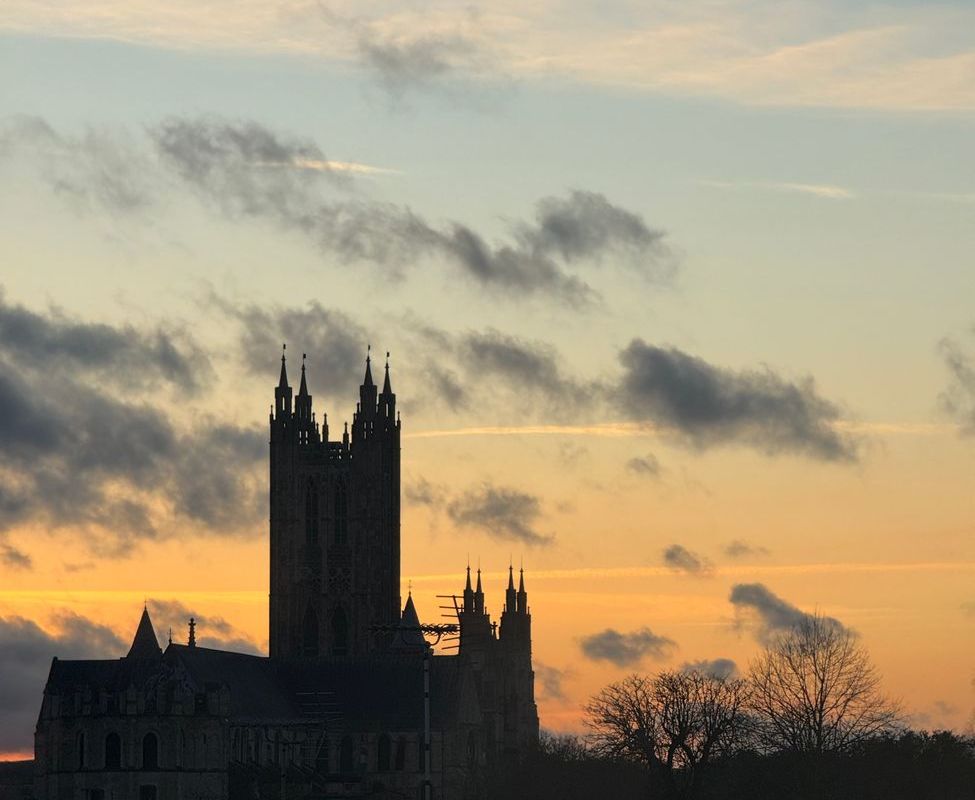
There’s another story about a church’s survival that takes a different path than the ones I just shared. In this case, the church wouldn’t have survived had it not been for human intervention. I learned this story while on pilgrimage to Canterbury Cathedral in the summer of 2022. Canterbury Cathedral was founded in 597 CE, and has stood as a Christian place of worship through war, famine, fire, and plague.

During World War II, it was targeted by German forces, not because of its usefulness to the war effort, but because of its connection to the identity of the British people. As journalist Christopher Morley is credited with saying: “Wars are won in the mind before they can be won on the field.” The German air force believed that, if they could destroy major cultural sites, they could destroy the morale of the British people – and give their country a pathway to victory.

The people of Canterbury knew ahead of time that the Germans were coming, So the Dean of the Cathedral coordinated a response with the help of his parishioners. Early in the morning on June 1, 1942, several parishioners camped out on the roof of the cathedral. One of them, Tom Hoare, recalled the experience:

“We could hear the roar of the planes overhead and when we looked up we saw flares shoot up into the sky from them, and explosives and incendiaries began to fall. They seemed to be coming down like hailstones.”

As these incendiary – or fire-starting – bombs landed on the cathedral’s roof, the men quickly smothered them with sand, then used garden shovels to toss them onto the church lawn nearly 200 feet below. By the time the blitz ended, one-fifth of the city of Canterbury was in ruins. 1,800 buildings were either seriously damaged or destroyed, and 43 people had died. But these parishioners, known as the “firewatchers,” are credited with saving the cathedral from total destruction.

Maybe this kind of intervention doesn’t qualify as a miracle. But it certainly qualifies as an Act of God. Because, it was the action of the Body of Christ – his blood pumping through the hearts of parishioners as they waited for the bombs to drop, his love sustaining them as they put out fires, one by one. This was what saved the cathedral that night.

“By the dawn’s early light,” they could see that the cathedral was still there. And it reminded the people of Canterbury that they were still there. Even amid unimaginable violence and destruction, they could use their hands and feet and minds and relationships, to save something that mattered.

They would remain. And they would rebuild. And they would receive the bread and wine in that old church, because Jesus was still with them.

Yesterday, the United States of America celebrated its 250th birthday. There are dozens of patriotic songs to mark the day – including the National Anthem, which I have quoted throughout this sermon. These songs tell stories of victory, miracles, and cultural pride.

As Christians, we are loyal to Jesus before all others. So, in this church, we strategically avoid theming church services around national identity. But, it is still true that we are tied to this country – by virtue of living in proximity to one another, under one flag.

Whether we trace our roots back to indigenous people or the 13 colonies; whether we moved here last year or our family has lived here for generations; whether our family came here voluntarily or by force – we are a community. Our survival depends on the goodwill of our neighbors, our representatives, and the generations of people who came before us. We have common things to save, and common things to lose. So, we are responsible, in some way, for the preservation of this country.

But, too often, we are told we are powerless to make an impact. Most of us aren’t military commanders or politicians. Most of us aren’t lawyers or celebrity activists. We’re not movers-and-shakers.

But that’s ok. Because the firewatchers of Canterbury teach us that we don’t need to be any of those things to make a difference…A church committee can beat a blitz. Willing hands, some sand, and a shovel can save a cathedral. A community can stand beneath the shadow of warplanes and the blare of sirens, and still not accept that all hope is lost.

This land, our land, is worth saving simply because we live in it. Even though we live in hard times, And even though we see politicians stirring up trouble and perpetuating hardship and wars that nobody asked for, we don’t have to give up.

Chapels rise above the rubble, charred beams form crosses, roofs split and spotlight Jesus. Simple, Christian folk win wars by putting out fires one-by-one. Acts of God are happening all around us, demonstrated by the courage and persistence of normal people doing small things. Empowered by Jesus – and sustained by the body and blood of his Holy Communion – we are living miracles, praying for miracles and working miracles in the world around us.

So, come to table. For solace and for strength, for pardon and for renewal, knowing that you are equipped to serve the world in his name. Amen.
A Locked Door & a Word of Peace

‘When it was evening on that day, the first day of the week, and the doors of the house where the disciples had met were locked for fear of the Jews, Jesus came and stood among them and said, “Peace be with you.”’

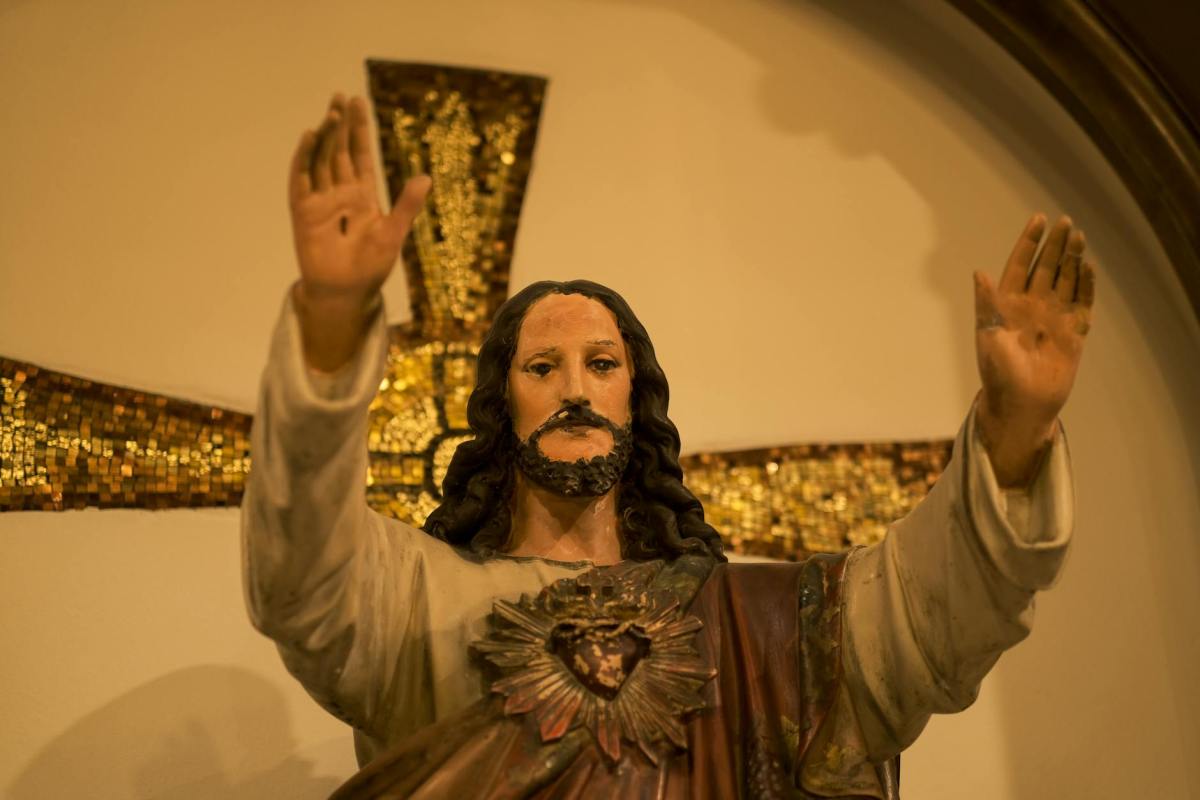
In today’s Gospel reading, we get an inside look at the disciples’ doubt, joy, and faith as the resurrected Jesus greets them with a word of peace. One Anglican priest sharing online noted that Jesus’ introduction here – rooted in the Jewish greeting of “shalom” – is essentially the same as our tradition of “passing the peace.” (Which, of course, we got from Jesus.)

Jesus basically says, “The peace of the Lord be always with you.” But instead of mumbling a dutiful, “And also with you,” the disciples are completely transformed by this greeting. They are in the presence of the Prince of Peace, and so peace has become more than a greeting – it is real. Heartened by this new reality, they are about to change the world.

Jesus knew that this would happen. In fact, he promised it only a few days before.

In John 14-17, in what some call his “farewell discourse,” Jesus says:

“Peace I leave with you; my peace I give to you. I do not give to you as the world gives. Do not let your hearts be troubled, and do not let them be afraid.” – John 14:27

And later in that passage, he says it more bluntly:

“I have said this to you, so that in me you may have peace. In the world you face persecution. But take courage; I have conquered the world.” – John 16:33

Still, the disciples had reason to doubt. In the space between his farewell discourse and his greeting in the locked room, a lot has happened. In fact, we re-lived most of it last week during our Holy Week services:

Jesus is arrested while praying, ridiculed by his own people, and charged with heresy against God and treason against the Roman emperor. He is assaulted by soldiers, spat on by passersby and finally, killed in a public execution.

His body is prepared for burial. And he lies dead in a tomb. And then, a couple of disciples come weeping to the tomb and find it empty. Finally, Mary Magdalene rushes to the house where the rest of the disciples are staying and announces, “I have seen the Lord.”

In the time after Jesus’ promise of peace, his followers, friends, and family have experienced everything but peace. Fear, yes. Horror, yes. Grief, of course. Existential despair, everywhere.

In the felt absence of Jesus Christ, life has been, well, Hell. In the chaos of those days, I wouldn’t be surprised if not one disciple remembered Jesus’ promise of peace. Their nervous systems were short-circuiting. They were afraid of being arrested as accomplices by the local authorities.

But maybe even worse, their lives had lost a sense of purpose. After all, they had hitched their wagon to a grand cause: the salvation and transformation of the world. They had abandoned fishing boats, families, social norms, and even common sense – and now their leader had died in shame. And they were hiding behind a locked door.

Though Mary Magdalene insisted she had seen the risen Lord, the disciples weren’t sure what to think or do. And can we blame them?

But that evening, Jesus showed up again. We don’t know if he walked through a wall or poofed into the room. But there he was, standing among them, with visible wounds in his hands and his side where the nails and spear had punctured his skin.

It’s probably for the best that he showed up like this, as weird as it was. The terrified disciples probably wouldn’t have let him in if he had knocked on the door, afraid that it was some kind of terrible trick.

And the first thing he says is “Peace.” And as he utters the word of peace, his disciples let out the breath they have been holding since he died and they breathe in the Holy Spirit. And they rejoice, because they know that Jesus kept his promise.

Peace is Jesus’ calling card. It was made real in the upper room by the presence of the living, breathing Jesus Christ. And it is made real today by the Holy Spirit that lives in us. It is the thing that enlivens us to pursue the path of life, and the way of Christ.

But what does Jesus mean when he says he gives us peace?

The scriptures reveal that Christ’s peace is not merely the absence of conflict. It is a transforming presence that calms fear, steadies the nerves, and makes people courageous beyond their own potential. It is an active force that propels trembling and tired people out of their locked rooms and into the light of day. It is stable ground that – like a loving parent – motivates us to go out into the world seeking better things for ourselves and our neighbors.

In drawing people to look toward the living Christ, this peace puts our disagreements into perspective. It leads us to recognize that resentment, conflict, and violence are distractions that keep us from living lives of purpose and transformation.

Importantly, Christ’s peace is not the same as “keeping the peace.”

This is obvious in Jesus’ own life. In every act of love – in every shared meal, invitation, and miraculous healing – the family of God got bigger and his enemies grew more numerous. Though he rejected violence, he became a target for violence. He proclaimed peace, and got killed for it.

And this is evident in the disciples’ lives. As soon as they encountered Jesus in that room, they threw caution to the wind, ran outside, and told everyone the good news. Christ’s peace had emboldened them, and many around them would dismiss them as crazy.

This is the paradox of the peace Jesus gives: It doesn’t make all our problems go away; in fact, by emboldening us, it might put us in situations of increasing conflict. But, Christ’s peace also puts our problems in their proper place, which is in view of the risen Lord, whose path leads to abundant and beautiful life.

Throughout our lives, we may find ourselves hiding behind locked doors. For many of us, this time contains real threats to our lives, livelihoods, and wellbeing. And there are real costs to insisting on peace in a world corrupted by war and conflict. Who wouldn’t be afraid?

But, even in the isolation of our hiding places, Jesus will find us. He will poof into the room or walk through walls if he has to. And the first thing he will offer is real “Peace.”

So, when we greet one another with “peace” today, I think we should really take it seriously. Because “the peace of the Lord” isn’t just a cute little thing we say to one another on Sunday morning. It is a sign that Jesus is really here with us. Jesus Christ, through the Holy Spirit, is really living in each of us. And even in our fear, we can become each other’s cause for joy.

This peace we offer one another is the stuff that will embolden us to lead lives of purpose. Because we know and feel and rejoice – that Jesus lives.

Amen.

Yet all are one in Thee | All Saints’ Sermon

Readings here

O blest communion, fellowship divine!
We feebly struggle, they in glory shine;
yet all are one in Thee, for all are Thine.
Alleluia, Alleluia!

Today we celebrate the Feast of All Saints, also called “All Hallow’s Day.” This is the holiday from which Halloween gets its name since Hallow’e’en, or Hallow’s-evening, is the night before All Hallow’s Day. Hallow just means “holy person,” or saint.

Historical records show that some form of All Saints’ Day has been celebrated among Christians since the fourth century. Originally, it was meant to commemorate the lives of the martyrs, those people who died in service of their faith.

As Christianity spread throughout Europe, All Saints’ celebrations eventually made their way to the British Isles. It was there that the feast was moved to November First. By the ninth century, the Pope declared it a universal holiday, intended to commemorate the growing list of official saints in the church calendar.

Even after the Protestant Reformation and America’s independence from England, the Episcopal Church managed to keep All Saints’ Day in our calendar. But its theology has changed a little bit since the early days. Though we acknowledge many of the saints of the Catholic Church, our tradition doesn’t have a canonization process. Instead, we can make recommendations to a committee that votes on who should be remembered in our calendar…it’s rather bureaucratic.

But part of the reason we do it this way is because we have a broader definition of the saints than the sanctoral calendar might suggest. To be understood as a saint in our tradition, you don’t have to have performed a miracle or died as a martyr, you just have to be a person who tried to follow Jesus the best you knew how. That persistent faithfulness serves as encouragement for others walking the same road, and it is why the church finds it meaningful to remember people in our calendar.

But, the beauty of the whole thing is that anyone can be a saint…to someone. Saints are all around us. Whether named or unnamed, known or unknown, they stretch out in all directions, holding us in our suffering, affirming us in our struggle, blessing us with words of hope, and helping us experience the love of God that knows no bounds.

Our faith teaches us that this “communion of saints” is not merely a nice thought, but a mystical reality. The Body of Christ acts like a tether – holding all the saints together across time and distance, and even death. We are never alone.

As a kid, I was friends with a Catholic girl from Louisiana who always did her Hail Mary prayers before bed, even when she was sleeping over at my house:

Hail, Mary, full of grace,
the Lord is with thee.
Blessed art thou amongst women
and blessed is the fruit of thy womb, Jesus.
Holy Mary, Mother of God,
pray for us sinners,
now and at the hour of our death.
Amen.

One time, when we were about 12 years old, I heard her whispering these prayers in the dark, and told her to stop. I earnestly believed, as my Protestant church had taught me, that you could only pray to Jesus. At best, praying to Mary was fruitless. At worst, it was idolatry.

Of course, I didn’t realize then that prayers like the Hail Mary are not prayed “to” the saints, but “with” them. They are prayers of intercession, not so different from the having an intercessor pray the Prayers of the People on our behalf. They are intended to invite the eternal and ever-present ancestors of our faith to advocate for us before Christ.

More than 20 years after that fateful sleepover, I found myself sitting alone in a hospital chapel in Slidell, Louisiana. I was out of tears, and out of words to pray.

I whispered, “Holy Mary, Mother of God, pray for us. Please…please.”

Only a few weeks earlier, I had accepted a two-year position at an Episcopal Church in Houston, Texas. I graduated from Yale Divinity School and went on a brief pilgrimage to Canterbury Cathedral. Then Daniel (my husband, not the Old Testament prophet!) and I – along with my mother-in-law – packed up our apartment and our two cats to make the 26-hour drive to Texas.

Daniel hadn’t been feeling well for several weeks, and on moving day, he could barely stand up. Two days into our three-day trip, we were staying the night in Slidell, Louisiana, when he woke up in the middle of the night doubled over in pain. My mother-in-law and I rushed him to the little regional hospital.

After hours of waiting, the weary nurse looked at Daniel and said, “You are very sick.”

The surgeon said he would have to have risky surgery with a long recovery time. We were terrified (much like the Old Testament prophet).

And there were other complications…Our Medicaid didn’t work in Louisiana. The hotel we were staying in was mildewed from Hurricane Ida. The cats were stir-crazy. And our past-due U-Haul was sitting in the parking lot.

Weary with many things, I started talking to Mary about three days into Daniel’s hospital stay: “Holy Mary, Mother of God, pray for us. Please, please.”

Meanwhile, friends from all over the country were praying, too. A former associate priest from my sending parish had already sent the local priest to Daniel’s bedside. People were sending cash to help us with expenses. A parishioner and his father-in-law drove ten hours roundtrip to pick up our U-Haul and take it Houston. The rector of my new church met the movers to unpack my stuff. The Diocese figured out insurance.

The saints of God, both living and dead, were praying with us and acting on those prayers. They were holding us steady in the love of God.

Daniel asked the surgeon if we could “wait and see” on surgery. And in that little regional hospital, with no one else to attend to, the surgeon shrugged, and said “sure.”

A few days later, Daniel was healing. And after a week in Slidell, Louisiana, we were back on the road on our way to Texas.

I wasn’t expecting a miracle. I couldn’t find the words to pray for one. I had nothing left to say to God.

But, thank God, the saints were praying: My friend Joe in Maryland; Reverend Elaine in New Jersey; my dad Gary in Florida; and my new parishioner Vyonne in Houston; Mary, the mother of God, of course. And even Misty, the Catholic girl from Louisiana, who taught me about the saints when I was busy telling her she was wrong.

All the saints were holding us in that patchwork without end or beginning, bound in the love of God.

I can’t imagine what life would be like without all those saints. In fact, I can only imagine hope at all, because I have seen it with my own eyes, living and breathing in all the saints, made real by each person who simply tries to follow Jesus the best they know how.

On All Saints, we remember that, in Christ, the veil is always thin between the living and the dead. Across time and distance – and even death – the saints are always praying, moving, acting, and loving hope into the world.

The air is thick with the saints. I pray that you will have the courage to count yourself among them.

Jesus Has Stepped Out of Line

Readings here

Restore us, O Lord God of hosts; show the light of your countenance, and we shall be saved. Amen.

On Friday, Daniel and I went to see the re-release of the Shin Godzilla movie. The film begins with a mysterious disruption in the water. A boat sinks and a circle of red fluid marks its downward path. Steam rises from the bay and cracks appear in the bridges and tunnels that cross it.

The setting shifts to the inside of a government building, where the audience is introduced to dozens of government officials. They are assistants, chiefs of staff, military personnel – even the prime minister – and one hundred nameless others. The whole group of officials, all wearing matching black suits, moves together into bigger and bigger boardrooms with more and more people. They seem to think that the sheer number of people present at the meeting will solve the emerging national disaster. In the biggest boardroom of them all, each official sits in their assigned seat and takes a turn reading their theories off of little notecards. “It’s an earthquake!” “It’s a submarine.” “It’s a creature!” someone finally suggests. No, that’s preposterous, the room responds! The meeting continues, with great order and great civility, as befits a democratic nation.

Meanwhile, out in the streets of Tokyo, a monster called Godzilla has emerged from the water and is making its way onto land. As it moves through the streets, it leaves a trail of utter devastation in its wake, then finally returns to the sea.

After it retreats, the government officials must decide how they will prepare the country for Godzilla’s inevitable return. But they are faced with a steady stream of bureaucratic concerns: How will they be perceived on the international stage? How will they stay in the good graces of military superpowers like the U.S.? How will they keep the economy afloat? What bills have to pass before they can invest in recovery efforts? Meanwhile, as they sit in conference rooms and wring their hands, worrying about the optics of any given choice, Godzilla is out there, recharging, and preparing himself for another attack.

In the face of a Godzilla-sized problem, the people in charge respond with matching suits, conference rooms, and little notecards. They respond with calls to “keep the peace” and present a united front. But false unity will not save the day. Instead, it is the ones who are willing to agitate that bring about true peace. Evil is only defeated when one person steps out of line and says, “Enough.” And eventually, others follow.

Today, in the Gospel of Luke, Jesus reveals himself as the agitator in the story of good and evil. He says: “I came to bring fire to the earth!… Do you think that I have come to bring peace to the earth? No, I tell you, but rather division!”

Jesus is like fire that burns away the underbrush and fertilizes the soil, so new things can finally grow. He rejects false unity in favor of true and lasting peace. When Jesus shakes things up, there is discord – not because he’s being mean or trying to start a fight, but because people, by their nature, don’t like to be disturbed. As a group, we don’t like to do things differently. We don’t like to have to change our habits, opinions, or beliefs. But Jesus says that healing requires an intervention. So, he offers something beyond civility, something different than traditional family structures and political regimes. He proclaims freedom, love, and belonging for all people.

And this disturbs the way things are. But it is only by disturbing the shadows that light comes into the world.

In this time of urgent, monstrous problems, we often end up looking like all those officials in suits in the Godzilla movie. We strive to keep the peace, follow the chain of command, and maintain a sense of civility. But if we’re not willing to confront the urgent, monstrous things, we will be stuck inside debating our little problems while evil gains power in the world around us.

Jesus’ call to “love God and love our neighbor” is not a call to civility. It is not a call to sit calmly and behave, to “wait and see.” It is a call to step out of line and be bold; and to say: I know who I am and whose I am, and I know what Jesus requires of me: to go where his fire burns.

We are living in a world of urgent, monstrous problems. One of them, in particular, has had an impact on our church, in Austin and across the country. Our immigrant neighbors, families, and friends are being terrorized. Regardless of their legal status, they are being imprisoned without translators and housed without beds and adequate food. Just a few weeks ago, the daughter of an Episcopal priest in New York was arrested by ICE agents after going to a routine hearing, as part of her student visa process.

Over a dozen Episcopal parishioners in various parts of the country have been imprisoned, and some are still in ICE custody. In early July, Presiding Bishop Sean Rowe called the church to account: “When religious institutions like ours enjoy easy coexistence with earthly power, our traditions and inherited systems can become useless for interpreting what is happening around us… Churches like ours… may be some of the last institutions capable of resisting this administration’s overreach and recklessness. To do so faithfully, we must see beyond the limitations of our tradition and respond not in partisan terms, but as Christians who seek to practice our faith fully in a free and fair democracy.”

For too long, I have been afraid to talk about the monster of the immigration crisis from the pulpit. I have been trying to be civil, so I chose false unity over true and lasting peace.

But Jesus came to bring fire, and through the Holy Spirit, that fire is all of ours to own. So, I will own it. We must be willing to tell the truth “in the present time” or else, all is lost. We must be willing to step out of line, to be agitators for good, right, and holy causes: causes of love and compassion for our neighbors.

Immigrants are neighbors we know personally, and neighbors that are themselves part of the Body of Christ. Immigrants are us. If we can’t strive for their safety, we will have to admit that we’re the false prophets, hypocrites, and fools that Jesus reprimands.

The Gospel, which means “Good News,” must be good news for everyone. And the good news is that freedom, justice, mercy, and love are the guiding ethics of the Kingdom of God. It is not enough to say that, and then do nothing about it. We must be willing to be agitators for the most vulnerable among us, even if it causes division, and puts us at odds with people we love. Because, when something monstrous is outside, you can’t solve it with civility. Evil is only defeated when one person steps out of line and says, “Enough.”

Jesus has stepped out of line. The choice is ours: will we follow him or not? Amen.

Let Them Sing by Paul Gleason

My friend Paul presented the Palm Sunday homily last weekend at our church. I really enjoyed it and I hope you do, too.

palm sunday

Readings: Isaiah 50:4-7; Luke 19:28-40

He’s finally here. Jesus has finally entered Jerusalem. His whole life has been leading him to this place. And he’s not the only one who knows it. For a year he’s been preaching in the country, gathering a multitude of disciples that’s following him now, into the city. And they have some pretty particular ideas about what this means. Blessed is the king who comes in the name of the Lord. He’s finally here, the king of Israel is finally here. What’s he going to do? Who knows? But we can guess. Chase out the Romans, restore the ancient Kingdom of David, the possibilities seem endless. And the multitudes of his disciples and the people of Jerusalem who are throwing their clothes at his feet and waving their palms in the air are ecstatic. And they began to praise God joyfully with a loud voice. Luke tells us they are saying Blessed is the king, but joyfully with a loud voice? They’re singing. They are so full of joy and hope that they can’t help but sing, because he’s finally here.

It must be said that Jesus doesn’t exactly disabuse the multitudes of this notion they’ve got. That he’s here to kick some Roman keister. Earlier in Luke he told the twelve what’s really going to happen, about how he’s going to suffer and die on the cross. But of course telling a secret to the twelve was like telling it to a brick wall. Huh? Anyway, Jesus sends two of them ahead to find him a colt, so that he can ride into Jerusalem on horseback, like a king. And the people who saw him approaching must have immediately heard the words of the prophet Zechariah ringing in their ears.

Rejoice greatly, O Daughter Zion!
Shout aloud, O Daughter Jerusalem!
Lo, your king comes to you,
triumphant and victorious is he,
humble and riding on a donkey,
on a colt, the foal of a donkey.

He will cut off the chariots from Ephraim
and the warhorse from Jerusalem,
and the battle bow shall be cut off.
And he shall command peace to the nations.
His dominion shall be from sea to sea
and from the River to the ends of the earth.

And there he is at last, riding on a colt. Surely the Roman chariots and warhorses will be routed. The victory of peace is at hand. The prophecy is being fulfilled before their eyes, and so they celebrate in the streets of Jerusalem. They start the party. They sing for joy.

And it’s tempting to say, they’re deluded. They are deluded. Because they have no idea how bad it’s about to get. The ones who do are the Pharisees. So they try to stop the singing, end the party. They say, Teacher, order your disciples to stop. This isn’t just because they’re jealous of all the attention this new rabbi’s been getting. We don’t have to think of these Pharisees as part of that cabal of chief priests, scribes, and political leaders who are already plotting Jesus’ death. They’re worried about what the Roman response to this festival, to this sudden unexpected outpouring of worshipful, joyful song, is going to be. They are worried about what’s going to happen to them, to Jesus, and to all of the people of Israel, disciples of Jesus or not. And they are absolutely right to worry. Within a few days the king, who was finally here, will be gone. The disciples will be scattered. Rome will still stand and, within a few short years it will decide it has had quite enough of these annoying Israelites. Its armies will siege and sack their city. Its armies will burn their temple to the ground. The Pharisees, they can see it coming. And they’re right. They have taken an honest look at the world, they have seen it clearly, and they have concluded that there is nothing here to sing about.

And Jesus, he can see it coming, too. His own death, I’ve already mentioned that he knows about that. And Luke tells us, in the next chapter of his Gospel, that Jesus knows what’s coming for Jerusalem. But what must have been worse, or I think it must have been worse for him, was to know that while all of these people are throwing their clothes at his feet and waving their palms in the air, in a few days, an equal number going to be shouting for his death. He can see Rome and the scheming leaders of his day. He can see into the hearts of everyone around him. He knows how fickle they are, how many of his own disciples will abandon him. If anyone can see the reasons not to sing, it’s him.

And yet he turns to the Pharisees and says, I tell you, if these were silent, the stones would shout for joy. What I take him to be saying is that this feeling, this upswelling of joy in the people’s hearts is so powerful that it seems to be permeating the world around them. Like a failing dam if you stopped it up here it would just burst out over there. So what he says, in effect, is let them sing. Even if Rome won’t like it. Let them sing, in spite of their erring hearts. In spite of the fact that Maundy Thursday and Good Friday are coming, in spite of every good reason I can think of for them to stay silent, let them sing anyway.

Jesus, as Luke presents him in today’s Gospel, wants his disciples to feel joy and share it. And it is Jesus who brings that joy with him to Jerusalem and to all of his disciples wherever they may be. He’s finally here, and in Jerusalem like in Bethlehem he arrives unexpectedly and fills everyone around him with irrepressible joy. And here and now on Palm Sunday we commemorate and we share in that joy they felt in Jerusalem. The party finally begins, and then it is over, too soon. Thursday and Friday always come, so soon.

And it will be tempting to think that we in our joy were deluded, too. Lent after all is the time for reflection on our failures and shortcomings, the time in which we, like those Pharisees, are supposed to make an honest assessment of ourselves and our world. And there are a lot of reasons not to sing. If we’re particularly introspective, we might echo good old John Calvin, who in the second volume of his Institutes lamented that “No one can descend into himself and seriously consider what he is without feeling God’s wrath and hostility toward him. … All of us, therefore, have in ourselves something deserving of God’s hatred.”  If we find it easier to see sin in the world we won’t have to venture too far to find that, either. But the discovery will be no less painful. The German theologian Friedrich Schleiermacher understood original sin not as a sin that we are born with but as a sin that we are born into. He writes “…the sinfulness which is prior to all action operates in every individual through the sin and sinfulness of others … it is transmitted by the voluntary actions of every individual to others and implanted within them.” In other words, the sins we see in our society are our sins, too, transmitted to us, implanted in us, operating through us, even if it looks like they are somebody else’s fault. I don’t mean to frighten you a lot, but I do submit that there will always be good reasons for us not to sing for joy.

And yet we do. Not because we can’t see our broken world or our erring souls clearly. I think we can. But we sing for joy anyway, because as Christians we proclaim that the spirit of Christ is present among us, present at our table. And his presence can act on us like he acted on the people of Jerusalem. It can move us to joy. As Christians we are called to see ourselves and our world rightly. Jesus spends too much time in the Gospels naming the evils he sees for us to doubt that. But we must also be ready to sing for joy. We ought to be known for our joy.

I’m pretty sure I’ve heard sermons that said Palm Sunday was a preview of Easter. And it’s true that Easter is usually the most joyful day of the year, when the fast of Lent is over, and spring is here, and the sun shines through the windows on the pews full of everyone in their brightest clothes. The brass choir plays and the people sing. He’s finally here, and it’s quite a party. Except, in the Gospels, he isn’t there on Easter.  Not like he was on Palm Sunday. He is risen, yes, but he doesn’t process through the streets of Jerusalem again. He appears elsewhere, in the country again, on the road to Emmaus. There was more confusion and awe and fear on that first Easter, if you ask me, than there was joy.

So perhaps on Easter we are actually celebrating like it’s Palm Sunday. Like he’s finally here. Like everyone on that road to Jerusalem we are hoping for that day when the chariots are cut off from Ephraim and the war horse from Jerusalem. We are hoping for the triumph of peace at last, and for the day when his dominion stretches from sea to sea and from the River to the ends of the earth. And whatever our doubts and whatever our failings may be, we are moved to sing with hope and joy. Blessed is the king who comes in the name of the Lord! Peace in heaven, and glory in the highest heaven!

He’s almost here. Amen.

image source here.