“O God, deliver us from the presumption of coming to this Table for solace only, and not for strength; for pardon only, and not for renewal. Let the grace of this Holy Communion make us one body, one spirit in Christ, that we may worthily serve the world in his name” (Rite II, Prayer C, Book of Common Prayer).
If you read the e-news this week, you’ll know that I went down a rabbit hole about disasters that endangered church buildings. The whole thing was triggered by a photo that was floating around social media this week. In the photo, a crucifix hangs on the wall above the altar of St. Mary’s Catholic Church in Highmore, South Dakota. In an otherwise dark room, Jesus and the cross are perfectly illuminated by a light streaming in from above.
According to the story that was shared with it, a tornado damaged the roof of the nave, causing it to split in a nearly straight line across the length of the room. Through that crack, sunlight beamed through, spotlighting the suffering Christ. It is a powerful image. And, to my great relief, it has been verified as authentic since my email went out on Thursday.
There are other reports of storms destroying communities, but leaving crosses and steeples curiously untouched. For example, when a tornado hit a church school in Illinois in March, only the chapel was left undamaged. A school employee commented to local news:
“…today, with all the damage and destruction around us, Christ continues to be at the center of our building, untouched, and being the shining light of hope and faith in our…community.”
In other cases, the church itself was destroyed, but there were still signs of Jesus there. In one case, after the bombing of Coventry Cathedral during World War II, the roof caved in, and two charred beams fell into the nave, forming the shape of a cross. That cross now rests on an altar constructed from the rubble of the original building.
Perhaps all of these stories are “making mountains out of molehills”… It would be reasonable to chalk them up to mere coincidence. After all, for every miracle, there is its opposite – a time when nothing remained, no phoenix rising from the ashes, no “proof through the night that the flag was still there,” as it were.
But there is still power in these images, because they convey something that is true, no matter what the damage looks like after the battle is over. When disaster comes for us, Jesus Christ is here. He will not flee when the going gets tough. He will remain, and help us rebuild.
…
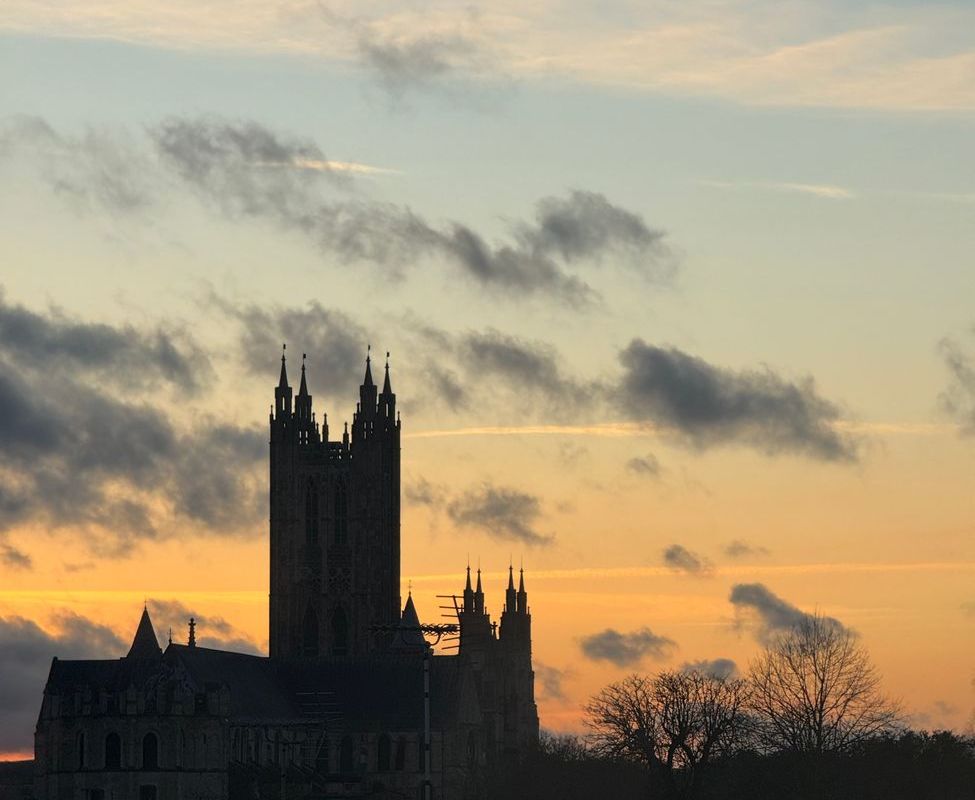
There’s another story about a church’s survival that takes a different path than the ones I just shared. In this case, the church wouldn’t have survived had it not been for human intervention. I learned this story while on pilgrimage to Canterbury Cathedral in the summer of 2022. Canterbury Cathedral was founded in 597 CE, and has stood as a Christian place of worship through war, famine, fire, and plague.
During World War II, it was targeted by German forces, not because of its usefulness to the war effort, but because of its connection to the identity of the British people. As journalist Christopher Morley is credited with saying: “Wars are won in the mind before they can be won on the field.” The German air force believed that, if they could destroy major cultural sites, they could destroy the morale of the British people – and give their country a pathway to victory.
The people of Canterbury knew ahead of time that the Germans were coming, So the Dean of the Cathedral coordinated a response with the help of his parishioners. Early in the morning on June 1, 1942, several parishioners camped out on the roof of the cathedral. One of them, Tom Hoare, recalled the experience:
“We could hear the roar of the planes overhead and when we looked up we saw flares shoot up into the sky from them, and explosives and incendiaries began to fall. They seemed to be coming down like hailstones.”
As these incendiary – or fire-starting – bombs landed on the cathedral’s roof, the men quickly smothered them with sand, then used garden shovels to toss them onto the church lawn nearly 200 feet below. By the time the blitz ended, one-fifth of the city of Canterbury was in ruins. 1,800 buildings were either seriously damaged or destroyed, and 43 people had died. But these parishioners, known as the “firewatchers,” are credited with saving the cathedral from total destruction.
Maybe this kind of intervention doesn’t qualify as a miracle. But it certainly qualifies as an Act of God. Because, it was the action of the Body of Christ – his blood pumping through the hearts of parishioners as they waited for the bombs to drop, his love sustaining them as they put out fires, one by one. This was what saved the cathedral that night.
“By the dawn’s early light,” they could see that the cathedral was still there. And it reminded the people of Canterbury that they were still there. Even amid unimaginable violence and destruction, they could use their hands and feet and minds and relationships, to save something that mattered.
They would remain. And they would rebuild. And they would receive the bread and wine in that old church, because Jesus was still with them.
…
Yesterday, the United States of America celebrated its 250th birthday. There are dozens of patriotic songs to mark the day – including the National Anthem, which I have quoted throughout this sermon. These songs tell stories of victory, miracles, and cultural pride.
As Christians, we are loyal to Jesus before all others. So, in this church, we strategically avoid theming church services around national identity. But, it is still true that we are tied to this country – by virtue of living in proximity to one another, under one flag.
Whether we trace our roots back to indigenous people or the 13 colonies; whether we moved here last year or our family has lived here for generations; whether our family came here voluntarily or by force – we are a community. Our survival depends on the goodwill of our neighbors, our representatives, and the generations of people who came before us. We have common things to save, and common things to lose. So, we are responsible, in some way, for the preservation of this country.
But, too often, we are told we are powerless to make an impact. Most of us aren’t military commanders or politicians. Most of us aren’t lawyers or celebrity activists. We’re not movers-and-shakers.
But that’s ok. Because the firewatchers of Canterbury teach us that we don’t need to be any of those things to make a difference…A church committee can beat a blitz. Willing hands, some sand, and a shovel can save a cathedral. A community can stand beneath the shadow of warplanes and the blare of sirens, and still not accept that all hope is lost.
This land, our land, is worth saving simply because we live in it. Even though we live in hard times, And even though we see politicians stirring up trouble and perpetuating hardship and wars that nobody asked for, we don’t have to give up.
Chapels rise above the rubble, charred beams form crosses, roofs split and spotlight Jesus. Simple, Christian folk win wars by putting out fires one-by-one. Acts of God are happening all around us, demonstrated by the courage and persistence of normal people doing small things. Empowered by Jesus – and sustained by the body and blood of his Holy Communion – we are living miracles, praying for miracles and working miracles in the world around us.
So, come to table. For solace and for strength, for pardon and for renewal, knowing that you are equipped to serve the world in his name. Amen.

