Praised be You, my Lord, through Sister Mother Earth,
who sustains us and governs us and who produces
varied fruits with colored flowers and herbs.
Amen.
Let’s play a guessing game…
I just read the lyrics to a song as my opening prayer. When do you think that song was written? (Someone shouts out “1960.”)
Ah, you fell right into my trap! This song, entitled “Canticle of the Sun,” was composed by St. Francis of Assisi in 1225.
I am always amused by St. Francis – and particularly this canticle – because it sounds an awful lot like the language of new age religion that developed in the 1960s and 70s. Growing up in a more fundamentalist church, my community may have accused St. Francis of being an “earth worshipper.” They would have been scandalized to know that such language could be reconciled with Christianity.
In reality, St. Francis’ commitment to a life of poverty and service reveals Christian discipleship taken to its most radical conclusion.
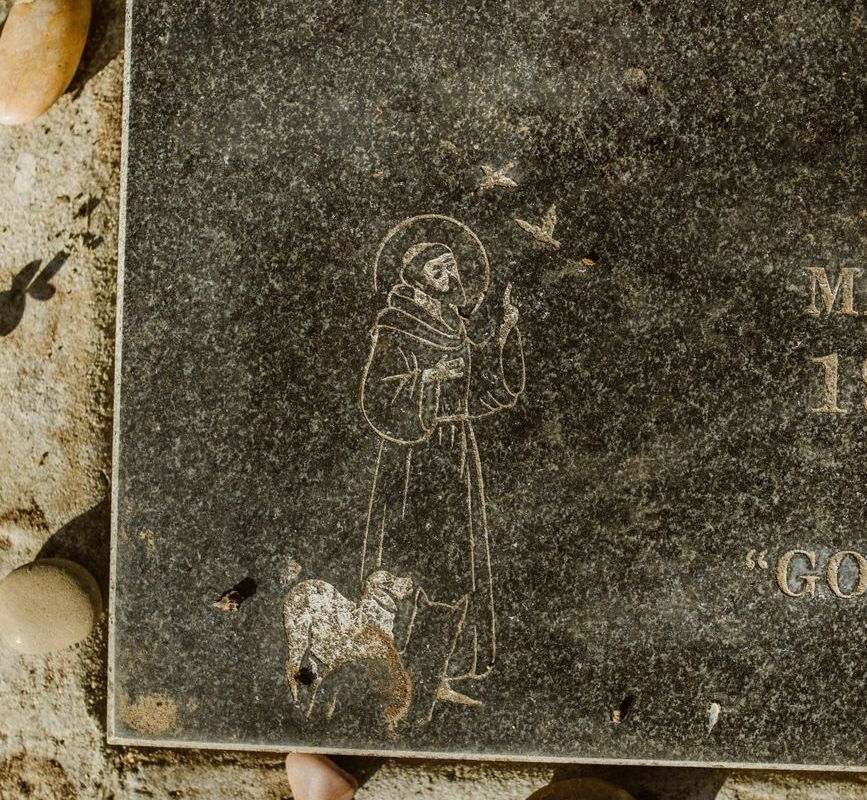
But, these days, St. Francis is most well-known for his connection to animals. He is said to have preached to birds, calling them his “little sisters” and reminding them to praise God for life’s blessings. Another time, people say, he tamed a wolf by blessing him, and then negotiating a meal plan that did not include humans. Because of this, over the years, his feast day has turned into an occasion for pet blessings.
Singing to mother earth. Blessing wolves. Calling birds his sisters. St. Francis was practically a Disney princess. But the social world surrounding St. Francis – and indeed, his own family – was not so welcoming of St. Francis’ lifestyle.
That’s because St. Francis wasn’t just an ordinary, outdoorsy kinda guy. His love for all living things caused him to pursue an alternative way of life that is hard for most of us to imagine.
To do this, he had to reject the life he was born into…
St. Francis was born rich. His dad was a silk merchant and his mom had a trust fund. As may be expected, as a result, Francis was a bit of a party boy in his youth. He spent lots of time with the beat poets of his day, called troubadors. And, according to the Catholic Encyclopedia, he was “handsome, witty, gallant and delighted in fine clothes.”
Francis was set up to lead a charmed life, with little hardship or concern. But, one day, he was running the family cloth business when a homeless man approached him asking for money. After finishing up with a customer, Francis ran after the man and gave him everything he had in his wallet. His friends and family mocked and scolded him. But this moment marked a turning point in his life, though he didn’t realize it at the time.
Francis spent the next few years serving in the military off and on. He became ill at one point. Then he had a mysterious vision that convinced him to stop partying with his friends. Instead, he lived among poor beggars in Rome.
During this period, he happened upon a chapel in ruins and heard an icon of Christ say, “Francis, Francis, go and repair my church which, as you can see, is falling into ruins.”
Anxious to do what Christ had commanded, he stole cloth from his father’s store to give money to the church, which got him in trouble with both the church and his dad. His dad beat him and locked him up in the family home until his mom secretly released him. Eventually, his father disowned him.
So, Francis left “high society” behind: the money, the clothes, the respect – he let go of all of it, just like he had given all his money to the homeless man all those years before.
Over many years, he began to repair fallen chapels by hand. Eventually, he took a vow of poverty and formed a religious community that lived by the rule: “to follow the teachings of our Lord Jesus Christ and to walk in his footsteps.”
He reasoned that, in his death on the cross, Jesus had given up all worldly possessions. To walk in his footsteps, then, meant that Francis should do the same.
The impact of Francis’ vow of poverty is still felt today, among the thousands who have made similar vows in the way of St. Francis. He has inspired global charity movements to care for the poor and marginalized, and advocacy movements among the poor and marginalized.
Francis is an interesting case study for a lot of reasons, but particularly during this stewardship season. Because, Francis takes today’s Gospel reading to its most extreme conclusion.
“Therefore I tell you, do not worry about your life, what you will eat or drink; or about your body, what you will wear…But seek first his kingdom and his righteousness, and all these things will be given to you as well. Therefore do not worry about tomorrow, for tomorrow will worry about itself.”
When those of us without much money read this passage, it is reassuring. We might not have enough food to eat or enough money to pay our bills, but we can trust that Jesus will provide what we need from the abundance of his Kingdom.
But, what is the good news in this passage for people who grew up like Francis?
I mean, think about it: Francis already had everything. He was a nepo baby. His dad owned a fashion brand and his mom was some kind of duchess. The life available to him was one of decadence, without want or worry.
Why would a man who already had everything give it all up in pursuit of merely having enough? Of course, I can’t get inside Francis’ mind. But the stories about his life reveal two things about his relationship with God.
First, Francis felt closest to God in proximity to the poor and marginalized, whether human or creature. When Francis encountered God in the homeless man at his textile stall, it made him aware that his sheltered lifestyle was obscuring God’s presence, emanating from all living things. As he sought out relationships with the poor, it opened him up to a new value system, one in which abundance is understood through God’s unconditional mercy and love – not through financial wealth.
Second, Francis trusted the nudges that he felt from God, and acted on them. Whether in visions, dreams, or experiences in nature, when God spoke to him, Francis listened. Even when it was hard. Even when it put him at odds with his friends and family.
He trusted that Christ would make good on his promises to take care of him, even when he couldn’t see a way forward.
Francis left everything behind so that he could gather up the only treasure that mattered: the love, beauty, and belonging of the Kingdom of God.
While I don’t think that all of us are called to make a vow of poverty, Francis makes me think about my own complicated relationship with money, which is really about my desire to know and control the future.
In the world we live in, we are told that the only way to ensure our future survival is to “store up for ourselves treasures here on earth.” We are celebrated for guarding our wealth like a dragon in a cave, a leprechaun at the end of a rainbow, or Gollum with his “one ring.” But, as we know from those fantasies, guarding our money doesn’t make us strong or brave – it doesn’t make us the heroes in the story. At worst, it makes us the villains. It dulls the Spirit of God in us. And it pulls us away from one another.
Francis learned early on that having “everything” wasn’t really living. He had to reject it all so that he could truly live. And, in rejecting wealth, he experienced the eternal abundance of Christ’s paradise. Ultimately, Francis’ rejection of wealth made him understand that money is a liar – because none of us, through accumulation, can avoid being human. We are all vulnerable in the end.
And thanks be to God! Because God’s love can’t be bought. We are part of God’s family because we were made to be God’s family. And that means what we are well-suited to take care of one another. And promised to be taken care of from now through eternity.
Whether we take a vow of poverty or not, we can commit to live like Francis today: to know that our human need is everyone’s responsibility; to understand that money is a tool for taking care of each other today, not controlling the future; to remember that we can’t take our money with us when we die; and to let that free us to give and receive generously from the deep well of God’s love.
This generosity of spirit is ultimately not about what money can do, but about what we can do through the power of Christ, when we are free from money’s power. That is the vision of the church, and of the world that the church is charged with building.
How will we live so that Francis’ vision becomes our own? “Francis, Francis, go and repair my church which, as you can see, is falling into ruins.”
Amen.

