Nathan Chen is about to show up and do a back flip | Advent 1 Sermon

Readings here

Almighty God, give us grace to cast away the works of darkness, and put on the armor of light, now in the time of this mortal life in which your Son Jesus Christ came to visit us in great humility; that in the last day, when he shall come again in his glorious majesty to judge both the living and the dead, we may rise to the life immortal. Amen.

Today is the first day of Advent – the start of the Christian new year. Advent is often translated as “arrival,” but it can also carry a more active connotation: “coming.” The Season of Advent holds the fullness of these meanings. We acknowledge with renewed hope that Christ has already come to earth, and has already defeated death – he has arrived. And we anticipate Christ’s second coming – he is still on his way.

We are celebrating, but we are also waiting for the final celebration, when Christ will come in “glorious majesty” to restore all things.

The longer I have been in a congregation that follows the church seasons, the more I have come to appreciate them. While there is no way that Christians in the fourth century could have anticipated the cesspool of consumerism that this season has become, their work on the church calendar continues to be a blessing…

Because, following it – especially in this season – reorients our focus from the frenzy of secular Christmas, and calls us to a deeper, more focused anticipation. There’s no harm in enjoying the superficial fun of the season: Santa Claus and Jingle Bells and gift exchanges are perfectly acceptable ways to celebrate with family and friends (even if it is still Advent).

But, the church calendar reminds us that there is something eternal at work underneath all these distracting celebrations. There is something that calls for our singular attention, not as a test of our faithfulness, but because it is so wonderful. Someone has arrived to change everything, and he will carry us into a future of unfettered joy and ultimate freedom.

As a thought experiment, I tried to think of a time when I was called to pay singular attention, simply because it was so wonderful. It wasn’t as hard as I thought it would be…

When I was at Yale Divinity School, I got word that the Yale Figure Skating Club was putting on their winter show. Made up of amateurs, the show was typically just a way for hobby skaters to have some fun while their friends cheered them on. But that year, there were whispers that a special guest was coming…

Three-time world champion and two-time Olympic figure skater Nathan Chen was enrolled at Yale that fall. And word on the street was that he was going to come to the show.

With uncharacteristic clarity of purpose, I convinced a small group of seminarians to take the hike over to the main campus to see what we could see. I was the only figure skating mega-fan among them. So, while everyone else bought concessions and chatted about term papers, I was staring straight ahead, hand on my chin, laser-focused on the rink. I didn’t dare leave my seat. If Nathan Chen was going to be there, there was no way in heck I was going to miss it.

After more than a half-hour of very sweet performances by people who could barely skate, a young man swiftly and silently skated onto the ice. My friends – lulled into the stupor of greasy food and easy conversation – didn’t seem to notice…But I noticed.

I let out the loudest, highest, most piercing, blood-curdling scream. It was so unlike me, that I didn’t recognize it as my own voice until the person in front of me turned around in shock.

Nathan Chen was here, in the same room as me, and he just did a back flip!!! (They didn’t even let him do that at the Olympics because they thought it was too dangerous!!!!) And then, he did his signature quadruple jump, the move that would win him the gold medal in 2022.

The adrenaline was coursing through my body, probably as much as it was coursing through his. And I was just sitting there.

Amid the chatter and distraction around me, something demanded my singular attention. And I was determined not to miss out on the realization of the hope that I had carried with me to the rink that day. I didn’t know when he would arrive, but I trusted that he would.

And what I found was that the wait was worth it, not just for the satisfaction of seeing a dream realized. It was worth it to gather up my new friends, take a risk in inviting them, and spend an afternoon passing the time together in that chilly rink. The joy was abundant even before Nathan Chen got on the ice. The light was already breaking through…but nothing could beat that back flip!

In today’s reading from Matthew, Jesus tells his followers to pay attention: to “keep awake,” not as a test of their faithfulness, but because something wonderful is on the way. Jesus “will come again in glory to judge the living and the dead, and his kingdom will have no end.”

And, while no one knows the day or hour that Christ will return, they should “stay on the alert” with such single-mindedness that it is almost as if they’re waiting for a thief to break into their home. In modern terms, we might say it is almost as if record-breaking figure skater Nathan Chen is about to show up and do a back flip.

We don’t know when he’s coming, but the only way to live, in the meantime, is to stay alert to the promise that Christ will come.

Dr. Andrew McGowan notes the paradox in this idea of staying alert to a thing you can’t predict. He says:

“Jesus’ apocalyptic proclamation is framed by Matthew not as futurology, but as a call to live in a particular way now…So, while Jesus warns from trying to correlate world events and the end of time, the paradoxical message remains that the reader needs nevertheless to “watch,” even without knowing just what we are watching for.”

What Jesus is doing here is making it impossible for us to inoculate ourselves against the unimaginable glory of his coming kingdom. If we don’t know when he’ll arrive, we can’t settle the issue; we can’t put the Kingdom of God in a box.

What’s more, we can’t take a break or rest on our laurels. We’ll just have to be laser-focused on the loving, self-sacrificial, lively work of his kingdom. We’ll just have to let joy run in our veins like adrenaline, until it becomes infectious. We’ll have to take action based on the assumption that all our hopes will be realized.

Christ is coming – we don’t know when or how. But we know that when he comes, death itself will die, and we will live in the eternal light of God. In the meantime, we live with the knowledge that he has already arrived by looking for the cracks in the world where his light is already breaking through. And we make plans that align with God’s promises of joy and freedom, of wholeness and reconciliation, of unconditional love.

This is what Advent is all about.

At the beginning of a new year, we learn again how to “stay awake” to the presence of Christ who was and is and is to come. We learn again how to live in the paradox that some theologians describe as the “already and not yet” – anticipating the glory of Christ’s second coming without losing sight of the light that is already breaking through.

“Come, let us walk in the light of the Lord!”

Amen.

Eternal Word, New Beginnings

Readings here

Today is the first Sunday in Advent.  The word Advent means arrival. But we’ll get back to that later. Today also marks the beginning of a new year for the church.  So, Happy New Year! 

When we think about typical new year’s festivities, we probably imagine raucous celebration. The ball drops, couples kiss, and fireworks go off around the world.  People crowd into streets, bars, and houses in sparkly clothing. And strangers drink and even sing together like old friends. 

The next day, people make and eat special New Years’ food, thought to bring good luck: black-eyed peas, tamales, goose, and even pickled herring make the list.  In my family, we eat corned beef and cabbage. 

All of these traditions seem to be a way to conjure optimism out of thin air. They encourage us to perform reckless and unjustified hope. The drinks and debauchery help us literally forget the old year, with its old sorrows and annoyances. And in the hazy glow of midnight, we can look forward to a limitless future. 

We tell ourselves: this year is gonna be different.  We’ll finally become who we always wanted to be. We’ll finally get the job, mend the relationship, make the move, start the workout, and get the good news.  

We have no reason at all to believe any of these things are influenced by the fact that it is a new year. But, we decide to believe things will change…at least until the end of January. 

— 

In Christian tradition, our Advent new year is also a season of hope.  But our hope looks a little different. And, unlike new year’s resolutions, it’s a pretty bad conversation starter at holiday parties. Because, Christian hope is apocalyptic. Which is to say, it has a lot to do with the end of the world. 

By now, we are well-acquainted with the apocalyptic literature of the Bible. Our scripture readings have been tracking with the apocalypse for a couple of weeks now. In Daniel, Jeremiah, Revelation, the Gospels, and even the Psalms, we have heard prophecies proclaimed about the end times. Today, we hear news of a mysterious “Son of Man” who is coming to judge the world. 

These apocalyptic predictions are kind of like New Year’s Resolutions – in that they help us imagine the future. But there’s one big difference: these scriptural resolutions are not about hoping for things you can put on your resume or brag about on Facebook. 

And they are not about forcing unjustified optimism that only lasts a month. At their core, they seek to legitimize and justify hope, and to make it more than a game of personal willpower. 

On its surface, apocalypse can seem grim. But it’s not supposed to be traumatic. It is meant to be just alarming enough to wake us up and turn us around, so we can see the big picture. 

It draws us into the mystery of our faith. And this mystery dwells in paradox. Appearing to be about the future, predictions of the final judgment are actually the story of everything, reaching back to the farthest past.  

They compel us to look forward to the final days, but when we do that, we end up being drawn back to the very beginning, when the breath of God moved over the waters before time began. With a word, God created the world. And at the end, the same Word, the Word made flesh in Jesus, “will come to judge the living and the dead.” 

The creative presence of God imbues all things, at all times and in all places. This is big news! And it is the cause for our hope. 

— 

But still, the fact remains that we are in the middle of things, and the middle is an unsettling place. What do we do with ourselves in the present tense? How do we read the signs? How do we know that Christ is coming near? 

Let’s take a closer look at today’s reading from Luke: Jesus starts with a pretty typical apocalyptic message.  There will be weird shifts in the planets, eclipses, weather events, and terrible tidal waves. A collective sense of foreboding will fall upon the face of the earth. Then, the “Son of Man,” the long-awaited Messiah, will descend from on high.  

We assumed all these signs were pointing to a terrible end. But it turns out, this Son of Man, Jesus, has come to redeem the world. 

And what does redemption mean? It means someone pays all of your debts and sets you free from bondage and obligation.  It means everything that was taken away is now given back to you and you have everything you need. 

Jesus clarifies his words with a parable… 

‘”Look at the fig tree and all the trees; as soon as they sprout leaves you can see for yourselves and know that summer is already near. So also, when you see these things taking place, you know that the kingdom of God is near. Truly I tell you, this generation will not pass away until all things have taken place. Heaven and earth will pass away, but my words will not pass away.’ 

Jesus says, this is how you know that Christ is coming near: the things you took as signs of death are being transformed into new life. 

Like fig trees sprouting new leaves, just in time for summer.  You’ll have delicious fruit to eat by August. 

The signs of Christ’s coming, even when they are foreboding, are not intended to be understood through a lens of death and destruction. Like winter turning into spring, signs of death ultimately lead to new life: the branch springing up, the new leaves on the fig tree, freedom and fresh starts. These signs of life are already present with us, and they’re just as real as death. Christ is already near. 

It is good for Christian apocalypse to be central to our faith, because it is an antidote to atrophy. We don’t accept death as the end of the story. And this means we live our lives with persistence., taking care of our neighbors, praying for restoration, and abounding in love for another. 

— 

The trials and tribulations endemic to this world wear on us. We are tired and afraid. We’d like to forget about our troubles for a little while. I think people have probably felt this way since the world began. 

But Jesus shouts, now is not the time!  Now is the time to “be alert” and pay attention!  If you don’t pay attention, you’ll miss the buds on the branches. You’ll miss the joy of the sweet, sticky figs. 

You’ll miss the fact that the Word of God is speaking into darkness, and always doing a new thing. 

— 

And that’s what Advent is really about. Whether we’re looking back to creation, or the incarnation, or looking ahead with fear and trepidation, God is always interrupting time to do a new thing. 

Advent means arrival, after all. And what is arrival but an interruption, an abrupt end of one thing and the start of a new thing? The arrival of a baby that will save the world. The arrival of a King that will make our winter spring.  

In Advent, timelines merge, worlds collide, and life on earth takes on the afterglow of Heaven. Here, darkness is always muddled with light, and endings are always new beginnings. 

Here, hope is always justified by the glorious, persistent goodness of the eternal Word, surprising us with redemption, over and over again. Happy New Year! 

Our Times are in God’s Hand: A Sermon on Apocalypse

Blessed Lord, who caused all holy Scriptures to be written for our learning: Grant us so to hear them, read, mark, learn, and inwardly digest them, that we may embrace and ever hold fast the blessed hope of everlasting life, which you have given us in our Savior Jesus Christ; who lives and reigns with you and the Holy Spirit, one God, for ever and ever. Amen. 

Readings here.

The year was 2002. I was 13 years old.  The country had recently survived Y2K, a contentious presidential election, the September 11 terrorist attacks, 4 major hurricanes, and dozens of tropical storms, one of which was a direct hit on my home. My dad had just lost his job and had to start commuting nearly four hours roundtrip for his new one. My grandpa died. 

And then, one day in the spring, I was home alone, when the sliding glass door on my house began to shake. Suddenly, I heard a deep, resounding BOOOMMM coming from far away. I looked outside and didn’t see a soul on my cul-de-sac, even though the workday had ended. 

I came to the only, logical conclusion.  It was the end of the world. And all the Christians had been raptured – taken up to Heaven before the Great Tribulation on earth. All the Christians. Except, of course, for me. 

The apocalypse was here.  

Things had not gone as planned. Maybe I had prayed a prayer wrong, or maybe my pastor had failed to seal my Baptism in the name of the Father, the Son, and the Holy Spirit. Whatever the case, here I was, the last member of my family still earthside.  And all I could do was wait for the violence and destruction to begin. 

“There shall be a time of anguish, such as has never occurred since nations first came into existence.” 

“For nation will rise against nation, and kingdom against kingdom; there will be earthquakes in various places; there will be famines. This is but the beginning of the birthpangs.” 

A half-hour later, the kitchen door opened, and my mom and sister walked in. My dad got home from his new, faraway job, just a little later than I expected.  A neighbor called to ask if we had heard the “sonic boom,” when the space shuttle reentered earth’s atmosphere, on its route back to Kennedy Space Center. 

Ohhhh…so it wasn’t the apocalypse after all. Just a cascade of disorienting circumstances that had sent my anxiety into a tailspin. 

After hearing today’s scripture readings, maybe your heart rate went up a little, like mine did on that day in 2002. 

Our Daniel and Mark readings are undoubtedly “apocalyptic.” They prophecy a chaotic and violent end and warn their readers to stand at the ready for all that is coming. It is tempting to avoid these passages, because they are disorienting. They stress us out and make us feel bad.  And worse than that, they make us feel obligated to prepare for a future of unthinkable difficulty.  

What does apocalypse have to do with Christian hope? 

Well, I think we have often misunderstood the apocalypse. So, let’s talk about what it means for something to be apocalyptic… 

In informal conversation, when we say “the apocalypse,” we’re most likely referring to the final and complete destruction of the world, or at least, the inhabitable world. 

Scientists might speak of climate apocalypse, politicians of institutional apocalypse, and Christians throughout history have read into wars, storms, recessions, and generally bad vibes as signs of the impending final judgment. 

But in the ancient world, apocalypse had a more nuanced meaning.  The word itself comes from the Greek word, apokalypsis, which means “to uncover or reveal.” That definition ties the apocalyptic tradition to the prophets, because prophets are God’s messengers, revealing God’s active participation in human affairs. 

Not all prophecy is doom and gloom, but much if it is a warning that God’s people need to get back on track. And that’s where apocalypse comes in. While apocalyptic stories often carry a sense of foreboding, their purpose is not to make us freeze in fear and await our fate. 

As John Collins puts it: apocalypse “is intended to interpret present, earthly circumstances in light of the supernatural world and of the future, and to influence both the understanding and the behavior of the audience by means of divine authority” (1).

In other words, apocalyptic proclamations reveal the perils of losing sight of God in the short term, while declaring God’s ultimate power over all things in the long term.  In contrast to doom and gloom, they should encourage us to stay the course and carry hope through all of life’s trials.  As we say in our birthday blessing, “our times are in God’s hand.” 

It’s also good to remember that the dark future foretold is not so different from the ongoing fear and violence of our present reality. The drama of these stories casts a spotlight on the worst of the human condition so we can see it for what it really is. And in the process, we can see who we are, and who God is. 

— 

Today’s scriptures bring the trials of living, breathing, suffering people into the context of God’s power. 

They reference many cataclysms and many terrors we ourselves can recognize – when human apathy and wills to power lead to bloodshed, institutional collapse, hunger, and collective trauma that would span generations. 

This is demonstrated well in the book of Daniel, which occurs in the midst of a cycle of terror… 

At one time, the Hebrew tribes were split into two nations: the Kingdom of Israel in the North, and the Kingdom of Judah in the South. In 732 BCE, war broke out in the Northern Kingdom when Assyria invaded, killing thousands, including women and children. 

After the initial bloodshed, those who survived were systematically deported and displaced. The goal was forced assimilation of the Hebrew people, which would make it harder for them to retaliate against the Assyrian kingdom, by reducing their sense of shared identity. 

During this period, Assyria took part of the Southern Kingdom, but they didn’t gain complete control. But in 597 BCE, Babylon took the Southern Kingdom of Judah. Known as the Babylonian Exile, this period saw several phases of forced displacement of the Hebrew people, led by King Nebudchanezzar the Second.  

The war ultimately resulted in the destruction of Jerusalem and its Temple in 587 BCE. Some of the Bible’s most hauntingly beautiful literature is written about the Babylonian Exile, including the books of Daniel, Isaiah, Jeremiah, and Lamentations. 

For those whose lives had been burnt to the ground by invading armies, this was surely the apocalypse. This was surely the end of the world.  

Yet, it was within this hopeless context that Daniel’s prophecy rang out: “But at that time, your people shall be delivered.” 

The world of the ancient near east may have been consumed by “war and rumors of war,” but the people of Judah would survive. Their times were still in God’s hand. 

Fifty years later, the Judeans were permitted to go back to their homeland. They rebuilt the Temple. They rebuilt their lives. And God was with them the whole time. 

In Mark, we hear Daniel’s words echoing in the voice of Jesus. Jesus tells his followers there will be destruction and bloodshed, terror and chaos.  

And within the first months and years of the early church, Christ-followers would indeed face persecutions, executions, false prophets, and false narratives. They would be blamed for things they didn’t do, and pushed ever further to the margins of society.  

Just as in Daniel, Jesus’ words are not foretelling some distant, future darkness beyond imagination. They are a clarion call and a comfort in the present darkness. Christ followers can rest assured, in all these trials, that the good news is still worth living out, and that God will sustain them in the end. 

This is what apocalypse should teach all of us: God remains steady in the midst of our chaos, pain, and existential despair – in the very center of the worst thing that we can imagine. God doesn’t ignore evil, doesn’t celebrate injustice, and doesn’t revel in our suffering.  

Our hope comes from a deeper well than the brutality happening around us and to us.  And hope can be sustained no matter the circumstance, because it comes directly from the Creator of all things. 

If you feel today that you are standing at the edge of apocalypse, consider this: maybe it’s not the end. 

It may very well be the end of certain assumptions, communities, families, relationships, and ways of being. It may be the end of the world that you imagined, but it is not the end. 

When the chaos of this world feels apocalyptic, we can see that disorientation for what it is:  a clarion call to live like Jesus, to endure in the struggle, to love self-sacrificially, to pay attention, to rest in the care of one another, and to look for the life of the world to come.  

We do not need to fear the apocalypse. With hope in our hearts, we keep moving forward, held steady in God’s hand. 

1. Collins, John J. (1984). Daniel: With an Introduction to Apocalyptic Literature. Eerdmans.

the storm

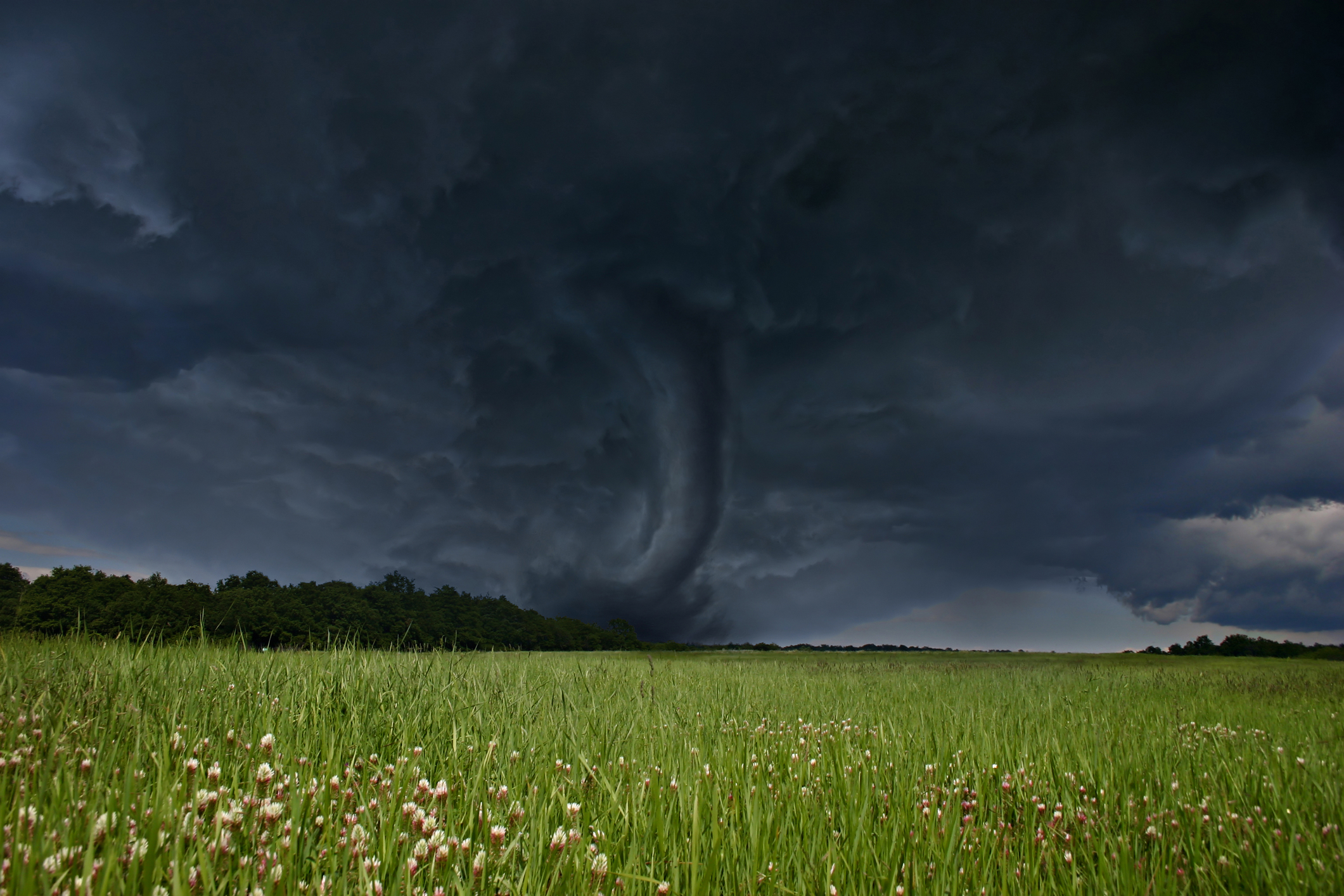
tornado dream

I was warming up for police training at a church recreational center on Virginia’s coast. There were nearly 100 of us there, all dressed in gray and navy, doing jumping jacks and anticipating the events of the day.

The sky was overcast through the large, south-facing windows, built high into the wall of the gymnasium. Someone shouted. The wind picked up in a cacophonous symphony of howls and rustling sand. My eyes grew wide in terror: an enormous tornado was headed toward the building. We sat down, some huddled together, myself apart from the group, knowing that following a safety procedure at this point was futile.

The tornado passed the building then, barring our view of the coastline for a few minutes. From the windows in the northern wall, I saw a girl in a red cape running, but it was too late. She was swept up as the winds racked and swayed the tall grass between our building and the church sanctuary. It tore through the sanctuary, demolishing the eastern wall.

I knew that it was bound to head inland, toward Daniel. I texted him:

“I hope you survive. It’s headed your way. Know that I love you very much.”

As I hit send, the howling I’d endured for close to a half hour stopped suddenly, giving way to eerie silence. The stillness was interrupted only by the sound of my heart beating furiously, high on adrenaline.

And then I woke up, convinced my dream had been prophetic, convinced the end was nigh. After several minutes of lying there, overheated and frozen in fear, I woke up Daniel, told him I was afraid, and snuggled into his side, thankful for him, thankful we were both together and alive.

*photo found here