Little Lamb, Get Up!

Sermon for the Sixth Sunday after Pentecost

Reading available here (Track 2)

God did not make death, 
And he does not delight in the death of the living.

Last week, a group of us from the congregation went to the movie theater to see “Jesus: A Deaf Missions Film.” 

This movie is a big deal, because it’s the first film about the life of Jesus ever produced in American Sign Language.  And it was made by an all-Deaf production team with all-Deaf lead actors. (Fortunately for me, there were also English subtitles.)

I never saw the Passion of the Christ. And I still haven’t watched The Chosen series. So, for me, it was out of the ordinary to see the Gospel story acted out on the big screen.  I found it immediately captivating. 

The filmmakers made an interesting choice to begin the film with the Pentecost scene… 

The disciples had left the upper room, where they’d been hiding from political authorities.  They had been compelled by the Holy Spirit to pour into the streets.  

The film depicts these disciples signing in many different languages. People in the crowd who had never learned about Jesus were now receiving the good news in their own language – sign language – for the very first time. 

As a hearing person and a native English speaker, before watching that scene last Sunday,  I had never really thought about what a privilege it is to have such easy access to the words and stories of my faith tradition. 

It has always been easy to see myself in the story. I never felt like it wasn’t for me.  Because, for me, there was no barrier to entry. 

And, I think, because of that, I’d always thought of Pentecost as the moment when the select few people who comprise the church, of which I am a part, were empowered to share the good news of Jesus Christ to “everyone else.” 

But watching the movie in ASL, I realized that Pentecost was actually the moment when “everyone else” was empowered to be the church, because the Holy Spirit had translated the good news for them. 

Put another way, the disciples were instruments of the message, but they were not instigators of it. Their proximity to the incarnate Christ didn’t make them any better than those who heard the message for the first time that day. 

Now, everyone understood that Jesus, who lived and died as a human, identified with their fragile humanity,  regardless of their identity, language, or ability. 

At the same time, they understand that Christ, who came back to life, had invited them to something bigger than their fragile humanity.  All people were entrusted with the work of building God’s kingdom. They were invited to refuse the terms of their mortal existence, and to live into the abundant, eternal life of God. 

— 

After that opening scene, the movie goes back three years, to the day Jesus met Peter. From there, it closely follows the story of Jesus all the way to his Ascension. 

But, after my glorious Pentecost epiphany, watching Jesus and his disciples slowly walk across the grasslands and hills of Galilee and Judea, felt a bit like pulling teeth. Jesus’ earthly ministry was a lot of things, but in some ways, it wasn’t very impressive

What I mean is, it wasn’t flashy or boisterous. The crowds were small by today’s standards. And Jesus was kind of shy about his miracles, even telling some people not to tell anyone about them. Even his crucifixion was the shameful punishment of the poor. 

But something revolutionary was happening. Not necessarily because Jesus was charismatic or charming. Or because he righted the wrongs of the world with the *snap* of a finger. But because, every action he took proclaimed life in the midst of a culture of death. 

Every miracle, every interaction, every loving glance, and every decision he made not to give up on someone – these were seeds of hope, planted in depleted hearts. 

Everything Jesus touched, and everywhere he went, it was as if a garden had started growing. Jesus was infecting the world with a culture of resurrection. 

— 

In today’s Gospel reading, we encounter a pairing of two intense miracle stories, stuck together like nesting dolls. 

Here, illness is interrupted by illness, which is then interrupted by death. But just when you think there can’t be any more interruption, the spiral of death is interrupted by resurrection

First, the president of the synagogue falls at Jesus’ feet, begging him to come heal his daughter, who is at the point of death.  

Jesus agrees, but is confronted by a dense crowd as he begins to walk through town. 

Then, within the crowd, a woman who has struggled with incurable bleeding reaches out to Jesus. 

The contrast between these two people couldn’t be much vaster: Jairus is a well-regarded, male religious leader who leans on his social position to ask for healing. But the woman in the crowd doesn’t have that option… 

She has been rendered “impure” by twelve years of menstrual bleeding. (This means that she has not been able to participate in religious life for twelve whole years.) And she is most certainly not allowed to touch a man outside her own household. 

But Jesus is worth the risk of further social isolation. She boldly yanks the hem of Jesus’ clothing, a last-ditch effort at healing. 

Jesus doesn’t balk. He finds and affirms the woman who has been healed through his Divine power.  

“Daughter, your faith has made you well.” 

I can imagine the crowd murmuring: Can it be? Even the lost cause can be healed. Even years of grief can lead to hope. If Christ can restore this woman to community, maybe he can restore our broken society. 

— 

By now, Jairus’ daughter is dead.  

Twelve years old – alive as long as the woman bled – and nearly at the age of “womanhood” herself, Jesus was already taking a risk by touching her. But now, he will have to touch a corpse, in clear violation of purity laws. 

But Jesus still doesn’t balk.  He approaches her bedside, takes ahold of her hand, and raises her from the dead.  

“Talitha cum”: Which literally means, Little lamb, get up. 

I can imagine the crowd murmuring in amazement: Can it be? Even the dead can be restored to life. Even the deepest grief can lead to hope. If Christ can resurrect this child, maybe he can resurrect the dying world. 

In these nesting doll stories, Jesus reveals that his Kingdom is one where life prevails over a culture of death. 

Jesus does not delight in our grief, illness, hardship, or loss. Neither does he delight in the way we judge and ostracize one another. 

The “bleeding woman” and the “dead girl” are no longer defined by what others them and makes them “impure.” Thanks to Jesus, now there is no barrier to entry. Now, they are free to live, abundantly. 

— 

As we follow the story of Jesus’ earthly ministry, we journey with him on a path that leads to the cross.  It is tempting, living as we are in a world filled with death, to believe that the cross is the end of the story. 

But each part of the story of Jesus, from birth ‘til Pentecost, reveals a God who does not delight in death. A God who, in fact, refuses death altogether. Each relationship, parable, and miracle bend toward resurrection, not just for him, but for all of us

Our job as his disciples is not to decide who gets access to abundant life, because Christ has already made that clear: Everyone. Our job is to bend toward resurrection, by breaking down barriers that separate us from God and one another. 

We live into the broad and wide and growing Kingdom of God, when we refuse judgments that stigmatize, policies that polarize, and words that dehumanize.  

Our commission is to open the doors wide and join the crowd, where we might just witness a miracle: restored community, renewed hope, green things growing where death had entered in. 

Talitha cum. Little lamb(s), get up.

Jesus is calling us toward resurrection. 

Amen. 
Courage to Believe: Sermon for Easter 3

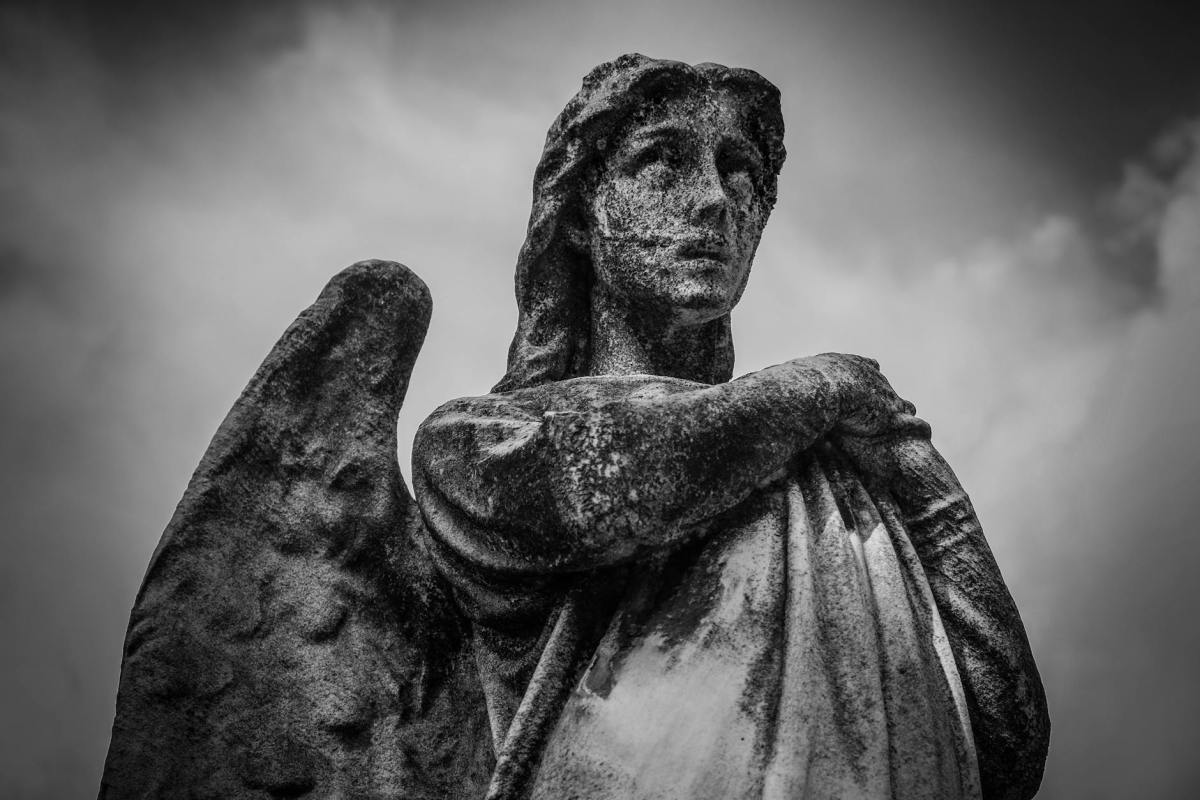
As a young kid, I attended a Christian school run by the Church of Christ denomination.  When I was in the second grade, my teacher, Miss Terrell, taught us about guardian angels. 

I’ll never forget what she said:  “Wherever you go and whatever you do, your guardian angel is always with you, watching you.” 

The reason I’ll never forget what she said is because it absolutely terrified me!  What she was describing was some kind of supernatural surveillance state! 

It was made worse by the fact that, when you’re 7 years old, you suddenly become very body aware. I spent countless hours worrying that my guardian angel was watching me use the bathroom

As the weeks passed, it got even worse. I started having nightmares about stoney-faced angels glaring at me, with swords in their hand.  I was convinced angels were hiding in my dark closet, ready to crawl out and get me as soon as I fell asleep. I can’t even count the number of times I ran to my parents’ room and crowded in between them on the bed.  

But even there, I couldn’t get relief. The angels were following me. Always scowling and always threatening to cause me harm.  

There was no escape. “Wherever you go and whatever you do, your guardian angel is always with you, watching you.” 

One evening, I finally fell asleep in my own bed. In the middle of the night, I woke up and noticed a warm light emanating from the end of my bed.  

There at my feet was what appeared to be a little girl, about my age. She was dressed in a white chiffon robe, and glowing like the sunlight at golden hour from head to toe. Though appearing like a child, she had an intense, warm presence. 

I sat up in bed and looked into her face. She didn’t say anything, but looked back at me knowingly. Suddenly, an overwhelming sense of peace washed over me. I laid back down and fell asleep.  

After that encounter, I was a different person. I was never afraid of angels again.  

The next morning, I told my parents what I had seen. Though skeptical at first, they kept an open mind. When they realized I was cured of my terror, they came to accept that something really had happened

At school that day, I drew a picture of myself sitting up in bed, with the angel standing at the foot of the bed.  When Miss Terrell asked me to describe my drawing, I told her about my night. 

And you know what’s funny?  She didn’t believe me. 

At the time, I was incredulous! How could the person who told me about angels not believe what I had seen and experienced? 

— 

Now, as an adult, I understand it better. I can muster more sympathy for Miss Terrell. 

The truth is, I think most of us have trouble believing that unlikely or miraculous events really happened, even when they happened to us. 

We don’t trust our instincts. We think we must have gotten something wrong: maybe we misunderstood or misremembered. Maybe we were too young or too tired or too gullible.  

And even if we do leave room for the possibility, what does that mean for all the times the thing we prayed for didn’t happen? 

In a culture dominated by rationalism, denial seems like our best option. Because, if we actually dare to believe in a miracle, people will think we’ve lost our minds! 

— 

Today we meet the disciples as they grapple with their own tangled up feelings of joy, fear, and doubt in the face of a very unlikely event. 

And we watch, as they try to muster the courage to believe, and then proclaim, that something miraculous has really happened

— 

To get a better understanding of what’s going on, let’s put this passage in context: 

At this point in Luke’s story, the women have talked to angels at an empty tomb, and two men have encountered a strange man on the road to Emmaus. 

After breaking bread with this apparent stranger, Luke tells us that “their eyes were opened, and they recognized” that it was Jesus. ‘They said to each other, “Were not our hearts burning within us while he was talking to us on the road.’”  

Even before they consciously recognized that it was Jesus, they sensed his presence in their heart. But, in the space between their heart and their rational mind, doubt wedged its way in. And in the time it took to interpret their experience, the story was already starting to get fuzzy. 

So, when the two men tell their friends about their dinner with Jesus, it is easy for everyone in that room to be skeptical. 

Even after Jesus shows up, in the flesh, still bearing wounds, they’re not convinced. They’re still afraid to trust themselves. They’re still afraid of what everyone else will think. 

It’s easier, in some ways, to tell themselves they’re losing their minds, than it is to admit that their friend came back from the dead.  

Sometimes, it’s easier to believe in ghosts than in God. 

— 

Like those first Christians, we catch glimpses of the Divine, but we’re so quick to shut our eyes again. We hear stories of miracles, but we’re so eager to chalk them up to coincidence. 

We come to church each week for communion, praying for Christ to be “known to us in the breaking of the bread.”  But then we leave, not expecting this divine encounter to fundamentally change our lives. 

Whether you have personally had a mystical experience or remarkable vision, you have been invited to come to the table, where Jesus offers himself. 

Here at the communion table, Jesus says,  “Look! It’s me, bread made flesh, wine made blood. Look! It’s you, the Body of Christ, still transforming the world.” 

Like the disciples, we encounter the resurrected Christ whenever we reach out our hands and accept the bread of heaven.   

Our first task is simply to show up and experience this gift of Christ’s presence.  

Our next task, as the disciples will attest, is the harder one: to take the risk of believing that Jesus is present with us, and capable of changing our lives. 

— 

Our Scriptures speak to the timelessness of doubt – they remind us that skepticism is so very human. And Jesus, who lived and died as one of us, knows what it feels like to be human.   

He knows that believing in a miracle is just as anxiety-inducing as it is wondrous.  He knows that proclaiming resurrection puts us at terrible risk in a society more bent on death than on life. 

And the truth is, we can’t explain the mechanics of the Kingdom of God. Try as we might, we can’t rationalize divine encounter or divine transformation.  

The life of faith can’t be wrapped up in a tidy proof. That doesn’t mean it isn’t true

Here, at the table, Christ calls us to leave a little room for possibility. He challenges us to expect a divine encounter. And to trust that God is near when our hearts begin to burn within us. 

Each week as we gather, we are learning how to believe in the miracle of resurrection. 

With our minds broadened to the possibility of hope, we have the strength to venture back out into a world of so many unknowns, and trust that God is transforming it. 

— 

Eat this bread, drink this cup. Leave a little room for a divine encounter. As the disciples can tell you, it might just change the world. 

I Demand to See the Body: Sermon for Easter 2

When I first looked at this week’s scripture readings, I struggled to understand exactly how they fit together.  

At first glance, our Acts reading and our John reading don’t draw out one particular theme.  

How does “Doubting Thomas” fit together with…starting a commune? Like most things, it turns out that these scriptures don’t benefit from oversimplification!

So I kept thinking… 

It’s the Easter season, so it’s customary to continue in our story with the now resurrected Jesus visiting his disciples and friends. 

And on this day, we hear the story of Thomas, who, apparently, lost his invitation to the dinner party.  And thought he had missed his chance to see Jesus, in all his resurrected glory.  

Ok, so, that story’s squared away for now. 

But the tricky part of the way we read scriptures in the Episcopal Church is that, even though Thomas is always right here, waiting for us, on the Second Sunday in Easter, the other passages move around in a three-year cycle.  

That means that this is the only time in three years that today’s Acts passage is paired with the story of Thomas. Though a bit complicated, the lectionary cycle gives us several ways to encounter the unfolding story of Christ and his church. And to make connections we may not have noticed before. 

All that to say: when I dug deeper into today’s readings, the thing that stuck out to me was the fixation on bodies

Not dead bodies, but living ones. And, not just any body, but the Body of Christ. 

— 

With that in mind, let’s get back to Thomas… 

Thomas is an important part of the resurrection narrative, because he’s just like us. 

He says what everyone is thinking, even if they won’t admit it:  “I’m not gonna believe that Jesus rose from the dead, until I see it for myself! Show me the evidence!” 

And Jesus readily complies. A week later, Jesus returns and immediately tells Thomas: “Put your finger here and see my hands. Reach out your hand and put it in my side. Do not doubt but believe.” 

Thomas doesn’t need to touch Jesus after all.  

In the presence of Jesus’ living, breathing, resurrected body, this body that still holds the battle wounds of death, in that moment, Thomas believes. 

And Jesus is more than willing to help him believe. 

Jesus goes on to say: “Have you believed because you have seen me? Blessed are those who have not seen and yet have come to believe.” 

Because of that statement, Thomas has been forced to bear the nickname, Doubting Thomas, for the last 2,000 years.  

But it seems clear that Jesus isn’t condemning him for wanting to see the body. 

Rather, Jesus is graciously acknowledging that it is hard to believe in him without any evidence. 

Jesus gets it.  

If the Gospel of John were turned into a play, this would be the moment where Jesus breaks the fourth wall.  It’s almost as if he’s looking out into the future and speaking directly to us. 

We are the ones who “have not seen and yet have come to believe.”  

But can’t there more than that? Like Thomas, I want evidence: 

  • I want proof that Jesus is who he says he is.  
  • I want examples of how God is acting in the world, now.  
  • I want Jesus to show up and start pointing to all the things he’s up to,  
  • So that I can believe that he really is paying attention. 

And I wouldn’t say I want any of these things because I don’t have faith. 

It’s just that the world is a tragic place.  

It is full of horrific violence that never seems to end.  Of illness, grief, fear, and so much anxiety.  There are too many people struggling to survive.  And too many people making their survival impossible. 

Sometimes it seems like nothing will get better. 

But, Thomas demanded to see the body of Christ and Jesus consented. In doing so, they both taught us that it is ok to make that demand. 

Well then, I demand to see the body.  

— 

Where is Christ’s body for us, today?  

Our Collect, which paraphrases the Scriptures, says that we have “been reborn into the fellowship of Christ’s Body.”  

If we are part of Christ’s body, that means that we encounter Jesus, quite literally, in one another. 

In other words, WE are the living, breathing, resurrected body of Christ, for one another.  We bear the battle wounds of our own difficult lives,  and we allow one another to witness those vulnerabilities.  

— 

At first glance, this strange proposition doesn’t feel the same as Jesus showing up for Thomas. 

But, when I think about it, I can honestly say that the reason I’m still a Christian is because people in the church kept showing up and loving me. 

When I felt abandoned, they stepped forward and said, “here I am.” 

And every time I have demanded to see evidence of God working in the world,  I have only needed to turn to my right or to my left,  and observe my siblings in Christ doing that work. 

The church at its best makes believing in Jesus not only easier, but compelling.  Because we actually do catch glimpses of Christ when we reach out our hands in care for one another. 

— 

And that’s why the Acts passage has something to say about our Gospel. 

In Acts, we see how the early church showed up as Christ’s body for one another. They participated in a radical experiment to give up their personal property and share “everything in common.” In doing so, they ensured that no one in their community struggled to survive.  

As theologian Will Willimon puts it, this community showed the surrounding culture that: “The church takes care of its own, thus creating in its life together a kind of vignette, a paradigm of the sort of world God intends for all” (Interpretation Commentary on Acts, 53). 

While the church has never managed to broadly sustain this kind of communal living situation, this passage reminds us that being Christ’s body in the world is a serious undertaking. Just as we have received love from others, we must make it our job to share that love with others. 

It’s not always easy.  

In fact, this job of caring for one another as Christ’s Body is both the heart of our faith, and the hardest thing to do. It requires us to see ourselves as one part of the bigger whole.  It forces us to always imagine what is possible, instead of giving up when things feel too hard. It puts us in situations of risk and discomfort, because to be like Jesus in this world means showing up, even if the doors are locked. 

Caring for one another as Christ cares for us means we can’t give up on each other. And we can’t give up on building a better world. 

— 

The good news is, we’re not giving up. 

Just this week, I have spent hours learning about the history and hopes of this place. And I have been energized by your faithful labor and persistent care for one another.  

Limb by limb, the Body of Christ is being made visible. And the Holy Spirit is urging us to continue the work. 

Of course, the church has never been perfect. The Body of Christ has, perhaps, never been as visible to us as it was to Thomas. Because of this, there will be struggles and disagreements and roadblocks. We will have our doubts.  

But we can demand to see the Body. We can ask for Jesus to reveal himself, and expect to see him, quite literally, in one another. 

So, look for Jesus and expect him to show up. He’s already here. 

Amen. 

At the Fault Line of the Resurrection

A Sermon for Easter

I shall not die, but live,
and declare the works of the Lord

shot of hill country in texas with bird flying over
Photo by J. Amill Santiago on Unsplash

This morning, we join Mary and the disciples at the threshold of the tomb.

As we poke our heads into that dark cave in the hill country outside Jerusalem, we brace ourselves for the stench of death, and find it empty.

In the long hours after Jesus died, we were trying to be strong. But the absence of a body finally breaks us. Our worst fear already came true, when the man who promised he would save us, died on the cross. But now, Jesus is really gone, and it feels like a second death.

Now, hope is dead. And there is no possibility of closure, only the bodily ache of despair.

But, just as we are hit with a fresh wave of grief, we turn our faces toward the blinding light of the morning as a mysterious messenger beckons us:

“Do not be alarmed! Do not weep! The longing you have held in your body, the fear and the hope, the promises you were foolish enough to believe – all of it has been redeemed! All of it has been transformed!”

Against all odds, Jesus Christ was dead, and now he is alive.

Here we are again, this Easter morning, standing at the threshold of the tomb, gazing into an empty burial chamber in amazement. Daring to believe in resurrection.

We stand at the doorway between darkness and light, fear and hope, death and life. Here, at the threshold, our perspective is broadened. We finally have the vantage point to understand the truth of all things: Here, in this space between all we thought we knew, and all that Christ is making new, the way we order the world breaks down. The dichotomies no longer make sense. In view of the risen Christ, “even the darkness is as light.”

At the empty tomb, we see everything with new eyes. NOW, we live in the ambient light of the Savior, the living Word, who created all things and redeems all things.

There is no need to fear the future. Because Jesus Christ is risen, and all things grow toward his light. In fact, there is no need, even, to hope. Because what our ancestors have hoped for since Eden has already come true.

We’re not yearning for the old days, or waiting for better ones. Heaven has come to earth, and paradise is here!

New life bursts forth at the threshold of a tomb in Judean hill country.

Here in Austin, we are intimately familiar with thresholds, in the geological sense. That’s because we quite literally live on a fault line. The city is built on a geological landmark called the Balcones Escarpment.

map of fault lines and zones in Texas
Balcones, and the Mexia-Talco-Luling Fault Trends, where black lines are faults, the blue shaded area is the Claiborne Group, yellow is the Jackson Group, and tan is the Wilcox Group (Image: Public Domain)

As Austin resident Stephen Harrigan put it in a 1987 article for Texas Monthly,

“The Balcones Escarpment…is geology’s most fateful mark upon the surface of Texas, a bulwark of cracked and weathered rock that extends in a pronounced arc from Waco to Del Rio. It is the Balcones that creates the Hill Country, that sets the stage for the Edwards Plateau and the High Plains beyond. The cotton economy, for our schematic purposes, ends at the base of the escarpment, where the rich blackland prairie…runs literally into a wall. Above that mass of limestone there is only a veneer of soil, and the country is hard, craggy, and scenic—cowboy country. The distinction is that sharp: farmers to the east, ranchers to the west.”

On the east side of town where we are right now, you can still see traces of fertile farmland. Each day when I come home, I have to be extra careful not to track fine, black dirt into my living room.

But just a few miles west, the landscape suddenly transforms into hill country. The ground rises up in stops and starts to reveal red clay and rocky passes.

The first time you drive west toward Lake Travis, you might find, like I did, that “amazement seizes you” at the sudden shift in perspective.

Like the Psalmist, maybe you’ll exclaim:

“This is the Lord’s doing,
and it is marvelous in our eyes.”

The landscape here, not unlike the culture, is a juxtaposition of abundance and want, softness and hard living, simultaneously quaint and exhilarating.

But you should know that the Balcones Escarpment isn’t the only interesting thing about the fault line. The result of a violent collision of earth that occurred 20 million years ago, the Balcones Fault Zone also produced the Edwards Aquifer.

Basically, when the ground was pushed up into hill country, it was also pushed down into deep ravines and caves. Rainwater flooded these hidden caverns, forming underground springs that provide water to local waterholes, the Colorado River, and the households of most of Central Texas.

These aquifers are literally what make life possible here.

So, if you’re having trouble finding the fault line, just look to where green things grow and people gather. Amid the tumult, and against the odds, life is nurtured and sustained, right here, at the threshold.

Like so many who settled here before us, the perspective of this place might grip you.

Living here, at the site of a geological wonder, you are living proof of a bigger truth: that the ways we sort the world, into good and bad, salvageable and broken, safe and dangerous, habitat and wasteland, no longer make sense in view of the fault line.

From this vantage point, we see things differently: All of it is redeemable. All of it holds hidden possibility. All of it can be made new.

At the fault line, you realize you no longer need to let yourself down easy. You no longer need the old stories or the doubted promises. Things can be bigger, and better, and more beautiful than you imagined.

Here at the threshold, life is bursting forth.

Today we worship in a church, formed at a geological threshold. And we stand with the disciples, at the fault line of the resurrection.

We have held the black earth of the east while gazing up at the red hills to the west. We have drunk the pure water from aquifers borne of violent shifts below the surface.

We dare to proclaim that the old things can be made new. We insist that life is persistent, growing in crevices and dusty hills, against all odds.

We have seen with our own eyes how the death of an old world can create the conditions for abundant life.

And if all this is true, just about the ground we stand on, how much more is in store for us, who proclaim the resurrection of Jesus Christ, the Son of God, the redeemer of the whole world!?

On Easter, we declare that, even in darkness, life is bursting forth!

And so, we proclaim: Alleluia!

“O death, where is thy sting?
O grave, where is thy victory?”

Christ swallowed up death and shifted the tectonic plates. Resurrection is here.

Two thousand years after the disciples peered into the empty tomb, we still bear witness to the Risen Savior.

We still dare to be faithful, in a fickle and distracted world. We still dare to believe in the reconciliation of all things, and all people. We still dare to see the bigger picture.

A dead man crossed the threshold of a tomb. Now, we know that life is always possible. Even death carries the seed of resurrection.

I shall not die, but live,
and declare the works of the Lord.

Amen.

Sermon for Easter: The Florida Snail Kite

A Sermon on Unexpected Hope

Readings available here


Snails, Kites, and an Empty Tomb

In 1964, the U.S. Government published the very first official list of endangered species. The list included the now-extinct Ivory Billed Woodpecker and the critically-endangered Florida Panther. But there’s one species whose story has taken a surprisingly hopeful turn, nearly 60 years later…

This is the story of the Florida Snail Kite.

Related to hawks and eagles, the Snail Kite is a large, bird-of-prey that lives in Florida’s wetlands. The males are charcoal gray and the females are dappled with brown and white. They have large, round, red eyes; bright yellow talons; and, a nearly 4-foot wingspan.

In ancient Egyptian mythology, the Kite is said to appear when the gods are resurrecting someone. But it looked like the Florida Snail Kite was the one in need of resurrection…

You see, Florida Snail Kites feed on one thing: the Florida Apple Snail. And that’s where the problem started.

By the end of the 1990s, much of the Florida Everglades had been drained, or disrupted by industrial agriculture. This caused a significant decline in the native apple snail population. And this, in turn, threatened the survival of the Snail Kite, whose long, hooked beak is uniquely adapted to hunt and eat the snail.

By the early 2000s, there were fewer than 800 birds remaining. And progress was slow.

In 2011, the governor of Florida cut Everglades restoration funding by over 120 million dollars. The next year, the National Research Council gave Florida an “F” rating for their progress in conserving the Snail Kite population. Without significant changes at the state level, it seemed that nothing was going to save the Snail Kite.

…Meanwhile, when no one was looking, someone quietly released their pet snails into the Everglades.

While politicians slashed funds, conservationists shook their heads, and nature-lovers mourned, the island apple snail was on the move.

Like any invasive species, the island apple snail was never supposed to be there. And conservationists tell us that invasive species are almost always bad news. They signal the slow death of an ecosystem, as fragile food chains are disrupted, and natural resources get knocked out of balance.

Once an invasive species really takes off, this normally signals the end of an ecosystem’s harmonious story; the death knell of abundant life…the proverbial stone being rolled across the tomb.

Maybe you’ve heard some of these terrible, awful, no-good invasive stories:

  • The aggressive gray squirrel starves out the red squirrel.
  • The Burmese Python eats the wood storks.
  • The European starling spreads disease, to livestock and humans.

Violence and death are everywhere when invasive species roll in.

And once they get a foothold, there is no future for the habitat, without somebody or something making a way where there seems to be no way.

Without something that makes HOPE possible.

So, you can imagine my shock when I read this headline:

In Florida, an invasive snail is helping save an endangered bird.

In March 2022, conservationists reported that there are now over 3,000 Snail Kites living in Florida’s wetlands, compared to less than 800, 20 years ago. And their numbers are on the rise!

All because someone dumped their pet snails in the Everglades. And the snails decided to make the best of it. All because something that never should have happened DID happen. And it made hope possible.

Today, on Easter Sunday, we make the most daring and strange declaration of our faith.

We declare that something that never should have happened DID happen. Jesus was dead, and now he is alive. Jesus was in a tomb, and now the stone is rolled away. Mary was weeping, and now she is running, and shouting the news: “I have seen the Lord!”

As Christians, our story is now marked forever, not by death, but by abundant life. The death knell became Easter bells.

If that first Easter had a headline, maybe it would read:

“In Judea, an invasive resurrection is saving the world.”

Bishop N.T. Wright notes the invasive nature of the Easter story by calling it “strange.” Strange because, throughout most of the Gospel stories, the writers nearly constantly draw on Hebrew scriptures to legitimize Jesus’ ministry.

But when they get to Easter, all the theological commentary suddenly falls away. And they let the resurrection speak for itself.

The disciples were just as surprised as we are that Jesus, dying as a human in a mortal body, could rise from the dead. The bodily resurrection of one person was never part of the Messianic narrative. The Messiah was supposed to come back at the very end of time and resurrect all people. Not roll out of a tomb three days after being murdered.

For the disciples, the death of Jesus was never meant to signify anything other than the world’s cruelty. They couldn’t see the resurrection coming, because it defied everything they understood about the natural world, and everything they believed about God.

So, in the moments before the resurrection, Jesus’ community was grieving not only the death of a friend, but the death of hope.

They were witnesses and victims of extraordinary oppression and violence. They thought that Jesus was going to start a revolution. That he would create a habitation in which all could thrive. As long as Jesus could just stay alive, abundant life was on the horizon.

His crucifixion was the death of a dream. In those days and nights before resurrection, the disciples were an endangered species with no hope in sight.

But something was happening in the shadows. An invasive resurrection disrupted the old story of death and grief.

Something that never should have happened DID happen.

Through his death, Jesus defeated death and mortality for all time. The stone was rolled away. The screeching of the Kite was heard again above the marshes.

And in his rising, Jesus brings us all back to life. We have a future, because Jesus is alive!

Jesus calls us to hope when all seems lost. He calls us to hope when our leaders aren’t making it possible to thrive, the money has dried up, our tears have dried up, and our voices are cracked from shouting.

Jesus’ love reproduces and grows in the murky swamps, even when we can’t see it.

The Risen Christ descended into Hell and defeated evil. Rose to heaven and sits at the right hand of God. Stands with us in the garden as we weep for all that is lost.

He is the one who brings us out of our tombs into the bright light of day, and tells us that he is building something new. He will give us good things to eat, and friends on our way.

We are called to abundant life, because Jesus is alive. We are called to harmony with our siblings, because Jesus is alive. We are called to love with an invasive and persistent love, because Jesus is alive.

We are called, today, to dare to hope for resurrection in the graves and murky swamps and dark valleys, of our world, and of our lives.

“O death, where is thy sting?
O Hell, where is thy victory?”

Snails, kites, and an empty tomb remind us that things that defy the odds can also be true. A future is possible.

An invasive snail made conservationists rejoice. And a God whose death defeated death changed everything.

Christ is alive! Hope is alive! Alleluia!

Good Friday

In 2011, God was silent. I didn’t stop believing, but I was numb. Numb like cold fingers in the middle of winter: on the brink of frostbite. I was terrified of losing the religion, the community, and the language of faith that had been central to my life as a child and young adult. The stillness made me feel unhinged.

Perhaps as a way of coping with not knowing what the future of my faith looked like, I found other practices – other rituals – to fill the void. And in retrospect, the quiet cleared the clutter, opening up space for new ways of thinking and being.

I also read Still by Lauren Winner, a book I’d recommend to anyone feeling existentially lost. I realized I’d been waiting for my faith to return or to grow back to just the way it was before the silence when I should have understood this dark period as part of the path.

There is nothing wrong with feeling numb. There is nothing wrong with stillness. Nothing is lost in the process – you are still you, God is still God (much different and much more complicated than we can imagine, I’m sure), a community is waiting somewhere to love you for who you are, not what you profess on any given day.

Today I feel stable, but not always certain. I feel loved, but I’m not always sure it’s unconditional. But what I know is that living with grace and intention will never be the wrong path. See people and love them anyway. Forgive. Work toward justice. Leave yourself vulnerable to the fulfillment and pain of love.

Easter still life

ea4I have never been more pleased with a photograph. Steam rises from a hot cup of coffee in the late afternoon sun on Easter. I had the most pleasant day yesterday; it couldn’t have been lovelier. Cool breeze, hot sun, open windows, exposed wood beams, a home cooked meal, and good conversation.

I leave you with a verse from one of my favorite Easter songs, Now the Green Blade Riseth:

When our hearts are wintry, grieving, or in pain,
Thy touch can call us back to life again;
Fields of our hearts that dead and bare have been:
Love is come again, like wheat that springeth green.

alleluia!

easter vigil

As the sun sets, attendees are given an unlit candle. Outside, the light of Christ is lit just as the last light of the sun settles on the horizon. Parishioners process in quietly and await the coming of the light of Christ as it is solemnly paraded down the center aisle. All are aided in lighting their candles from the light of Christ at the front, passing it on, candle by candle to those within their pew. The sanctuary is unlit apart from the growing light of Christ clutched in the hands of this body of individuals, awaiting the readings in silence.

Each contained fire flickers and flares – rhythmically, chaotically, still for just a moment – as members of the congregation recount God’s victory amid despair and oppression. Psalms are chanted in a resonating baritone. The mood is somber, but a quiet hope begins to swell as words of salvation are announced, as the chanting echoes across the high ceilings and glass walls of the sanctuary.

All at once, the room comes alive with light, parishioners ring bells they hid among their belongings, and the organist begins a triumphant song. All stand and sing:

Jesus Christ is risen today, Alleluia!
our triumphant holy day, Alleluia!
who did once upon the cross, Alleluia!
suffer to redeem our loss. Alleluia!

Hymns of praise then let us sing, Alleluia!
unto Christ, our heavenly King, Alleluia!
who endured the cross and grave, Alleluia!
sinners to redeem and save. Alleluia!

But the pains which he endured, Alleluia!
our salvation have procured, Alleluia!
now above the sky he’s King, Alleluia!
where the angels ever sing. Alleluia!

For the first time since Lent began, Alleluia rings out again. The world was dark and cold as a winter night, but Christ is alive and in it and working once again!

tree blossom

The final verse of Wheat that Springeth Green, in particular, rang true for me this year:

When our hearts are wintry, grieving or in pain,
thy touch can call us back to life again,
fields of hearts that dead and bare have been:
love is come again, like wheat that springeth green.

How I needed to exhaust my lungs with the singing of those words! After a long, dark winter, after several weeks of chaos and confusion and self doubt, after 8 months of not dealing with the weight of moving away from everything familiar and comforting, I needed to acknowledge the barren winter in my heart, clear the snow away, and discover joy without limitation in Love springing up again.

He is risen! Alleluia!

first image source: Catholic News/second image: my own