Reconciled, Forgiven, Freed | Christ the King Sermon

Readings here

Today is “Christ the King” Sunday. And that means it is the last Sunday of the church year. Next week, we will start our three-year scripture cycle over again, with Year A, and we will enter into the season of Advent.

The tone will shift, and we will look forward, with renewed urgency, to the coming of Christ: both the Christ-child that we celebrate at Christmas, and the risen Christ, who promises to bring about the “restoration” of the world.

On this last Sunday of the Christian year, as we prepare for the chaos, longing, and joy that Christmas brings, it is good to remember that Christ is king, which means that “perfection” is his job – not ours. Jesus holds everything together, when our best laid plans seem to be falling apart. He calls us to let go of what burdens us, so we can join with him at the banquet he prepares for us.

Over the past 40 or so years, it has become increasingly unpopular to use kingly metaphors when referring to God or Jesus. Though our scriptures are full of references to the triune God as Counselor, King, and Almighty One – and though God’s relationship with his people hinges so often on his authority – some of our newest liturgies remove these references.

In some of the liturgies of our church, words like “Lord” have been changed to “Savior” or, simply, “God.” Kingdom has been changed to “reign.” Some of the most faithful people I know refer to the Kingdom of God as the “kin-dom of God,” deemphasizing the hierarchy between God and humankind and emphasizing humanity as equal members of the family of God.

None of this is necessarily a bad thing…

For one, these edits are pretty subtle – they don’t necessarily change very much in the context of a single prayer or turn of phrase. In some cases, they bring renewed meaning to well-worn statements of faith by signaling that God’s domain is more generous and expansive than those of worldly rulers. And, in a world run by tyrants and would-be tyrants, it is reasonable to be wary of using hierarchical language associated more with violence than benevolence.

In a recent article written for The Living Church, the Reverend Barbara White speaks to this point:

In a world of developed democracies, which is nevertheless beset by dictators, oligarchs, and those who want to be, it makes sense to wonder if kingship is the most relevant metaphor for Christ’s relationship to the world and to humanity. There is also the uncomfortable fact that the term “Christ Is King” has been recently highjacked by alt-right antisemites on social media—which should be…condemned by all who bear the name of Christ…

In this day and age, it is good to be careful with our language. And it is reasonable for us to worry about what it signals to declare Christ as King when there are people out there suggesting that Christ’s kingship is some kind of political maneuver that means that people that look and think “like them” should be in charge.

But, anyone who calls Christ King while encouraging more division, more judgment, and more self-righteousness is missing the point entirely. Because, by naming Christ as our King, we should be seeking, not to uphold, but to destroy the hierarchies and boundaries that divide people. We are all made equal under the banner of Christ our King.

In today’s Gospel reading, we encounter the final moments before Jesus’ death on the cross. Smug bystanders mock and ridicule Jesus for claiming that he is the Son of God and the Messiah, the “anointed” one. They have placed a sign over his head that reads: “King of the Jews.” It is intended as a clear denial of his kingship – after all, this so-called Savior is dying.

Meanwhile, from his lofty height on the cross, Jesus looks down and asks for their forgiveness: “Father, forgive them; for they do not know what they are doing.”

In that moment, one of the criminals on the cross next to Jesus receives a spark of understanding: Jesus is not only innocent, he really is the Savior spoken of in the prophecies.

So, he asks for all he thinks he can ask for, as a guilty man: “remember me.” And Jesus gives him all that he can give: eternity: “Today you will be with me in paradise.”


Jesus is a king who turns everything on its head: his throne is a cross and his law is forgiveness.

Here on the cross, there is a profound reversal of expectations. The bottom falls out of earthly power structures held up by self-interest, self-righteousness, and control. And now, the full sweep of humanity falls into the arms of Christ: reconciled, forgiven, and freed.

This moment on the cross reveals the true character of Christ’s kingdom: No one is too far gone. No one is beyond forgiveness. And the scorned and abandoned are the first to enter paradise.

When the criminal recognizes Christ as king, he can finally let go of his own will to power. He releases his protective pride and accepts the compassion Jesus shows him. He dares to reveal his deepest hope – that he will not be forgotten. And when he asks, he receives more than he could imagine.

His story can be a lesson for all of us. When we accept Christ as king, we no longer have to hold onto our own wills to power – motivated by shame, longing, regret, and fear – because we know we are held by a savior who loves us more than his own life.

In a time when association with kings and kingdoms is perhaps more fraught than it has been since the American Revolution, we must reclaim the concept of Christ as King. We do this by placing it within the broad message of the Gospel, which reveals that Christ is fundamentally different from the rulers of this world.

He does not rule through control or fear, but by endlessly expanding freedom and joy, in a single-minded path to reconciliation. He is Love, embodied, calling us by name, finding us when we’re lost, and forgiving us even when we don’t ask for it. He makes it possible for us to be a “kin-dom,” a family made up of people who aren’t related and might have hardly anything in common, besides being so deeply loved by Jesus. By reconciling us to himself, we can find peace with one another.

Christ is King, which means we can lay down their weapons, our burdens, and our pride and let Christ do what he does best: make a way to paradise, for everyone. Amen.

Freedom, Flesh, Fear

Readings here

One of the most frustrating things about being a human, at least for me, is that you don’t just get to a point where you have everything figured out. You can check off a lot of your goals, but at the end of the day, you’re still just a little creature flailing around. Deep down, you’re still just that little kid asking big questions about the world and how you fit into it.

My husband, Daniel, and I have been talking about this recently. More specifically, we’ve been reflecting on the core values that guide the decisions we make. I like to think that, deep down, I am driven by virtues of kindness, peace, love, and joy. And those are real values I hold.

But Daniel very astutely pointed out that I am also driven by a less positive value: I am deeply afraid of getting in trouble. I am a card-carrying, life-long rule follower. Not because the rules always make sense. Not because I always agree with them. And certainly not because I think rules are somehow innately virtuous and always there to protect us.

(In fact, I do have a radical streak in me. In my 20s, I tried to bring about significant reforms at the retail stores and factories I worked at. It didn’t work.) But I have to admit that fear is always at play, making me doubt myself and making it harder to live into those virtuous core values. After months of reckoning with this fear, I encountered today’s epistle reading, and something shook loose.

Today, Paul sets two “F-words” in opposition to one another: Freedom and Flesh. Christians have often misunderstood the way Paul uses the word “flesh.” He doesn’t mean it simply as the physical body. Rather, “flesh” is a way of thinking about our natural inclinations in a broken world. The “works of the flesh,” which we might call “sin,” are attitudes and actions driven by ego and self-protection. They are things that keep people divided, that cause schisms and disappointments beyond repair. They are habits that keep people chained in cycles of addiction and isolation. They are distractions that keep us from loving our neighbor as ourselves.

These “works of the flesh” are ultimately “works of fear.” Because they are motivated, deep down, by fear: fear that we are not lovable, that we don’t have enough, that we will be misunderstood, that there’s an unseen enemy lurking around every corner.

But the F-word that Jesus invites us to is neither Flesh nor Fear. It is Freedom.

“For freedom Christ has set us free.” I tried to figure out why the sentence was phrased that way, but that’s really what it means: Christ has set us free so that we can be free. In the original context, this meant that the early Christians were free from a rigidly interpreted Jewish legal code. But that idea can be expanded. For us today, the scripture suggests that we are free from the ideologies, expectations, and fears that don’t allow us to imagine a world beyond “flesh.”

Christ’s freedom is not the limited freedom of our patriotic songs, which ask us to prove our allegiance to one place and one people. It is not the violent freedom that we take by trampling on others, dividing people into categories of powerful and weak, ally and enemy. It is not the regulated freedom brought about by man-made laws, which by their very nature can only restrict the worst in us, not encourage the best in us. Christ’s freedom is certainly not the small, false freedom I achieve when I avoid getting into trouble.

It’s bigger than all of that. “For freedom Christ has set us free.” The freedom of Christ is different from anything we have ever encountered in this world of flesh, because it exists beyond fear. It rejects “brokenness” as the natural order of things and reveals “love of neighbor” as the natural order of the Kingdom of God.

As Paul told us in last week’s reading, there is no dichotomy that Jesus hasn’t already destroyed: “…there is no longer Jew or Greek, there is no longer slave or free, there is no longer male and female; for all of you are one in Christ Jesus.”

The freedom of resurrection life is so big that it cannot be defined against what it is not. True freedom doesn’t require haves and have-nots to define its own quality of freedom. True freedom is found in the flattening of hierarchies and abandonment of control. It is evident in our mutual relationship to Christ and one another, as we become a part of his Body in the world.

Theologian Kathryn Tanner puts it this way: “All our action is to be like that of the ministers at the Lord’s banquet table, distributing outward to others the gifts of the Father that have become ours in and through the Son” (Jesus, Humanity, and the Trinity). We are free to give, free to receive, and free to luxuriate in God’s goodness in us, through us, and all around us.

“For freedom Christ has set us free.” What a profound and odd statement: to be free for the sake of freedom.

But if we could just lean into it, feel it, and let go of just a little bit of our fear, do you realize that the world would be an entirely different place? We would be governed not by things that divide, isolate, and shame us, but by the neighborly love of the Kingdom of God. Shaken loose, we would bubble over with love, joy, peace, patience, kindness, generosity, faithfulness, gentleness, and self-control. These attributes would become infectious, leading us deeper into resurrection life and bringing the world with us.

When we follow Jesus, we are called to be radical in the original sense of the word—to “affect the fundamental nature of something.”

We are called, first, to believe that Christ made us for freedom, not for fear. Then we are called to turn this world of the flesh into a world overgrown with fruits of the Spirit. We do that by rejecting fear as a core value, by committing to love beyond man-made boundaries, and by letting go of control. And by practicing actions and attitudes that lead us back to communion with Christ and one another.

The day we finally understand that we are free, there will be so much fruit, the whole world will feast.

Amen.

Becoming Wise

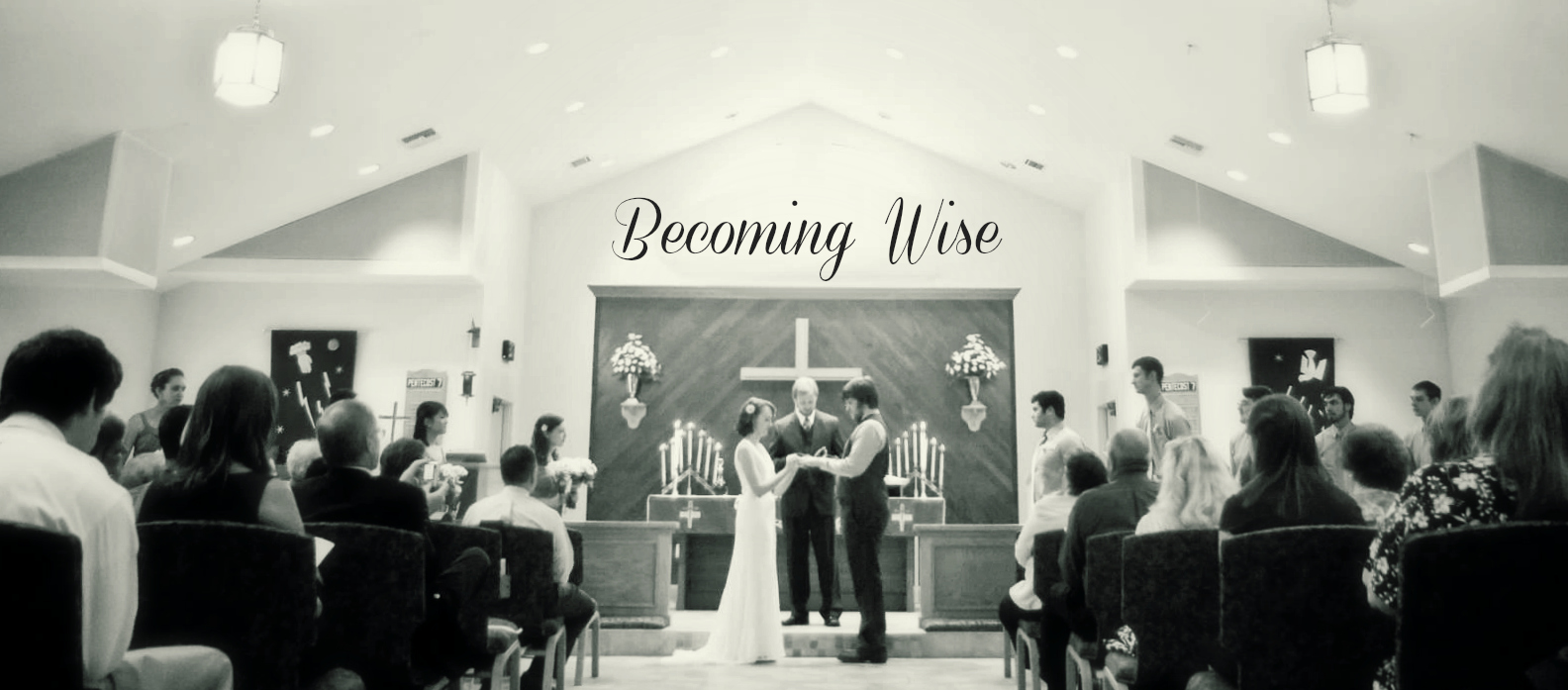
wise wedding

Hello, my name is Leah Wise and I have a confession to make:

I’m a feminist who took my husband’s last name.

“How could you?!” my feminist sisters cry. Well, because I wanted to.

Let me acknowledge that I’m right there with you when you say that taking on a husband’s name implies an unequal balance of power between the sexes, that it’s part of an archaic patriarchal system, that it arose within a tradition that passes women as property between father and spouse. I agree; that’s why Daniel didn’t ask my father’s permission to marry me. Independent adults can make their own decisions.

I’ll admit that I really didn’t think about not taking Daniel’s last name until after we were married. It took me 6 months to make all the changes to my legal documents, in part due to laziness and in part due to the fear that everything would be different with a new last name (it wasn’t, but more on that later).

I considered (and consider) myself the academic sort and I didn’t want to confuse my professors with a new last name. But, for the most part, my hesitation wasn’t due to the fact that I felt I had built a name for myself as a supreme scholar using my maiden name; I was afraid more that they’d question me for my age. I was 21 when I got married. That’s young by a lot of people’s standards and I didn’t want their condescending judgment. I hadn’t really considered that the name change itself would produce that response.

Back to the point. I acknowledge that patriarchy is bad for women and that the name change developed within that system. But I changed my name because I wanted to have the same last name as my husband. I don’t want to sound like a cliche, young-and-in-love moron, but I was wooed by the idea of creating a family unit with my husband (not the child-bearing family unit necessarily, just being identifiable as a married pair). I like that people call us The Wises. I discussed the subject with a friend and mentor earlier this week and I liked the way she phrased this point: getting married is choosing your next of kin. You tell the world, by marriage, that you have chosen a life partner who is closer to you than your parents or siblings; you have taken them on as your family. Having a uniform last name symbolically represents this bond.

I changed my name because I had the open space – the freedom – to make that choice for myself. I’m sure I was influenced by custom, but I married a man who believes strongly in fairness, equality, and egalitarianism. We both received departmental awards as undergraduates in the same field and graduated summa cum laude. We’re equals and we know it and we’re proud of it. If he had suggested that I had no say in the name change, I more than likely would have broken it off altogether; that’s straight up male chauvinism.

Additionally (this may come as a surprise to some of you), changing my last name had its perks. For one, I felt like I could become something better than I was as a Wells (I should have mentioned that my new last name is very similar to my old last name). Because changing my last name was my choice, I gained a fresh outlook on my identity (it feels similar to moving to a different town or graduating high school). I also symbolically shed the burdens and ideologies of the family I grew up in. College changed me profoundly from an ideological and religious standpoint and I think the superficial move away from my past helped me admit my new identity to myself and my family. It helped me gain the footing to stand behind my beliefs. The family name I took on doesn’t represent a family that is less broken than my own. It represents the pact I made with my husband to stand beside him for the rest of my life.

There are numerous other arguments that neutralize the name change: when you keep your maiden name, you keep your father’s name, thereby re-affirming patriarchy; future children are easily added to the family without name confusion when you take on a uniform last name; a uniform names provides social legitimacy; etc. I agree with those sentiments, but ultimately it comes down to personal choice.

It strikes me that feminism has always been about choice. To paraphrase my friend again, feminism is about equal pay, respect, civil rights, and self governance – all, at their root, about freedom. While I believe that American women are still beaten down by an unjust patriarchal system, while I know women oftentimes don’t reach high enough or stand up for themselves or gives themselves credit, we cannot lose sight of the original heart of feminism. Don’t shame your sisters in this struggle who think differently or choose differently. The beauty of creating an expansive landscape of choice is that we can journey out in an increasing number of directions and still be within our rights. The last thing we need is to restrain those beaten-down women who came to feminism to find room to grow.

I became a Wise because I wanted to. If I felt strongly that I was encouraging patriarchy by doing so, Daniel and I would have made up a new name or co-hyphenated.

We would have resolved it together because we’re in this together. That’s why they call us Wise.