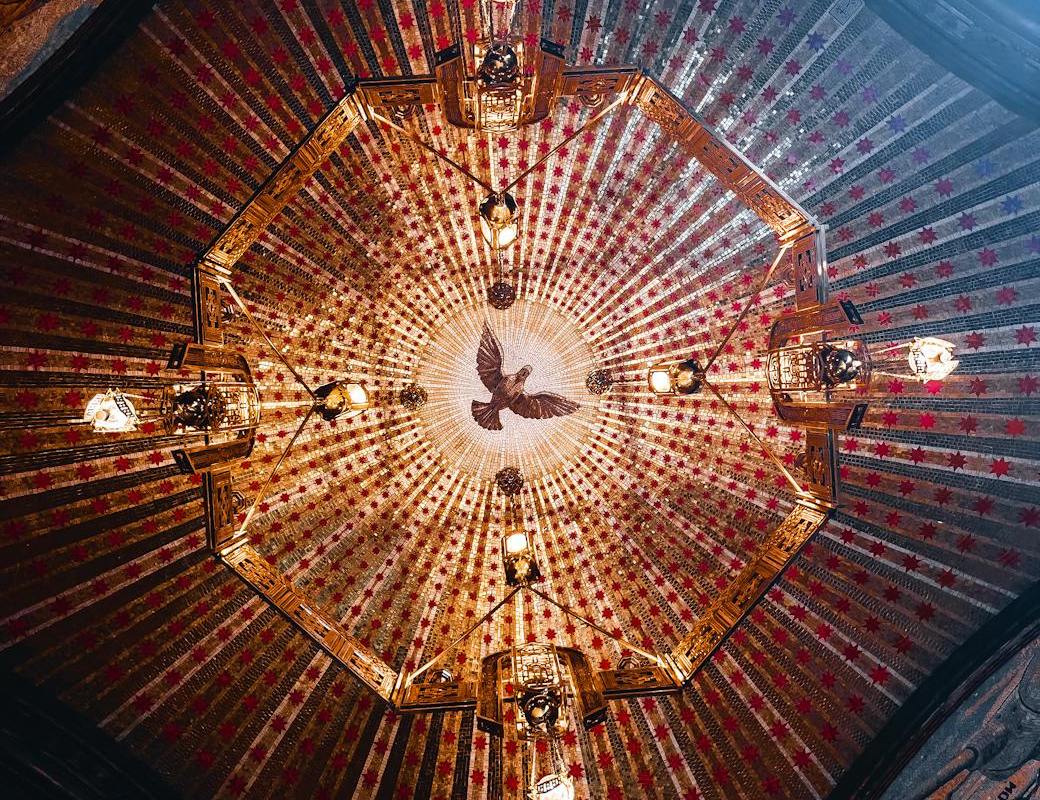
That the Lord would put his Spirit on them | Pentecost

Readings here

“Would that all the Lord’s people were prophets, and that the Lord would put his spirit on them!”

Today’s readings, taken together, give us a sense of the character of the Spirit of God, who is always on the move.

In Numbers, she rests gently, like a butterfly, on the heads of elders surrounding Moses, as God prepares the tired and hungry Israelites to receive a feast in the wilderness. In the Psalm, she is sent out, like a dove, to create new life, adding to the number of varied and marvelous creatures of the earth. In John, she flows out, like water, from the hearts of Jesus’ followers, providing refreshment to those without hope. In Acts, she erupts – like gale-force winds and rampaging wildfire – causing the disciples to tumble out of the isolation of their gathering place.

And, of course, she speaks – in dead languages and living ones – uniting the people in Jerusalem, not in a common language, but in common understanding. Flowing and flying and rushing and disrupting – the Spirit is not the gentle presence we might imagine. To paraphrase theologian Will Willimon: where the Spirit is, something is coming to life (Acts: Interpretation, 30).

(Just so you know, I am using feminine pronouns for the Holy Spirit today because the Hebrew word is in a feminine form. That doesn’t mean that the Spirit is a woman – it just means that the Spirit is not an “it.”)

Our scriptures make clear that the Spirit of God has been present since the beginning of time: The Spirit is where God is. But until this day in the Book of Acts – which we call Pentecost – the Spirit was thought to be something that might land on you for a little while, and then depart. And, if the Spirit of God was “on you,” you would almost certainly begin to prophesy.

We see it in our Numbers reading: “Then the Lord came down in the cloud and spoke to him, and took some of the spirit that was on him and put it on the seventy elders; and when the spirit rested upon them, they prophesied.”

But what does it mean to prophesy?

First, let’s define some terms. To prophesy is to proclaim a message from God. The person who prophesies is called a prophet. And what the prophet proclaims is called a prophecy.

Rabbi Abraham Heschel says that:

“The prophet is no hireling who performs his duty in the employ of the Lord…The fundamental experience of the prophet is a fellowship with the feelings of God, a sympathy with divine pathos, a communion with the divine consciousness which comes about through the prophet’s reflection of, or participation in, divine pathos” (The Prophets, 31).

What he means by this is that the prophet is so close to God that it is as if they share the mind and heart of God. They become more than a messenger or mouthpiece for God – because the Spirit resting on them connects them to God’s reality.

In other words, the Spirit enables them to look at the world with the vision of God – and this new vision reveals the smallness of their human point-of-view: the pride, competition, and needless division that leads to conflict on the ground.

This new vision forces the prophet to “tell it like it is” with divine clarity. It compels them to tell the truth. And from this truth-telling, an opening is made for something new.

When the Spirit of God arrives like a storm at Pentecost, she lands on the disciples – not as a butterfly – but as fire. Hot, burning, and wild – the disciples move like sparks, tumbling out into the street where they start to speak at least 15 languages. They surprise themselves before shocking the crowds.

It is the Jewish Festival of Weeks in Jerusalem, and a jumble of people from many places are in the street to celebrate God’s gift of the law to Moses.

When the disciples speak, the chaos of their outburst has the surprising effect of unifying the crowd. Because, suddenly, everyone can understand what the disciples are saying. In fact, the disciples are even speaking dead languages – almost as if the Spirit is calling all of history to attention.

And then, from the chatter, one clear voice rings out. It is Peter! Jesus’ friend who put on a brave face when Jesus was with him, but denied him three times as soon as he was alone. This man Willimon calls “cowardly” is now speaking boldly in the public square – the Spirit has gotten ahold of him!

He uses the words of the prophet Joel to frame this event as evidence of the old prophecies coming true. “Don’t you see?” He says: “In the last days it will be, God declares, that I will pour out my Spirit upon all flesh.”

He also uses Joel to proclaim that the Kingdom of God has come near, through the person of Jesus Christ: and “all who call on his name will be saved.”

The Spirit of God is on the move once again – connecting humanity to the heart of God. And now, she is available to all, without reservation or limitation, and without an expiration date.

As Willimon puts it: “…in Jesus the Christ, there is a power loose in the world which is power for them.” (36).

This miracle of many languages proves Peter’s proclamation. The people in the crowd are from different places, have different concerns, and speak different languages. But all of them understand God calling to them, because the Spirit uses the language of their hearts to bring them into the very heart of God.

And there, they are brought into the unity of the Body of Christ.

We are blessed beyond measure to be a congregation that relives the miracle of Pentecost every time we get together.

On any given Sunday, we worship together in two or three languages: English, ASL, and even Spanish. With the help of our human interpreters – and the Spirit of God – we are able to participate, together, in the life and love of God.

And because of this, we know that barriers don’t have to be burdens. We know that the Spirit doesn’t privilege some languages, people, and cultures over others: She will always speak in a way we understand – even when her call is beyond words.

We know that Jesus made a Way for us to join in the hard and joyful work of his kingdom. And we know that, in our own ways, we are called to prophesy.

Drawn into the heart and vision of God, we are called to tell the truth about what we have seen in this place, even and especially when it defies the world’s tired old stories. So that an opening is made for new life to grow amid the world’s decay.

No matter what brought you here today, know that you are unconditionally and endlessly loved by the God who existed before the world began, and you are held by the Spirit who rushed in like the wind to get to you.

And no matter what anyone says, you are called to participate in God’s own life. You are called to give water to those who thirst, in body and soul. And to follow the Spirit, who is always on the move.

But you are not called alone. Above all, you are called to participate the Body of Christ – which is to say, the church. Here in the church, we are delighted to discover surprising unity in our differences, and reassurances that these differences are not insurmountable.

Our differences are a gift of the Spirit. By softening the barriers between us, they make us brave like Peter. They allow us to speak in the multi-lingual voice of God, which transcends the smallness of our individual points-of-view, a nd beckons us back to the heart of God: to the source of Love that will be our salvation.

Amen.

The Light is Yours | Sermon for Pentecost

Readings here

For the citizens of Charlottesville, Virginia, the hot months of 2017 are better known as the “Summer of Hate.”

The previous year’s election had emboldened white supremacist groups to step out of their anonymous chat rooms into the public square. And they had chosen Charlottesville for their debut. On the evening of August 11, I was locked inside my church with 500 other people, among them Katie Couric and Cornell West.

As the interfaith prayer service began to wind down, the worship leader suddenly walked to the back of the church. He spoke quietly with someone, then headed back up to the front. That’s when he told us: “The Nazis are outside.”

The next few moments are hazy in my memory. But, someone must have told us we were in lockdown. It wasn’t safe to leave. Then the worship leader spoke again: “So, we’re going to sing loud enough to drown out their hate.”

We started to sing: This little light of mine, I’m gonna let it shine…

Time seemed to stand still. As we drummed on the backs of the hardwood pews and stomped our feet to the rhythm, the candle flames danced on the altar.

Meanwhile, back in the narthex, unarmed priests, pastors, rabbis, and imams were guarding the doors. The Nazis had called in dozens of false emergencies to deploy the Charlottesville Police away from their tiki torches and hateful chanting, as they marched through the University of Virginia’s campus across the street from the church.

The only things separating us from terror that night was our clergy, the big red doors of the church, and “This Little Light of Mine.” In spite of it all, it felt like the Kingdom of God.

Last Friday, I led chapel at the day school, as I do every month.

The theme this month was Pentecost. We talked about the connection between God’s love for each one of us, and the love we share with others, as a response to that love.

Pentecost makes rich use of metaphors of wind and fire, and here in the sanctuary, candles are one of the best tools we have to talk about those things. So, I asked the kids to watch carefully as I lit the candlelighter, and then walked to each candle and lit a new flame. We counted the flames together: 1, 2, 3, 4, 5, 6!

I asked them to notice how each time a new flame was lit, it didn’t take away the light from the first one. Every time light was shared, all it did was make even more light. At the cusp of having abstract reasoning skills, maybe the kids didn’t totally understand the metaphor.

But they understood this: We are loved by the God of the universe, and we can share that love with others. And when we share it, it doesn’t take anything away from us. All it does is make even more love.

Then we got to the good part…

We sang This Little Light of Mine, and the kids waved their hands in the air and stomped their feet. A group of girls joined hands and twirled around in a circle like contra dancers. And at the end of the song, a raucous cheer rang up to the rafters.

I am not exaggerating when I say it felt like a revival. It felt like the Holy Spirit had blown through the place and filled us with so much light, we couldn’t hold it in any longer.

We were safe and loved here in the sanctuary. And it felt like the Kingdom of God.

There’s just something about that song…

I asked the Head of School why the kids like it so much, and she thinks it’s because it offers rare permission for little ones to claim their own humanity, in a world that doesn’t give them much power. They get to move and shout, and they are encouraged to claim that something is “mine, and I have the power to share it.”

In the candlelight of that locked-down prayer vigil and the morning light of chapel, we sang This Little Light of Mine, and we became the church: the people of God, together in God’s kingdom.

Because we understood that we had been found by God, and made into light by God, we just had to let it shine.

It should be said that This Little Light of Mine isn’t a children’s song. It is an African American spiritual.

It was composed in the context of brutality and indignity worse than most of us can imagine. It was first sung in a place where hope had no business showing up, where God could have easily been mistaken as dead.

But, as God often does, and as hope often does, it did show up… and it wasn’t just a pining or passive kind of hope.

It was defiant hope – a refusal to take the oppressor at their word. To claim that something is “mine” and I have the power to share it is to reclaim your own humanity, to claim your own belovedness in the eyes of God, and to claim, further, that only the God who created you has a right to make those judgments about your worth.

With a clarity that pierces the heart and stirs the soul, the song captures the truth of the Gospel, and reveals the ultimate power of Pentecost.

When the Holy Spirit rushed in like wind and fire on that first Pentecost, the faithful began to speak in the languages of the world. And when they poured into the streets, it was the same as Christ reaching out his hand to diverse humanity and saying, “you all are mine and I love you.” And when they prophesied and announced the good news, it was the same as God calling every race, nation, and tongue “good.”

The Spirit of Truth announced that day: “all are welcome, no exceptions.”

In the presence of the Spirit, the Divine Advocate, every dichotomy by which the powerful retain control was made meaningless. And everyone – every class, age, gender, culture, language, and identity – was boldly affirmed as beloved by God. And everyone, hearing the good news in their own language, was welcomed into the Kingdom of God.

Those who heard the good news couldn’t help but share it. They were empowered to become advocates themselves: they cared for people in such a way that they could reclaim their God-given dignity. They cared for people without suggesting that something about them was too far gone.

There was light enough for everyone. And nothing was lost in sharing it.

If, for any reason, you have never been sure that you were deserving of light; and if, for any reason, you were told you were wrong to want it…

The church, on Pentecost, says otherwise. The good news is good news for everyone. The Spirit of God advocates for you. The Kingdom of God is here, and you’re a part of it.

On this Pentecost, Christ reaches out and hands you a candle.

This light is yours. And you have the power to share it. You’re already shining. Amen.

An Act of God: Pentecost Sermon

Readings available here

Today is the day of Pentecost.  

The story we just read in Acts reveals a chaotic scene:  

Jesus has ascended into Heaven, and the disciples are hunkered in a house, not sure what to do next. Suddenly, violent wind and flames of fire invade every room. 

Down below, in the streets, Jews from all over the Greco-Roman world are gathered in the capital city for the Feast of Weeks,  This is a time to bless the wheat harvest, and remember God’s gift of the Ten Commandments given to Moses on Mount Sanai. 

The ruckus in the house seems to have compelled the disciples over the threshold and out into the street. There, the crowd meets them with alarm.  

Something strange is happening.  The disciples, who should be speaking their native Aramaic, are somehow understood by festival goers from all over the Greco-Roman world.  The chosen people of God – torn apart by centuries of displacement and war – are brought back together in this moment, united in common understanding. 

United, also, in confusion. Desperate to make meaning of the event, many in the crowd dismiss the disciples, as we might have done:  

“They are filled with new wine,” they said.  

In other words, they’re drunk. 

And then, perhaps the biggest surprise of all:  The timid, bumbling Peter, who denied Christ three times at the crucifixion, steps forward, without fear, and begins proclaiming the Gospel. 

Wind and fire, and wild chaos in the street. Pentecost had the trappings of a natural disaster.  But instead, it was an act of God.

orange flames of fire go out into dark night
Photo by Francesco Paggiaro on Pexels.com

The after-effects of this spiritual storm were like nothing the world had seen before. Within months, Christian communities started cropping up everywhere.  And they certainly weren’t drunk, but they were acting pretty strange.  

They were caring for rich and poor, tending to the sick, sharing in communion, giving their money away, and even dying for the Truth. And they were spreading infectious joy along the way. 

These first Christians were changing people’s lives, because their own lives had changed. They had become fearless. 

That day, the church was born. And the Holy Spirit has been keeping us on our toes ever since. 

— 

A funny thing about preaching is that you start to mentally file away stories in case you need to use them in a sermon someday. 

As I was going through my mental files this week for a story about Pentecost, various natural disasters kept coming to mind. 

Here’s one: In 1997, my little Indiana town was readying itself for a tornado. My parents tucked my sister and me into sleeping bags, and lowered us into the crawl space through an opening in the coat closet.  The tornado hit a street over, and we were spared. 

Here’s another one: In 2005, my coastal Florida town was supposed to get hit with five hurricanes, but all of them diverted at the last minute.  The high school senior t-shirt that year read: “I survived 2005.” 

Then, last week, my friend’s daughter was driving home when a tornado ripped through her apartment complex in Houston. She said that the wind came like a solid wall, going 80 miles per hour. My friend’s daughter and granddaughter escaped, unscathed. 

I’m thankful for my brain for trying to help. But none of these stories even come close to paralleling the after-effects of Pentecost. 

These aren’t the kinds of cataclysms that set new things into motion. They are simply natural disasters. A bad thing you try to avoid. 

It seems that, when I try to think of moments of profound disruption in my life, my head doesn’t jump to positive transformation.  Instead, it jumps to stories of survival These stories are about safety, near-misses,  and that final, heaving sigh of relief.  

The best thing I can say for them is that they hint at “the calm after the storm,” which is maybe something like “peace.”  But, given the liveliness of Pentecost, it doesn’t seem like the Holy Spirit came to bring us peace 

In the musical, Rent, which takes place in the context of the AIDS epidemic, one line that has always stuck with me is:  “The opposite of war isn’t peace; it’s creation.” 

I think Pentecost reveals the Truth of that statement. While there is an alternative to the brokenness and discord we see all around us, it isn’t the temporary relief of “the calm after the storm” – it’s the new creation.  It’s new life, bubbling over, spreading out, and unstoppable. 

In the Pentecost story, we finally see how the saving love of Christ is not only available to all, but actively growing and putting its tendrils out into the world. 

  • The Spirit of God calls to each of us in our own language, and from our own experience. We are known. 
  • The Advocate calls us home to Jesus, and to one another. We are loved. 
  • The Divine Wind burns away the chaff in our hearts. We are becoming fearless. 

Like Peter, once afraid to speak, we are emboldened to rush out into the world and proclaim the Good News: Love is here, for everyone! Love, trivialized in pop songs and scorned by politicians, is not a trivial thing after all.  Like wildfire, if given a chance to spark, it will cover the world.  

It’s not a natural disaster, but a creative act of God. 

As theologian Will Willimon puts it, Pentecost reminds us that the Spirit is not “an exotic phenomenon of mainly interior and purely personal significance…the Spirit is the power which enables the church to ‘go public’ with its good news, to attract a crowd and…to have something to say worth hearing” (Interpretation Commentary on Acts, 33). 

In all this, Pentecost offers us revolutionary hope.  

But hope is hard to hold onto.  

  • It is more sensible to decide that survival is all we can hope for. 
  • It is more expedient to resign ourselves to “good enough.” 
  • In the face of the world’s grief, and our own, it is more comforting to stay hunkered down inside that house in Jerusalem. 

But, our Scriptures testify that we are Pentecost People. We are possessed with the Holy Spirit, who calls us to be sober, but strange: caring for rich and poor, tending to the sick, sharing in communion, giving our money away, dying, and living, in the Truth.  

The Spirit calls us to defy the status quo, by living as though hope is our birthright. 

And, we can live in hope, because we know that Pentecost is True. Because, 2,000 years later, 7,000 miles from Jerusalem, living on a continent the disciples didn’t even know existed,  we are worshipping God and sharing in Christ’s communion. 

The Holy Spirit set the world on fire. 

And we, Christ’s disciples, are the still here, carrying – within us and among us – the flame of love that lights up the world. 

(The Paschal Candle is blown out.) 

Amen.