As you’ve probably heard, during the next few months, the clergy of this church will be preaching with a special focus on Paul’s Letter to the Romans. Our hope is that we’ll all get to the end of this season with a better understanding of the Apostle Paul, the first-century Church in Rome, and what this ancient letter has to say for us today.
You may recall that, over the last few chapters, Paul has been working out a theological position, which he describes as “justification by faith.” The church in Rome seems to be struggling to understand how to integrate Jews and Gentiles into shared life under a new identity which will come to be known as “Christianity,” At this time, following Jesus is simply called, “The Way.”
The congregation in Rome is asking: “What does it mean for a non-Jew to be brought into the promises of the God of Israel?” “How should these Gentiles behave?” “And which laws should they follow?”
Paul says that the only measure by which a Christ-follower is judged is “faith.” Rather than ethnically prescribed laws or rituals, this is the thing that will unify all people who follow in the Way of Jesus. So, to be “justified by faith” is to be brought into the promises of God – not by proving ourselves worthy – but by turning to God with the expectation that we will receive his grace – his “unearned favor.”
Today, we continue in Romans 6. At this point, Paul is offering a necessary point of clarification to “justification by faith.” Because, he realizes that, by telling people that they don’t have to follow God’s laws in order to receive his grace, he might have opened the door to a…well, moral free-for-all.
“Hold up!” he says. “Just because God doesn’t choose to save you based on how well you behave, it doesn’t mean that we should change the words of that folksy hymn to: ‘they will know we are Christians by our hedonism.’”
With that in mind, for the next couple of chapters, Paul decides to focus on the concept of sin.
But, what does Paul mean when he uses the word, sin? I think, for most of us, sin is thought of as a personal offense. Sin is about “me” making a mistake because of some shortcoming within myself – which means the entire responsibility is on me to fix it. (As a Type A, eldest daughter, Enneagram 1, I confess that I live a lot of my life as if this is true.)
But, for Paul, sin cannot be fully understood as a consequence of personal weakness. Scholar Brendan Byrne says that Paul understands sin as “a ‘power’ tyrannizing the human race” (Brendan Byrne, Sacra Pagina: Romans).
In other words, sin is, in some ways, external to “you” or “me.” It is like a parasite that can get ahold of you and make you act against your sincerely held values. It is temptation that takes innocent needs and desires, and twists them into something ugly, instead of life-giving. And it is systemic – in that, it can ensnare a community, a nation, and even the world in its distortions.
Sin can make people of goodwill act against the will of God. And Paul doesn’t think that it’s something any of us are meant to overcome on our own. Its power can only be diminished by a greater power. And for Paul, this is the power of Jesus.
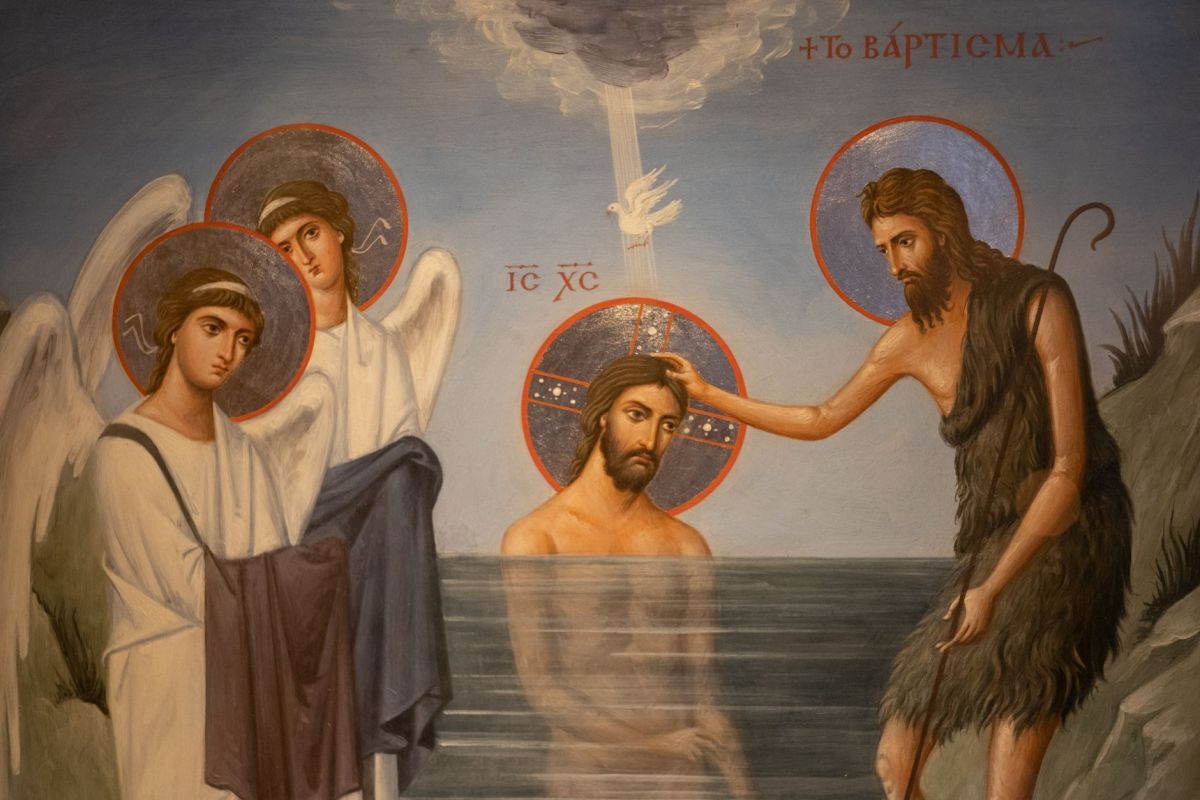
Paul uses the example of Baptism to describe how Jesus em-powers us to overcome the forces of sin. Paul says that baptism is more than a symbol of good winning over evil. For him, baptism is the mechanism by which Jesus instills us with the power to resist sin, and follow in his Way.
It’s easier to understand this if you know that first-century baptism was “full-immersion” baptism. An attendant would have assisted you in stepping down into a baptismal pool, before dunking you in the water. Then you would have emerged, fully soaked, and walked up a different set of steps to leave the pool. In this movement down, and then up again, it was understood that you were spiritually entering your own grave, and then rising from the dead – following the same pattern as Jesus.
Even though we follow a different practice today, the meaning is still the same. In the act of baptism, we descend into our own – and Christ’s own – death, and ascend into the promise of resurrection life. We approach our baptism as wanderers and leave it as pilgrims in the Way of Jesus. And, from that point on, our lives are ordered by the sacrifice and glory of Jesus, enabling us to follow in his footsteps with the assurance that we already know the way.
The powerful mystery of all this is that Jesus is not just an example to us, but an eternal presence with us.
As Byrne puts it: “Christ does not lose his individual personal identity but, nonetheless, as risen Lord and “life-giving spirit,” he somehow “contains” within His person, in a communal sense, the messianic community destined for salvation.”
Caught up in Christ, we become not just a partner with him, but a part of him. We are knit into the tapestry, caught in the web, held in the arms, and adopted into the family of God. From this foundation of love, our lives are transformed. We are no longer pressed down by the power of sin and death, Because we have caught a glimpse of our own resurrection.
For Paul, we are justified, and we receive grace, through fragile, human faith. But the sign of that grace is our life transformed by power of Jesus, which helps us resist evil, choose good, and return to him in repentance.
Contrary to popular belief, Christianity is not about tracking who is right and who is wrong. It’s not about relentless guilt and punishment for our shortcomings and our sins. It is not a divine test that we are doomed to fail. Of course, we will still make mistakes. We will still get caught up in manipulation, half-truths, and self-serving tendencies. We will still let fear burden our decisions. We will still sin.
But, Christianity is about this: Sin doesn’t have power over us anymore. Sin is “dead to us.”
And we are alive! In the creative, abundant, beautiful life of Christ. As a part of his resurrected life, we counter the power of sin by trusting that joy, love, and forgiveness form the pattern of life in his kingdom.
Our daily task is to be present to Christ’s power that is already within us, so that we can follow in his Way more completely: trusting that his “grace is sufficient” to turn our lives around, to heal the things that are broken, and to restore us to his family.
The struggles and temptations of this life are not ours to manage alone. The power of Christ is in us. And, in Jesus, even death leads to new life.
Amen.

