Owe nothing but love

“Owe no one anything, except to love one another; for the one who loves another has fulfilled the law.”

Readings here.

We are in the winding-down phase of Paul’s Letter to the Romans. In fact, it will show up in our Sunday readings for only one more week. It has been a long journey with Paul this summer. And maybe, like me, you’ve grown a bit weary of all of this Romans talk.

But, overall, I would say that this “sermon series” experiment has been a fruitful one. It has allowed us to follow Paul’s argument from beginning to end, giving us a fuller picture of the early church, and, hopefully, a clearer understanding of Christ’s love and our own salvation.

As I mentioned in the sermon I gave at the other campus last week: “At the start of chapter 12, Paul has just completed his rigorous theology of salvation that validates the equal claim of all people to the eternal promises of God.”

Now that his readers are clear about their own salvation, they are invited to respond by following the example of Jesus and living differently than they did before. And Paul doesn’t leave them hanging. He outlines the values and behaviors that exemplify Christ-likeness.

As a writer myself, I can’t help but nerd out over Paul’s elegant framing for this section, which goes from chapter 12 to the beginning of chapter 13.

“Let love be genuine…Owe no one anything, except to love one another.”

Biblical scholar Brendan Byrne refers to this frame of love as a “bracket.” He writes that the bracketing: “enfold[s] all obligations, from the sublime to the most mundane, within the one central response of love. No domain of Christian life stands apart from this core requirement” (Sacra Pagina: Romans, 393).

“Let love be genuine.” That first sentence of chapter 12 gets to the heart of what it means to follow Jesus. The rest of the chapter describes how “genuine love” is made evident through our behaviors: “Rejoice with those who rejoice, weep with those who weep. Live in harmony with one another; do not be haughty, but associate with the lowly; do not claim to be wiser than you are, and so on.”

As chapter 13 begins, Paul reemphasizes the point, this time through the lens of law and duty: “Owe no one anything, except to love one another; for the one who loves another has fulfilled the law.”

God’s laws matter, Paul says, but they matter because love matters. Paul seems to know that we humans have a tendency to hyper-focus on the list of restrictions instead of focusing on the intention behind them. The intention of God’s law is and ever will be: “love your neighbor as yourself.” If you are operating from a place of love, you will make choices that fulfill God’s ethical requirements.

Start from love, and right action will follow.

“Let love be genuine…Owe no one anything except to love one another.”

Paul has answered the question of: “How do we follow Jesus?” with a resounding call to “love.” But the question that remains for us today is: “How do we actually love like Jesus?” Not in the romantic or family sense. Not as a one-off, or simply a nice thing to do when it is convenient. But as a habit that transforms every interaction in our lives.

If you’ve driven on any Austin highways this weekend, you may have seen the latest safety message for Labor Day Weekend: “Drive safe as a labor of love.”

When I saw this message on 290, it surprised me – because it runs contrary to most public safety announcements that warn about personal consequences, like getting pulled over.

Yes, it’s clearly an attempt to make a timely safety message for “Labor” Day. But it also promotes a social ethic: Pay attention out there, because your actions impact others. It could just as easily say, “Drive safe, to love your neighbor as yourself.”

It seems like the public safety people have been reading Romans! In its simplicity, this silly roadside message drives home the cause-and-effect that Paul keeps emphasizing: Start from love – and right action will follow.

This concept came together for me when I read a section of Martin Buber’s I and Thou with friends last week.

Martin Buber, a Jewish philosopher writing at the beginning of the twentieth century, believed that relationships operate in two modes. The most common one – the mode that makes up most of our interactions and experiences throughout life – is called the “I-it” relationship. This is when we interact with one another from a well-meaning, but superficial place.

For example, you and I meet and I make a series of judgments about you based on how you look, where you grew up, your gender, age, and profession. Likewise, you judge me in the same way, painting a picture of me based on a set of identity markers and personality traits.

When we’re done interacting, we might know a whole lot about one another, but we still don’t really know one another. We have seen each other as categories of people, but we haven’t encountered the whole person underneath.

The other mode of relationships is what Buber calls the I-Thou or “I-You” relationship. In this interaction, there is a breakthrough that goes beyond the surface. It’s like our souls meet, and who we are in God’s eyes becomes clear to each of us. Buber would call this, becoming “real.”

The I-You encounter makes us so powerfully aware of God’s love that we are filled with love for all living things. Buber says that, in these flashes of knowing between two people, we are so full of divine love that it is as if we are Jesus on the cross, willing to die for the love of the world.*

We become aware, as Byrne puts it in connection to Romans: “To all – even the most difficult and unlovable – believers owe a debt of love flowing from the love with which God love[s] them…”

In this “I-You” interaction between two people, we become able to love all people without judgment or resentment.

Depending on who you are, Martin Buber’s philosophy is either an “aha” moment or a head-scratching moment. But I bet all of us can remember a time that we connected with someone in a way that made us aware of a presence beyond ourselves and a truth beyond our comprehension.

In fact, I have had those connections with many of you – in the smallest moments. And they give me a sense that anything is possible – and that the world can be better.

“How do we actually love like Jesus?” We pay attention to God-moments in our interactions with our neighbors: with unhoused people asking for money on the street, in the profound observations of children, in the peace of nature, with friends at a football game, or at the “passing of the peace” in church.

We stay attuned to divine love under the surface of all that is – and how it binds us together and makes us whole. Because, when we experience real and genuine love, it enables us to see the whole world through God’s eyes. And we won’t be able to help but give what we “owe” from the abundance of love we have already received.

We will become each other’s labor of love. And we will keep laboring: when we disagree, when our ego gets the best of us, when we’re tired of saying we’re sorry.

We’ll keep laboring in love. Because we know that Love is who we really are in Christ. And what could be better than being real?

Amen.

Let Love Be Genuine | Paul, The Cross, Dolly Parton

Watch the sermon recording here.
Scripture readings here.

Today’s readings from Matthew and Romans feel like they are meant to go together. Both provide actionable guidelines for living as a Christian. In other words, they teach us about “Christian discipleship”: how to be, act, and move through the world in a way that emulates the self-sacrificial and transforming love of Jesus.

In Matthew, Jesus boils down Christian discipleship into one difficult teaching: “Jesus told his disciples, “If any want to become my followers, let them deny themselves and take up their cross and follow me. For those who want to save their life will lose it, and those who lose their life for my sake will find it.”

That command – to “take up their cross” – is not a throwaway line on the way to some other point, but central to Christian identity. The image it evokes – of total self-sacrifice – is what differentiated the first Christians from the self-preservation and bravado of the surrounding culture. And it is what inspired the first Christian martyrs to endure persecution, knowing that what looked like death to outsiders was the way to everlasting life.

But death is not the only meaning of the cross. In fact, scholar Andrew McGowan says that Jesus’ call to “take up the cross” is not primarily about the death that comes at the journey’s end, but about the path leading up to it.

Crucifixion on a cross was reserved for those deemed least significant in Roman society: enslaved people, criminals, and traitors. Carrying your cross through the streets, moving slowly through the jeering crowds, was to be put to shame. It was to be told by everyone who mattered that you didn’t matter. McGowan says “the image of “taking up the cross” refers to that journey of shame.”

For those first disciples and for us, “taking up the cross” is not about death, but about life: both the life we dare to lead when we risk shame and misunderstanding to follow Jesus and the life that awaits us on the other side of death, in eternity with him.

Taking up the cross also invites us to enter the full story of Jesus, just as he entered ours in the incarnation. We are being invited to take a walk in Jesus’ shoes. To participate in his life, not just observe it with detached sympathy. And against common sense, to find that placing ourselves in circumstances of shame and suffering brings us closer to the beating heart of God.

And this is where Romans comes in. As you’ll recall from Rev. Mike’s sermon last week, Paul has just completed his rigorous theology of salvation that validates the equal claim of all people to the eternal promises of God. Paul will spend the final chapters of his letter sharing practical advice on Christian discipleship. In other words, he will connect the dots between what we believe and how that belief is lived.

The portion we read today works as a direct response to the question we might have after Jesus’ teaching in Matthew: What does it mean to take up our cross and follow Jesus? Put another way, what does it mean to practice Christian discipleship?

Paul boils it down to one, deceptively simple teaching: “Let love be genuine.” Everything that follows in this chapter describes the impact of genuine love.

Scholar Brendan Byrne says that, up until this point in Romans, when Paul mentions love, he is referring to God’s love (Romans, Sacra Pagina). But now, Paul says, “the ball is in your court.” God’s love and mercy have been poured out on us through the saving grace of Jesus Christ and we are empowered to share it.

This is what salvation means and does. It makes us, not just recipients of divine love, but participants in it. Genuine love compels us to respond to one another’s joys and sorrows as if they were our own. And when we turn toward others in this way, we are drawn closer to the beating heart of Jesus.

This is what it means to “take up our cross”: to love so well that, when people look at us, they see Jesus.

Who reveals Jesus to you? What can you learn from them?

Like many of you, I spent much of last week mourning the death of a modern-day saint, Dolly Parton. While I didn’t follow her career closely, I was always delighted to see clips of her interviews and guest appearances. As a singer myself, I have always admired her soprano voice that was both soaring and sweet, and the way she wore her heart on her sleeve, in her art and in her life.

This week, a group of us got to talking about what made her so universally beloved. Online eulogies crossed political, cultural, and generational lines. Even those who didn’t share her beliefs proclaimed their love for her. One atheist online commented that they were willing to believe in Heaven since that was the only place suitable for Dolly Parton.

Undoubtedly, Dolly Parton was human. As a public figure, there is much we will never know about her private life, but we can assume she had hard days just like the rest of us.

But, I think Parton had such an impact on people because the central ethic of her life was “genuine love.” She loved migrant workers and gay people and Republicans and Democrats. She loved poor Appalachians and rich, coastal elites, and everyone up, down, and in between.

When people got mad at her, she never retaliated. She simply apologized. And she didn’t entertain manufactured conflict. She was steady in her beliefs and her behavior. She lived her values. She carried her cross.

Which is to say, Dolly Parton loved so well that, when people looked at her, they seemed to see Jesus. They were able to love themselves and, in turn, love others, because she radiated so much resurrection light.

When we talk about Christian discipleship, it is easy for us to boil it down to a list of behaviors. Metrics by which we measure our progress in some kind of punishing Christian fitness program.

But Paul’s words are not a checklist. And carrying our cross is not about proving to anyone that we are worthy of salvation. Carrying our cross is an invitation to participate fully in the life of Jesus. To live and love as God intended, wearing our hearts on our sleeve.

Because it is here that we find abundant life: in laughter and weeping, in humility and vulnerability, in forgiving, in letting go. In admitting our faults so that we can love faulty people. In choosing each other when the world would try to make us enemies.

Living in love is risky. People will take advantage of us. People won’t understand. We might lose respect, or security, or friends. There will be times that we don’t want to keep trying. Where our patience wears thin and self-preservation wins over our good intentions.

There will be times that we resist it, because it feels like one more act of self-denial will make us lose ourselves. But, if Dolly Parton taught us anything, it’s that living in “genuine love” is not a process of disappearing for the sake of others, but of becoming more yourself. As Rev. Mike put it last week: “become what you already are.” Because, when we stop trying to fit in with everyone else and start trying to be like Jesus, we find that we are finally free. We have been loved into who we were meant to be.

Our cross is a weighty one. But, when we dare to take it up, we will find that it is not a burden, but more like a weighted blanket. Our cross is a holy paradox: signaling death and yet revealing resurrection.

The jeering crowds around us will tell us we’re walking toward our own grave. But we know better. We walk in love, and we’re more alive than we’ve ever been. Amen.

Caught up in Christ: Romans, Sin, Baptism

Readings here

As you’ve probably heard, during the next few months, the clergy of this church will be preaching with a special focus on Paul’s Letter to the Romans. Our hope is that we’ll all get to the end of this season with a better understanding of the Apostle Paul, the first-century Church in Rome, and what this ancient letter has to say for us today.

You may recall that, over the last few chapters, Paul has been working out a theological position, which he describes as “justification by faith.” The church in Rome seems to be struggling to understand how to integrate Jews and Gentiles into shared life under a new identity which will come to be known as “Christianity,” At this time, following Jesus is simply called, “The Way.”

The congregation in Rome is asking: “What does it mean for a non-Jew to be brought into the promises of the God of Israel?” “How should these Gentiles behave?” “And which laws should they follow?”

Paul says that the only measure by which a Christ-follower is judged is “faith.” Rather than ethnically prescribed laws or rituals, this is the thing that will unify all people who follow in the Way of Jesus. So, to be “justified by faith” is to be brought into the promises of God – not by proving ourselves worthy – but by turning to God with the expectation that we will receive his grace – his “unearned favor.”

Today, we continue in Romans 6. At this point, Paul is offering a necessary point of clarification to “justification by faith.” Because, he realizes that, by telling people that they don’t have to follow God’s laws in order to receive his grace, he might have opened the door to a…well, moral free-for-all.

“Hold up!” he says. “Just because God doesn’t choose to save you based on how well you behave, it doesn’t mean that we should change the words of that folksy hymn to: ‘they will know we are Christians by our hedonism.’”

With that in mind, for the next couple of chapters, Paul decides to focus on the concept of sin.

But, what does Paul mean when he uses the word, sin? I think, for most of us, sin is thought of as a personal offense. Sin is about “me” making a mistake because of some shortcoming within myself – which means the entire responsibility is on me to fix it. (As a Type A, eldest daughter, Enneagram 1, I confess that I live a lot of my life as if this is true.)

But, for Paul, sin cannot be fully understood as a consequence of personal weakness. Scholar Brendan Byrne says that Paul understands sin as “a ‘power’ tyrannizing the human race” (Brendan Byrne, Sacra Pagina: Romans).

In other words, sin is, in some ways, external to “you” or “me.” It is like a parasite that can get ahold of you and make you act against your sincerely held values. It is temptation that takes innocent needs and desires, and twists them into something ugly, instead of life-giving. And it is systemic – in that, it can ensnare a community, a nation, and even the world in its distortions.

Sin can make people of goodwill act against the will of God. And Paul doesn’t think that it’s something any of us are meant to overcome on our own. Its power can only be diminished by a greater power. And for Paul, this is the power of Jesus.

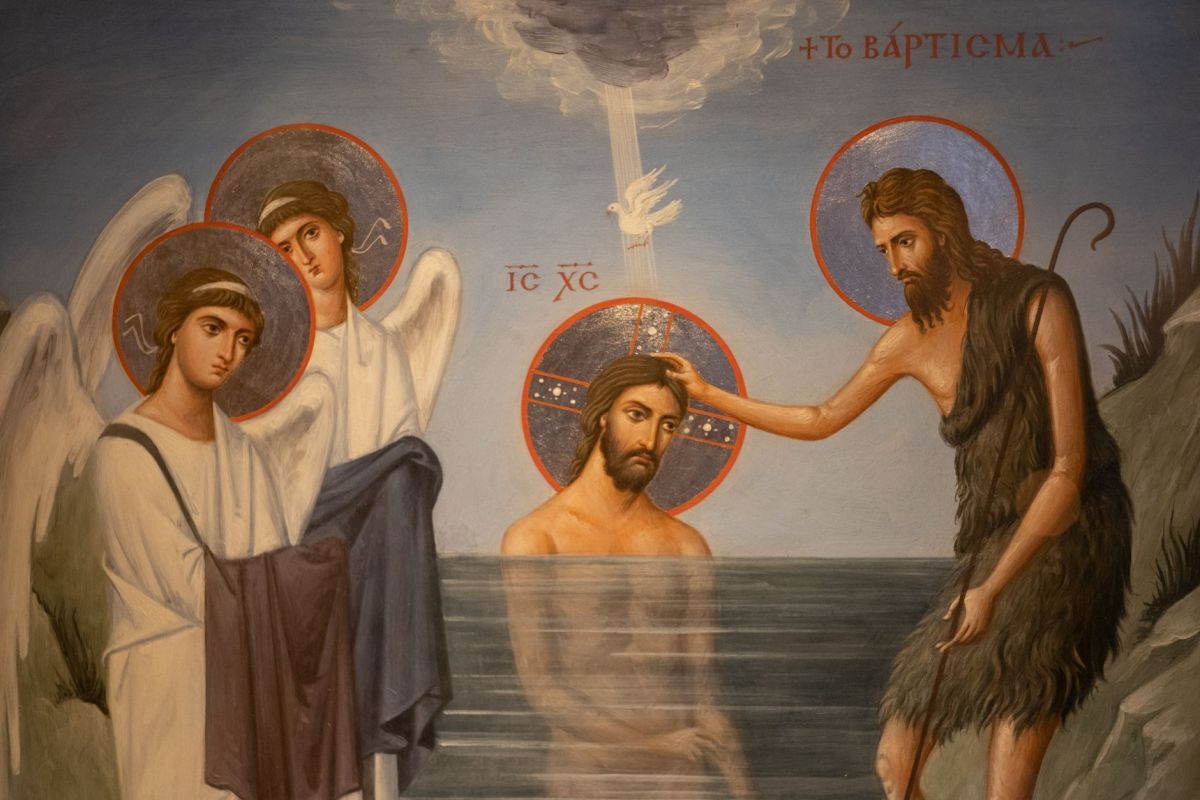
Paul uses the example of Baptism to describe how Jesus em-powers us to overcome the forces of sin. Paul says that baptism is more than a symbol of good winning over evil. For him, baptism is the mechanism by which Jesus instills us with the power to resist sin, and follow in his Way.

It’s easier to understand this if you know that first-century baptism was “full-immersion” baptism. An attendant would have assisted you in stepping down into a baptismal pool, before dunking you in the water. Then you would have emerged, fully soaked, and walked up a different set of steps to leave the pool. In this movement down, and then up again, it was understood that you were spiritually entering your own grave, and then rising from the dead – following the same pattern as Jesus.

Even though we follow a different practice today, the meaning is still the same. In the act of baptism, we descend into our own – and Christ’s own – death, and ascend into the promise of resurrection life. We approach our baptism as wanderers and leave it as pilgrims in the Way of Jesus. And, from that point on, our lives are ordered by the sacrifice and glory of Jesus, enabling us to follow in his footsteps with the assurance that we already know the way.

The powerful mystery of all this is that Jesus is not just an example to us, but an eternal presence with us.

As Byrne puts it: “Christ does not lose his individual personal identity but, nonetheless, as risen Lord and “life-giving spirit,” he somehow “contains” within His person, in a communal sense, the messianic community destined for salvation.”

Caught up in Christ, we become not just a partner with him, but a part of him. We are knit into the tapestry, caught in the web, held in the arms, and adopted into the family of God. From this foundation of love, our lives are transformed. We are no longer pressed down by the power of sin and death, Because we have caught a glimpse of our own resurrection.

For Paul, we are justified, and we receive grace, through fragile, human faith. But the sign of that grace is our life transformed by power of Jesus, which helps us resist evil, choose good, and return to him in repentance.

Contrary to popular belief, Christianity is not about tracking who is right and who is wrong. It’s not about relentless guilt and punishment for our shortcomings and our sins. It is not a divine test that we are doomed to fail. Of course, we will still make mistakes. We will still get caught up in manipulation, half-truths, and self-serving tendencies. We will still let fear burden our decisions. We will still sin.

But, Christianity is about this: Sin doesn’t have power over us anymore. Sin is “dead to us.”

And we are alive! In the creative, abundant, beautiful life of Christ. As a part of his resurrected life, we counter the power of sin by trusting that joy, love, and forgiveness form the pattern of life in his kingdom.

Our daily task is to be present to Christ’s power that is already within us, so that we can follow in his Way more completely: trusting that his “grace is sufficient” to turn our lives around, to heal the things that are broken, and to restore us to his family.

The struggles and temptations of this life are not ours to manage alone. The power of Christ is in us. And, in Jesus, even death leads to new life.

Amen.