Nathan Chen is about to show up and do a back flip | Advent 1 Sermon

Readings here

Almighty God, give us grace to cast away the works of darkness, and put on the armor of light, now in the time of this mortal life in which your Son Jesus Christ came to visit us in great humility; that in the last day, when he shall come again in his glorious majesty to judge both the living and the dead, we may rise to the life immortal. Amen.

Today is the first day of Advent – the start of the Christian new year. Advent is often translated as “arrival,” but it can also carry a more active connotation: “coming.” The Season of Advent holds the fullness of these meanings. We acknowledge with renewed hope that Christ has already come to earth, and has already defeated death – he has arrived. And we anticipate Christ’s second coming – he is still on his way.

We are celebrating, but we are also waiting for the final celebration, when Christ will come in “glorious majesty” to restore all things.

The longer I have been in a congregation that follows the church seasons, the more I have come to appreciate them. While there is no way that Christians in the fourth century could have anticipated the cesspool of consumerism that this season has become, their work on the church calendar continues to be a blessing…

Because, following it – especially in this season – reorients our focus from the frenzy of secular Christmas, and calls us to a deeper, more focused anticipation. There’s no harm in enjoying the superficial fun of the season: Santa Claus and Jingle Bells and gift exchanges are perfectly acceptable ways to celebrate with family and friends (even if it is still Advent).

But, the church calendar reminds us that there is something eternal at work underneath all these distracting celebrations. There is something that calls for our singular attention, not as a test of our faithfulness, but because it is so wonderful. Someone has arrived to change everything, and he will carry us into a future of unfettered joy and ultimate freedom.

As a thought experiment, I tried to think of a time when I was called to pay singular attention, simply because it was so wonderful. It wasn’t as hard as I thought it would be…

When I was at Yale Divinity School, I got word that the Yale Figure Skating Club was putting on their winter show. Made up of amateurs, the show was typically just a way for hobby skaters to have some fun while their friends cheered them on. But that year, there were whispers that a special guest was coming…

Three-time world champion and two-time Olympic figure skater Nathan Chen was enrolled at Yale that fall. And word on the street was that he was going to come to the show.

With uncharacteristic clarity of purpose, I convinced a small group of seminarians to take the hike over to the main campus to see what we could see. I was the only figure skating mega-fan among them. So, while everyone else bought concessions and chatted about term papers, I was staring straight ahead, hand on my chin, laser-focused on the rink. I didn’t dare leave my seat. If Nathan Chen was going to be there, there was no way in heck I was going to miss it.

After more than a half-hour of very sweet performances by people who could barely skate, a young man swiftly and silently skated onto the ice. My friends – lulled into the stupor of greasy food and easy conversation – didn’t seem to notice…But I noticed.

I let out the loudest, highest, most piercing, blood-curdling scream. It was so unlike me, that I didn’t recognize it as my own voice until the person in front of me turned around in shock.

Nathan Chen was here, in the same room as me, and he just did a back flip!!! (They didn’t even let him do that at the Olympics because they thought it was too dangerous!!!!) And then, he did his signature quadruple jump, the move that would win him the gold medal in 2022.

The adrenaline was coursing through my body, probably as much as it was coursing through his. And I was just sitting there.

Amid the chatter and distraction around me, something demanded my singular attention. And I was determined not to miss out on the realization of the hope that I had carried with me to the rink that day. I didn’t know when he would arrive, but I trusted that he would.

And what I found was that the wait was worth it, not just for the satisfaction of seeing a dream realized. It was worth it to gather up my new friends, take a risk in inviting them, and spend an afternoon passing the time together in that chilly rink. The joy was abundant even before Nathan Chen got on the ice. The light was already breaking through…but nothing could beat that back flip!

In today’s reading from Matthew, Jesus tells his followers to pay attention: to “keep awake,” not as a test of their faithfulness, but because something wonderful is on the way. Jesus “will come again in glory to judge the living and the dead, and his kingdom will have no end.”

And, while no one knows the day or hour that Christ will return, they should “stay on the alert” with such single-mindedness that it is almost as if they’re waiting for a thief to break into their home. In modern terms, we might say it is almost as if record-breaking figure skater Nathan Chen is about to show up and do a back flip.

We don’t know when he’s coming, but the only way to live, in the meantime, is to stay alert to the promise that Christ will come.

Dr. Andrew McGowan notes the paradox in this idea of staying alert to a thing you can’t predict. He says:

“Jesus’ apocalyptic proclamation is framed by Matthew not as futurology, but as a call to live in a particular way now…So, while Jesus warns from trying to correlate world events and the end of time, the paradoxical message remains that the reader needs nevertheless to “watch,” even without knowing just what we are watching for.”

What Jesus is doing here is making it impossible for us to inoculate ourselves against the unimaginable glory of his coming kingdom. If we don’t know when he’ll arrive, we can’t settle the issue; we can’t put the Kingdom of God in a box.

What’s more, we can’t take a break or rest on our laurels. We’ll just have to be laser-focused on the loving, self-sacrificial, lively work of his kingdom. We’ll just have to let joy run in our veins like adrenaline, until it becomes infectious. We’ll have to take action based on the assumption that all our hopes will be realized.

Christ is coming – we don’t know when or how. But we know that when he comes, death itself will die, and we will live in the eternal light of God. In the meantime, we live with the knowledge that he has already arrived by looking for the cracks in the world where his light is already breaking through. And we make plans that align with God’s promises of joy and freedom, of wholeness and reconciliation, of unconditional love.

This is what Advent is all about.

At the beginning of a new year, we learn again how to “stay awake” to the presence of Christ who was and is and is to come. We learn again how to live in the paradox that some theologians describe as the “already and not yet” – anticipating the glory of Christ’s second coming without losing sight of the light that is already breaking through.

“Come, let us walk in the light of the Lord!”

Amen.
Surprise, Inspiration, Bold Proclamation: Advent 4

Five years ago, I journeyed to the diocesan offices in Richmond, Virginia to undergo several hours of interviews for “postulancy.” Postulancy is the first step, of many, on the path to ordination in the Episcopal Church.  

I have heard some people call postulancy the “narrow gate.” Because, for many people, this is the most critical step in an ordination process. In these interviews, the aspiring priest is compelled to describe their call with clarity and conviction to a roomful of strangers. 

That day in Richmond, I was finally at the end of my interview, and they asked the closing question: “Is there anything else you’d like to tell us?” 

To everyone’s surprise – including my own – I blurted out some garbled sentence about Mary. Whether compelled by the Holy Spirit or by the delirium of anxiety, in that moment, I needed to talk about Mary. It suddenly felt urgent to tell them that Mary’s call by God to mother the Savior of the World meant a whole lot to me. 

As a kid growing up in churches that didn’t let women teach or preach, Mary had become my friend. She was a reminder that women could also be a part of God’s story. And not only that: in the story of Jesus, especially Luke’s telling, women are the first to be called. 

Mary, and her cousin Elizabeth, are prophets and apostles in the first chapter in the story of Jesus. In the most literal terms, they grew, nurtured, and birthed good news into the world, Elizabeth, as the mother of John the Baptist, and Mary, as the mother of Jesus. 

Jesus’ ministry with and for us on earth occurred, because Mary took the risk of saying, “Here am I, the servant of the Lord.” 

I told the committee all of these things as I pondered them in my heart. I pondered a little too hard, because I started crying from the beauty and weight of it all. 

My rector, who had accompanied me to the meetings, had an amused expression on his face. Later, we laughed together as he recounted how I had made myself cry during an optional question at the very end of a long interview. But, I’m glad Mary showed up during that intense moment in my life. 

Because, in many ways, she is the template of the life of faith, not one defined just by having the will to believe, but by moments of surprise, inspiration, and bold proclamation that lead to sustained trust in God. 

In today’s Gospel reading, Mary is inspired by Elizabeth’s Spirit-filled blessing to view her strange and miraculous pregnancy within the whole history of God’s persistent goodness. As soon as Elizabeth calls her “blessed,” she starts up with an original song we now call the Magnificat… 

He has mercy on those who fear him
in every generation. 
He has shown the strength of his arm,
he has scattered the proud in their conceit. 
He has cast down the mighty from their thrones,
and has lifted up the lowly. 
He has filled the hungry with good things,
and the rich he has sent away empty. 
He has come to the help of his servant Israel,
for he has remembered his promise of mercy. 

Though her words are spoken with the boldness of a prophet, Mary is not foretelling the future. With sudden urgency, she is actually sharing what has already, and always, been true about this loving, generous, just, and merciful God.  

She says: God has already fed the hungry; freed his people from slavery; dethroned tyrants; sustained orphans, widows, and refugees; and brought the lost back to their homes, back to the flock, and back into the arms of God. 

Maybe Mary surprised herself when she blurted all that out. Maybe God’s promises had felt far away for awhile. Maybe on that long journey to visit Elizabeth, the initial joy of her miraculous pregnancy had given way to fear, confusion, and even doubt. 

But then, the Holy Spirit prompted Elizabeth to say exactly what Mary needed to hear: “Blessed is she who believed that there would be a fulfillment of what was spoken to her by the Lord.” 

Elizabeth’s words rang true. They hit her like a bolt of lightning that illuminated the dark night of Mary’s strange circumstances. It helped for someone else to say, out loud, that she had already been called, and that meant she could rise to the challenge of God’s continued call on her life, no matter where it took her.  

This realization compelled her to sing! She had professed God’s goodness, she had seen the proof of that goodness throughout time, and now it was time to trust it.  

This is how she embodied the life of faith: as a cycle of memory, inspiration, and bold proclamation, with each one necessary to reviving and sustaining the other. 

This week, New York Times columnist David Brooks, wrote a piece on his own life of faith, entitled The Shock of Faith: It’s nothing like I thought it would be (gift link). In it, he shares the non-linear path that led him from atheism to whole-hearted participation in Jewish and Christian communities.  

He talks about coming to faith, not as single moment of conversion, but as “an inspiration” that occurs at various times throughout life. He says that the first time he felt this inspiration, it was “as though someone had breathed life into those old biblical stories so that they now appeared true.” 

In particular, Brooks shares a story about being startled by God on a hiking trip, as he read a Puritan prayer: 

Let me learn by paradox that the way down is the way up,  
That to be low is to be high,  
That the broken heart is the healed heart,  
That the contrite spirit is the rejoicing spirit,  
That the repenting soul is the victorious soul. 

Suddenly, it hit him that these paradoxical sayings were true. He says he was “seized by joy” and suddenly aware of the beauty all around him. 

In a paragraph that recalls Mary’s Magnificat, Brooks goes on to say: 

“That contact with radical goodness, that glimpse into the hidden reality of things, didn’t give me new ideas; it made real an ancient truth that had lain unbidden at the depth of my consciousness. We are embraced by a moral order. What we call good and evil are not just preferences that this or that set of individuals invent according to their tastes. Rather, slavery, cruelty and rape are wrong at all times and in all places, because they are an assault on something that is sacred in all times and places, human dignity. Contrariwise, self-sacrificial love, generosity, mercy and justice are not just pleasant to see. They are fixed spots on an eternal compass, things you can orient your life toward.” 

Brooks suggests that faith may be born in the will to believe, but it is sustained in transcendent moments of awe, in nudges from the Holy Spirit that lead us to recall God’s faithfulness in history, and trust in his goodness, in all times and places. 

Through the witness of their lives, Mary and other people of faith remind us that goodness is intrinsic to God’s nature, and that love, generosity, mercy, and justice are God’s intended order of the universe. 

Yet, even as we will ourselves to believe, we cannot guarantee that the life of faith will prevent fear, confusion, or even doubt. We may not always feel like a part of God’s story. We may need someone to bless us and remind us of how God sustained his people in the wilderness. We will need to be inspired, in quiet moments and lightning bolt shocks, over and over again. 

My hope in these last days of Advent is that we take heart and find moments of joy in our life of faith, unburdened by worries that we’re not holy or good enough to be called by God.  

Like Mary, we can embrace this journey with God as a cycle of memory, inspiration, and bold proclamation, with each one necessary to reviving and sustaining the other. 

God calls us, and God will come near to us again. Amen. 

Eternal Word, New Beginnings

Readings here

Today is the first Sunday in Advent.  The word Advent means arrival. But we’ll get back to that later. Today also marks the beginning of a new year for the church.  So, Happy New Year! 

When we think about typical new year’s festivities, we probably imagine raucous celebration. The ball drops, couples kiss, and fireworks go off around the world.  People crowd into streets, bars, and houses in sparkly clothing. And strangers drink and even sing together like old friends. 

The next day, people make and eat special New Years’ food, thought to bring good luck: black-eyed peas, tamales, goose, and even pickled herring make the list.  In my family, we eat corned beef and cabbage. 

All of these traditions seem to be a way to conjure optimism out of thin air. They encourage us to perform reckless and unjustified hope. The drinks and debauchery help us literally forget the old year, with its old sorrows and annoyances. And in the hazy glow of midnight, we can look forward to a limitless future. 

We tell ourselves: this year is gonna be different.  We’ll finally become who we always wanted to be. We’ll finally get the job, mend the relationship, make the move, start the workout, and get the good news.  

We have no reason at all to believe any of these things are influenced by the fact that it is a new year. But, we decide to believe things will change…at least until the end of January. 

— 

In Christian tradition, our Advent new year is also a season of hope.  But our hope looks a little different. And, unlike new year’s resolutions, it’s a pretty bad conversation starter at holiday parties. Because, Christian hope is apocalyptic. Which is to say, it has a lot to do with the end of the world. 

By now, we are well-acquainted with the apocalyptic literature of the Bible. Our scripture readings have been tracking with the apocalypse for a couple of weeks now. In Daniel, Jeremiah, Revelation, the Gospels, and even the Psalms, we have heard prophecies proclaimed about the end times. Today, we hear news of a mysterious “Son of Man” who is coming to judge the world. 

These apocalyptic predictions are kind of like New Year’s Resolutions – in that they help us imagine the future. But there’s one big difference: these scriptural resolutions are not about hoping for things you can put on your resume or brag about on Facebook. 

And they are not about forcing unjustified optimism that only lasts a month. At their core, they seek to legitimize and justify hope, and to make it more than a game of personal willpower. 

On its surface, apocalypse can seem grim. But it’s not supposed to be traumatic. It is meant to be just alarming enough to wake us up and turn us around, so we can see the big picture. 

It draws us into the mystery of our faith. And this mystery dwells in paradox. Appearing to be about the future, predictions of the final judgment are actually the story of everything, reaching back to the farthest past.  

They compel us to look forward to the final days, but when we do that, we end up being drawn back to the very beginning, when the breath of God moved over the waters before time began. With a word, God created the world. And at the end, the same Word, the Word made flesh in Jesus, “will come to judge the living and the dead.” 

The creative presence of God imbues all things, at all times and in all places. This is big news! And it is the cause for our hope. 

— 

But still, the fact remains that we are in the middle of things, and the middle is an unsettling place. What do we do with ourselves in the present tense? How do we read the signs? How do we know that Christ is coming near? 

Let’s take a closer look at today’s reading from Luke: Jesus starts with a pretty typical apocalyptic message.  There will be weird shifts in the planets, eclipses, weather events, and terrible tidal waves. A collective sense of foreboding will fall upon the face of the earth. Then, the “Son of Man,” the long-awaited Messiah, will descend from on high.  

We assumed all these signs were pointing to a terrible end. But it turns out, this Son of Man, Jesus, has come to redeem the world. 

And what does redemption mean? It means someone pays all of your debts and sets you free from bondage and obligation.  It means everything that was taken away is now given back to you and you have everything you need. 

Jesus clarifies his words with a parable… 

‘”Look at the fig tree and all the trees; as soon as they sprout leaves you can see for yourselves and know that summer is already near. So also, when you see these things taking place, you know that the kingdom of God is near. Truly I tell you, this generation will not pass away until all things have taken place. Heaven and earth will pass away, but my words will not pass away.’ 

Jesus says, this is how you know that Christ is coming near: the things you took as signs of death are being transformed into new life. 

Like fig trees sprouting new leaves, just in time for summer.  You’ll have delicious fruit to eat by August. 

The signs of Christ’s coming, even when they are foreboding, are not intended to be understood through a lens of death and destruction. Like winter turning into spring, signs of death ultimately lead to new life: the branch springing up, the new leaves on the fig tree, freedom and fresh starts. These signs of life are already present with us, and they’re just as real as death. Christ is already near. 

It is good for Christian apocalypse to be central to our faith, because it is an antidote to atrophy. We don’t accept death as the end of the story. And this means we live our lives with persistence., taking care of our neighbors, praying for restoration, and abounding in love for another. 

— 

The trials and tribulations endemic to this world wear on us. We are tired and afraid. We’d like to forget about our troubles for a little while. I think people have probably felt this way since the world began. 

But Jesus shouts, now is not the time!  Now is the time to “be alert” and pay attention!  If you don’t pay attention, you’ll miss the buds on the branches. You’ll miss the joy of the sweet, sticky figs. 

You’ll miss the fact that the Word of God is speaking into darkness, and always doing a new thing. 

— 

And that’s what Advent is really about. Whether we’re looking back to creation, or the incarnation, or looking ahead with fear and trepidation, God is always interrupting time to do a new thing. 

Advent means arrival, after all. And what is arrival but an interruption, an abrupt end of one thing and the start of a new thing? The arrival of a baby that will save the world. The arrival of a King that will make our winter spring.  

In Advent, timelines merge, worlds collide, and life on earth takes on the afterglow of Heaven. Here, darkness is always muddled with light, and endings are always new beginnings. 

Here, hope is always justified by the glorious, persistent goodness of the eternal Word, surprising us with redemption, over and over again. Happy New Year! 

Divine Reassurances and Difficult Questions: A Sermon on Mary

Advent 4, Year BReadings here

For the past couple of months, I’ve have been slowly making my way through a book series about Jesuit priests who travel through space to meet singing aliens.

While these books, The Sparrow and Children of God, sound pretty lighthearted in their premise, they are actually extremely intense. They follow a Jesuit and linguist named Emilio Sandoz through the thrill of discovering alien life, the tedium of the long journey to another planet, the awe of taking that first step into completely foreign territory, and the surprising joy of engaging meaningfully with another sentient species.

Throughout the books, Sandoz is depicted as a person of wavering faith. Though he has devoted his life to God, he still grapples with life’s most difficult existential questions.

Questions like: Am I really doing what God wants me to do? Where is God in all this suffering? How can beauty and pain exist simultaneously?

But here’s the question the story seems to ask more than any other: If I had known what I know now, would I have followed God’s call on my life?

Early on in the first book, Sandoz has an experience of God so profound that those witnessing it say his face was shining like a saint. But that moment of spiritual certainty is overshadowed by years of tragedy, loss, and physical disability. Sandoz spends the rest of his life wondering what it could mean to have received divine reassurance that God has a plan for him, but to still be grappling with the confusion, doubt, and discomfort of not really knowing what will happen next.


Because I have been living in this alien world with Emilio Sandoz for so long, I can’t help but imagine Mary grappling with the same divine reassurances, and the same difficult questions.

But before I get into that, let me give you a bit of background on what we might call the “Mary Discourse.”

For the past few years, it has been trendy for preachers to riff on the popular Christmas song: “Mary, did you know?”

The song, which we’ll actually hear during the Offertory, goes like this:

Mary did you know
That your baby boy
Would one day walk on water?
Mary did you know
That your baby boy
Would save our sons and daughters?

Did you know
That your baby boy
Has come to make you new?
This child that you’ve delivered
Will soon deliver you.

Though the song was released in 1991, a parody called “Yes, I freaking knew” was shared online in 2019. That song uses all the same words from the original, except each repetition of “Mary did you know?” turns into an exasperated declaration: “Yes, I freaking knew.”

The parody song set off an ongoing conversation about what, exactly, Mary knew when she consented to God’s call on her life. We know that almost immediately after Gabriel’s visit, Mary sings a song about empires falling, and God keeping God’s promises. We call it the Magnificat.

But even though her words are forceful and prophetic, we often talk about Mary as meek, mild, and mostly silent. In other words, there is a disparity between her own words and the church’s historical characterization of Mary.

I mean, look at the hymn we just sang (“The angel Gabriel from heaven came”):

Out of 4 verses, Mary only gets one verse with a speaking part. This, despite being the one who bore Jesus Christ, the Savior of the World, in her own body! The fourth verse has the nerve to give us a speaking part, which doesn’t really seem fair to Mary, since we weren’t there for any of it.

I think the “Yes, I freaking knew” parody is right to point out that Mary wasn’t just a passive part of the story. At some level, of course she knew that saying yes was a big responsibility, with world-changing repercussions.

For us today, Mary is not a “most highly favored lady” because God sent the angel Gabriel to have a little chat with her. We remember her today because she boldy said YES to God’s call on her life.


Today’s passage is all about what it looks, sounds, and feels like for God to call us to something, and for us to respond.

The narrative follows the structure of a classic call narrative. Like the Old Testament prophets and patriarchs, Mary is brought into the terrifying presence of God’s messenger, who shares a bewildering and improbable message:

You will bear the son of God. You, little old Mary, from a region about the size of Houston, Texas, are being asked to consent to something that will risk your future, for the sake of the whole world.

This experience must have been unlike anything Mary could have imagined for herself, a young, poor woman from a marginalized religious group. Like Emilio Sandoz encountering an alien world for the first time, I imagine that Mary felt equal parts joy and wonder as Gabriel told her that the story of salvation was, at last, coming to pass.

She knew, in that moment, that God was at work in the world. And everything would be different.

In the near presence of God, of course she said yes: “Here am I, the servant of the Lord; let it be with me according to your word.”

So, it seems clear that Mary freaking knew, at the moment of her call, that she would play a part in God’s plan. Jesus was coming and nothing would ever be the same.


But could Mary have possibly known…everything?

Could she have known the jumbled beauty and pain of childbirth? Could she have known that Jesus, once he was grown, would put her own people at odds with one another, almost immediately? Could she have known the intricacies of his ministry, and the difficulty of navigating the needy crowds? Could she have known the intense horror and grief she would feel when her son was murdered by the empire?

As Mary sat at the foot of the cross, her son gasping his presumed last breath, do you think she really knew what saying yes to God would mean? Do you think she wondered if she had lost the plot somewhere along the way?

Indeed, even after Jesus’ resurrection, the fledgling church looked nothing like the empire-destroying world Mary sang about in her Magnificat.

Are you there, God? It’s me, Mary.

At the end of Christ’s earthly ministry, I wonder if Mary secretly pondered a question she dared not say out loud: If I had known what I know now, would I have followed God’s call on my life?


I don’t mean to be bleak, but in this last reflective moment of Advent, I do mean to be honest.

When we, like Mary, say yes to where God is leading us, we can never really know what that means for our future. In following Jesus, we are not promised a roadmap. We are not guaranteed glory or safety or a simple life. We are not even promised rational answers to our existential questions.

But, what we are promised is that everything will change, for the better.

As we look forward to celebrating God coming near to us, in the form of a human named Jesus, what we can know is this: It wasn’t enough for God to be at work in the world, in a vague and distant way. It wasn’t enough for God to be just out of arm’s length.

No! For our sake, God wanted to be a baby we could hold, a person we could embrace, a fellow citizen in an unjust empire, a cousin who cries with you at your kitchen table, a friend who tells jokes and calls you on your crap, a son who loves his mom.

We worship an incarnate, em-bodied Savior who calls us, like Mary, to use our own body, mind, and spirit for the sake of the transformation of the world.

He reminds us that, even in our human frailty, we are stronger than we know. Empires will be toppled, and the lowly will be lifted up. And God is, truly, with us.

When we answer the call of the Gospel, we can never really know where Christ will lead us.

But I hope, when Jesus’ tiny hands reach out to you from the manger this Christmas, you can hold him close to your heart, and say: YES.

Amen.

The Kingdom of God, the Kingdoms of this World

A sermon given on the second Sunday of Advent – Readings here

The story of Isaiah takes place over 2,500 years ago. But, because Isaiah’s ministry takes place within a complicated and violent political drama, it still resonates with us today.

Rabbi Abraham Heschel says that:

“the years in which Isaiah began his prophetic activity were the beginning of a most critical period for both Israel and Judah.”i

The threat of military invasions from multiple nations loomed at every border. Vigilante groups took up arms, overstepping the political hierarchy, and stirring up resentment and rage in the population. The Northern Kingdom of Israel had already been suppressed. And now, parts of Judah had been taken over by Edomites and Philistines, who had taken advantage of the chaos to bolster their own political influence.

And then things got even worse. Jerusalem was under siege.

As King Ahaz tried to figure out a way to save his people, and his land, from increasing devastation, Isaiah asked for a meeting.

In chapter 7, Isaiah gives the king a prophetic message:

“Take heed, be quiet, do not fear, and do not let your heart be faint, because of these two smoldering stumps of firebrands…It will not come to pass…If you do not stand firm in your faith, you will not stand at all.”ii

Isaiah tells King Ahaz that the invading armies will leave, and the influence of these antagonistic nations will decrease in time, but Ahaz has to be patient, and wait. He has to believe that God won’t abandon his people.

It’s simply not enough for Ahaz.

He allies with the powerful Assyrians, asking them to send troops and supplies to Judah to help them win the war. He chooses military might over God.

Heschel responds:

“No other ruler would have acted differently. The state was in peril, so he appealed to a great power for military aid. Isaiah offered words; Assyria had an army…

The future of the country was in peril. The king would have had to justify to his people a refusal to ask for help.

So Ahaz decided that it was more expedient to be “son and servant” to the king of Assyria than son and servant to the invisible God. He took refuge in a lie.”iii

The lie was that military power, and not God, could save his people.


The consequences were devastating.

While Ahaz did achieve temporary peace in Judah, it was at a cost to his own personal faith and, eventually, to the survival of his kingdom. Caught up in the thrill of his political alliance with Assyria, he continuously failed to listen to Isaiah’s warnings of destruction.

By the time Ahaz’ son, Hezekiah, took the throne, Assyria was demanding more and more tribute in exchange for their protection. And in the following years, Hezekiah broke ties with Assyria. He allied with Egypt and Babylon, in an attempt to reduce Assyria’s influence.

This was the fatal flaw.

In the coming years, the Kingdom of Judah lost every last bit of its freedom. God’s people were in exile.


This history matters, because it is the context from which today’s Isaiah reading comes to us.

In fact, most of Christianity’s messianic prophecies take place, not in a context of peace, but of utter destruction.

Burned out buildings, streets filled with rubble, air filled with the cries of dying children, and weeping parents. Hostages taken; futures taken. Rage and despair everywhere you turn.

This image of war hits close to home. We can see with the eyes of Isaiah, because we have been inundated with these scenes for two months in Israel and Palestine, nine months in Sudan, and two years in Ukraine.

In fact, the violence is happening all over, every day, and has always been happening, since the beginning of human history.

We continue to live in a world where rulers, civilians, and people of faith are being asked to make impossible decisions, sometimes for our own survival.


But, even while recognizing that there is a real threat, Isaiah asks us: will we choose God or political power?

When we justify the death of civilians, we are not choosing God. When we choose to ignore the suffering of God’s beloved children, we are not choosing God. When we convince ourselves that might makes right, we are not choosing God.

In times of war, we are justified in being afraid.

But Isaiah insists that being afraid can’t justify “taking matters into our own hands.” Because that kind of fear denies the power of God.

Our streets are full of the blood, and the cries of people who bear the image of God. And we are, all of us, complicit. Because we have forsaken our own prophesies. We have forgotten that only God can bring lasting peace, in a kingdom where Christ’s eternal light erases every shadow.


Advent is a time of reckoning with the reality that we are caught between the Kingdoms of this world and the Kingdom of God.

The prophets call us back to this reckoning, even as they sing songs of future peace.

In the beautiful passage we read today, Isaiah reminds us that God yearns to make all things beautiful. He tells us there’s a voice that calls us to clean up the rubble, and make the path straight, so that we can walk, as refugees, to the paradise God has for us.

This voice is personified, in the Gospels, by John the Baptist. He declares that God is speaking “peace to his people,” but we can’t hear it over the bombs. He dares to call people to get ready, repent, and turn away from the kingdoms of this world, so we will notice when Jesus shows up.


Jesus is on his way, and when he gets here, the distance between Heaven and earth comes crashing down into a single plane. When God shows up, everything is different. Everything is made new. Thank God, the prophets are getting us ready!

And thank God for Advent, the season that’s meant to shake us up.

This season reminds us: there is no peace if we keep choosing violence. There is no garden if we keep choosing grenades.

It’s time to say no to the kingdoms of this world, and choose the Kingdom of God instead.


Our prophetic texts tell us that God is ready for us to return.

Jesus Christ, the incarnate God, will scoop us up in his arms and give us a hug. He will stroke our hair and tell us he understands – deep in his bones – what it feels like to fear, what it feels like to be displaced, what it feels like to yearn for peace.

But our prophetic texts also ask us a very important question. And now is the time to answer it:

Are we ready to repent?

Amen.

Sermon: Immanuel

A Sermon for the Fourth Sunday of Advent

Readings may be found here

Through the written word and the spoken word, may we know your living Word, Jesus Christ our Savior. Amen.

I’m about to hit the six-month mark of my ministry here at Grace. These first months have been full of unexpected experiences.

  • I’ve danced to Cuban music in the parish hall. 
  • I’ve tried, and failed, to capture stray cats. 
  • I’ve repeatedly asked God to bless noses, ears, and tummies with the day school kids. 
  • And I’ve participated in a Brubeck Jazz Mass, of all things.

But if someone were to ask me which experience has shaped me the most so far, I could easily sum it up in one word: funerals.

Since July 1st, I have participated in seven funerals. And that’s not even counting the many I have missed.

This number says a lot about the scale of the grief that our community is holding right now. We have lost so many people this year.

And that loss is tangible: Each beloved person who has died leaves an empty seat. Things feel different without their singing and their laughter ringing through the building. 

I imagine that many of us are living in the tension between wanting to “get back to normal” and knowing that we can never really go back to how things were before. Because grief changes us.

And I am far more sensitive to this now, because I have become a student of funerals.

Here are some things I have observed about funerals…

First, funerals create a space for authenticity. Unlike most other public events, at a funeral, no one expects you to act like you’re doing fine. There’s no point pretending.

Second, the liturgy does a lot of the legwork so that we can simply be. It anticipates that each of us responds to loss in highly personal ways. But it also creates sacred space for us to be together in our grief. The funeral service carries us through the tides of sadness, memory, and joy – we are allowed to feel it all, together.

And the biggest lesson of all, funerals are a reminder that simply being there makes a difference. 

In fact, in my particular role, I’m learning that the only way to do a funeral is to be with the people at a funeral.

By being with, I mean to focus on what it means, not just to be present, but to have presence: Pay attention. Ask people what they need. Listen to stories. Speak with reverence. Protect sacred spaces. Acknowledge the value of feeling it all.

Above all, open your heart as wide as possible.

As I reflected on today’s scriptures, I realized that my time at funerals has helped me to feel, in my gut, that it really does make a difference that Jesus is called “Immanuel,” God with us.

Isaiah prophecies that a child will be born to save the people of Judah. He will be called Immanuel. The prophecy claims that this holy child will witness the defeat of the violent and exploitative rulers of the day.

Of course, as we know from our Matthew passage, this prophecy is directly linked to the Christian belief that Jesus is the Messiah, the savior of the world. When a messenger of God appears to Joseph, Matthew’s narrator argues that Jesus’ birth was the fulfillment of the prophet’s words:

“Look, the virgin shall conceive and bear a son,

and they shall name him Emmanuel…”

Now, I should mention that Jewish interpretations of the Isaiah prophecy vary significantly from Christian ones, as might be expected. 

Biblical scholars suggest that Isaiah was speaking of events that would happen within the lifetime of his listeners. This was an uncertain period when ancient Judah was threatened by Syria and the Northern Kingdom of Israel.

So, we see that the Gospel writers use Hebrew prophecy in unexpected, and even contested ways. I mention this only because I don’t want to suggest that everything in the Christmas story is straightforward. 

But if we believe, as I do, that the Gospel writers were speaking to the real experience of early Christian witnesses, then it’s important for us to figure out why these prophecies and stories about Jesus were so important that they needed to be written down.

Jesus’ story is linked to ancient prophecy because there is something happening here that speaks powerfully of who God is…

“Immanuel.” 

For early Christ followers and for us today, everything hinges on the promise that we worship a God whose central quality is “being with us.”

I mean, this is what Christmas is about: the incarnation! God came to earth in human form because it mattered for God to show up. It mattered for the Creator of the universe to be in solidarity with our full humanity: with our laughter and our weeping, our joy and our pain. 

And it matters that he can feel that bodily ache of loss and grief, in just the same way we do. Because God became flesh in the person of Jesus, he identifies with the full spectrum of our experiences, and remains with us when everything feels too hard to bear.

And when you think about it, so much of Jesus’ doing on earth was mostly being with people. On hillsides, in boats, and at dinner tables – even on the cross – he pays attention, asks people what they need, listens to even the smallest voices, protects the vulnerable, and models unconditional love.

To the disappointment of many, he didn’t show up in the way anyone expected – people thought he was going to start a bloody revolution that would signal the end of the world. 

But Jesus’ revolution – this being with revolution – was even more significant than a war. Jesus was killed for claiming that the love of an incarnate God could change everything. In his life, death, and resurrection, he opened his heart so wide that the world, with all of its grief and suffering, could be cradled inside!

Christ, Immanuel, flings out his arms and tells us that all human experience is and will be permeated by the presence and love of God. All things will be redeemed. All suffering will have its ultimate end in the comforting arms of God.

As followers of Jesus, Immanuel, our own work is straightforward:

It is being with: opening our hearts to others, and making room for Jesus to enter into the damaged and grieving caverns of our spirit. 

It is being like Joseph, who decided to stay in the uncertainty and vulnerability of being with Mary and his divine stepson, Jesus, trusting that his presence mattered.

But, alas! I’m getting ahead of myself. After all, it’s still Advent, and we’re still waiting. 

So I’ll share one last image. 

A few years ago, while on a retreat, I prayed with an icon of a very pregnant Mary. Her rounded stomach contained a surprising scene. Instead of a child, she carried the Milky Way galaxy in her womb. 

This abstract representation of the Christ-child reminded me that Christ has always been here, since the beginning of things. The baby we are waiting for already holds the whole world.

My hope for us today is that, in being with one another, holding Christ in our own hearts and bodies, we can make Immanuel fully known. Amen.

Sermon: Origin Stories

Sermon for the First Sunday of Advent

Lectionary Readings here

O house of Jacob, 
come, let us walk 
in the light of the Lord! 

I must admit that I struggled to write this sermon. 

I kept trying to interpret today’s prophetic and apocalyptic lectionary readings through the lens of the increasingly violent news of the last two weeks. 

But my mind kept spinning in circles… 

I couldn’t manage to make sense of any of it. The days counted down and I still couldn’t find the right words. 

  • As I read Isaiah’s prophecy of paradise, I kept thinking about the multiple mass shootings that we have endured over the last couple of weeks. And the bigotry and legacy of violence that make killing our neighbors seem like an option at all.  
  • As I read the Psalm, I found myself sighing with the knowledge that, in every generation, we have needed to pray for the peace of Jerusalem. 
  • As I read Romans’ morality checklist, I found myself frustrated at Paul for wasting his words on little behavioral issues in the midst of so much worldly chaos. 
  • And as I read Jesus’ apocalyptic warning, I wondered, as I often do these days, if maybe we have endured as much as we can.  

Maybe Christ really is coming soon. 

— 

Of course, we know that Christ is coming soon.  

In Advent, that’s what we’re waiting for. Only four more weeks to go!  

Though, I bet when most of us think about Jesus coming this time of year, we are likely picturing a baby in a manger and not a grown man descending from the clouds as our friends and coworkers are mysteriously “taken.” 

But, Advent has always been trippier and time-warpier than the quaint nativity would lead us to believe. 

When Christians use the word Advent, we are simultaneously referring to the arrival of the baby Jesus and the second coming of Christ.  

In other words, his coming and his coming again. 

The mental work of holding the past, present, and future together in our minds reminds us that our faith is disruptive. It takes us out of finite and linear time. 

Just as we think the story has ended, it starts all over again. 

In this season, we are dropped back into a story we are already participating in. 

It is a story that we live as people of faith whenever we declare hope in the face of death and love in the face of hate. 

— 

So, it’s kind of a side effect of Advent that everything feels a bit wobbly. It’s no wonder I struggled to find the words! 

But, as I kept thinking about it, I began to see today’s readings as origin stories… 

Creation and destruction, beginnings and endings. These prophecies, songs, exhortations, and apocalypses ALL tell us something about the ancient people who followed God into the wilderness of their lives. 

They reveal their terror. And their ultimate hope that God would intervene in their displacement and their grief.  

And they reveal a God who promises to intervene, and then actually shows up. 

These stories tell us about the ancestors of our faith, in hopes that we can glean something from their witness and their wisdom. 

In other words, when we tell these stories and listen to them, we are attempting to learn something about who we are and who God is. 

As we hear them, we take on the responsibility of interpreting them and letting them change us. Because our origin stories are not just old wives’ tales or ancient myths. They are calls to action.  

But, I didn’t fully understand all of that until I visited the First Americans Museum in Oklahoma City a couple of weeks ago. 

— 

The museum, which was curated by 39 of the indigenous tribes now living in Oklahoma, is essentially about origin stories.  

Let me walk you through the exhibit… 

At the beginning of the exhibit, you are greeted by a video that tells the creation stories of three of the tribes who were displaced to Oklahoma in the 1800s.  

The clear voice of a young woman pierces the darkened room. She says:  

“Our stories give meaning to our lives. They teach us how to live and how to act responsibly. They are always with us.” 

These indigenous creation stories are harmonious and hopeful. They talk about a divine creator who cares for humankind and gives them everything they need. 

They find food in the fruitful forests of North America, and companionship in the animals around them.  

The Creator is fundamentally good, and all is well in this earthly paradise.  

— 

But, too quickly, you walk a little further in, and the story changes. 

As you turn the corner in the exhibit, a new video begins playing. This time, the mournful voice of an elderly woman sings in the background. 

This is the story of the Trail of Tears… 

Between 1830 and 1850, as many as 200,000 Native Americans were forcibly removed from their homelands by the U.S. government.  

Since the start of European colonization, 55 million Native Americans had already been killed by disease and violence. At least 3,000 more died while taking the arduous journey from the east coast to the expanding American West. 

After they arrived, they continued to face encroachment and violence from white settlers.  

Firsthand accounts describe grandmothers and children being slaughtered in front of their family members. One indigenous educator, still alive today, recalled that her great-grandmother always slept with moccasins on her feet, in case she needed to run. 

This destruction story shapes contemporary indigenous life just as much as their creation stories do. 

— 

And then you walk a little further in… 

In the third section of the exhibit, activists, educators, and elders share stories of indigenous autonomy, pride, and activism. Like the ancient prophets, this generation of indigenous people “have a fire shut up in their bones…and cannot hold back.”  

They are responsible for their stories. Because they know that who they are today is dependent on telling and retelling their stories with as much clarity and truth as possible, in order to understand who they are and who their Creator is. 

Their creation stories remind them that the Creator is fundamentally good, and that the earth is rightfully a place of peace, abundance, and joy. Displacement and destruction cannot take away that promise. When everything is ending, their stories show them how to begin again. 

They tell their stories, because, in doing so, they shine a light on the past that makes a bright future more possible. 

— 

The First Americans Museum gives Christians a good reason to be ashamed of our origin stories.  

After all, the colonists interpreted the Bible’s stories as an excuse for domination. To them, America is what God owed them as God’s chosen people. They failed to remember that whole part about “beating their swords into plowshares.”  

And there is no doubt that the recent massacre in Colorado was influenced by violently homophobic interpretations of Bible passages. 

For good reason, I think we often get hung up on the way our origin stories have been dangerously misinterpreted. It can be easier to keep them at arm’s length.  

But we can’t move forward as people of faith without knowing who we are and who God is. 

— 

When I think about Biblical origin stories through the First Americans Museum’s lens of responsibility, they show me a path forward: 

  • In Isaiah, I hear that God’s aim for all creation is peace, abundance, and joy. 
  • In the Psalm, I hear that our call as people of faith is to praise, pray, build unity, and do good. 
  • In Romans, I hear that our commitments to Christ create new rhythms for our lives that draw us into the fellowship of God’s church. 
  • And in Matthew, I hear that Christ has not deserted us. Though we can’t predict the future or mark our calendars for Christ’s return, we can know that Christ is with us in an eternity that goes in both directions, from past to future. We are never alone. 

— 

We have a responsibility to listen to our stories with faithfulness and humility, and to be honest about the past so that we can travel the path to Christ’s future. 

Advent’s time loop reminds us that we are always in a process of interpreting who we are in light of where we came from.  

And just when we think the story is over, a little light gets into the darkness of our apocalypse, and we can begin again. 

And yes, our stories are often strange and inconceivable. Because in a world burdened with violence and sorrow, it is inconceivable that God could ever show up.  

And yet, our stories remind us that God, in Christ, is present and active.  

They make it a little more possible to believe that our fragile, mortal lives carry meaning and promise.  

They remind us that we are called to build communities without borders or barriers, where love is the highest value. 

Come, let us walk in the light of the Lord! Amen! 

Keep Awake: An Advent Sermon

This post was originally published on stylewise-blog.com on November 29, 2020

Photo by George Becker on Pexels.com

A Sermon Given on the First Day of Advent

Gospel Reading: Mark 13:24-37. Read here.

“And what I say to you I say to all: Keep awake.”
Amen.

Happy New Year!

Today is the first day of Advent, which marks the beginning of a new year in churches that follow the liturgical calendar. While the rest of the world shops Cyber Monday sales and blasts Christmas music from their car radios, the church enters a time of introspection in anticipation of a miracle. In our tradition, the season is often marked by children’s pageants and quaint Lessons & Carols services. A hushed sense of the sacred permeates all that we do.

For this reason, Advent has historically been my favorite season. I love the extreme contrast between my religious practice and the chaos of the world. In this season, I get a clear reminder of the way my faith shapes me differently. The hustle and bustle of the world can be overwhelming this time of year; meanwhile, I am patiently waiting for the Baby Jesus.

I have to admit that this year feels different. After enduring nearly nine months of pandemic, shouldn’t there be a baby already?

We have been holding our breaths for new life. We have been waiting for a vaccine that will free us to hug our loved ones again. We have been enduring the pain of social and political questioning. It feels like time either runs ahead, or slows to a halt. I find myself asking how we got to the end of 2020 so quickly, and then complaining that it will never end! I remarked to a friend over the phone last week that, in a way, the pandemic has left us all displaced. We are wayfaring strangers navigating a new world. Everything feels…different, and I am impatient! I don’t feel like quietly waiting for Jesus to come.

I admit that it has crossed my mind that this is the Apocalypse; I know I’m not alone in this, because a quick internet search reveals dozens of article titles ranging from: “The Four Horsemen of the Viral Apocalypse” to, inexplicably, “The Zombie Apocalypse and Covid-19”.

Epidemiologists predicted that this would be an “Apocalyptic Fall,” and it seems that it has turned out that way. If even the scientists are saying it, maybe something is broken. Maybe it really is the end?

It is within this dizziness and disorientation – and frankly, terror – that we read today’s Gospel reading.

This passage in Mark does not sound like the quaint and quiet Advent I’m used to. I’m not accustomed to singing Advent hymns that go: “in those days, after that suffering, the sun will be darkened.” In fact, this chapter is called “The Little Apocalypse.” Linked to the Book of Revelation, it is full of mysterious declarations and disturbing images. Many centuries of Christians have puzzled over these apocalyptic stories, trying to search it for clues. But we’re often left with more questions than answers.

The more I sit with the text, the less I feel inclined to even look for straightforward answers. I am too disturbed, disoriented, and exhausted to make sense of it.

So what do we do with that?

The word apocalypse means an uncovering or revealing, so the question that really needs answering is: what is it revealing? Thanks in part to the fact that I’ve been taking a class on Revelation this semester, I have a few ideas.

First, apocalypse intentionally disrupts our sense of time. This chapter in Mark includes a half a dozen references to Old Testament prophecies while simultaneously telling us that it’s actually about the future. It removes us from the stable ground of the present. Instead, we are pushed back and forth from the strange and foreboding past to the shocking and uncertain future, like time travelers in a dysfunctional time machine.

Apocalypse also disturbs our self-perception. It makes us take a good hard look at ourselves and those around us, to see everything with new perspective. It also makes us ask if we’re ready for Jesus to come to earth. Like children assessing the play room before their parent comes in, we wonder if we have time to clean up the messes we’ve made.

Finally, apocalypse gives voice to suffering. That’s why some scholars call it the “literature of the dispossessed.” What they mean is that people who write and tell such wild, mysterious, and horrifying stories are trying to find ways to say something true about their grief and struggle. Vietnam veteran, Tim O’Brien, writes about this in his essay entitled, How to Tell a True War Story, saying, “when you go to tell about it, there is always that surreal seemingness, which makes the story seem untrue, but which in fact represents the hard and exact truth as it seemed.”

Like a war story, apocalypse is disorienting and disturbing precisely because it mirrors the turmoil in our world. It compels every reader and listener to enter in to the story of chaos and brokenness.

So, it seems that apocalypse pushes our senses to the edge. In this way, what it reveals or uncovers for us is the truth of the world as it really is. We know this world well, because we live in it. Rather than be terrified by its mysteries, apocalypse is reaching out and telling us, “I see what you’re going through and I understand it.” And we are meant to be left feeling that we aren’t wayfaring strangers. Instead, we are slightly bumbling, regular humans on an admittedly scary journey that Jesus shares with us.

So why read apocalypse during Advent? Perhaps, because the season of Advent disorients us, too. We exist in a spiritual story in which Mary is still pregnant and yet Jesus has died. In which we wait for Jesus to come, and also come again. In which Jesus is alive and speaking, even though he’s not yet born. This time-warp can feel disturbing, but it reveals to us something true.

It reveals to us that even in death, we can hope. Even in wandering, we are held steady on the path. And even in chaos, we can see the light of Jesus entering in. Maybe today’s Gospel reminds us to “Keep awake” because once we knowingly enter this apocalyptic way of thinking, we’re simply too excited to fall asleep. Everything is different, and we are right to be impatient. Jesus is coming, and, if I may be so bold, it’s about darn time.

Christmas is coming

awesome yeti ornament nativity scene f10f5 f11

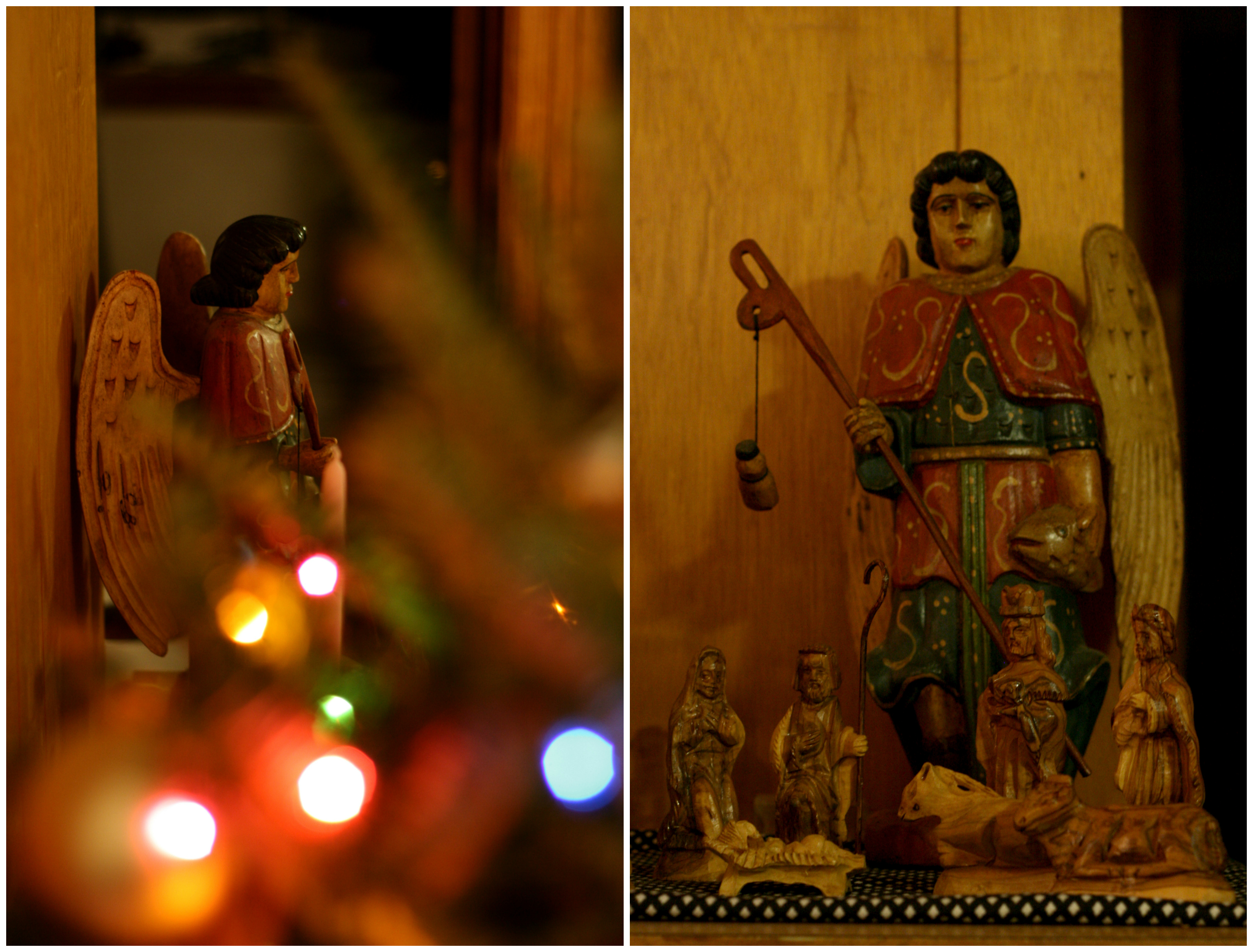
We finally got a Christmas tree! It’s rather small, several feet shorter than last year’s, but it’ll do. Ah, the smell of evergreens. Daniel found a hand-carved nativity scene on ebay last month, so we placed it on our side table next to the tree. I love that St. Raphael the giant archangel watches over the scene.

This past weekend was full of Christmas cheer. We sang carols around the piano at a cocktail party Saturday night, watched the church children’s pageant yesterday morning, and attended our church’s Lessons and Carols service in the evening. Since I’m in the church choir now, I got to participate in all the special music and help lead the congregation in song. I love Christmas when it’s celebrated with intention, ritual, and care. Christmas without the observance of Advent isn’t nearly as lovely (I say this coming from a non-liturgical background)!

“Go and tell John what you hear and see:
the blind regain their sight,
the lame walk,
lepers are cleansed,
the deaf hear,
the dead are raised,
and the poor have the good news proclaimed to them.
And blessed is the one who takes no offense at me.”

– Matthew 11:4-6

first sunday of advent

hk7

Besides this, you know what time it is, how it is now the moment for you to wake from sleep. For salvation is nearer to us now than when we became believers; the night is far gone, the day is near. Let us then lay aside the works of darkness and put on the armor of light; let us live honorably as in the day, not in reveling and drunkenness, not in debauchery and licentiousness, not in quarreling and jealousy. Instead, put on the Lord Jesus Christ, and make no provision for the flesh, to gratify its desires. – Romans 13: 11-14

people, look east

A selection of verses from the Advent hymn, People Look East:

Birds, though you long have ceased to build,
guard the nest that must be filled.
Even the hour when wings are frozen,
God for fledgling time has chosen.
People, look east and sing today,
Love the bird is on the way.

Stars, keep the watch. When night is dim,
one more light the bowl shall brim,
shining beyond the frosty weather,
bright as sun and moon together.
People, look east and sing today,
Love the star is on the way.

Angels, announce with shouts of mirth
Christ who brings new life to earth.
Set every peak and valley humming
with the word, the Lord is coming.
People, look east and sing today,
Love the Lord is on the way.

a poem for Advent

Light of Christ

She held it cupped in her wrinkled palms,
across her lifeline, it burned
And fragmented and grew.
She peered in, squinting hard,
Hands to nose
Stars igniting in her eyes.

She clenched it then, tightly
Pushed it away with the force of her now
elongated arm, like a sigh, or fainting,
or a fervent dance.

She didn’t let go.
Afraid, though, of
The Revealing:
over-exposure,
Conviction – no trial necessary

But it hurt, holding its
heat, its heaviness
She shuttered her eyes

Release.
She knows it’s gone.
She can see the sun with her eyelids pinched tight.
A whisper, a knowing – she musters the courage to
Look.

She is enwrapped in a gown of radiance
frothy and feathered and laden with silk,
A light that imparts light
A glow that reveals, not her own:
griminess, despair, darkness.
The light of truth and love,
The light of Christ encroaching on:
decay, vanity, deceit,
Death.

Embraced, ignited,
A girl on fire
Enshrouded in the revealing and
Holy Light of Christ.