Surprise, Inspiration, Bold Proclamation: Advent 4

Five years ago, I journeyed to the diocesan offices in Richmond, Virginia to undergo several hours of interviews for “postulancy.” Postulancy is the first step, of many, on the path to ordination in the Episcopal Church.  

I have heard some people call postulancy the “narrow gate.” Because, for many people, this is the most critical step in an ordination process. In these interviews, the aspiring priest is compelled to describe their call with clarity and conviction to a roomful of strangers. 

That day in Richmond, I was finally at the end of my interview, and they asked the closing question: “Is there anything else you’d like to tell us?” 

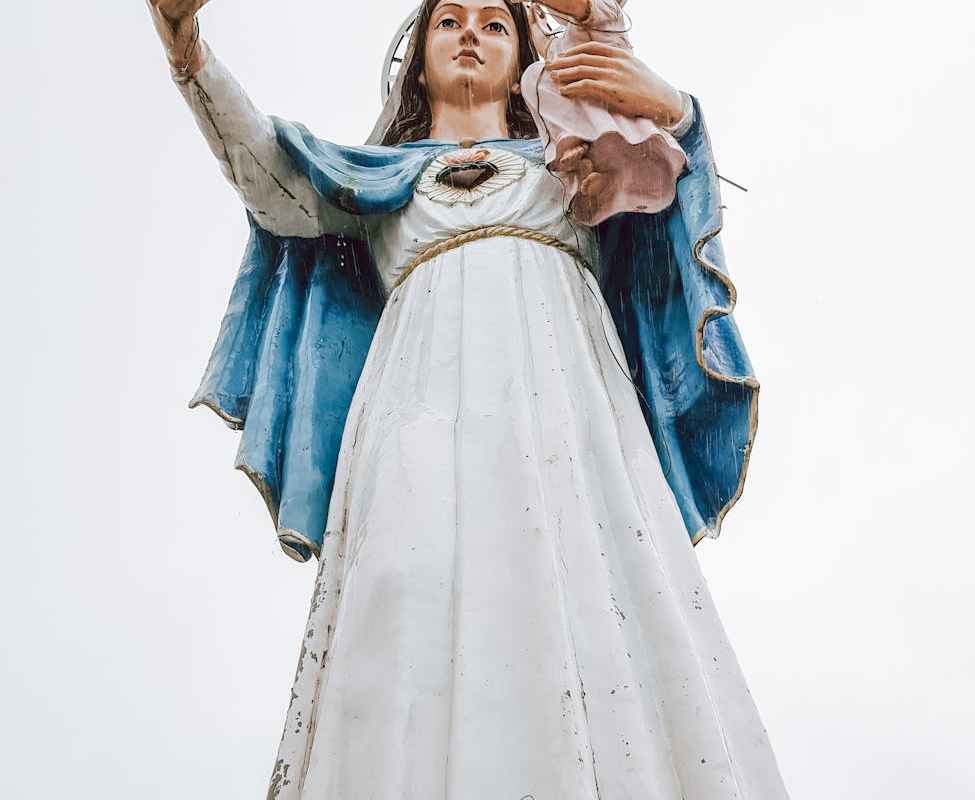
To everyone’s surprise – including my own – I blurted out some garbled sentence about Mary. Whether compelled by the Holy Spirit or by the delirium of anxiety, in that moment, I needed to talk about Mary. It suddenly felt urgent to tell them that Mary’s call by God to mother the Savior of the World meant a whole lot to me. 

As a kid growing up in churches that didn’t let women teach or preach, Mary had become my friend. She was a reminder that women could also be a part of God’s story. And not only that: in the story of Jesus, especially Luke’s telling, women are the first to be called. 

Mary, and her cousin Elizabeth, are prophets and apostles in the first chapter in the story of Jesus. In the most literal terms, they grew, nurtured, and birthed good news into the world, Elizabeth, as the mother of John the Baptist, and Mary, as the mother of Jesus. 

Jesus’ ministry with and for us on earth occurred, because Mary took the risk of saying, “Here am I, the servant of the Lord.” 

I told the committee all of these things as I pondered them in my heart. I pondered a little too hard, because I started crying from the beauty and weight of it all. 

My rector, who had accompanied me to the meetings, had an amused expression on his face. Later, we laughed together as he recounted how I had made myself cry during an optional question at the very end of a long interview. But, I’m glad Mary showed up during that intense moment in my life. 

Because, in many ways, she is the template of the life of faith, not one defined just by having the will to believe, but by moments of surprise, inspiration, and bold proclamation that lead to sustained trust in God. 

In today’s Gospel reading, Mary is inspired by Elizabeth’s Spirit-filled blessing to view her strange and miraculous pregnancy within the whole history of God’s persistent goodness. As soon as Elizabeth calls her “blessed,” she starts up with an original song we now call the Magnificat… 

He has mercy on those who fear him
in every generation. 
He has shown the strength of his arm,
he has scattered the proud in their conceit. 
He has cast down the mighty from their thrones,
and has lifted up the lowly. 
He has filled the hungry with good things,
and the rich he has sent away empty. 
He has come to the help of his servant Israel,
for he has remembered his promise of mercy. 

Though her words are spoken with the boldness of a prophet, Mary is not foretelling the future. With sudden urgency, she is actually sharing what has already, and always, been true about this loving, generous, just, and merciful God.  

She says: God has already fed the hungry; freed his people from slavery; dethroned tyrants; sustained orphans, widows, and refugees; and brought the lost back to their homes, back to the flock, and back into the arms of God. 

Maybe Mary surprised herself when she blurted all that out. Maybe God’s promises had felt far away for awhile. Maybe on that long journey to visit Elizabeth, the initial joy of her miraculous pregnancy had given way to fear, confusion, and even doubt. 

But then, the Holy Spirit prompted Elizabeth to say exactly what Mary needed to hear: “Blessed is she who believed that there would be a fulfillment of what was spoken to her by the Lord.” 

Elizabeth’s words rang true. They hit her like a bolt of lightning that illuminated the dark night of Mary’s strange circumstances. It helped for someone else to say, out loud, that she had already been called, and that meant she could rise to the challenge of God’s continued call on her life, no matter where it took her.  

This realization compelled her to sing! She had professed God’s goodness, she had seen the proof of that goodness throughout time, and now it was time to trust it.  

This is how she embodied the life of faith: as a cycle of memory, inspiration, and bold proclamation, with each one necessary to reviving and sustaining the other. 

This week, New York Times columnist David Brooks, wrote a piece on his own life of faith, entitled The Shock of Faith: It’s nothing like I thought it would be (gift link). In it, he shares the non-linear path that led him from atheism to whole-hearted participation in Jewish and Christian communities.  

He talks about coming to faith, not as single moment of conversion, but as “an inspiration” that occurs at various times throughout life. He says that the first time he felt this inspiration, it was “as though someone had breathed life into those old biblical stories so that they now appeared true.” 

In particular, Brooks shares a story about being startled by God on a hiking trip, as he read a Puritan prayer: 

Let me learn by paradox that the way down is the way up,  
That to be low is to be high,  
That the broken heart is the healed heart,  
That the contrite spirit is the rejoicing spirit,  
That the repenting soul is the victorious soul. 

Suddenly, it hit him that these paradoxical sayings were true. He says he was “seized by joy” and suddenly aware of the beauty all around him. 

In a paragraph that recalls Mary’s Magnificat, Brooks goes on to say: 

“That contact with radical goodness, that glimpse into the hidden reality of things, didn’t give me new ideas; it made real an ancient truth that had lain unbidden at the depth of my consciousness. We are embraced by a moral order. What we call good and evil are not just preferences that this or that set of individuals invent according to their tastes. Rather, slavery, cruelty and rape are wrong at all times and in all places, because they are an assault on something that is sacred in all times and places, human dignity. Contrariwise, self-sacrificial love, generosity, mercy and justice are not just pleasant to see. They are fixed spots on an eternal compass, things you can orient your life toward.” 

Brooks suggests that faith may be born in the will to believe, but it is sustained in transcendent moments of awe, in nudges from the Holy Spirit that lead us to recall God’s faithfulness in history, and trust in his goodness, in all times and places. 

Through the witness of their lives, Mary and other people of faith remind us that goodness is intrinsic to God’s nature, and that love, generosity, mercy, and justice are God’s intended order of the universe. 

Yet, even as we will ourselves to believe, we cannot guarantee that the life of faith will prevent fear, confusion, or even doubt. We may not always feel like a part of God’s story. We may need someone to bless us and remind us of how God sustained his people in the wilderness. We will need to be inspired, in quiet moments and lightning bolt shocks, over and over again. 

My hope in these last days of Advent is that we take heart and find moments of joy in our life of faith, unburdened by worries that we’re not holy or good enough to be called by God.  

Like Mary, we can embrace this journey with God as a cycle of memory, inspiration, and bold proclamation, with each one necessary to reviving and sustaining the other. 

God calls us, and God will come near to us again. Amen. 

Eternal Word, New Beginnings

Readings here

Today is the first Sunday in Advent.  The word Advent means arrival. But we’ll get back to that later. Today also marks the beginning of a new year for the church.  So, Happy New Year! 

When we think about typical new year’s festivities, we probably imagine raucous celebration. The ball drops, couples kiss, and fireworks go off around the world.  People crowd into streets, bars, and houses in sparkly clothing. And strangers drink and even sing together like old friends. 

The next day, people make and eat special New Years’ food, thought to bring good luck: black-eyed peas, tamales, goose, and even pickled herring make the list.  In my family, we eat corned beef and cabbage. 

All of these traditions seem to be a way to conjure optimism out of thin air. They encourage us to perform reckless and unjustified hope. The drinks and debauchery help us literally forget the old year, with its old sorrows and annoyances. And in the hazy glow of midnight, we can look forward to a limitless future. 

We tell ourselves: this year is gonna be different.  We’ll finally become who we always wanted to be. We’ll finally get the job, mend the relationship, make the move, start the workout, and get the good news.  

We have no reason at all to believe any of these things are influenced by the fact that it is a new year. But, we decide to believe things will change…at least until the end of January. 

— 

In Christian tradition, our Advent new year is also a season of hope.  But our hope looks a little different. And, unlike new year’s resolutions, it’s a pretty bad conversation starter at holiday parties. Because, Christian hope is apocalyptic. Which is to say, it has a lot to do with the end of the world. 

By now, we are well-acquainted with the apocalyptic literature of the Bible. Our scripture readings have been tracking with the apocalypse for a couple of weeks now. In Daniel, Jeremiah, Revelation, the Gospels, and even the Psalms, we have heard prophecies proclaimed about the end times. Today, we hear news of a mysterious “Son of Man” who is coming to judge the world. 

These apocalyptic predictions are kind of like New Year’s Resolutions – in that they help us imagine the future. But there’s one big difference: these scriptural resolutions are not about hoping for things you can put on your resume or brag about on Facebook. 

And they are not about forcing unjustified optimism that only lasts a month. At their core, they seek to legitimize and justify hope, and to make it more than a game of personal willpower. 

On its surface, apocalypse can seem grim. But it’s not supposed to be traumatic. It is meant to be just alarming enough to wake us up and turn us around, so we can see the big picture. 

It draws us into the mystery of our faith. And this mystery dwells in paradox. Appearing to be about the future, predictions of the final judgment are actually the story of everything, reaching back to the farthest past.  

They compel us to look forward to the final days, but when we do that, we end up being drawn back to the very beginning, when the breath of God moved over the waters before time began. With a word, God created the world. And at the end, the same Word, the Word made flesh in Jesus, “will come to judge the living and the dead.” 

The creative presence of God imbues all things, at all times and in all places. This is big news! And it is the cause for our hope. 

— 

But still, the fact remains that we are in the middle of things, and the middle is an unsettling place. What do we do with ourselves in the present tense? How do we read the signs? How do we know that Christ is coming near? 

Let’s take a closer look at today’s reading from Luke: Jesus starts with a pretty typical apocalyptic message.  There will be weird shifts in the planets, eclipses, weather events, and terrible tidal waves. A collective sense of foreboding will fall upon the face of the earth. Then, the “Son of Man,” the long-awaited Messiah, will descend from on high.  

We assumed all these signs were pointing to a terrible end. But it turns out, this Son of Man, Jesus, has come to redeem the world. 

And what does redemption mean? It means someone pays all of your debts and sets you free from bondage and obligation.  It means everything that was taken away is now given back to you and you have everything you need. 

Jesus clarifies his words with a parable… 

‘”Look at the fig tree and all the trees; as soon as they sprout leaves you can see for yourselves and know that summer is already near. So also, when you see these things taking place, you know that the kingdom of God is near. Truly I tell you, this generation will not pass away until all things have taken place. Heaven and earth will pass away, but my words will not pass away.’ 

Jesus says, this is how you know that Christ is coming near: the things you took as signs of death are being transformed into new life. 

Like fig trees sprouting new leaves, just in time for summer.  You’ll have delicious fruit to eat by August. 

The signs of Christ’s coming, even when they are foreboding, are not intended to be understood through a lens of death and destruction. Like winter turning into spring, signs of death ultimately lead to new life: the branch springing up, the new leaves on the fig tree, freedom and fresh starts. These signs of life are already present with us, and they’re just as real as death. Christ is already near. 

It is good for Christian apocalypse to be central to our faith, because it is an antidote to atrophy. We don’t accept death as the end of the story. And this means we live our lives with persistence., taking care of our neighbors, praying for restoration, and abounding in love for another. 

— 

The trials and tribulations endemic to this world wear on us. We are tired and afraid. We’d like to forget about our troubles for a little while. I think people have probably felt this way since the world began. 

But Jesus shouts, now is not the time!  Now is the time to “be alert” and pay attention!  If you don’t pay attention, you’ll miss the buds on the branches. You’ll miss the joy of the sweet, sticky figs. 

You’ll miss the fact that the Word of God is speaking into darkness, and always doing a new thing. 

— 

And that’s what Advent is really about. Whether we’re looking back to creation, or the incarnation, or looking ahead with fear and trepidation, God is always interrupting time to do a new thing. 

Advent means arrival, after all. And what is arrival but an interruption, an abrupt end of one thing and the start of a new thing? The arrival of a baby that will save the world. The arrival of a King that will make our winter spring.  

In Advent, timelines merge, worlds collide, and life on earth takes on the afterglow of Heaven. Here, darkness is always muddled with light, and endings are always new beginnings. 

Here, hope is always justified by the glorious, persistent goodness of the eternal Word, surprising us with redemption, over and over again. Happy New Year! 

Love is Lord of Heaven and Earth | Christ the King

Readings here

On November 11, 1918, World War One finally ended, after four long years. World War One is often called the first modern war. The National Park Service says: “Machine guns, poison gas, rapid-fire artillery, aerial bombardment, tanks, and submarines were all new innovations that brought about horrors never before seen on the battlefield.” 

As many as 22 million people were killed, more than any war in recorded history, up to that point. That kind of destruction doesn’t just impact one family or one community – it affects the world. The result was one big existential crisis.  

Many people asked: How could God permit this suffering? There was no easy answer. 

By 1925, countries long-considered “Christian nations” were allowing new worldviews to take root. In the communist Soviet Union and fascist Italy and Germany, God was no longer part of the equation. God was too abstract and too far away. The people wanted a king.  

Or, rather, they wanted a strongman, a no-nonsense politician who could lead people, scarred by modern war, to a modern promised land. This promised land wasn’t concerned with peace, and it wasn’t imagined through a lens of hope.  Hope was frivolous in times like these. 

Instead, it was all brute force, brute speech, fear of foreigners, scorn of minorities, fences, and locked doors. 

In large numbers, the people of Europe decided that liberty and justice for all was an old-fashioned value after all.  They had become accustomed to rationing, casualties, and adrenaline coursing through their veins.  And the strongmen told them these things were good, and right, and true – signs of their virtuous endurance. 

It was within this context that Pope Pious the Eleventh began a new tradition of the church: Christ the King Sunday. Within a few years, many other denominations had taken up the cause, including Episcopalians. 

Declaring Christ as King in that particular moment was not random. Pope Pious was making a subversive political statement against the politicians and dictators vying for the world’s thrones.  

He was reminding the church that they already had what, and who, they needed, in the person of Jesus Christ. And he was declaring that God still had something to say in these modern times: The Kingdom of God had not died on the battlefield.  God had not gone AWOL. 

Against the powers and principalities, Christ had not been moved, and would not be moved: 

His dominion is an everlasting dominion 
that shall not pass away, 
and his kingship is one 
that shall never be destroyed. 

Christ was and is and will be on his throne. 

The world’s rulers might win the day, but they had no power to bring about the kind of promised land their citizens were really looking for, beneath all their fear and despair. 

I like doing a deep dive into history, because it reminds me that the trials of our current day are not greater than those of the past. In many generations and many places, the people of God have struggled with existential crises. In hard times, we have wondered where God is. And we have desperately looked for someone to save us. 

It is hard to answer the questions of our suffering. The world’s corruption can’t be justified by trite reminders that “God is in control.” 

And, I’m sorry to say that I have yet to find a justification for suffering that provides a quick fix. 

But what I can say – because it is what our Scriptures say – is that there are spiritual realities bigger and wilder than we can understand, here on the ground. I can say that the Kingdom of God is breaking through the cracks of earthly decay, showing up now in flashes, but ever-growing toward the ambient light of paradise. 

I can say that, if the world is actually doomed, it has no business being as beautiful as it is, and people have no reason to be as kind as they often are. 

I can also say that, in my darkest moments, when I have asked God “why?” the answer has not always come in words.  But in time, hope has, eventually, come.  

And isn’t that also worth asking about? How is hope still a possibility in a suffering world? How is hope still alive? 

Our scriptures tell us hope is alive because Christ is alive. Even now, he is situated as King on his throne.  

But what makes this king so different from the crude and failing rulers of this earth? And where is the evidence of his kingdom in the middle of life’s sorrow? 

The answer arrives in the life and person of Jesus… 

In his weekly newsletter on the Gospel reading, scholar Andrew McGowan talked about the dialogue between Jesus and Pontius Pilate, the Rome-appointed governor of Judea. 

McGowan says: 

‘Pilate already knows the answer to the first fateful question, “Are you the King of the Jews?”, at least on his own terms.  This question is verbally identical in all four Gospels, which is remarkable. There is no serious possibility, however, that the homeless Galilean itinerant Jesus, is a “king” of any kind, at least in the sense that Pilate would understand that term—or how we would, normally.’ 

On Christ the King Sunday, the church proclaims that this Jesus, this homeless man, is the only true and wise king. In his humble ministry on earth and in his arrest, trial, and death, he exhibits few signs of kingship

He isn’t charming, he doesn’t grandstand, and he doesn’t make political alliances. He doesn’t rally his followers to take up arms, surround himself with “yes men,” or bribe Roman representatives to cut him a deal. Any gift he has received he has already given away. He has no possessions and no permanent home. 

Neither an effective politician nor social reformer, Jesus provides the one thing no earthly ruler has ever been able to offer without coercion: the Truth, unburdened by moral and mortal decay. 

In his humble life, self-sacrificial death, and shocking resurrection, the Son of God reveals himself as the answer to all our questions. The Truth is that worldly power will not save us – only love beyond our reckoning will save us. 

And God is Love. And Christ’s kingdom is “not from this world.”  And this is why we can have hope. 

As McGowan goes on to say:

‘“…the love of God…is the real order of the universe.  

To celebrate Jesus’ kingship is not to look away from the world we know, but to see it as it might be, ruled by the true power of love.’ 

No matter what they tell you, the kings, presidents, bishops, and rulers of this earth will never bring us to the promised land. We are not one election, one war, or one succession away from a resolution to the trials and griefs of this life. 

But, as we are reminded throughout our Scriptures, and in our history books, we are not the first generation to confuse brutality with hope. We are not the first people to be duped into believing we needed a strongman.  

We want our earthly rulers to take care of us, so we don’t have to work so hard to take care of one another. We want them to fix things for us. And too often, we accept the lie that fixing things means some people will stay broken. 

But, when we expect these things, we give them too much power. We cannot afford to make them kings, because we risk making them gods. And these false gods – these earthly rulers – will never be able to bring about the life-altering, darkness-shattering, hope-bringing, joy-giving transformation of the world we long for.  

Only Christ can do that.  Only the Kingdom of God can do that.  

Even in these modern times, in our deepest despair, the light of Christ is breaking through. In defiance of all who would justify cruelty, violence, and dehumanization as means to an end, we proclaim love as our salvation, because Christ is the only true king. Amen.

Our Times are in God’s Hand: A Sermon on Apocalypse

Blessed Lord, who caused all holy Scriptures to be written for our learning: Grant us so to hear them, read, mark, learn, and inwardly digest them, that we may embrace and ever hold fast the blessed hope of everlasting life, which you have given us in our Savior Jesus Christ; who lives and reigns with you and the Holy Spirit, one God, for ever and ever. Amen. 

Readings here.

The year was 2002. I was 13 years old.  The country had recently survived Y2K, a contentious presidential election, the September 11 terrorist attacks, 4 major hurricanes, and dozens of tropical storms, one of which was a direct hit on my home. My dad had just lost his job and had to start commuting nearly four hours roundtrip for his new one. My grandpa died. 

And then, one day in the spring, I was home alone, when the sliding glass door on my house began to shake. Suddenly, I heard a deep, resounding BOOOMMM coming from far away. I looked outside and didn’t see a soul on my cul-de-sac, even though the workday had ended. 

I came to the only, logical conclusion.  It was the end of the world. And all the Christians had been raptured – taken up to Heaven before the Great Tribulation on earth. All the Christians. Except, of course, for me. 

The apocalypse was here.  

Things had not gone as planned. Maybe I had prayed a prayer wrong, or maybe my pastor had failed to seal my Baptism in the name of the Father, the Son, and the Holy Spirit. Whatever the case, here I was, the last member of my family still earthside.  And all I could do was wait for the violence and destruction to begin. 

“There shall be a time of anguish, such as has never occurred since nations first came into existence.” 

“For nation will rise against nation, and kingdom against kingdom; there will be earthquakes in various places; there will be famines. This is but the beginning of the birthpangs.” 

A half-hour later, the kitchen door opened, and my mom and sister walked in. My dad got home from his new, faraway job, just a little later than I expected.  A neighbor called to ask if we had heard the “sonic boom,” when the space shuttle reentered earth’s atmosphere, on its route back to Kennedy Space Center. 

Ohhhh…so it wasn’t the apocalypse after all. Just a cascade of disorienting circumstances that had sent my anxiety into a tailspin. 

After hearing today’s scripture readings, maybe your heart rate went up a little, like mine did on that day in 2002. 

Our Daniel and Mark readings are undoubtedly “apocalyptic.” They prophecy a chaotic and violent end and warn their readers to stand at the ready for all that is coming. It is tempting to avoid these passages, because they are disorienting. They stress us out and make us feel bad.  And worse than that, they make us feel obligated to prepare for a future of unthinkable difficulty.  

What does apocalypse have to do with Christian hope? 

Well, I think we have often misunderstood the apocalypse. So, let’s talk about what it means for something to be apocalyptic… 

In informal conversation, when we say “the apocalypse,” we’re most likely referring to the final and complete destruction of the world, or at least, the inhabitable world. 

Scientists might speak of climate apocalypse, politicians of institutional apocalypse, and Christians throughout history have read into wars, storms, recessions, and generally bad vibes as signs of the impending final judgment. 

But in the ancient world, apocalypse had a more nuanced meaning.  The word itself comes from the Greek word, apokalypsis, which means “to uncover or reveal.” That definition ties the apocalyptic tradition to the prophets, because prophets are God’s messengers, revealing God’s active participation in human affairs. 

Not all prophecy is doom and gloom, but much if it is a warning that God’s people need to get back on track. And that’s where apocalypse comes in. While apocalyptic stories often carry a sense of foreboding, their purpose is not to make us freeze in fear and await our fate. 

As John Collins puts it: apocalypse “is intended to interpret present, earthly circumstances in light of the supernatural world and of the future, and to influence both the understanding and the behavior of the audience by means of divine authority” (1).

In other words, apocalyptic proclamations reveal the perils of losing sight of God in the short term, while declaring God’s ultimate power over all things in the long term.  In contrast to doom and gloom, they should encourage us to stay the course and carry hope through all of life’s trials.  As we say in our birthday blessing, “our times are in God’s hand.” 

It’s also good to remember that the dark future foretold is not so different from the ongoing fear and violence of our present reality. The drama of these stories casts a spotlight on the worst of the human condition so we can see it for what it really is. And in the process, we can see who we are, and who God is. 

— 

Today’s scriptures bring the trials of living, breathing, suffering people into the context of God’s power. 

They reference many cataclysms and many terrors we ourselves can recognize – when human apathy and wills to power lead to bloodshed, institutional collapse, hunger, and collective trauma that would span generations. 

This is demonstrated well in the book of Daniel, which occurs in the midst of a cycle of terror… 

At one time, the Hebrew tribes were split into two nations: the Kingdom of Israel in the North, and the Kingdom of Judah in the South. In 732 BCE, war broke out in the Northern Kingdom when Assyria invaded, killing thousands, including women and children. 

After the initial bloodshed, those who survived were systematically deported and displaced. The goal was forced assimilation of the Hebrew people, which would make it harder for them to retaliate against the Assyrian kingdom, by reducing their sense of shared identity. 

During this period, Assyria took part of the Southern Kingdom, but they didn’t gain complete control. But in 597 BCE, Babylon took the Southern Kingdom of Judah. Known as the Babylonian Exile, this period saw several phases of forced displacement of the Hebrew people, led by King Nebudchanezzar the Second.  

The war ultimately resulted in the destruction of Jerusalem and its Temple in 587 BCE. Some of the Bible’s most hauntingly beautiful literature is written about the Babylonian Exile, including the books of Daniel, Isaiah, Jeremiah, and Lamentations. 

For those whose lives had been burnt to the ground by invading armies, this was surely the apocalypse. This was surely the end of the world.  

Yet, it was within this hopeless context that Daniel’s prophecy rang out: “But at that time, your people shall be delivered.” 

The world of the ancient near east may have been consumed by “war and rumors of war,” but the people of Judah would survive. Their times were still in God’s hand. 

Fifty years later, the Judeans were permitted to go back to their homeland. They rebuilt the Temple. They rebuilt their lives. And God was with them the whole time. 

In Mark, we hear Daniel’s words echoing in the voice of Jesus. Jesus tells his followers there will be destruction and bloodshed, terror and chaos.  

And within the first months and years of the early church, Christ-followers would indeed face persecutions, executions, false prophets, and false narratives. They would be blamed for things they didn’t do, and pushed ever further to the margins of society.  

Just as in Daniel, Jesus’ words are not foretelling some distant, future darkness beyond imagination. They are a clarion call and a comfort in the present darkness. Christ followers can rest assured, in all these trials, that the good news is still worth living out, and that God will sustain them in the end. 

This is what apocalypse should teach all of us: God remains steady in the midst of our chaos, pain, and existential despair – in the very center of the worst thing that we can imagine. God doesn’t ignore evil, doesn’t celebrate injustice, and doesn’t revel in our suffering.  

Our hope comes from a deeper well than the brutality happening around us and to us.  And hope can be sustained no matter the circumstance, because it comes directly from the Creator of all things. 

If you feel today that you are standing at the edge of apocalypse, consider this: maybe it’s not the end. 

It may very well be the end of certain assumptions, communities, families, relationships, and ways of being. It may be the end of the world that you imagined, but it is not the end. 

When the chaos of this world feels apocalyptic, we can see that disorientation for what it is:  a clarion call to live like Jesus, to endure in the struggle, to love self-sacrificially, to pay attention, to rest in the care of one another, and to look for the life of the world to come.  

We do not need to fear the apocalypse. With hope in our hearts, we keep moving forward, held steady in God’s hand. 

1. Collins, John J. (1984). Daniel: With an Introduction to Apocalyptic Literature. Eerdmans.

The Saints of God are Just Folk Like Me

Proper 26, All Saints’ Sunday 2024 – Readings here

I was 23 years old before I celebrated my first All Saints’ Day.  

Growing up in an Evangelical denomination, we were allergic to the word, “saint.” We weren’t really into people and their stories. We were into doctrines and rules by which we could measure ourselves and others. We were determined to cast off the baggage of centuries of tradition in pursuit of a clearer, more consistent, more relevant Christianity. 

This mindset was influenced by a few major ideological shifts: the anti-Catholic sentiment of the Protestant Reformation, which saw the saints and all their associated celebrations as superstition at best, and idolatry at worst; the optimism of expanding imperialism and the industrial revolution, which directed people in the Western world to leave behind the past, in order to forge ahead to a limitless age of progress; and the rugged individualism of American culture, which made religion a personal practice rather than a collective one, and measured each person by their ability to prove themselves worthy of God’s love. 

The saints simply didn’t fit into the picture. They were funny, old relics of medieval Catholicism. Their stories and experiences, so often tied up with struggle, were quite frankly embarrassing to our self-sufficient, modern ears. They were messy and weird, hard to manage, and rarely fit within the norms of fundamentalism. 

My faith story was one without a prologue, because it lacked the stories of the saints. As a result, faith was like a path that had never been trod before. It was dark and mysterious, an unknown venture that I had to endure on my own. No one, besides, perhaps, my parents and my pastor, could offer wisdom for the journey. It was often a lonely place. 

But many years later, I found myself in an Episcopal Church on the occasion of All Saints.  

Still wary of more “Catholic” traditions, I had nevertheless found hope and healing among the people in that big, neo-classical building across from University of Virginia’s campus. They had held me, watched me cry, and let me sit with my grief after leaving the Evangelicalism I was raised in.  

I had left because it turned out that, in addition to saints, they were allergic to women in leadership. But this Episcopal Church hadn’t put pressure on me to contort myself into an “acceptable” version of a woman or a Christian. They didn’t seem to believe that Christianity was about proving myself worthy of God’s love.  

And they didn’t act like the Christian journey was a thing I should do on my own. In fact, through the liturgy, they had carried me along in the faith when I was too spiritually weary to utter the words myself. 

These ordinary, holy people had started to help me feel like Christianity was much bigger and more vibrant than what I had grown up with. Because it wasn’t about me, sitting in a dark room alone with an exacting God. It was about us, wherever we found ourselves, walking together toward the light of a loving God. 

Still, on All Saints, I wondered what the long-dead saints, with their fantastical stories, could possibly teach me about the good news. And then, we sang a silly, little British song about the saints of God. 

To my mind, today’s sequence hymn, “I Sing a Song of the Saints of God,” is perfectly composed. In the first two verses, we encounter abbreviated, and basically anonymous, tales of the formalized saints of our tradition: 

  • Doctors, like St. Luke and St. Hildegaard 
  • Queens, like St. Helena and St. Margaret of Scotland 
  • Shepherdesses, like St. Bernadette of Lourdes 
  • Soldiers, like St. Martin of Tours 
  • And too many priests and martyrs to name. 

There is something jarring about the juxtaposition of the sickly-sweet little children’s tune and the harrowing realities of these ordinary, holy people who walked with God, so often to their own death. 

The jaunty little melody and the laundry list of unnamed saints work together to suggest that the saints, even while being worthy of veneration, are nothing to get worked up about. They’re everywhere, in every generation. There are so many, the song doesn’t even have time to name them. 

And then, what is, at first, subtle in the song’s composition is made concrete in its closing words – 

They lived not only in ages past; 
there are hundreds of thousands still; 
the world is bright with the joyous saints 
who love to do Jesus’ will. 
You can meet them in school, or in lanes, or at sea, 
in church, or in trains, or in shops, or at tea; 
for the saints of God are just folk like me, 
and I mean to be one too. 

For the saints of God are just folk like me, and I mean to be one too.  

When I was 23, red-eyed from crying, but surrounded by Christian love, I sang a song of the saints of God, and I finally understood the saints. 

It’s right there in our church’s catechism: 

“The communion of saints is the whole family of God, the living and the dead, those whom we love and those whom we hurt, bound together in Christ by sacrament, prayer, and praise.” 

It turns out, the saints aren’t just long-dead people with nothing to offer. Both living and dead, they are exemplars of ordinary, everyday holiness, who shore up our faith in turbulent times and show us the way in the midst of life’s uncertainty. 

The church can’t afford to ignore 2,000 years of saint stories because we think they’re old or weird, or mystical or uncool. Because the church is nothing without the saints: the named ones and the anonymous ones, the ones we find acceptable and the ones we find confounding, the ones who died in glory and the ones sitting here in this room. 

All of them have something to teach us about the path of Christ. All of them, in their own time and place, lit up the world with a little bit of good news. 

Our faith rests on the legacy of the saints.  

Because of this, it finds its shape and meaning in a rich and never-ending web of relationships, spanning from ancient times to the far-future. These relationships reveal God’s unbroken chain of love in a broken world.  

Through the example of the faithful in every generation, we understand who the Triune God is, in eternal relationship with Godself. 

Through relationships with our fellow disciples, we learn what it means to live into the greatest commandment to love one another, without worrying about the outcome or the cost. 

And these relationships inform our relationship with the world – with the downtrodden and alienated, displaced and forgotten, hated and misunderstood, immigrant and citizen, rich and poor. 

In communion with the saints, we find that the Kingdom of God “is closer than we know” (1).

And the path of Christ is not ours to walk alone. We are not left without history, tradition, exemplar or teacher. The air is heavy with the prayers of the saints. The streets are crowded with them. 

Like God, the saints are everywhere, always revealing God’s love in places where love has no right to exist. We are not alone.  

So why not rise to the challenge?  

Why not live like you and I could be saints, to someone? 

Why not act like miracles can take place through the mechanism of our ordinary, holy lives? 

Why not share our testimonies, so we can be reminded that love counts for something? That it changes hearts and moves the needle. That sometimes, it even makes enemies friends. 

I have seen the saints at work, loving me back into faith, changing the course of someone’s life, standing up for the vulnerable, overcoming their fears, taking responsibility for the wellbeing of strangers, turning ravaged places into gardens. 

It’s not so hard to find them when you start looking for them. 

As we approach a stressful Election Day, my prayer for all of us is that we look for the saints at work. And that we rise to the challenge, determining to be saints to someone, not worrying whether the love we live out comes across as weird or old-fashioned or even foolish. 

For the saints of God are just folk like me, and I mean to be one, too. 

(1) On his deathbed, my Great Grandpa Camp told my mother: “Heaven is closer than we know.” In today’s Gospel reading, Jesus says “You are not far from the Kingdom of God.”

Everything That Actually Matters

Readings here

“Jesus, looking at him, loved him and said, “You lack one thing; go, sell what you own, and give the money to the poor, and you will have treasure in heaven; then come, follow me.” 

In Florida and North Carolina and places in between, our fellow Americans are grappling with the aftermath of Hurricanes Helene and Milton. Though the floodwaters and storm surges have subsided, there are over 1,000 people missing across several states. People are still without access to water and power, and some are still stuck in isolated, waterlogged homes. 

My husband and I, who grew up in Florida, kept vigil Wednesday night as Milton made landfall, anxiously waiting for family to respond to our text messages: Are you safe? Is everyone accounted for? Do you have what you need? How can I help? 

Fortunately, our family is safe.

The physical storms have passed, but the wounds remain. These wounds are social, physical, and financial.  And they cut like jagged lines through neighborhoods and towns: disrupting relationships, destroying the comforts and norms of communal life, and compounding grief. 

It’s enough to break a person. And I think that’s why we tend to assume that things will devolve into dystopia after a storm – we expect looting, marauding, and spats of violence. Under conditions of want, we expect people to give up on the whole social project.  Now, it’s every man for himself

But surprisingly, this isn’t the case. While the road to recovery is complicated, it happens at a quicker pace than we might expect. And it’s all because people rocked by the impoverishing aftermath of disaster become more generous,  not less generous. 

In her book, A Paradise Built in Hell, Rebecca Solnit set out to understand what happens to communities after disasters, by studying real-life disasters throughout American history.  

Her findings disprove the dominant story that, in the face of scarcity and suffering, people will become selfish, violent, and uncollaborative. Across time, location, and demographic, the opposite proved true. She found utopia. 

Solnit writes: 

“In the wake of an earthquake, a bombing, or a major storm, most people are altruistic, urgently engaged in caring for themselves and those around them, strangers and neighbors as well as friends and loved ones. The image of the selfish, panicky, or regressively savage human being in times of disaster has little truth to it. Decades of meticulous sociological research…have demonstrated this. But belief lags behind, and often the worst behavior in the wake of a calamity is on the part of those who believe that others will behave savagely and that they themselves are taking defensive measures against barbarism.” 

In other words, when a community loses everything, all at once, our human impulse is to care for one another. Social standing, past hurts, personal quirks, and property lines cease to matter when we’re all equally vulnerable, when we’re all aware of our own fragility and need. 

The only questions that matter are these: Are you safe? Is everyone accounted for? Do you have what you need? How can I help? 

All that matters is finding a reason to hope. And it turns out, the reason to hope is, very often, looking back at us – it’s the family bond and reciprocal care of other humans. As one makeshift restaurant put it, after the San Francisco Earthquake: “one touch of nature makes the whole world kin.” 

And haven’t we all experienced this?  

After 9/11 or Harvey or Helene or Milton, hasn’t the shock forced us to reach out to others, to find reassurance in one another’s company, and to reexamine what really matters?  

Haven’t we prayed a little more, and lingered a little longer while hugging a loved one?  Haven’t we looked up at the clear blue sky with a renewed sense of wonder to be here at all? Haven’t we been moved to donate our time and money, and open up our homes, because we suddenly understood that we need each other? 

It’s no wonder that one of God’s first acts of love toward humankind was creating another human. When things get urgent and raw enough, we remember that the whole world is kin

And when we remember that, anything feels possible. 

— 

It may seem like a strange juxtaposition, but Jesus’ command for the rich young man to sell all of his possessions, places him in a context similar to post-disaster communities.  It asks him to place people above possessions and says something about Christ’s vision for the Kingdom of God. 

Let me be clear that, when Jesus tells the man to give up everything, he is not calling him to suffering. Jesus does not want us to hope for disaster, as if suffering will make us more holy. Jesus does not delight in suffering and death – his resurrection testifies to that fact. 

But, when he tells the man to choose a life of poverty, he is pointing him to the root of hope that is buried under the rubble of our material dependency.  

His possessions, and the accumulation of those possessions (1), are a distraction from real living (2). They keep him from recognizing the generous love of God, found most richly in relationships with his fellow human. 

He is trying to get the man to consider that abundant life is not a thing that can be accumulated or possessed. Abundant life is found in reciprocal generosity, caring for and receiving care from others. 

If you had the choice, why wouldn’t you try to live in that blessedness – that place in which the whole world is kin? Choosing it instead of waiting for the inevitable disaster. Choosing it now, because disaster has already struck somewhere, and hope only grows in the context of mutual care. 

— 

In the end, the man couldn’t fathom making such a sacrifice. And Jesus wasn’t surprised. But, Jesus’ words still ring in our ears, and we should consider them, too. 

Material possessions will not be the marker of our success, and they will not ultimately determine whether the Kingdom of God will survive and flourish. 

Because, God’s kingdom is not built with stone, silver, and stained glass, but as a family system of reciprocal generosity. It is predicated, not on financial liquidity, but on the liquidity of love. Which is to say, it is a place of radical trust and radical dependency. 

We give and receive in equal measure, to be reminded that true and lasting wealth is the bond we share with one another, and with God. 

As kin to one another, we are to open our hands and hearts now, not waiting for someday when it feels like we have acquired “enough,” because that day will never come. 

We are to quit judging ourselves and others by material and financial possession. And reject social forces that pressure us to look, act, consume, and invest according to the logics of wealth, power, and control.  

If disasters have anything to teach us, it is that control is an illusion. All that we possess could be gone tomorrow. 

Our true wealth lies in giving up control to Jesus Christ, who alone can bring about the transformation of the world, who exemplifies generosity, even to the point of giving himself to death on the cross, who, in his earthly ministry, had no money of his own, but brought prosperity of health, spirit, and love to all he encountered on the road. 

Jesus is not asking us to give up “everything” to follow him. He is directing our attention to “everything” that actually matters.

So that we can strengthen the bonds of love, building utopia right here, birthing new life in the rubble. 

Amen. 


(1) Thanks to Dean McGowan for making this point.
(2) Martin Buber, in his book I and Thou, says “All real living is meeting.”

Jesus, Our Neighbor (in the Buy Nothing Group)

You open wide your hand 
and satisfy the needs of every living creature. 

Readings here.

Ever since the start of the start of the pandemic, I have been a member of my neighborhood’s “Buy Nothing Group.”  The Buy Nothing Project is a national organization with one goal in mind: forge community connections by giving and receiving, without exchanging any money. 

To join one, you simply find your neighborhood group on Facebook and verify with the admin that you actually live there. From there, you start interacting with your neighbors in a “gift economy.” 

During the pandemic, I was part of a large Buy Nothing group that included nearly all of New Haven, Connecticut, from scrappy grad students in falling-apart duplexes to rich people in Victorian mansions to residents in subsidized housing. 

In a Buy Nothing Group, none of these economic categories mattered. The only thing that mattered is that you were willing to give and receive without judgment. 

When we adopted a kitten who was destroying all our house plants, I gave them away to my neighbors for a better chance at survival. When my French Press coffee maker broke, a neighbor gave me hers.  And when we were getting ready to move to Texas, I was able to give away three bags full of groceries to a woman whose refrigerator had just broken down, spoiling all her food. 

But these were just the small things.  

Being in a Buy Nothing Group wasn’t just about what I could offer or receive.  It was about witnessing other people’s generosity. 

Someone offered up their car on loan so a neighbor could get to doctors’ appointments.  People painted each other’s houses, moved heavy furniture up and down third-floor walkups, and shared backyard garden harvests. They offered their skills, like carpentry, and their time as babysitters.  

In some ways, I think I mentally survived those dark days of lockdown because I was in a Buy Nothing group. That group gave me more than hope. It gave me proof that goodness was already in the world. 

In the middle of an apocalypse, we were still living in beatitude.

— 

At a basic level, the Buy Nothing Project is just a common-sense way to get rid of things you don’t want. But it’s transformative because it is principled – community connection matters more than transactional exchange. 

One of the primary principles is that: “We come from a place of abundance ~ not scarcity.” 

It asks its participants to behave as though there is more than enough to go around. 

Which is actually a big deal, considering our entire economic system runs on “scarcity.” The idea that “supply is limited” is good for business, because it convinces us that we should spend now and spend more to get what we want or need. 

But economic scarcity impacts more than the bottom line. It forms our social world, too. Scarcity thrives on a dichotomy between the haves and have-nots, and on the power differential between the “self-made” success stories and the naive poor.  It implies there’s not enough to go around. It makes every person on this planet our competition

Scarcity discourages us from being generous. Because we feel like we will never have enough. And in all this, it keeps us from building meaningful, dependent relationships with our neighbors and communities.  

We keep everyone at arm’s length, either to protect our assets or protect our pride. We can’t risk giving or receiving in a world of scarcity. 

— 

Over the years, I have often returned to an article written by Hebrew Bible scholar and theologian Walter Brueggemann, entitled “The Liturgy of Abundance, the Myth of Scarcity.”  

In the article, he rejects the idea of scarcity by tracing a theme of “abundance” in the Bible. He starts from the beginning, when God creates the lush and bountiful earth and all its creatures, calling it “very good.” 

He talks about God’s promise to the chosen people of Israel – how, even in hardship, war, and slavery, God ultimately provides for their need. 

  • God gives them manna in the wilderness, and quail when they complain it’s not enough.  
  • God promises them a land flowing with “milk and honey,” a phrase that points toward, not just sustenance, but an overabundance of good things. 
  • God raises up radicals and prophets who constantly remind them to turn away from idols and kings that promise them the world’s riches in exchange for their freedom.  
  • God folds foreigners, women, the poor, and the ostracized into the ongoing story of God and his people, widening the boundaries of the Kingdom of God. 

In all this, God reveals that scarcity, with all its hoarding, boundary-making, withholding, and harsh judgment is not the ethic of the Kingdom of God. 

Today’s story continues that theme of abundance… 

The message of Jesus has been spreading, and now over 5,000 people are gathered to catch a glimpse of him. They have come for healing and hope. But right now, they are hungry. 

And apparently only one boy remembered to pack a lunch. And it’s the lunch of a peasant: bread made from cheap barley and two fish. 

Jesus begins distributing the food and miraculously, everyone is fed, with twelve baskets of food left over. Here, in the most obvious way, our Scriptures reveal that God is a God of abundance. He not only provides for the basic needs of those surrounding him, his generosity overflows. 

This miraculous act of feeding shows the 5,000 that God’s act of abundant creation in Genesis never stopped. Now, it is being lived out in the person of Jesus Christ. More than providing hope, it was proof that goodness was still active in the world. 

— 

But notice that this miracle of abundance was not solely an act of God.  

The Feeding of the 5,000 was kind of like a Buy Nothing Group, if Jesus was your neighbor. The people were hungry. The disciples facilitated. A boy offered what he had. Jesus opened his hands and spread it around. And the people willingly received. 

Giving and receiving required participation from the people in the crowd.  It required a willingness to try from the skeptical disciples, deep trust from the boy, and an honoring of that trust from Jesus.  

And it required a different economic principle – where the entire point was community flourishing. Each person’s open heart and open hand was acknowledged there on that hillside, and then multiplied exponentially in the hands of Jesus. 

Those who bore witness to the Feeding of the 5,000 – as we do now – were reminded that God’s economy is one of abundance, where even the passive desire to care for one another can lead to a miracle. 

— 

We live so much of our lives with our fists closed tight around what we have, afraid that if we lose it, we won’t have what we need. But our scriptures reveal a God who is continually working to gain our trust, and to pry our fingers open.  

God “opens wide his hand” and shows us how to live into abundance. True freedom comes when we trust him enough let go of our pride and accept the gift he is handing to us, take what we need, and then keep passing it on. 

Even the smallest act of letting go and receiving can destabilize the myth of scarcity that poisons our society. Even the most meager resource, offered with open hands, can meet the need and change the hearts of those who witness the exchange. 

And so, we pray that God will pry open our fingers and open our hands, to receive his abundant gift and to pass it on to others until the whole world is not only fed, but full.  Amen. 

The Scandal of Suffering

A Sermon on the Beheading of John the Baptist

Readings available here.

The beheading of John the Baptist.  

The mere thought of beheading is so gruesome that I want to avert my eyes as I read the story. 

Reverend Brin assured me that they did not read this passage during kids’ church this morning. Now, I’m normally not an advocate for censorship, but the moral ickiness and graphic violence of this event made me wonder, at first read, why the writer of Mark wanted it to be shared at this point in the story, and in this way. 

The story is disruptive, in more ways than one. 

For the last five-and-a-half chapters, we have been moving at a steady clip with Jesus and his disciples, as they have sought out the marginalized, healed the sick, and restored people to community. 

The narrative has become almost predictable: Jesus goes somewhere, he tries to take a nap or eat lunch, and then a great need arises to which he must respond.  So, he performs a miracle.  

Person by person, bit by bit, the culture of death in the ancient near-East is being covered by new buds of hope.  The Kingdom of God is spreading. 

Now, word of his deeds has reached the regional Jewish ruler, “King Herod.” This Herod is the son of the other Herod, who tried to kill baby Jesus. A Jew himself, Herod works for the Roman authorities, and lives the lavish lifestyle afforded to him by his compliance. Many in his religious community consider him a sell-out. 

By this point in Jesus’ ministry, John the Baptist has already been dead several months.  Mark tells us that John was arrested way back in chapter one. But something curious happens when news of Jesus’ “mighty deeds” reaches Herod:  His guilty conscience can’t help but think that John the Baptist has been raised from the dead. 

Herod’s shock seems to bend space and time, and the narrative suddenly takes a turn. We find ourselves in a flashback, watching horror unfold in the decadent courts of Herod and his family. 

— 

Herod didn’t want to kill John.  

While John had disapproved of his marriage to his brother’s sister, the story doesn’t suggest there was any danger in John voicing that opinion. After all, Herod knew, as well as John, what religious law mandated.  And the story even tells us that Herod “liked to listen to John.”  

But John’s insistence that Herod’s marriage to “Herodias” was unlawful disrupted Herodias’ game plan. She couldn’t risk having her husband change his mind. In a time when the only way for a woman to gain power was through a favorable marriage, she was determined to hold onto what she had. 

So, when Herod throws himself a big birthday party and promises the world to Herodias’ daughter – in front of powerful guests – Herodias knows exactly what to do. When her preteen daughter comes to her for advice, she instructs her in the ways of power: Exploit the fragile ego of the man who controls your future.  Make him kill the man who would put that future at risk. 

“Deeply grieved,” Herod has John killed. His head is paraded on a meat platter at Herod’s birthday party. In his power-drunk bragging, Herod backed himself into a corner. He murdered a holy man. There is blood on his hands. 

— 

This flashback, though only 14 verses long, is like a punch in the gut.  

Corruption and exploitation are oozing from the seams. Herod and Herodias’ self-involvement refuses righteousness at every turn. And they use their own daughter as fodder, training her up in the ways of power, and making her complicit in the death of an innocent man. 

The brutal violence and stomach-turning exploitation in this story are disruptive. The flashback doesn’t fit in with the hope that’s spreading, as Jesus meets and heals people across Judea and Galilee. It’s a crack in the story of the growing Kingdom of God, a near-halting of the narrative.  

So why would Mark place it here? 

Perhaps Mark includes it at this moment to remind us that, though our lives are relentlessly disrupted by cruelty and violence, these are not meant to be things we accept as part of the story of God. The story of God, in Christ, is the story of life. 

Theologian Henri Nouwen spoke of this when he wrote: 

“A life with God opens us to all that is alive. It makes us celebrate life; it enables us to see the beauty of all that is created; it makes us desire to always be where life is… If anyone should protest against death it is the religious person, the person who has indeed come to know God as the God of the living” (from A Letter of Consolation).

For those of us who have experienced even a taste of Jesus’ life-giving love, cruelty, violence, and suffering should feel disruptive. We should never accept them as inevitable or unavoidable or good. 

When they show up in our own stories – or the stories of others – they should stop us in our tracks, just like John’s beheading does in the Gospel of Mark. 

It is good for us to feel “deeply grieved” in the face of the world’s death-dealing. It shows that we have internalized the hope of the resurrection. 

It shows us that God is still working in us. God is still on the move. 

But beyond disruption, this story serves as a cautionary tale. By observing Herod and his family, we see that making decisions to protect ourselves or retain worldly power won’t save us, in the end. Because these desires are based in the fear of death, they have no power to bring about flourishing. 

Herod and Herodias “looked out for number one,” but it didn’t protect them from suffering. Herod was wracked with guilt after murdering John. And, in the end, he was deposed by family members. He and Herodias died in exile. 

Their self-involvement couldn’t ultimately save them. What it did do was help them justify other people’s suffering. 

When we focus too much on ourselves, it is easy to become complicit in other people’s suffering. It’s easy to justify violence if that’s what it takes to retain control. We make it our business to police, imprison, and do away with those who threaten our access to resources or our social position. 

We quickly forget that Jesus proclaims abundant life for all of us, not only a select few who know how to play the game. 

Herod teaches us that self-involvement, taken to its natural conclusion, causes more suffering than it quells. It is an impulse in direct contrast with Jesus’ other-centered, open-hearted, life-giving love. 

— 

The disruptive story-within-a-story of the John’s beheading reminds us that death-dealing does not belong in the redemptive, joyful story of the growing Kingdom of God. 

Our first task is to believe that. Our next task is to act like it

In our own lives, my prayer is that we are so steeped in the hope of the resurrection that we experience suffering, violence, and exploitation as disruptive to the story of God, of which we are a part. 

My prayer is that we have the persistence to resist the cycle of violence, the courage to risk embarrassment, punishment, and social standing by speaking out, and the open-heartedness to stop politicking long enough to love our neighbor. 

In a world marked by so much exploitation and brutality, my prayer is that we lead lives of loving disruption, always pointing to the righteous and peaceful Kingdom of God. 

Amen. 

Little Lamb, Get Up!

Sermon for the Sixth Sunday after Pentecost

Reading available here (Track 2)

God did not make death, 
And he does not delight in the death of the living.

Last week, a group of us from the congregation went to the movie theater to see “Jesus: A Deaf Missions Film.” 

This movie is a big deal, because it’s the first film about the life of Jesus ever produced in American Sign Language.  And it was made by an all-Deaf production team with all-Deaf lead actors. (Fortunately for me, there were also English subtitles.)

I never saw the Passion of the Christ. And I still haven’t watched The Chosen series. So, for me, it was out of the ordinary to see the Gospel story acted out on the big screen.  I found it immediately captivating. 

The filmmakers made an interesting choice to begin the film with the Pentecost scene… 

The disciples had left the upper room, where they’d been hiding from political authorities.  They had been compelled by the Holy Spirit to pour into the streets.  

The film depicts these disciples signing in many different languages. People in the crowd who had never learned about Jesus were now receiving the good news in their own language – sign language – for the very first time. 

As a hearing person and a native English speaker, before watching that scene last Sunday,  I had never really thought about what a privilege it is to have such easy access to the words and stories of my faith tradition. 

It has always been easy to see myself in the story. I never felt like it wasn’t for me.  Because, for me, there was no barrier to entry. 

And, I think, because of that, I’d always thought of Pentecost as the moment when the select few people who comprise the church, of which I am a part, were empowered to share the good news of Jesus Christ to “everyone else.” 

But watching the movie in ASL, I realized that Pentecost was actually the moment when “everyone else” was empowered to be the church, because the Holy Spirit had translated the good news for them. 

Put another way, the disciples were instruments of the message, but they were not instigators of it. Their proximity to the incarnate Christ didn’t make them any better than those who heard the message for the first time that day. 

Now, everyone understood that Jesus, who lived and died as a human, identified with their fragile humanity,  regardless of their identity, language, or ability. 

At the same time, they understand that Christ, who came back to life, had invited them to something bigger than their fragile humanity.  All people were entrusted with the work of building God’s kingdom. They were invited to refuse the terms of their mortal existence, and to live into the abundant, eternal life of God. 

— 

After that opening scene, the movie goes back three years, to the day Jesus met Peter. From there, it closely follows the story of Jesus all the way to his Ascension. 

But, after my glorious Pentecost epiphany, watching Jesus and his disciples slowly walk across the grasslands and hills of Galilee and Judea, felt a bit like pulling teeth. Jesus’ earthly ministry was a lot of things, but in some ways, it wasn’t very impressive

What I mean is, it wasn’t flashy or boisterous. The crowds were small by today’s standards. And Jesus was kind of shy about his miracles, even telling some people not to tell anyone about them. Even his crucifixion was the shameful punishment of the poor. 

But something revolutionary was happening. Not necessarily because Jesus was charismatic or charming. Or because he righted the wrongs of the world with the *snap* of a finger. But because, every action he took proclaimed life in the midst of a culture of death. 

Every miracle, every interaction, every loving glance, and every decision he made not to give up on someone – these were seeds of hope, planted in depleted hearts. 

Everything Jesus touched, and everywhere he went, it was as if a garden had started growing. Jesus was infecting the world with a culture of resurrection. 

— 

In today’s Gospel reading, we encounter a pairing of two intense miracle stories, stuck together like nesting dolls. 

Here, illness is interrupted by illness, which is then interrupted by death. But just when you think there can’t be any more interruption, the spiral of death is interrupted by resurrection

First, the president of the synagogue falls at Jesus’ feet, begging him to come heal his daughter, who is at the point of death.  

Jesus agrees, but is confronted by a dense crowd as he begins to walk through town. 

Then, within the crowd, a woman who has struggled with incurable bleeding reaches out to Jesus. 

The contrast between these two people couldn’t be much vaster: Jairus is a well-regarded, male religious leader who leans on his social position to ask for healing. But the woman in the crowd doesn’t have that option… 

She has been rendered “impure” by twelve years of menstrual bleeding. (This means that she has not been able to participate in religious life for twelve whole years.) And she is most certainly not allowed to touch a man outside her own household. 

But Jesus is worth the risk of further social isolation. She boldly yanks the hem of Jesus’ clothing, a last-ditch effort at healing. 

Jesus doesn’t balk. He finds and affirms the woman who has been healed through his Divine power.  

“Daughter, your faith has made you well.” 

I can imagine the crowd murmuring: Can it be? Even the lost cause can be healed. Even years of grief can lead to hope. If Christ can restore this woman to community, maybe he can restore our broken society. 

— 

By now, Jairus’ daughter is dead.  

Twelve years old – alive as long as the woman bled – and nearly at the age of “womanhood” herself, Jesus was already taking a risk by touching her. But now, he will have to touch a corpse, in clear violation of purity laws. 

But Jesus still doesn’t balk.  He approaches her bedside, takes ahold of her hand, and raises her from the dead.  

“Talitha cum”: Which literally means, Little lamb, get up. 

I can imagine the crowd murmuring in amazement: Can it be? Even the dead can be restored to life. Even the deepest grief can lead to hope. If Christ can resurrect this child, maybe he can resurrect the dying world. 

In these nesting doll stories, Jesus reveals that his Kingdom is one where life prevails over a culture of death. 

Jesus does not delight in our grief, illness, hardship, or loss. Neither does he delight in the way we judge and ostracize one another. 

The “bleeding woman” and the “dead girl” are no longer defined by what others them and makes them “impure.” Thanks to Jesus, now there is no barrier to entry. Now, they are free to live, abundantly. 

— 

As we follow the story of Jesus’ earthly ministry, we journey with him on a path that leads to the cross.  It is tempting, living as we are in a world filled with death, to believe that the cross is the end of the story. 

But each part of the story of Jesus, from birth ‘til Pentecost, reveals a God who does not delight in death. A God who, in fact, refuses death altogether. Each relationship, parable, and miracle bend toward resurrection, not just for him, but for all of us

Our job as his disciples is not to decide who gets access to abundant life, because Christ has already made that clear: Everyone. Our job is to bend toward resurrection, by breaking down barriers that separate us from God and one another. 

We live into the broad and wide and growing Kingdom of God, when we refuse judgments that stigmatize, policies that polarize, and words that dehumanize.  

Our commission is to open the doors wide and join the crowd, where we might just witness a miracle: restored community, renewed hope, green things growing where death had entered in. 

Talitha cum. Little lamb(s), get up.

Jesus is calling us toward resurrection. 

Amen. 

The Work of Jesus is Undeniably Good

Readings available here

Several years ago, Daniel and I were looking for treasures at an antique store when I noticed the distinctive red border of an old Time Magazine across the room.  

The issue was dated to sometime in the 1940s. I can’t remember who was on the cover, but I do remember the cover story. It was about the remarkable success of a relatively new procedure called the lobotomy

When I turned to the story, the accompanying image was of two very normal looking white women, dressed in house dresses, perfectly coifed and standing in the living room of a mid-century house. You would never suspect that these women had been deemed “insane” in the language of the time. 

What had driven such a diagnosis?  One was a chronic shoplifter and the other had been too depressed to finish her housework. 

In response to these apparently shocking behaviors, the authorities had deemed it appropriate to drill holes in their skulls, insert a sharp, pointed instrument, and sever the connection between the frontal lobe and the thalamus, which connects to the rest of the brain.  

To bystanders, lobotomized individuals became calmer and more compliant. They were easier to “deal with.” 

But eventually, critics of the procedure pointed out that these individuals had become shells of their former selves. They were apathetic, disengaged, and unable to socialize, leaving them permanently ostracized from society. And they had lost access to the skills and passions that had made their life worth living. 

How could lobotomies ever have been deemed ok? 

Easy. The general public was so obsessed with conformity that they attributed noncompliance to a moral or psychological disease. 

If you refused to color inside the lines, that was obviously your “personal demons” controlling you. That radical impulse needed to be literally cut out before you could reenter polite society.  

Throughout the 1930s, 40s, and 50s, thousands of patients received lobotomies. Overwhelmingly these patients were women.  Others included gay men, African Americans, the elderly, and others deemed mentally ill. 

Their issues may have been attributed to personal demons. But in hindsight, it seems clear that these demons were created, not conjured. 

Whatever issues these people may have had, they represented, not a moral failing on the part of the patient, but a moral failing on the part of a society who rejected them and failed to honor their dignity. 

All this leads us to our Gospel reading… 

Today we continue in Mark’s story of Jesus’ early ministry. Just as in last week’s reading, Jesus is meandering around the country, encountering increasing numbers of people in need of a cure from physical illness and demonic possession. 

In the section just before this one, which our lectionary skipped, we learn that Jesus is getting a bit overwhelmed by the sheer volume of that need. 

After a brief excursion up a mountain, where he names his 12 disciples, they return home for a little rest and relaxation. 

But Jesus can’t catch a break. This is where our reading begins today: 

“…the crowd came together again, so that Jesus and his disciples could not even eat.” 

Hungry, tired, sore from the journey, and desperate for a moment to hear himself think, he jumps up from the table and walks outside to confront the crowd. 

The author of Mark doesn’t tell us what Jesus does once he gets outside, but we get the sense that he’s acting a bit erratic. Because people have begun muttering among themselves, “He has gone out of his mind.” 

And even his family thinks so. They rush out the door and try to restrain him. 

It’s the perfect opportunity for an intervention. Lucky for him, a group of self-identified experts are waiting in the wings. These religious professionals, known as scribes, offer a diagnosis: 

That guy is the possessed by “Beelzebul,” Satan’s head honcho! He’s using forbidden magic to cast out demons! 

Like Time Magazine’s shoplifter and sad housewife, in this moment, Jesus is deemed insane.  But in the language of his time, they call it “demon possessed.” 

You see, in the Biblical world, just as today, demonic possession wasn’t so simple to diagnose. It tended to be a catch-all for a set of behaviors. 

Symptoms of mental illness, repeated moral transgressions, physical disabilities, and even nutritional deficiencies might lead one to be called “demon possessed.” Historically, people called “demon possessed” were more likely to be women, and more likely to be poor. 

The impacts of such a diagnosis could be significant. You were often forced to leave your family and community, to live in isolation without community care. 

So, when Jesus invites those called “demon possessed” to come to him for healing, he is not only demonstrating his divine power, he is boldly and publicly correcting a social evil.  He is calling out anyone who thinks some people don’t deserve to live with dignity.

No wonder the scribes are mad. 

In their eyes, Jesus has been crossing the line for weeks now, inviting the so-called “demon possessed” to the very center of the crowd, claiming that they deserve to be known, loved, and cared for. Now, they question Jesus’ legitimacy by suggesting he is just as crazy as the people he’s healing. 

Eventually, Jesus will pay the ultimate price for welcoming the outcasts. But not yet.  

Right now, Jesus has something to say.  He argues that he can’t possibly be possessed by Satanic forces, because Satan would never cast out Satan’s own minions.  

Evil forces would never use their power for good. And the work of Jesus is undeniably good.  

In inviting the oppressed, marginalized, and tormented to rejoin the community, Jesus reveals the generous and expansive Kingdom of God he is building.  This is the very same Kingdom of God we are called to build.

And now is a good time to continue the work…

We are in the midst of Pride Month, and in some circles, accusations of Pride as “demonic” are reaching a fever pitch.  Meanwhile, accusations of LGBTQ+ people as “mentally ill” or “insane” continue at a steady beat. 

While members of the LGBTQ+ community and their allies declare that everyone is worthy of belonging, self-named religious “experts” point their fingers and cry “Satan!” into the rainbow-colored crowd. 

But we know better, because we know Jesus. 

Using his own life as an example, at the risk of being ostracized himself, Jesus teaches us how to judge what is truly right, by showing us the difference between good and evil, between God and the Devil. 

He reminds us that he is present in movements and actions that bring about belonging, not marginalization. 

He compels us not to demonize the nonconformists, because the Holy Spirit is often most present at the margins and in the liminal spaces. 

He implores us to act on the will of God, which is that all people are fed, housed, and nourished – never, ever denied their humanity. 

From first century exorcisms to twentieth century lobotomies, in so many cases, it seems that society’s demons are created, not conjured. 

They represent, not a moral failing on the part of the individual, but a moral failing on the part of a society who rejects them, denies their dignity, and refuses their humanity. 

Jesus invites all of us to himself. And here, everyone belongs. Amen.

Not to Hurt Us, But to Heal Us

Lectionary readings linked here

O God, your never-failing providence sets in order all things both in heaven and earth: Put away from us, we entreat you, all hurtful things, and give us those things which are profitable for us; through Jesus Christ our Lord, who lives and reigns with you and the Holy Spirit, one God, for ever and ever. Amen. 

On Pentecost Sunday, in St. Cloud, Florida, a priest bit a woman during communion.  

Now, this wasn’t just another case of so-called “Florida Man” doing something erratic under the influence of a novel new street drug. In fact, if the priest could be said to be high on anything, he was high on his religious principles… 

Here’s a portion of the press release from the Catholic Diocese of Orlando, shared by ABC News

The incident between the priest and a female parishioner began at approximately 10 a.m. on Sunday during Mass at St. Thomas Aquinas Church in St. Cloud, Florida, when a woman “came through Father Fidel Rodriguez’s Holy Communion line and appeared unaware of the proper procedure,”… 

The same woman is said to have arrived at 12 p.m. for Mass on Sunday and stood in Father Rodriguez’s Communion line when he asked her if she had been to the Sacrament of the Penance (Confession) to which she replied that “it was not his business,”… “Father Rodriguez offered the woman Holy Communion on the tongue,” church officials said. “At that point, the woman forcefully placed her hand in the vessel and grabbed some sacred Communion hosts, crushing them.  

Having only one hand free, Father Rodriguez struggled to restrain the woman as she refused to let go of the hosts. When the woman pushed him, and reacting to a perceived act of aggression, Father Rodriguez bit her hand so she would let go of the hosts she grabbed.” 

Honestly, when I read that story, I am a little sympathetic to Father Rodriguez. Not because I think that what he did was right. But because, in some ways, I can imagine myself in his shoes.  

I can almost feel the horror he must have felt in that split second before he took action.  

I can imagine a scenario where the remaining consecrated wafers fly out of their container as the woman lunges for it. They fall onto the dirty floor,  where they’re scattered and crushed by the feet of people coming forward for communion.  The Body of Christ bruised and broken, now lies desecrated on the ground. 

And then, the priest looks up, only to meet the judging faces of those around him. His parishioners condemn him for failing in his most important task.  His clergy colleagues’ eyes drill into him. 

The stakes are high. If he doesn’t act quickly, people will act as if Father Rodriguez himself crucified Christ. 

Under immense pressure, he did what he thought he needed to do.  To protect the Body of Christ, he bit a woman.  

Ironically, in doing so, he hurt the Body of Christ, embodied in that woman. And, he scandalized the Body of Christ, gathered there in the church. 

It was Father Rodriguez’ very commitment to God, and his very love for God, that led him to do the unthinkable.  

It led him to forget that Christ gave his body for us as a living sacrifice, in order to heal us, not hurt us. It led him to prioritize the image of God in sterile and uniform communion wafers, instead of the image of God in an erratic and noncompliant human. 

The incident is a powerful object lesson for Christians.  

It forces us to grapple with how we respond when our ordered ceremonies and straightforward principles are disrupted by humans…being human

In a choice between principles and people, haven’t we sometimes landed on the side of Father Rodriguez? 

Haven’t we been tempted to refuse the messy, fragile, annoying, and weird people who stretch out their hands to us for care, choosing instead those who are safe, reasonable, and poised? Haven’t we scowled at the disruptive, avoided the eccentric, or turned away the person asking for help?  Haven’t we decided it might not be worth the trouble to do the humane thing, if that means being judged by people whose opinions carry consequences for us? 

And to the extent that we have done these things, I doubt we have done them out of malice. In many cases, we have done them out of a desire to love God in exactly the right way. But we lost our way somehow… 

And in that regard, we’re an awful lot like the Pharisees… 

In today’s Gospel reading, Jesus gets into it with some fellow Jewish theologians known as Pharisees. They are condemning him for not taking his religious principles seriously.  

It was the Sabbath day – a day set aside for rest from all labor – but the disciples were hungry. The story indicates that they were gleaning grain from a field. According to Jewish law, farmers were obligated to leave a certain amount of grain behind, so that those who needed it could sustain themselves. The disciples were basically using an ancient version of Social Services. 

Shortly after, Jesus performs a healing miracle in the synagogue. The man stretches out his hand, and Jesus gives of himself, healing the man in front of the gathered community. 

The Pharisees don’t even bat an eye at this miracle! In fact, they seem to expect it! In the presence of Jesus, miracles have apparently become commonplace. 

They don’t doubt Jesus – they doubt his interpretation of sabbath law. Somewhere along the way, they forgot that their religious principles were intended for the benefit of people. So, Jesus reminds them: “The sabbath was made for humankind, and not humankind for the sabbath.” 

In interpreting this passage, it can be tempting for Christians to suggest that Jesus is “doing away with all that legalism” and “bending the rules” in response to human need. 

But, I want to be clear that Jesus is not rejecting Jewish religious principles. Jesus is reminding those first witnesses, and now us, that our religious principles are intended to make us more generous, not more hard-hearted. 

Put another way, our liturgies, theologies, and rituals are not the ends of our worship.  They are the means to true worship.  And true worship is our enthusiastic participation in God’s loving transformation of the world. 

The problem has never been our principles – it’s that our attempts at reverence can so quickly turn into idolatry.  It’s that our desire for God to be glorified becomes a source of personal pride rather than public solidarity. 

As a church, we’re not always good at remembering that, in the Eucharist, we don’t only receive the Body of Christ – we become a part of it.  

Communion points us to sacredness by revealing the living Christ here at the table, and then boldly insisting that we, made in the image of God, are part of that sacredness

And this gift, of the Body of Christ, is not only for those of us gathered here – it is for all people. Because, in Christ’s giving of himself, we have become consecrated to be the hands and feet of Jesus in the world. 

Our religious principles should always lead us closer to each other, and closer to all of humanity. They should persuade us to proclaim the good news of God’s unconditional love to weird, imperfect, beautiful people, even at the risk of judgment from those who prefer a sterile and uniform Christianity. 

Christ has come, not to hurt us, but to heal us. 

Amen. 

Courage to Believe: Sermon for Easter 3

As a young kid, I attended a Christian school run by the Church of Christ denomination.  When I was in the second grade, my teacher, Miss Terrell, taught us about guardian angels. 

I’ll never forget what she said:  “Wherever you go and whatever you do, your guardian angel is always with you, watching you.” 

The reason I’ll never forget what she said is because it absolutely terrified me!  What she was describing was some kind of supernatural surveillance state! 

It was made worse by the fact that, when you’re 7 years old, you suddenly become very body aware. I spent countless hours worrying that my guardian angel was watching me use the bathroom

As the weeks passed, it got even worse. I started having nightmares about stoney-faced angels glaring at me, with swords in their hand.  I was convinced angels were hiding in my dark closet, ready to crawl out and get me as soon as I fell asleep. I can’t even count the number of times I ran to my parents’ room and crowded in between them on the bed.  

But even there, I couldn’t get relief. The angels were following me. Always scowling and always threatening to cause me harm.  

There was no escape. “Wherever you go and whatever you do, your guardian angel is always with you, watching you.” 

One evening, I finally fell asleep in my own bed. In the middle of the night, I woke up and noticed a warm light emanating from the end of my bed.  

There at my feet was what appeared to be a little girl, about my age. She was dressed in a white chiffon robe, and glowing like the sunlight at golden hour from head to toe. Though appearing like a child, she had an intense, warm presence. 

I sat up in bed and looked into her face. She didn’t say anything, but looked back at me knowingly. Suddenly, an overwhelming sense of peace washed over me. I laid back down and fell asleep.  

After that encounter, I was a different person. I was never afraid of angels again.  

The next morning, I told my parents what I had seen. Though skeptical at first, they kept an open mind. When they realized I was cured of my terror, they came to accept that something really had happened

At school that day, I drew a picture of myself sitting up in bed, with the angel standing at the foot of the bed.  When Miss Terrell asked me to describe my drawing, I told her about my night. 

And you know what’s funny?  She didn’t believe me. 

At the time, I was incredulous! How could the person who told me about angels not believe what I had seen and experienced? 

— 

Now, as an adult, I understand it better. I can muster more sympathy for Miss Terrell. 

The truth is, I think most of us have trouble believing that unlikely or miraculous events really happened, even when they happened to us. 

We don’t trust our instincts. We think we must have gotten something wrong: maybe we misunderstood or misremembered. Maybe we were too young or too tired or too gullible.  

And even if we do leave room for the possibility, what does that mean for all the times the thing we prayed for didn’t happen? 

In a culture dominated by rationalism, denial seems like our best option. Because, if we actually dare to believe in a miracle, people will think we’ve lost our minds! 

— 

Today we meet the disciples as they grapple with their own tangled up feelings of joy, fear, and doubt in the face of a very unlikely event. 

And we watch, as they try to muster the courage to believe, and then proclaim, that something miraculous has really happened

— 

To get a better understanding of what’s going on, let’s put this passage in context: 

At this point in Luke’s story, the women have talked to angels at an empty tomb, and two men have encountered a strange man on the road to Emmaus. 

After breaking bread with this apparent stranger, Luke tells us that “their eyes were opened, and they recognized” that it was Jesus. ‘They said to each other, “Were not our hearts burning within us while he was talking to us on the road.’”  

Even before they consciously recognized that it was Jesus, they sensed his presence in their heart. But, in the space between their heart and their rational mind, doubt wedged its way in. And in the time it took to interpret their experience, the story was already starting to get fuzzy. 

So, when the two men tell their friends about their dinner with Jesus, it is easy for everyone in that room to be skeptical. 

Even after Jesus shows up, in the flesh, still bearing wounds, they’re not convinced. They’re still afraid to trust themselves. They’re still afraid of what everyone else will think. 

It’s easier, in some ways, to tell themselves they’re losing their minds, than it is to admit that their friend came back from the dead.  

Sometimes, it’s easier to believe in ghosts than in God. 

— 

Like those first Christians, we catch glimpses of the Divine, but we’re so quick to shut our eyes again. We hear stories of miracles, but we’re so eager to chalk them up to coincidence. 

We come to church each week for communion, praying for Christ to be “known to us in the breaking of the bread.”  But then we leave, not expecting this divine encounter to fundamentally change our lives. 

Whether you have personally had a mystical experience or remarkable vision, you have been invited to come to the table, where Jesus offers himself. 

Here at the communion table, Jesus says,  “Look! It’s me, bread made flesh, wine made blood. Look! It’s you, the Body of Christ, still transforming the world.” 

Like the disciples, we encounter the resurrected Christ whenever we reach out our hands and accept the bread of heaven.   

Our first task is simply to show up and experience this gift of Christ’s presence.  

Our next task, as the disciples will attest, is the harder one: to take the risk of believing that Jesus is present with us, and capable of changing our lives. 

— 

Our Scriptures speak to the timelessness of doubt – they remind us that skepticism is so very human. And Jesus, who lived and died as one of us, knows what it feels like to be human.   

He knows that believing in a miracle is just as anxiety-inducing as it is wondrous.  He knows that proclaiming resurrection puts us at terrible risk in a society more bent on death than on life. 

And the truth is, we can’t explain the mechanics of the Kingdom of God. Try as we might, we can’t rationalize divine encounter or divine transformation.  

The life of faith can’t be wrapped up in a tidy proof. That doesn’t mean it isn’t true

Here, at the table, Christ calls us to leave a little room for possibility. He challenges us to expect a divine encounter. And to trust that God is near when our hearts begin to burn within us. 

Each week as we gather, we are learning how to believe in the miracle of resurrection. 

With our minds broadened to the possibility of hope, we have the strength to venture back out into a world of so many unknowns, and trust that God is transforming it. 

— 

Eat this bread, drink this cup. Leave a little room for a divine encounter. As the disciples can tell you, it might just change the world. 

At the Fault Line of the Resurrection

A Sermon for Easter

I shall not die, but live,
and declare the works of the Lord

shot of hill country in texas with bird flying over
Photo by J. Amill Santiago on Unsplash

This morning, we join Mary and the disciples at the threshold of the tomb.

As we poke our heads into that dark cave in the hill country outside Jerusalem, we brace ourselves for the stench of death, and find it empty.

In the long hours after Jesus died, we were trying to be strong. But the absence of a body finally breaks us. Our worst fear already came true, when the man who promised he would save us, died on the cross. But now, Jesus is really gone, and it feels like a second death.

Now, hope is dead. And there is no possibility of closure, only the bodily ache of despair.

But, just as we are hit with a fresh wave of grief, we turn our faces toward the blinding light of the morning as a mysterious messenger beckons us:

“Do not be alarmed! Do not weep! The longing you have held in your body, the fear and the hope, the promises you were foolish enough to believe – all of it has been redeemed! All of it has been transformed!”

Against all odds, Jesus Christ was dead, and now he is alive.

Here we are again, this Easter morning, standing at the threshold of the tomb, gazing into an empty burial chamber in amazement. Daring to believe in resurrection.

We stand at the doorway between darkness and light, fear and hope, death and life. Here, at the threshold, our perspective is broadened. We finally have the vantage point to understand the truth of all things: Here, in this space between all we thought we knew, and all that Christ is making new, the way we order the world breaks down. The dichotomies no longer make sense. In view of the risen Christ, “even the darkness is as light.”

At the empty tomb, we see everything with new eyes. NOW, we live in the ambient light of the Savior, the living Word, who created all things and redeems all things.

There is no need to fear the future. Because Jesus Christ is risen, and all things grow toward his light. In fact, there is no need, even, to hope. Because what our ancestors have hoped for since Eden has already come true.

We’re not yearning for the old days, or waiting for better ones. Heaven has come to earth, and paradise is here!

New life bursts forth at the threshold of a tomb in Judean hill country.

Here in Austin, we are intimately familiar with thresholds, in the geological sense. That’s because we quite literally live on a fault line. The city is built on a geological landmark called the Balcones Escarpment.

map of fault lines and zones in Texas
Balcones, and the Mexia-Talco-Luling Fault Trends, where black lines are faults, the blue shaded area is the Claiborne Group, yellow is the Jackson Group, and tan is the Wilcox Group (Image: Public Domain)

As Austin resident Stephen Harrigan put it in a 1987 article for Texas Monthly,

“The Balcones Escarpment…is geology’s most fateful mark upon the surface of Texas, a bulwark of cracked and weathered rock that extends in a pronounced arc from Waco to Del Rio. It is the Balcones that creates the Hill Country, that sets the stage for the Edwards Plateau and the High Plains beyond. The cotton economy, for our schematic purposes, ends at the base of the escarpment, where the rich blackland prairie…runs literally into a wall. Above that mass of limestone there is only a veneer of soil, and the country is hard, craggy, and scenic—cowboy country. The distinction is that sharp: farmers to the east, ranchers to the west.”

On the east side of town where we are right now, you can still see traces of fertile farmland. Each day when I come home, I have to be extra careful not to track fine, black dirt into my living room.

But just a few miles west, the landscape suddenly transforms into hill country. The ground rises up in stops and starts to reveal red clay and rocky passes.

The first time you drive west toward Lake Travis, you might find, like I did, that “amazement seizes you” at the sudden shift in perspective.

Like the Psalmist, maybe you’ll exclaim:

“This is the Lord’s doing,
and it is marvelous in our eyes.”

The landscape here, not unlike the culture, is a juxtaposition of abundance and want, softness and hard living, simultaneously quaint and exhilarating.

But you should know that the Balcones Escarpment isn’t the only interesting thing about the fault line. The result of a violent collision of earth that occurred 20 million years ago, the Balcones Fault Zone also produced the Edwards Aquifer.

Basically, when the ground was pushed up into hill country, it was also pushed down into deep ravines and caves. Rainwater flooded these hidden caverns, forming underground springs that provide water to local waterholes, the Colorado River, and the households of most of Central Texas.

These aquifers are literally what make life possible here.

So, if you’re having trouble finding the fault line, just look to where green things grow and people gather. Amid the tumult, and against the odds, life is nurtured and sustained, right here, at the threshold.

Like so many who settled here before us, the perspective of this place might grip you.

Living here, at the site of a geological wonder, you are living proof of a bigger truth: that the ways we sort the world, into good and bad, salvageable and broken, safe and dangerous, habitat and wasteland, no longer make sense in view of the fault line.

From this vantage point, we see things differently: All of it is redeemable. All of it holds hidden possibility. All of it can be made new.

At the fault line, you realize you no longer need to let yourself down easy. You no longer need the old stories or the doubted promises. Things can be bigger, and better, and more beautiful than you imagined.

Here at the threshold, life is bursting forth.

Today we worship in a church, formed at a geological threshold. And we stand with the disciples, at the fault line of the resurrection.

We have held the black earth of the east while gazing up at the red hills to the west. We have drunk the pure water from aquifers borne of violent shifts below the surface.

We dare to proclaim that the old things can be made new. We insist that life is persistent, growing in crevices and dusty hills, against all odds.

We have seen with our own eyes how the death of an old world can create the conditions for abundant life.

And if all this is true, just about the ground we stand on, how much more is in store for us, who proclaim the resurrection of Jesus Christ, the Son of God, the redeemer of the whole world!?

On Easter, we declare that, even in darkness, life is bursting forth!

And so, we proclaim: Alleluia!

“O death, where is thy sting?
O grave, where is thy victory?”

Christ swallowed up death and shifted the tectonic plates. Resurrection is here.

Two thousand years after the disciples peered into the empty tomb, we still bear witness to the Risen Savior.

We still dare to be faithful, in a fickle and distracted world. We still dare to believe in the reconciliation of all things, and all people. We still dare to see the bigger picture.

A dead man crossed the threshold of a tomb. Now, we know that life is always possible. Even death carries the seed of resurrection.

I shall not die, but live,
and declare the works of the Lord.

Amen.

The Pinnacle Epiphany: A Sermon on Transfiguration

Readings here

Early last week, I wrote an entire 1,200 word sermon.  

But this weekend was Diocesan Council. And it wasn’t just any Council Meeting. This year, the Episcopal Diocese of Texas is celebrating 175 years. 

Over 600 of us – lay and clergy – listened to story after story of lives being changed, and people doing incredible things in the name of the Gospel, over the Diocese’s 175-year history.  

  • Three religious leaders who blocked the bridge to Galveston to keep the KKK from rallying there.  
  • A white Episcopal priest who risked being lynched to stop the lynching of a Black man.  
  • The first woman priest ordained in Texas, at nearby Epiphany, in spite of a protest in the middle of the service.  
  • And then, the recent news, of millions of dollars being distributed to support scholarships, health access, and community programs.  

These were stories of people putting their bodies on the line, and their money where their mouth is. 

— 

I don’t know how y’all have been feeling lately, but I really needed to hear stories of hope. 

I had a breakdown on Thursday night, thinking about the death toll in Gaza, and the drowned mom and kids at the border, and all the other scary, terrible, evil things humans do to one another.  

I kept asking:  

  • What should I do?  
  • How should I act?  
  • How will I know when God is calling me to risk everything for the sake of what’s right?  

I was thinking of all those heroes and martyrs who came before me.  

The Christians who hid Jewish families during the Holocaust, the Civil Rights leaders who persisted through death threats.  My neighbors in Charlottesville who held the line in the face of white supremacists.  And even the Hebrew prophets, who yelled and yelled the words of God, even when everyone called them crazy.  

Sometimes I worry that my practice of religion is too sanitized.  

That I’m too comfortable.  

I can talk the talk, but what good is that, if I’m not living like a person who believes in resurrection?  What good is sound theology if I’m more worried about my reputation than the new creation?  

I don’t think I have a martyr complex, but I do revere the martyrs.  I do think there are things worth risking everything for.  

But what does that matter if I’m not the one willing to put my own body on the line? 

I say all this to give you some taste of the real agony I was feeling.  The guilt, the inadequacy, that sense that I want to do the right thing. But I’m not sure how to even know what the right thing is.  

When are we called to be prophets? When are we called to be pastors? When are we called to be…people? 

— 

With all this in my head, I listened to these diocesan stories, of lives being changed and people doing incredible things in the name of the Gospel. 

And during Hour 5 of yesterday’s 6-hour meeting, I realized I would need to re-write my sermon.  You could say I had an Epiphany about an Epiphany. 

— 

The Transfiguration reading we just heard is the bookend to the Season of Epiphany, that begins with the Wise Men finding the human God in the form of a toddler in a working class family. 

This first Epiphany is that God came down from glory and became human. Not a king, but a carpenter. 

Then, in the Transfiguration, we follow this human God up a mountain for another surprise.  This time, the man Jesus is revealed as the glorified Christ. The eternal Son of God, shining with an other-worldly glow. 

The Transfiguration is generally thought of as a pre-cursor to Christ’s final appearance after the resurrection. Here, in the middle of his earthly ministry, Jesus has invited three of his most trusted disciples to witness the full truth of his nature. 

Some scholars suggest that the optics of the Transfiguration are so similar to Jesus’ appearance after the resurrection, that this event was actually written back into the story after the fact.  

— 

But there’s a more interesting story to tell about the similarity between the Transfiguration and the Resurrection. 

While the Gospels don’t name the mountain Jesus and his friends climb, we often assume it’s Mount Horeb, which is the same as Mount Sinai.  

Christians associate the Transfiguration story with Mount Horeb, because of the text’s mention of Moses and Elijah:  

  • Moses encountered God and received the Ten Commandments on Mount Horeb. 
  • And Elijah flees to Mount Horeb to escape his call, when God shows up and speaks to him in a whisper. 

My friend Ora explained to me that, in Jewish theology, these encounters with God on the mountain are thought to exist outside of time, in God’s eternal timelessness. 

This means that you could think of every divine encounter on Mount Horeb as simultaneous events. God is always present there and always speaking – and the message is always the same. 

So, in this passage, when we are invited to encounter Jesus on the mountaintop, what we are witnessing is neither a story about a past event nor a pre-cursor to a future one.  

In a reality beyond our understanding, the Transfiguration is, and has always been, happening, now

When we bear witness to the Transfiguration, we are having an epiphany in the truest meaning of the word. 

  • We are “perceiving the essential nature of a thing.”  
  • The thing, in this case, being God.  

We are seeing the full glory of the eternal and always resurrected Christ, who was and is and is to come.  

Our eyes are fixed on hope incarnate, in the flesh. On the living sacrifice.  On the Word who spoke Creation into being, and still whispers new creation all around us. 

“Suddenly when they looked around, they saw no one with them any more, but only Jesus.” 

This is the Epiphany to end all Epiphanies. The pinnacle epiphany.  

Not only that God was a baby in a manger, or a man on the move.  But that God, in Christ, is bigger than the whole human story. And yet, he is an eternal and ever-present part of the human story. 

— 

The Epiphany I had during Diocesan Council was that you and I ask a lot of very good questions about the world’s suffering, and our responsibility to alleviate it. 

But the answer doesn’t arrive in words. It arrives in an Epiphany.  

It arrives in God made flesh, and flesh transfigured as God. It arrives as the person of Jesus Christ. 

— 

If we want to do brave and risky things for God, we already have the action plan we need.  

“Suddenly when they looked around, they saw no one with them any more, but only Jesus.” 

If we don’t know what to say or how to act or when to do risky things for the Gospel, we look to Jesus.  We might be asked to follow stars or hike up mountains – to take beatings, leave our nice things behind, and journey to places far beyond our comfort zone.  

But we’ll know when it’s right, because we’re looking to Jesus.  We have witnessed him there, in the timeless place of God, in his full resurrected glory.  We are assured that he is with us, has always been with us, is present in primordial winds that still blow through the streets. 

Evil creeps in, but it can’t win. Because we have seen Christ’s glory face to face.  

We know what hope looks like and no one can convince us otherwise. 

When we get back down the mountain, we’ll know what to do.  Because the Transfiguration is the pinnacle epiphany, eternally revealing the truth of things.  

And maybe the world will kill us for it. It killed Jesus, after all. 

But God whispers an epiphany on that mountaintop that echoes through eternity: 

Have you not seen? Have you not heard?  

We’re a resurrection people. 

Amen.