alleluia!

easter vigil

As the sun sets, attendees are given an unlit candle. Outside, the light of Christ is lit just as the last light of the sun settles on the horizon. Parishioners process in quietly and await the coming of the light of Christ as it is solemnly paraded down the center aisle. All are aided in lighting their candles from the light of Christ at the front, passing it on, candle by candle to those within their pew. The sanctuary is unlit apart from the growing light of Christ clutched in the hands of this body of individuals, awaiting the readings in silence.

Each contained fire flickers and flares – rhythmically, chaotically, still for just a moment – as members of the congregation recount God’s victory amid despair and oppression. Psalms are chanted in a resonating baritone. The mood is somber, but a quiet hope begins to swell as words of salvation are announced, as the chanting echoes across the high ceilings and glass walls of the sanctuary.

All at once, the room comes alive with light, parishioners ring bells they hid among their belongings, and the organist begins a triumphant song. All stand and sing:

Jesus Christ is risen today, Alleluia!
our triumphant holy day, Alleluia!
who did once upon the cross, Alleluia!
suffer to redeem our loss. Alleluia!

Hymns of praise then let us sing, Alleluia!
unto Christ, our heavenly King, Alleluia!
who endured the cross and grave, Alleluia!
sinners to redeem and save. Alleluia!

But the pains which he endured, Alleluia!
our salvation have procured, Alleluia!
now above the sky he’s King, Alleluia!
where the angels ever sing. Alleluia!

For the first time since Lent began, Alleluia rings out again. The world was dark and cold as a winter night, but Christ is alive and in it and working once again!

tree blossom

The final verse of Wheat that Springeth Green, in particular, rang true for me this year:

When our hearts are wintry, grieving or in pain,
thy touch can call us back to life again,
fields of hearts that dead and bare have been:
love is come again, like wheat that springeth green.

How I needed to exhaust my lungs with the singing of those words! After a long, dark winter, after several weeks of chaos and confusion and self doubt, after 8 months of not dealing with the weight of moving away from everything familiar and comforting, I needed to acknowledge the barren winter in my heart, clear the snow away, and discover joy without limitation in Love springing up again.

He is risen! Alleluia!

first image source: Catholic News/second image: my own

Let Them Sing by Paul Gleason

My friend Paul presented the Palm Sunday homily last weekend at our church. I really enjoyed it and I hope you do, too.
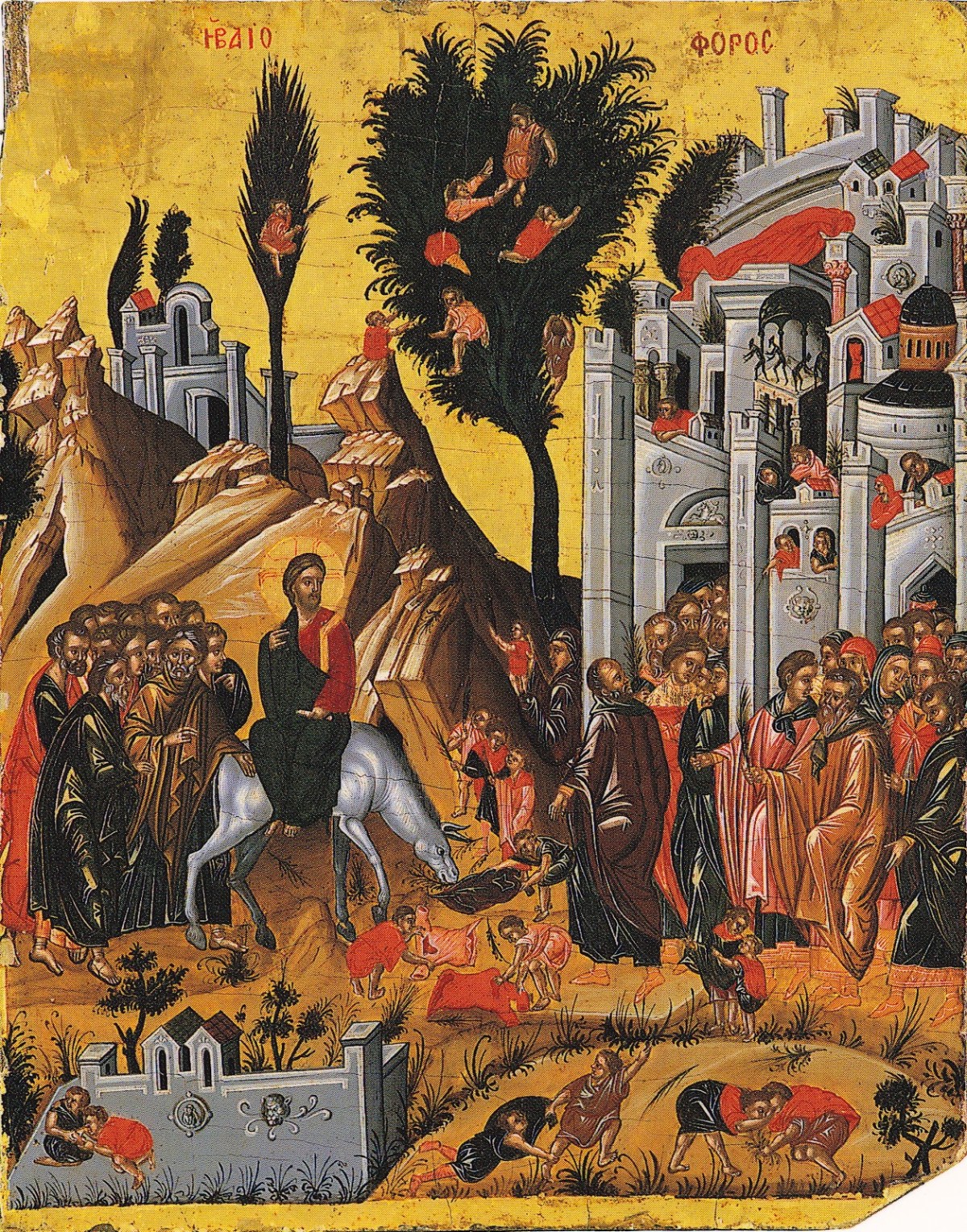
palm sunday

Readings: Isaiah 50:4-7; Luke 19:28-40

He’s finally here. Jesus has finally entered Jerusalem. His whole life has been leading him to this place. And he’s not the only one who knows it. For a year he’s been preaching in the country, gathering a multitude of disciples that’s following him now, into the city. And they have some pretty particular ideas about what this means. Blessed is the king who comes in the name of the Lord. He’s finally here, the king of Israel is finally here. What’s he going to do? Who knows? But we can guess. Chase out the Romans, restore the ancient Kingdom of David, the possibilities seem endless. And the multitudes of his disciples and the people of Jerusalem who are throwing their clothes at his feet and waving their palms in the air are ecstatic. And they began to praise God joyfully with a loud voice. Luke tells us they are saying Blessed is the king, but joyfully with a loud voice? They’re singing. They are so full of joy and hope that they can’t help but sing, because he’s finally here.

It must be said that Jesus doesn’t exactly disabuse the multitudes of this notion they’ve got. That he’s here to kick some Roman keister. Earlier in Luke he told the twelve what’s really going to happen, about how he’s going to suffer and die on the cross. But of course telling a secret to the twelve was like telling it to a brick wall. Huh? Anyway, Jesus sends two of them ahead to find him a colt, so that he can ride into Jerusalem on horseback, like a king. And the people who saw him approaching must have immediately heard the words of the prophet Zechariah ringing in their ears.

Rejoice greatly, O Daughter Zion!
Shout aloud, O Daughter Jerusalem!
Lo, your king comes to you,
triumphant and victorious is he,
humble and riding on a donkey,
on a colt, the foal of a donkey.

He will cut off the chariots from Ephraim
and the warhorse from Jerusalem,
and the battle bow shall be cut off.
And he shall command peace to the nations.
His dominion shall be from sea to sea
and from the River to the ends of the earth.

And there he is at last, riding on a colt. Surely the Roman chariots and warhorses will be routed. The victory of peace is at hand. The prophecy is being fulfilled before their eyes, and so they celebrate in the streets of Jerusalem. They start the party. They sing for joy.

And it’s tempting to say, they’re deluded. They are deluded. Because they have no idea how bad it’s about to get. The ones who do are the Pharisees. So they try to stop the singing, end the party. They say, Teacher, order your disciples to stop. This isn’t just because they’re jealous of all the attention this new rabbi’s been getting. We don’t have to think of these Pharisees as part of that cabal of chief priests, scribes, and political leaders who are already plotting Jesus’ death. They’re worried about what the Roman response to this festival, to this sudden unexpected outpouring of worshipful, joyful song, is going to be. They are worried about what’s going to happen to them, to Jesus, and to all of the people of Israel, disciples of Jesus or not. And they are absolutely right to worry. Within a few days the king, who was finally here, will be gone. The disciples will be scattered. Rome will still stand and, within a few short years it will decide it has had quite enough of these annoying Israelites. Its armies will siege and sack their city. Its armies will burn their temple to the ground. The Pharisees, they can see it coming. And they’re right. They have taken an honest look at the world, they have seen it clearly, and they have concluded that there is nothing here to sing about.

And Jesus, he can see it coming, too. His own death, I’ve already mentioned that he knows about that. And Luke tells us, in the next chapter of his Gospel, that Jesus knows what’s coming for Jerusalem. But what must have been worse, or I think it must have been worse for him, was to know that while all of these people are throwing their clothes at his feet and waving their palms in the air, in a few days, an equal number going to be shouting for his death. He can see Rome and the scheming leaders of his day. He can see into the hearts of everyone around him. He knows how fickle they are, how many of his own disciples will abandon him. If anyone can see the reasons not to sing, it’s him.

And yet he turns to the Pharisees and says, I tell you, if these were silent, the stones would shout for joy. What I take him to be saying is that this feeling, this upswelling of joy in the people’s hearts is so powerful that it seems to be permeating the world around them. Like a failing dam if you stopped it up here it would just burst out over there. So what he says, in effect, is let them sing. Even if Rome won’t like it. Let them sing, in spite of their erring hearts. In spite of the fact that Maundy Thursday and Good Friday are coming, in spite of every good reason I can think of for them to stay silent, let them sing anyway.

Jesus, as Luke presents him in today’s Gospel, wants his disciples to feel joy and share it. And it is Jesus who brings that joy with him to Jerusalem and to all of his disciples wherever they may be. He’s finally here, and in Jerusalem like in Bethlehem he arrives unexpectedly and fills everyone around him with irrepressible joy. And here and now on Palm Sunday we commemorate and we share in that joy they felt in Jerusalem. The party finally begins, and then it is over, too soon. Thursday and Friday always come, so soon.

And it will be tempting to think that we in our joy were deluded, too. Lent after all is the time for reflection on our failures and shortcomings, the time in which we, like those Pharisees, are supposed to make an honest assessment of ourselves and our world. And there are a lot of reasons not to sing. If we’re particularly introspective, we might echo good old John Calvin, who in the second volume of his Institutes lamented that “No one can descend into himself and seriously consider what he is without feeling God’s wrath and hostility toward him. … All of us, therefore, have in ourselves something deserving of God’s hatred.”  If we find it easier to see sin in the world we won’t have to venture too far to find that, either. But the discovery will be no less painful. The German theologian Friedrich Schleiermacher understood original sin not as a sin that we are born with but as a sin that we are born into. He writes “…the sinfulness which is prior to all action operates in every individual through the sin and sinfulness of others … it is transmitted by the voluntary actions of every individual to others and implanted within them.” In other words, the sins we see in our society are our sins, too, transmitted to us, implanted in us, operating through us, even if it looks like they are somebody else’s fault. I don’t mean to frighten you a lot, but I do submit that there will always be good reasons for us not to sing for joy.

And yet we do. Not because we can’t see our broken world or our erring souls clearly. I think we can. But we sing for joy anyway, because as Christians we proclaim that the spirit of Christ is present among us, present at our table. And his presence can act on us like he acted on the people of Jerusalem. It can move us to joy. As Christians we are called to see ourselves and our world rightly. Jesus spends too much time in the Gospels naming the evils he sees for us to doubt that. But we must also be ready to sing for joy. We ought to be known for our joy.

I’m pretty sure I’ve heard sermons that said Palm Sunday was a preview of Easter. And it’s true that Easter is usually the most joyful day of the year, when the fast of Lent is over, and spring is here, and the sun shines through the windows on the pews full of everyone in their brightest clothes. The brass choir plays and the people sing. He’s finally here, and it’s quite a party. Except, in the Gospels, he isn’t there on Easter.  Not like he was on Palm Sunday. He is risen, yes, but he doesn’t process through the streets of Jerusalem again. He appears elsewhere, in the country again, on the road to Emmaus. There was more confusion and awe and fear on that first Easter, if you ask me, than there was joy.

So perhaps on Easter we are actually celebrating like it’s Palm Sunday. Like he’s finally here. Like everyone on that road to Jerusalem we are hoping for that day when the chariots are cut off from Ephraim and the war horse from Jerusalem. We are hoping for the triumph of peace at last, and for the day when his dominion stretches from sea to sea and from the River to the ends of the earth. And whatever our doubts and whatever our failings may be, we are moved to sing with hope and joy. Blessed is the king who comes in the name of the Lord! Peace in heaven, and glory in the highest heaven!

He’s almost here. Amen.

image source here.

freshly pressed

freshlypressedThank you to all who accessed my blog through WordPress’ Freshly Pressed feature and read, commented, liked, or followed. The homily I posted here was presented in my local congregation last Sunday. Since it was my first time presenting a sermon, I was nervous and emotional, but I made it through and felt moved in a way I didn’t expect by the message presented in the Biblical readings and through the process of speaking the words aloud. Helping the oppressed – especially those suffering within systems we can at least begin to change with minimal effort – is close to my heart; expressing that to an audience made it real to me in a way it hadn’t been before. I’m thankful that WordPress made it accessible to a wider audience.

I thought I’d provide a few resources if you’re interested in poking around the blog or exploring social justice issues further:

  • If you’re interested in social justice and fair trade issues, I encourage you to check out my ethical style blog, Style Wise, for retailers, resources, and inspiration.
  • If you’d like to know more about my journey through Lent, you can read my Lent post
  • For all other explorations, you can navigate by topic using the Categories menu on the left hand sidebar. 
  • If you’re interested in a thorough discussion on the sacredness of life, you may want to read The Sacredness of Human Life by David P. Gushee. I’m reading it now and find it uplifting and thought provoking.

I can’t promise that all my future posts will be as meaningful as the last one, but I’ll continue to keep an account of my life with honesty and (hopefully) a fair amount of reflection.

Psalm 30:2

It takes some strain
to bow to humility
to ask for Help means:
I’ve really reached my
end.

So when I ask, know I’m
Desperate: I’ve run out of
time, excuses, plans.

I called to you –
Oh God! I called.
I asked for help with:
All the pomp & circumstance
of a General in Battle.

Bring your guns, ready
your forces. I’m
puffed up even in
my weakness. The commander of:
My Circumstances.

You were just reinforcements.

But instead,
Oh God! You laid me down
demanded light activity in
the nearest seaside town.

And the unrest, you
promised, would lose its
un-: I’d find the peace of
a Cicada at its end.

And the chaos would be
music and the nagging thoughts
a rhyme. And the world’d still spin around
us both, but we would dance
in time.

Lord, my God, I called to you for help, and you healed me. – Psalm 30:2

Lenten reflections & goals

tulips

I grew up an Evangelical Christian, though thankfully within churches that provided a broader worldview than strict fundamentalism. Although I don’t recall hearing any explicit anti-liturgical speeches from the pulpit, there was a below-the-surface distrust of liturgical traditions as well as a widespread belief that Catholics weren’t really Christians (though I never understood that). The only parts of the church calendar we followed were Christmas (we also tossed around the word Advent occasionally while not actually practicing it) and Easter.

As I learned more about the founding of evangelical movements in the United States, I came to understand that this separateness – this stubborn individualism – developed, in part, to bring Christianity into the hands and hearts of the masses. I think that’s a good thing. But I also think that throughout the complex and tangled history of Christian movements, we’ve had a tendency to throw the baby out with the bathwater. As an adult now with a wider view of Christian tradition, I see value in the familiarity and routine the church calendar provides. As Advent left its restorative mark on the Christmas season for me last year, I anticipate that Lent, too, can provide opportunity for reflection and transformation. I’ve participated in it half-heartedly for several years, but I’m ready to make a commitment to it practically and spiritually.

Lent is a season of repentance and self-denial leading up to the observance of Christ’s death and resurrection. It is intended to remind us of Christ’s grandiose and restorative act of self-sacrifice on the cross juxtaposed against our own human frailty. We reflect somberly on our fallen state to amplify the grace that arrives daily with the knowledge that Christ is risen indeed.

Lent, it seems to me, is not practiced well if one only considers what one is giving up. My  high school friends from liturgical traditions would give up soda or french fries every year, but could never explain to me the significance of the act. I scoffed at their ignorance when I should have scoffed at my own.

Giving something up, it turns out, is about penitence: it’s not just a project in self control but a strict disciplinary action taken against ourselves, a reminder that we are rowdy and undisciplined by nature.

The vital next step is to realize that giving up bad habits clears up space for spiritual reflection. I’m terrible at meditating on the character of God, on seeing myself as someone in relationship to and with the Divine. It wasn’t always that way; I spent a long time wanting my old spiritual awareness back instead of recognizing that I could progress toward a new and better spiritual life. I’m ready for progress.

This Lenten season, I’m giving up rewarding myself with non-essentials (clothes, books, makeup, etc.) and taking on better spiritual practice. I intend to read more theology, pray more, and intentionally seek out ways to practice kindness and self-sacrifice. I’m replacing bad habits with good ones. I’m filling the void instead of wallowing in it. I recognize my shortcomings and repent from them more fully, I think, when I compare them to the vibrant spiritual life I could live instead.

I encourage you to meditate and reflect on your life in relationship with Christ as you trudge through these final days of winter, as you look forward to the rebirth and joy that arrives with spring.

See! I am doing a new thing

The planting is hard but
the Sprouting
it hurts.
Imagine! Writhing
Up against nature’s grounding force
through mildewing grime
Would you – human –
with free will, with choice
ever push? Eat dirt,
awaken?
The mums are stronger
It wasn’t their choice
It’s nature
Look! If it’s light and
dew you want
you already have it.
Dilluted/deluded
in your watery
thoughts, you were
already taken Up
You have already fought
You are a golden mum
echoing light on each
dewy drop.

“Forget the former things;
do not dwell on the past.
See, I am doing a new thing!
Now it springs up; do you not perceive it?
I am making a way in the wilderness
and streams in the wasteland.”

people, look east

A selection of verses from the Advent hymn, People Look East:

Birds, though you long have ceased to build,
guard the nest that must be filled.
Even the hour when wings are frozen,
God for fledgling time has chosen.
People, look east and sing today,
Love the bird is on the way.

Stars, keep the watch. When night is dim,
one more light the bowl shall brim,
shining beyond the frosty weather,
bright as sun and moon together.
People, look east and sing today,
Love the star is on the way.

Angels, announce with shouts of mirth
Christ who brings new life to earth.
Set every peak and valley humming
with the word, the Lord is coming.
People, look east and sing today,
Love the Lord is on the way.

a poem for Advent

Light of Christ

She held it cupped in her wrinkled palms,
across her lifeline, it burned
And fragmented and grew.
She peered in, squinting hard,
Hands to nose
Stars igniting in her eyes.

She clenched it then, tightly
Pushed it away with the force of her now
elongated arm, like a sigh, or fainting,
or a fervent dance.

She didn’t let go.
Afraid, though, of
The Revealing:
over-exposure,
Conviction – no trial necessary

But it hurt, holding its
heat, its heaviness
She shuttered her eyes

Release.
She knows it’s gone.
She can see the sun with her eyelids pinched tight.
A whisper, a knowing – she musters the courage to
Look.

She is enwrapped in a gown of radiance
frothy and feathered and laden with silk,
A light that imparts light
A glow that reveals, not her own:
griminess, despair, darkness.
The light of truth and love,
The light of Christ encroaching on:
decay, vanity, deceit,
Death.

Embraced, ignited,
A girl on fire
Enshrouded in the revealing and
Holy Light of Christ.

“your life is hidden with Christ”

Wrapped in your own appendages

Fetally bowed:

Warm, blind, elastic

Gently burrowed

Swaddled,

Swallowed.

By the soft skin of

Your mother’s fluid

Arms

Under brown earth

Under dragging feet, under

The whimpers and

Shouts and snarls

Of Toil.

Your heart beats loud

With the hum of

Happy Solitude.

Awaking then to

Endless, White, Blankness

(here, finally, content)

Of the hiddeness of Christ.