Jesus’ Program

Did you know that any service of the Episcopal Church that includes communion is required to have a sermon? The church reformers wanted to make sure that scriptures were not only read in church, but understood among the people of a congregation. 

The preacher’s job was, and is, to “make plain” the words of our scripture texts so that, when we are invited to share in Holy Communion with Christ and one another, we feel fully a part of the Body of Christ, and united in his purpose. 

This call to preach the Gospel has persisted in our tradition for nearly 500 years. But it finds its origin in the very earliest practices of the church, informed by Jewish tradition. Today, in fact, we encounter Jesus delivering his first sermon.  

Couched between his 40-day fast in the wilderness and an attempt by the congregation to throw him off a cliff, this scene is the calm in the middle of “many dangers, toils, and snares” throughout Jesus’ ministry. 

In the story, Jesus reads a bit of scripture, then sits back down, before preaching nine, carefully chosen words: “Today this scripture has been fulfilled in your hearing.” 

In one small scripture text and just nine words, Jesus articulates a comprehensive vision for his ministry. I’ve heard people describe it in various ways: as Jesus’ manifesto, his statement of purpose, his strategic plan, and maybe most apt, his Inaugural Address. 

Biblical scholar Luke Timothy Johnson calls it a “programmatic prophecy.”  Which is to say, here, we get a preview of Jesus’ priorities, the ones that will guide his ministry and inform his tactics going forward. Here, we learn what kind of leader Jesus will be.

It’s important to remember that, in Jesus’ day, many people awaited a Messiah, a person anointed by God to carry out his will for transformation. But most imagined a politician, a king, or a war hero.  And many wanted a rabble rouser who would ignite a political takeover. 

This is why, even at nine words, Jesus’ sermon is provocative. In the same breath, Jesus identifies himself as the Messiah hoped for and outlines a surprising set of tactics for his reign. Instead of building an army to defeat the Roman emperor, Jesus turns his gaze to the downtrodden. 

During his reign, he will bring good news to the marginalized, impoverished, and forgotten ones, proclaim release to those trapped by prisons or circumstances, recognize the dignity of the Disabled, liberate and empower the oppressed, and declare the goodness of God for all time. 

He will reveal his power paradoxically, by ignoring and forsaking the world’s power networks, walking out of the spotlight, and sitting down in the crowd, among the people he has come to save. 

Jesus only needs nine words, because the real sermon isn’t what he says – it’s who he is. The real sermon is his own body. 

Jesus will use his heart and mind, his hands and feet – his very life – as the tools of transformation. He will use his own blood, not poured out on the battlefield, but shared at tables with friends and strangers, offered as sustenance for the world. 

Jesus’ program is not a strategic plan for domination, but a painstakingly personal, relational effort to care for each person according to their need. It is a blatant refusal of common sense, a waste of resources, and a brutally inefficient system. But that is the way of Jesus: Not a pitch, a campaign, or a policy, but a body, putting itself on the line for the salvation, redemption, and liberation of the world. 

Early Christians, understanding themselves as the Body of Christ, took this sermon very literally. 

In the earliest years of the Jesus movement, Christ-followers became known for their intensely, egregiously gracious community values: 

  • Wealthy elites worshipped with enslaved people.  
  • Jews worshipped with Gentiles.  
  • Women and men alike served as community leaders (Ludlow, 17). 
  • Widows were so highly regarded that they became their own order of clergy (Ludlow, 19). 
  • Babies abandoned due to disability or poverty were adopted and raised by church members (Holland, “Charity”). 
  • Landowners sold all their property and gave it to the church (Acts 4:37).  
  • Congregations took up collections for the poor in faraway places, and built housing for them in their hometowns (Pauline epistles, Holland). 

And here’s a really wild one:  Some, according to first-century bishop Clement, even sold themselves into slavery to provide for the destitute (Ludlow, 19). 

In the 4th century, Emperor Julian shared his annoyance with Christians, which he calls Galileans, in a letter to the pagan priest of Galatia: “How apparent to everyone it is and how shameful that our people lack support from us when no Jew ever has to beg and the impious Galileans [Christians] support not only their own poor, but ours as well” (22). 

Early Roman persecutions of Christians are thought to have occurred, in part, because Christians were so bent on ignoring the social order. They were refusing to live according to the “way things had always been done.” They didn’t seem to care about hierarchies, cultural boundaries, and political mandates. They were using their bodies and their lives as tools of transformation, pouring themselves out for the sustenance of the world. 

Many of them died as martyrs, unwilling to forsake the call of Christ. And yet, their communities were characterized by joy. 

How can this be? While early Christians struggled with the same theological disagreements, life circumstances, and wills to power as everyone else, there was a clear goal: Everyone has a place at the table, and everyone is fed. 

Of course they were joyful! The early church was like an open-invite dinner party. 

And how can you be downtrodden at a dinner party? How can you worry when another course is on its way? How can you fear when everyone you love is here with you, with scars and struggles and stories to tell? How can you grieve when each face around you is shining in the glow of candlelight, lit like the glory of Christ? 

How can you be burdened by the risk involved in Christ’s program when you know that this program, his own body, is what got you here? Christ and his followers endured “many dangers, toils, and snares,” putting their bodies on the line for the sustenance of the world. 

And the most incomprehensible part of all of this is that he did it, and they did it, for you. You and I are here today because the early Christians took Jesus literally. And because they took him literally, they weren’t willing to give up on the poor, the oppressed, the marginalized, the disabled, the lost and forgotten ones. 

Because they took him literally, we, “who were lost, are found.” Together, we are one body with many members, trying to figure out how to be Christ’s body for the world. 

In a nine-word sermon shared while seated, Jesus calls to us, not from the stage but among the crowd, to become one body and one blood, poured out for the sustenance of the world. 

So, here’s my own attempt at a nine-word sermon: This is what it means to participate in Communion. 

References:
Luke Timothy Johnson, Sacra Pagina Commentary Series: Luke
Morwenna Ludlow, The Early Church
Tom Holland, Dominion
“Crowd” language courtesy of Willie James Jennings (particularly After Whiteness)

Not ‘Ordinary’ At All

Father in heaven…Grant that all who are baptized into his Name may keep the covenant they have made, and boldly confess him as Lord and Savior; who with you and the Holy Spirit lives and reigns, one God, in glory everlasting. Amen. 

Among the many nerdy theological arguments clergy find themselves engrossed in, is a lively debate about what to call the season we’re currently in

Is it the Season of Epiphany or the Season after the Epiphany? The Feast of the Epiphany was Monday. Every year on January 6, we celebrate the arrival of the Wise Men bearing their gold, frankincense, and myrrh, and announcing Jesus as the “King of the Jews.” 

Epiphany marks the end of the Christmas season and the return to “ordinary time.” While “ordinary,” in this case, means “counted,” in many ways, we are also getting back to “normal” until Lent begins. 

But preachers and scholars can’t quite agree on the thematic details. Some feel like the broader theme of epiphany – meaning “sudden revelation or insight” – invades and permeates the scripture readings set for this season. They insist that we keep looking for signs and wonders of Christ’s action in the world. 

And I take their point. 

But personally, I am inclined to say Epiphany is done, and there’s nothing else to say about it. I think it’s just that I’m over the twinkly lights and the Christmas trees and the heightened sense of optimism, that our secular Christmas and New Year’s celebrations bring. I’m ready to put all that away and sink into my Seasonal Affective Disorder until spring. (Yes, I have been diagnosed.)

But in his weekly newsletter, Dr. Andrew McGowan suggested that we can’t say goodbye to “epiphanies” just yet. Because today, we celebrate the Baptism of Jesus, the descent of the Holy Spirit, and the sudden revelation of Jesus as the Son of God, announced by God himself. 

As a colleague put it, this moment in our Gospels is when the clock starts ticking on Jesus’ earthly ministry. He is baptized here, among the people he has come to save. He will spend the next three years with them, walking slowly toward Jerusalem, the cross, and the resurrection. 

In other words, Jesus’ baptism marks a spiritual, relational, and ritual transformation that will bond Jesus and this burgeoning faith community to one another for eternity. Jesus’ baptism, in a mystical and physical sense, is the beginning of the church. Because it gives form to a new religious movement that will eventually be called Christianity. 

That’s not ordinary at all. That’s an epiphany! 

This is why baptism has been so important to the church since the very beginning. And it is why we call it the “initiation rite” of our church… 

Our Book of Common Prayer describes Holy Baptism as “…the sacrament by which God adopts us as his children and makes us members of Christ’s Body, the Church, and inheritors of the kingdom of God.” It was described by the early church reformers as “the outward and visible sign of an inward and spiritual grace.”  

While Christ can and does speak to us whether we’re baptized or not, our baptism welcomes us into new life, a life dictated not by the finality of death and brokenness, but by the last Word of eternal life, held forever in the hand of God. 

While we usually baptize at a font by pouring water on the person’s forehead, the early church preferred baptizing in a pool of water. These were inground pools built within the walls of the church. The person to be baptized would be brought into the room, descend down several steps into the pool, be immersed face first, and then step up and out of the pool, where they would be clothed in white.i 

The layout was significant to the meaning of baptism: Stepping down into the pool signified stepping into the grave, being immersed in the water signified death (and purification), and stepping back out to be clothed in white signified the resurrection. 

This ritual, an “outward and visible sign,” revealed what baptism actually is: becoming one with the Body of Christ in his death, and his resurrection

Just like those ancient Christians, our baptisms still make us one with Christ and with his Body, the church. Whether water is poured on our foreheads, or we are immersed in a pool, at baptism we participate in our own funeral, and our own homecoming.  

But we don’t do it alone. The Episcopal Church no longer performs private baptisms, because we understand that our faith is not only for ourselves, but for our community, and strengthened by our community. 

This is why infant baptisms are part of our practice. We believe that life in Christ is nurtured in the church, that we learn from one another and, in turn, teach one another what it means to be “born again.”  

Our initiation into the church through baptism prepares us for a lifetime of growing in the faith. And it helps us pay attention to life’s epiphanies that both reveal Christ’s grace and urge us to respond in kind

Baptism, Christ’s and our own, points us to who we are.  

We are “resurrection people.” Life in Christ, and in his church, will not protect us from the trials and horrors of this life – from the fires and floods and griefs. 

But we are a people called to run toward the challenges of this life in service of love, drawing from a deep well of hope in Christ that can’t be moved by the death, destruction, and decay all around us, because we know we are held forever in the hand of God. 

To use a Biblical term, we can “gird our loins” for whatever comes, because we know we belong to Jesus, we are led by the Holy Spirit, and we have one another as mentors on the Way. 

[As we prepare to say together the Baptismal Covenant, I encourage you to take some time to reflect on and pray with the words.  Consider how the Holy Spirit is leading you to more fully embody your baptism. 

Later, as you come up for Communion, I encourage you to place a finger in the font and make the sign of the cross on your forehead, as a physical reminder of your participation in the resurrected life of Christ and his church. 

We will now take a couple minutes of silence for prayer and reflection…]

shrinemont weekend ’14

sh4

In the beginning of July, Daniel and I headed out with friends from church to attend the annual congregational get together at the Episcopal campground that borders the George Washington National Forest. It’s taken me forever to get to posting these, because on the way there, our car broke down (RIP) and the rest of July was spent either car-less or in Florida to buy my grandparents’ car (thanks, Grandparents!).

sh6

sh10

I had a most relaxing time despite the stress of losing a vehicle. We played literary games, sang gospel songs in three parts, read on the covered porch, ate s’mores, and went on a very educational hike thanks to the presence of an ecologist and a former geology major. I fell in a creek, got bitten by a horsefly, and overheated a bit, but that’s part of the joy of summertime!

sh13

sh18

sh19

sh23

sh27

sh31

sh32

sh33

The weekend could not have been better.


first sunday of advent

hk7

Besides this, you know what time it is, how it is now the moment for you to wake from sleep. For salvation is nearer to us now than when we became believers; the night is far gone, the day is near. Let us then lay aside the works of darkness and put on the armor of light; let us live honorably as in the day, not in reveling and drunkenness, not in debauchery and licentiousness, not in quarreling and jealousy. Instead, put on the Lord Jesus Christ, and make no provision for the flesh, to gratify its desires. – Romans 13: 11-14

alleluia!

easter vigil

As the sun sets, attendees are given an unlit candle. Outside, the light of Christ is lit just as the last light of the sun settles on the horizon. Parishioners process in quietly and await the coming of the light of Christ as it is solemnly paraded down the center aisle. All are aided in lighting their candles from the light of Christ at the front, passing it on, candle by candle to those within their pew. The sanctuary is unlit apart from the growing light of Christ clutched in the hands of this body of individuals, awaiting the readings in silence.

Each contained fire flickers and flares – rhythmically, chaotically, still for just a moment – as members of the congregation recount God’s victory amid despair and oppression. Psalms are chanted in a resonating baritone. The mood is somber, but a quiet hope begins to swell as words of salvation are announced, as the chanting echoes across the high ceilings and glass walls of the sanctuary.

All at once, the room comes alive with light, parishioners ring bells they hid among their belongings, and the organist begins a triumphant song. All stand and sing:

Jesus Christ is risen today, Alleluia!
our triumphant holy day, Alleluia!
who did once upon the cross, Alleluia!
suffer to redeem our loss. Alleluia!

Hymns of praise then let us sing, Alleluia!
unto Christ, our heavenly King, Alleluia!
who endured the cross and grave, Alleluia!
sinners to redeem and save. Alleluia!

But the pains which he endured, Alleluia!
our salvation have procured, Alleluia!
now above the sky he’s King, Alleluia!
where the angels ever sing. Alleluia!

For the first time since Lent began, Alleluia rings out again. The world was dark and cold as a winter night, but Christ is alive and in it and working once again!

tree blossom

The final verse of Wheat that Springeth Green, in particular, rang true for me this year:

When our hearts are wintry, grieving or in pain,
thy touch can call us back to life again,
fields of hearts that dead and bare have been:
love is come again, like wheat that springeth green.

How I needed to exhaust my lungs with the singing of those words! After a long, dark winter, after several weeks of chaos and confusion and self doubt, after 8 months of not dealing with the weight of moving away from everything familiar and comforting, I needed to acknowledge the barren winter in my heart, clear the snow away, and discover joy without limitation in Love springing up again.

He is risen! Alleluia!

first image source: Catholic News/second image: my own

Let Them Sing by Paul Gleason

My friend Paul presented the Palm Sunday homily last weekend at our church. I really enjoyed it and I hope you do, too.

palm sunday

Readings: Isaiah 50:4-7; Luke 19:28-40

He’s finally here. Jesus has finally entered Jerusalem. His whole life has been leading him to this place. And he’s not the only one who knows it. For a year he’s been preaching in the country, gathering a multitude of disciples that’s following him now, into the city. And they have some pretty particular ideas about what this means. Blessed is the king who comes in the name of the Lord. He’s finally here, the king of Israel is finally here. What’s he going to do? Who knows? But we can guess. Chase out the Romans, restore the ancient Kingdom of David, the possibilities seem endless. And the multitudes of his disciples and the people of Jerusalem who are throwing their clothes at his feet and waving their palms in the air are ecstatic. And they began to praise God joyfully with a loud voice. Luke tells us they are saying Blessed is the king, but joyfully with a loud voice? They’re singing. They are so full of joy and hope that they can’t help but sing, because he’s finally here.

It must be said that Jesus doesn’t exactly disabuse the multitudes of this notion they’ve got. That he’s here to kick some Roman keister. Earlier in Luke he told the twelve what’s really going to happen, about how he’s going to suffer and die on the cross. But of course telling a secret to the twelve was like telling it to a brick wall. Huh? Anyway, Jesus sends two of them ahead to find him a colt, so that he can ride into Jerusalem on horseback, like a king. And the people who saw him approaching must have immediately heard the words of the prophet Zechariah ringing in their ears.

Rejoice greatly, O Daughter Zion!
Shout aloud, O Daughter Jerusalem!
Lo, your king comes to you,
triumphant and victorious is he,
humble and riding on a donkey,
on a colt, the foal of a donkey.

He will cut off the chariots from Ephraim
and the warhorse from Jerusalem,
and the battle bow shall be cut off.
And he shall command peace to the nations.
His dominion shall be from sea to sea
and from the River to the ends of the earth.

And there he is at last, riding on a colt. Surely the Roman chariots and warhorses will be routed. The victory of peace is at hand. The prophecy is being fulfilled before their eyes, and so they celebrate in the streets of Jerusalem. They start the party. They sing for joy.

And it’s tempting to say, they’re deluded. They are deluded. Because they have no idea how bad it’s about to get. The ones who do are the Pharisees. So they try to stop the singing, end the party. They say, Teacher, order your disciples to stop. This isn’t just because they’re jealous of all the attention this new rabbi’s been getting. We don’t have to think of these Pharisees as part of that cabal of chief priests, scribes, and political leaders who are already plotting Jesus’ death. They’re worried about what the Roman response to this festival, to this sudden unexpected outpouring of worshipful, joyful song, is going to be. They are worried about what’s going to happen to them, to Jesus, and to all of the people of Israel, disciples of Jesus or not. And they are absolutely right to worry. Within a few days the king, who was finally here, will be gone. The disciples will be scattered. Rome will still stand and, within a few short years it will decide it has had quite enough of these annoying Israelites. Its armies will siege and sack their city. Its armies will burn their temple to the ground. The Pharisees, they can see it coming. And they’re right. They have taken an honest look at the world, they have seen it clearly, and they have concluded that there is nothing here to sing about.

And Jesus, he can see it coming, too. His own death, I’ve already mentioned that he knows about that. And Luke tells us, in the next chapter of his Gospel, that Jesus knows what’s coming for Jerusalem. But what must have been worse, or I think it must have been worse for him, was to know that while all of these people are throwing their clothes at his feet and waving their palms in the air, in a few days, an equal number going to be shouting for his death. He can see Rome and the scheming leaders of his day. He can see into the hearts of everyone around him. He knows how fickle they are, how many of his own disciples will abandon him. If anyone can see the reasons not to sing, it’s him.

And yet he turns to the Pharisees and says, I tell you, if these were silent, the stones would shout for joy. What I take him to be saying is that this feeling, this upswelling of joy in the people’s hearts is so powerful that it seems to be permeating the world around them. Like a failing dam if you stopped it up here it would just burst out over there. So what he says, in effect, is let them sing. Even if Rome won’t like it. Let them sing, in spite of their erring hearts. In spite of the fact that Maundy Thursday and Good Friday are coming, in spite of every good reason I can think of for them to stay silent, let them sing anyway.

Jesus, as Luke presents him in today’s Gospel, wants his disciples to feel joy and share it. And it is Jesus who brings that joy with him to Jerusalem and to all of his disciples wherever they may be. He’s finally here, and in Jerusalem like in Bethlehem he arrives unexpectedly and fills everyone around him with irrepressible joy. And here and now on Palm Sunday we commemorate and we share in that joy they felt in Jerusalem. The party finally begins, and then it is over, too soon. Thursday and Friday always come, so soon.

And it will be tempting to think that we in our joy were deluded, too. Lent after all is the time for reflection on our failures and shortcomings, the time in which we, like those Pharisees, are supposed to make an honest assessment of ourselves and our world. And there are a lot of reasons not to sing. If we’re particularly introspective, we might echo good old John Calvin, who in the second volume of his Institutes lamented that “No one can descend into himself and seriously consider what he is without feeling God’s wrath and hostility toward him. … All of us, therefore, have in ourselves something deserving of God’s hatred.”  If we find it easier to see sin in the world we won’t have to venture too far to find that, either. But the discovery will be no less painful. The German theologian Friedrich Schleiermacher understood original sin not as a sin that we are born with but as a sin that we are born into. He writes “…the sinfulness which is prior to all action operates in every individual through the sin and sinfulness of others … it is transmitted by the voluntary actions of every individual to others and implanted within them.” In other words, the sins we see in our society are our sins, too, transmitted to us, implanted in us, operating through us, even if it looks like they are somebody else’s fault. I don’t mean to frighten you a lot, but I do submit that there will always be good reasons for us not to sing for joy.

And yet we do. Not because we can’t see our broken world or our erring souls clearly. I think we can. But we sing for joy anyway, because as Christians we proclaim that the spirit of Christ is present among us, present at our table. And his presence can act on us like he acted on the people of Jerusalem. It can move us to joy. As Christians we are called to see ourselves and our world rightly. Jesus spends too much time in the Gospels naming the evils he sees for us to doubt that. But we must also be ready to sing for joy. We ought to be known for our joy.

I’m pretty sure I’ve heard sermons that said Palm Sunday was a preview of Easter. And it’s true that Easter is usually the most joyful day of the year, when the fast of Lent is over, and spring is here, and the sun shines through the windows on the pews full of everyone in their brightest clothes. The brass choir plays and the people sing. He’s finally here, and it’s quite a party. Except, in the Gospels, he isn’t there on Easter.  Not like he was on Palm Sunday. He is risen, yes, but he doesn’t process through the streets of Jerusalem again. He appears elsewhere, in the country again, on the road to Emmaus. There was more confusion and awe and fear on that first Easter, if you ask me, than there was joy.

So perhaps on Easter we are actually celebrating like it’s Palm Sunday. Like he’s finally here. Like everyone on that road to Jerusalem we are hoping for that day when the chariots are cut off from Ephraim and the war horse from Jerusalem. We are hoping for the triumph of peace at last, and for the day when his dominion stretches from sea to sea and from the River to the ends of the earth. And whatever our doubts and whatever our failings may be, we are moved to sing with hope and joy. Blessed is the king who comes in the name of the Lord! Peace in heaven, and glory in the highest heaven!

He’s almost here. Amen.

image source here.

a church, a chapel, and pigeons

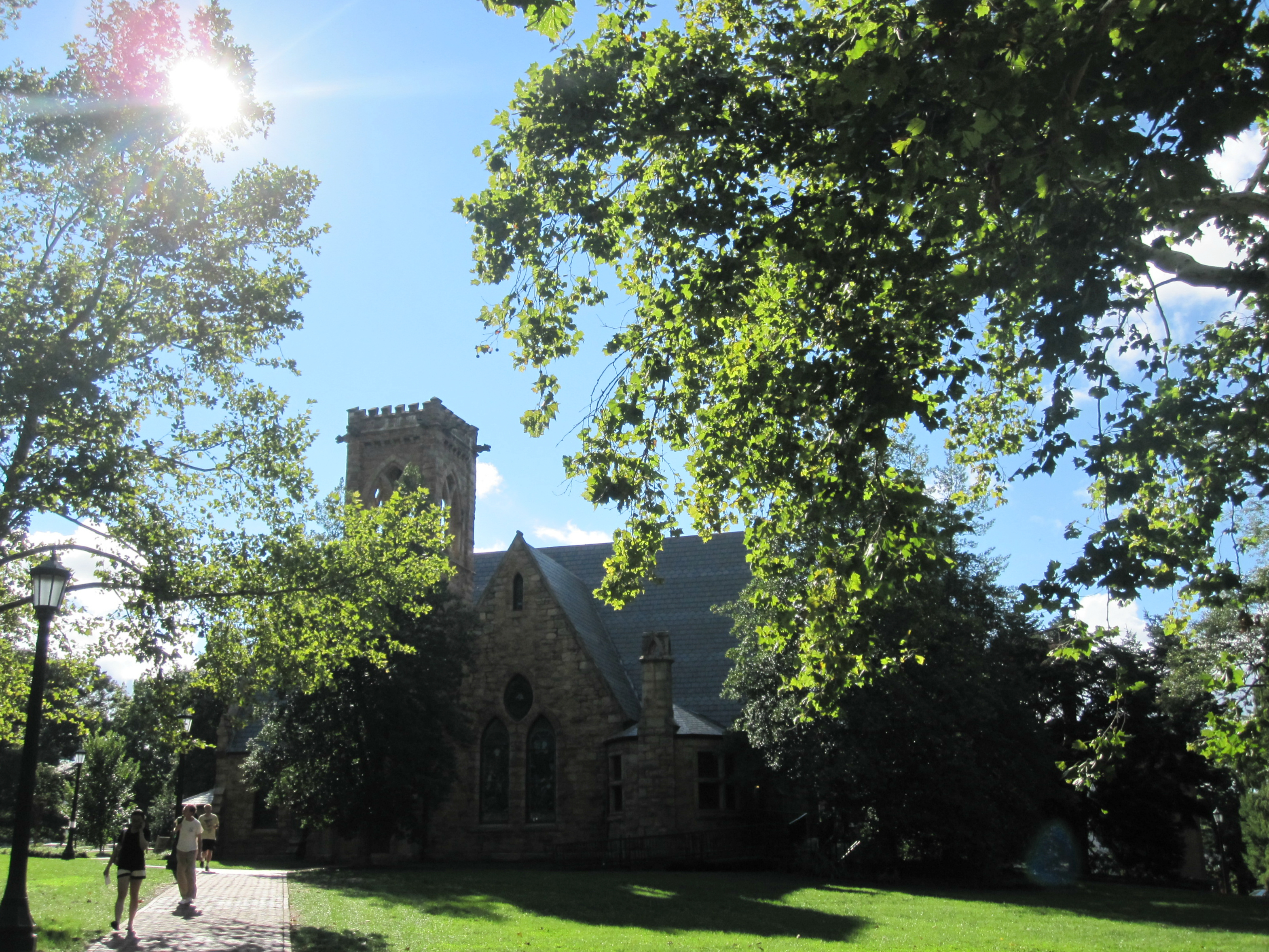
Yesterday evening was beautiful. I love the way the harsh, setting sun streaks across the images below and hyper-pigments the blue sky. We took a quick tour of UVA’s chapel before partaking in an evening service at the Episcopal church nearby. Thomas Jefferson was opposed to mixing religion with public higher education and never would have approved of a chapel on the Grounds. The structure was built in 1885, decades after his passing.

I took the photo of the pigeons earlier today after work. They perch there together quite frequently.