Someday at Christmas

And the Word became flesh and lived among us, and we have seen his glory, the glory as of a father’s only son, full of grace and truth. 

Readings here

As a lifelong choral singer,  I have always been a bit of a Christmas-song snob. And it’s only gotten worse since I became an Episcopalian, and learned about the Season of Advent. Because, as the snobbiest of Christmas-song snobs know,  it’s simply *not done* to sing Christmas music before December 25th. 

So, when Christmas songs start playing on the radio in November, I simply refuse to indulge in the merriment. Instead, I try to stop up my ears and ignore all the clatter about rocking around the Christmas tree, kissing Santa Claus, and filling the world with cheer. But this year, something shifted… 

It has been a hard year. I think I can say that without needing to qualify it. Many of us have borne witness to unimaginable loss and lived with prolonged grief.  We have seen our neighbors struggle. Some of us have lost jobs, or struggled to get one. Many of us have lost much more. 

This fall, when the Christmas music started playing, I noticed my ears perking up. In the midst of the world’s heaviness, I found myself wanting to entertain the idea of Christmas cheer, even if the songs were silly and it was, strictly speaking, not Christmas yet. I was desperate for something that would pull me out of my wallowing

So, with cautious hope – or perhaps desperation – I began really listening to Christmas songs, both secular and sacred. And I noticed that songs that had seemed silly and naive before were starting to sound different in my ear. 

But one in particular stood out… 

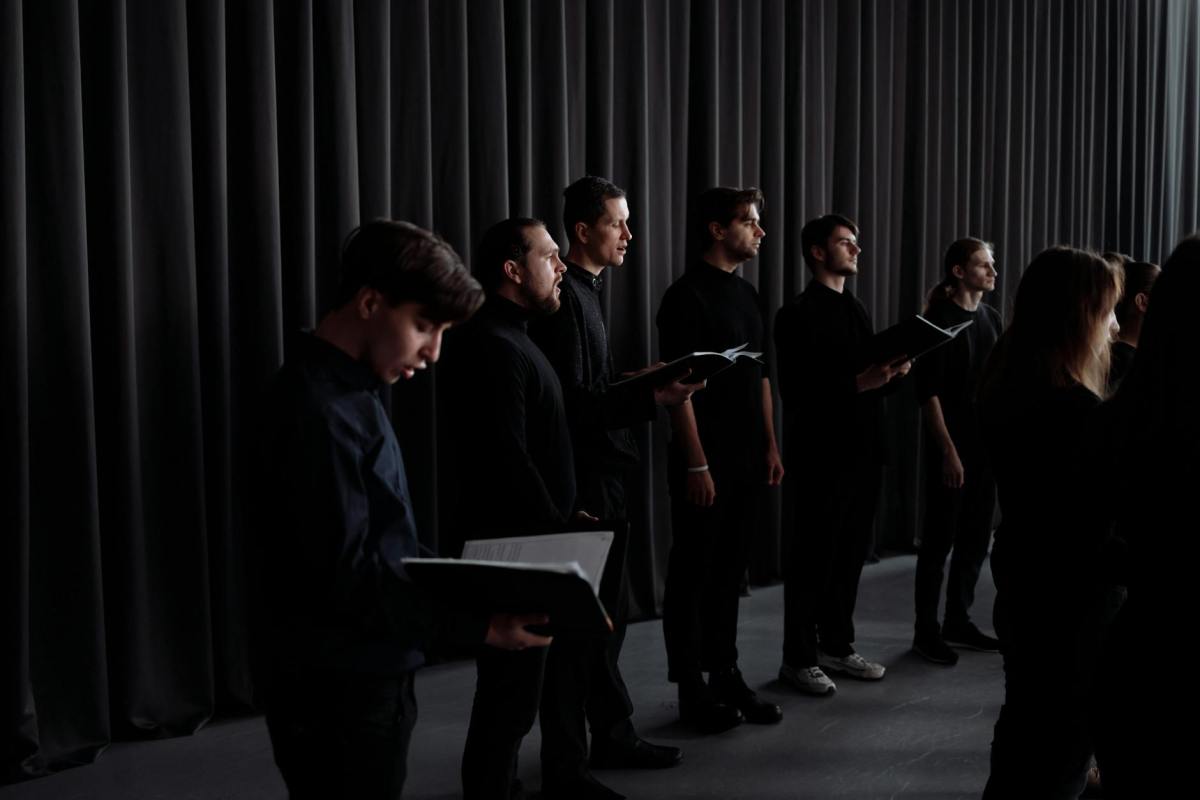
At a community choir concert earlier this month, I was fortunate enough to hear an arrangement of the Christmas classic, “Someday at Christmas.” Released by Stevie Wonder in 1967, this song was part of the soundscape of Christmas before I was born. But, I had never really paid attention to the words,  until this year, when 200 men began to sing in the big sanctuary of a church downtown: 

Someday at Christmas men won’t be boys 
Playing with bombs like kids play with toys 
One warm December our hearts will see 
A world where men are free 

Someday at Christmas there’ll be no wars 
When we have learned what Christmas is for 
When we have found what life’s really worth 
There’ll be peace on earth 

In the unified voice of 200 men, among the crowd of 300 concert goers, this shmaltzy pop song that has whined over the din of Christmas shoppers for 50 years, became something more. Each verse expanded a vision of the world just as big and beautiful as the prophecies of Isaiah: 

“Break forth together into singing, 
you ruins of Jerusalem; 

for the Lord has comforted his people, 
he has redeemed Jerusalem. 

The Lord has bared his holy arm 
before the eyes of all the nations; 

and all the ends of the earth shall see 
the salvation of our God.” 

And yet, at first, the choir sang from a tentative place: a place of desperation, or of hope nearly gone. They seemed to speak of a far-off someday. It seems that their hope had dimmed with each new grief and tragedy in our world, just as mine had

For awhile, I closed my eyes and listened to those hushed voices sing. But then, something caused me to open my eyes and re-focus my gaze. I looked up and noticed that there was a cross at the front of the sanctuary. It had been there the whole time, taking up the whole back wall behind where the singers stood. 

Suddenly, the cross and the music all came together, hitting me like a flash of light. It was as if the full spectrum of faith was being revealed in that room. The desperate prayers whispered in hard times, the cautious hope of someday, the comfort of kind voices filling the room with song. And the empty cross, rising above it all. 

The tone and tempo of the music shifted then, and those 200 voices crescendoed into a bold and forceful sound that made the wooden pews vibrate: 

Someday at Christmas man will not fail 
Hate will be gone and love will prevail 
Someday a new world that we can start 
With hope in every heart 

Quiet desperation had given way to a tangible proclamation of hope. And someday had transformed from passive prayer to bold certainty. As the sound reverberated through the room, all 500 of us gathered there could literally feel hope resonating in our bodies. In the ringing out of unified voices, over the course of many verses, hope had become incarnate

Words had become flesh. 

What was this, if not the miracle of the incarnation, playing out in our time and place? That words of hope could fill up a room and inspire everyone to believe. That things hoped for could be made real through living, breathing, singing humanity. 

This is the miracle of the incarnation, on that Christmas long ago: Jesus Christ, the Word and Lyric that made the world, came to us as a lowly human to be united with us. And to make the world around us vibrate with his tangible presence,  

In the face of life’s suffering and loss,  the incarnation reminds us that a young mother was so close to God, she could hold him in her arms, and a cross could not keep holding him. And, because of this, we will be held forever in the arms of God. 

And this is the miracle of the incarnation still: Christ came down to earth – and hope now has a fighting chance. Because the fulfillment of all our hopes lives among us, and in us. 

Against all odds, and against common sense, the hope of the world was born this day in a little, hill country town called Bethlehem. Sleeping in a food trough for animals,  delivered in the usual way, and arriving without pomp or glory. 

But, the air was thick with the singing of angels. Their glorias made the wood of that little barn vibrate. And tired shepherds carried the tune as they ran like fools to the manger. 

As time went on, the singing got louder. Until, on every tongue, in the presence of Jesus Christ, the hope of “Someday” was changed to “Today.” 

Amen. 

Gaudete! You are blessed

Readings here

From this day all generations will call me blessed: the Almighty has done great things for me, and holy is his Name. Amen. 

Today is one of my favorite days of the year: Gaudete Sunday! Here at Good Shepherd, it also happens to be “Rise Against Hunger” Sunday. (After the service, we will pack 10,000 meals for communities with food insecurity.)

Gaudete, which means “Rejoice,” references an ancient chant used on the third Sunday of Advent. But more broadly, it ties together the theme of today’s readings: JOY! Because we worship a God who “looks with favor on his lowly servants.” 

Joy is abundant throughout Mary’s Magnificat, which we read in place of the Psalm this week. After Mary receives the news that she is pregnant with Jesus, she visits her cousin Elizabeth, who affirms that she has been blessed by God. Moved suddenly by the literal presence of God within her, Mary bursts out in poetic verse. She rejoices, because she recognizes that God is now fulfilling his promise to bring about a just and merciful society – the very one her people had longed for since the world began. 

For Mary, you might say that “the personal is political.” Her individual experience of being blessed by God has expanded her perception of God’s blessing in the world. 

As scholar Luke Timothy Johnson puts it: 

“In the Magnificat, Mary’s praise for what God had done to her personally widens out to include what God does for all who fear Him in every age, including what God is doing for Israel by the birth of its Messiah. As God “showed power in his right hand” by His mighty works in the past, so does he “now take Israel by the hand.’” (Commentary on Luke, Sacra Pagina)

God calls Mary – a poor and powerless woman – to birth the Salvation of the world. In doing so, God shakes up the world, tearing down our assumptions about what blessedness looks like. 

While some of Mary’s words don’t sound like good news to everyone—for example, “the rich he has sent away empty”—God’s activity is actually a great equalizer. No more will some people have too much and others have too little. Everyone has been brought to a level place. 

Mary declares that, in God’s kingdom, blessedness is measured not by power or wealth, but by proximity to the Creator. 

But Mary’s is not the only proclamation of God’s blessing in today’s scripture readings. Our other readings use a framework of physical healing to arrive at the same point. 

In Isaiah, the prophet continues his description of the Kingdom of God, describing both the environment and its people. The scorched desert will be transformed into a never-ending oasis. 

There will also be a physical transformation for humanity. He says: 

“Then the eyes of the blind shall be opened, and the ears of the deaf unstopped; then the lame shall leap like a deer, and the tongue of the speechless sing for joy.” 

In Matthew, Jesus uses similar language to reveal to John that he is the fulfillment of the prophecies in Isaiah. As evidence, he describes his healing miracles:

“the blind receive their sight, the lame walk, the lepers are cleansed, the deaf hear…” 

It’s important for us to understand that ancient people understood this kind of “healing” as a great equalizer, in the same vein as God’s equalizing action in the Magnificat. 

Then, as today, many people with disabilities lived on the margins of society. Often, they couldn’t work. And if they had a particular disease, they couldn’t even live in town. Over time, these disabilities came to be understood as a consequence of someone’s sin. 

But, when Jesus healed them, he declared before the entire community that disability was not a barrier to following him. He made clear, instead, that disabled people were blessed. 

Many Christians today still read these passages and think that a disabled person is somehow less righteous than them. But we know that’s wrong. 

Because we are a community made up of Deaf people, we know that Deafness is not a thing to repent from. It is not a sign of sin or brokenness. It is simply one way of being human; and it shapes people, culture, and language in ways that reveal God’s blessing. 

And this is where the Magnificat comes back in. In Mary’s telling, the Kingdom of God rejects the world’s narrow understanding of blessedness.  It’s not about accumulating wealth or status, acquiring peak physical fitness, avoiding difficulty, or pretending to be anything other than human. 

In fact, acknowledging that we are human is the most important part. The only thing asked of us in the Magnificat is that we “fear God,” and all that means is that we trust and accept the powerful, life-altering love of God in service of our own unfettered joy, and the joy of the whole world. 

By choosing a poor and powerless woman to fulfill his promises, God makes clear that being imperfect by human standards is not a barrier to entering the Kingdom of God. In fact, being an outsider – whether poor, disabled, or otherwise – is a sign of blessedness in the new world that Christ is ushering in. 

Today, we will work together, shoulder to shoulder, as a response to Mary’s joy, and our own. We will measure, sort, and pack meals in an effort “fill the hungry with good things.” 

We do this not out of obligation, but because our scriptures and experiences make clear that proximity to the poor is proximity to God’s blessing. In acts of care for one another, we are reminded that everyone is equal in God’s kingdom, and that the blessings we have received are God’s desire for the whole world. 

Gaudete! Rejoice! 

Nathan Chen is about to show up and do a back flip | Advent 1 Sermon

Readings here

Almighty God, give us grace to cast away the works of darkness, and put on the armor of light, now in the time of this mortal life in which your Son Jesus Christ came to visit us in great humility; that in the last day, when he shall come again in his glorious majesty to judge both the living and the dead, we may rise to the life immortal. Amen.

Today is the first day of Advent – the start of the Christian new year. Advent is often translated as “arrival,” but it can also carry a more active connotation: “coming.” The Season of Advent holds the fullness of these meanings. We acknowledge with renewed hope that Christ has already come to earth, and has already defeated death – he has arrived. And we anticipate Christ’s second coming – he is still on his way.

We are celebrating, but we are also waiting for the final celebration, when Christ will come in “glorious majesty” to restore all things.

The longer I have been in a congregation that follows the church seasons, the more I have come to appreciate them. While there is no way that Christians in the fourth century could have anticipated the cesspool of consumerism that this season has become, their work on the church calendar continues to be a blessing…

Because, following it – especially in this season – reorients our focus from the frenzy of secular Christmas, and calls us to a deeper, more focused anticipation. There’s no harm in enjoying the superficial fun of the season: Santa Claus and Jingle Bells and gift exchanges are perfectly acceptable ways to celebrate with family and friends (even if it is still Advent).

But, the church calendar reminds us that there is something eternal at work underneath all these distracting celebrations. There is something that calls for our singular attention, not as a test of our faithfulness, but because it is so wonderful. Someone has arrived to change everything, and he will carry us into a future of unfettered joy and ultimate freedom.

As a thought experiment, I tried to think of a time when I was called to pay singular attention, simply because it was so wonderful. It wasn’t as hard as I thought it would be…

When I was at Yale Divinity School, I got word that the Yale Figure Skating Club was putting on their winter show. Made up of amateurs, the show was typically just a way for hobby skaters to have some fun while their friends cheered them on. But that year, there were whispers that a special guest was coming…

Three-time world champion and two-time Olympic figure skater Nathan Chen was enrolled at Yale that fall. And word on the street was that he was going to come to the show.

With uncharacteristic clarity of purpose, I convinced a small group of seminarians to take the hike over to the main campus to see what we could see. I was the only figure skating mega-fan among them. So, while everyone else bought concessions and chatted about term papers, I was staring straight ahead, hand on my chin, laser-focused on the rink. I didn’t dare leave my seat. If Nathan Chen was going to be there, there was no way in heck I was going to miss it.

After more than a half-hour of very sweet performances by people who could barely skate, a young man swiftly and silently skated onto the ice. My friends – lulled into the stupor of greasy food and easy conversation – didn’t seem to notice…But I noticed.

I let out the loudest, highest, most piercing, blood-curdling scream. It was so unlike me, that I didn’t recognize it as my own voice until the person in front of me turned around in shock.

Nathan Chen was here, in the same room as me, and he just did a back flip!!! (They didn’t even let him do that at the Olympics because they thought it was too dangerous!!!!) And then, he did his signature quadruple jump, the move that would win him the gold medal in 2022.

The adrenaline was coursing through my body, probably as much as it was coursing through his. And I was just sitting there.

Amid the chatter and distraction around me, something demanded my singular attention. And I was determined not to miss out on the realization of the hope that I had carried with me to the rink that day. I didn’t know when he would arrive, but I trusted that he would.

And what I found was that the wait was worth it, not just for the satisfaction of seeing a dream realized. It was worth it to gather up my new friends, take a risk in inviting them, and spend an afternoon passing the time together in that chilly rink. The joy was abundant even before Nathan Chen got on the ice. The light was already breaking through…but nothing could beat that back flip!

In today’s reading from Matthew, Jesus tells his followers to pay attention: to “keep awake,” not as a test of their faithfulness, but because something wonderful is on the way. Jesus “will come again in glory to judge the living and the dead, and his kingdom will have no end.”

And, while no one knows the day or hour that Christ will return, they should “stay on the alert” with such single-mindedness that it is almost as if they’re waiting for a thief to break into their home. In modern terms, we might say it is almost as if record-breaking figure skater Nathan Chen is about to show up and do a back flip.

We don’t know when he’s coming, but the only way to live, in the meantime, is to stay alert to the promise that Christ will come.

Dr. Andrew McGowan notes the paradox in this idea of staying alert to a thing you can’t predict. He says:

“Jesus’ apocalyptic proclamation is framed by Matthew not as futurology, but as a call to live in a particular way now…So, while Jesus warns from trying to correlate world events and the end of time, the paradoxical message remains that the reader needs nevertheless to “watch,” even without knowing just what we are watching for.”

What Jesus is doing here is making it impossible for us to inoculate ourselves against the unimaginable glory of his coming kingdom. If we don’t know when he’ll arrive, we can’t settle the issue; we can’t put the Kingdom of God in a box.

What’s more, we can’t take a break or rest on our laurels. We’ll just have to be laser-focused on the loving, self-sacrificial, lively work of his kingdom. We’ll just have to let joy run in our veins like adrenaline, until it becomes infectious. We’ll have to take action based on the assumption that all our hopes will be realized.

Christ is coming – we don’t know when or how. But we know that when he comes, death itself will die, and we will live in the eternal light of God. In the meantime, we live with the knowledge that he has already arrived by looking for the cracks in the world where his light is already breaking through. And we make plans that align with God’s promises of joy and freedom, of wholeness and reconciliation, of unconditional love.

This is what Advent is all about.

At the beginning of a new year, we learn again how to “stay awake” to the presence of Christ who was and is and is to come. We learn again how to live in the paradox that some theologians describe as the “already and not yet” – anticipating the glory of Christ’s second coming without losing sight of the light that is already breaking through.

“Come, let us walk in the light of the Lord!”

Amen.

Reconciled, Forgiven, Freed | Christ the King Sermon

Readings here

Today is “Christ the King” Sunday. And that means it is the last Sunday of the church year. Next week, we will start our three-year scripture cycle over again, with Year A, and we will enter into the season of Advent.

The tone will shift, and we will look forward, with renewed urgency, to the coming of Christ: both the Christ-child that we celebrate at Christmas, and the risen Christ, who promises to bring about the “restoration” of the world.

On this last Sunday of the Christian year, as we prepare for the chaos, longing, and joy that Christmas brings, it is good to remember that Christ is king, which means that “perfection” is his job – not ours. Jesus holds everything together, when our best laid plans seem to be falling apart. He calls us to let go of what burdens us, so we can join with him at the banquet he prepares for us.

Over the past 40 or so years, it has become increasingly unpopular to use kingly metaphors when referring to God or Jesus. Though our scriptures are full of references to the triune God as Counselor, King, and Almighty One – and though God’s relationship with his people hinges so often on his authority – some of our newest liturgies remove these references.

In some of the liturgies of our church, words like “Lord” have been changed to “Savior” or, simply, “God.” Kingdom has been changed to “reign.” Some of the most faithful people I know refer to the Kingdom of God as the “kin-dom of God,” deemphasizing the hierarchy between God and humankind and emphasizing humanity as equal members of the family of God.

None of this is necessarily a bad thing…

For one, these edits are pretty subtle – they don’t necessarily change very much in the context of a single prayer or turn of phrase. In some cases, they bring renewed meaning to well-worn statements of faith by signaling that God’s domain is more generous and expansive than those of worldly rulers. And, in a world run by tyrants and would-be tyrants, it is reasonable to be wary of using hierarchical language associated more with violence than benevolence.

In a recent article written for The Living Church, the Reverend Barbara White speaks to this point:

In a world of developed democracies, which is nevertheless beset by dictators, oligarchs, and those who want to be, it makes sense to wonder if kingship is the most relevant metaphor for Christ’s relationship to the world and to humanity. There is also the uncomfortable fact that the term “Christ Is King” has been recently highjacked by alt-right antisemites on social media—which should be…condemned by all who bear the name of Christ…

In this day and age, it is good to be careful with our language. And it is reasonable for us to worry about what it signals to declare Christ as King when there are people out there suggesting that Christ’s kingship is some kind of political maneuver that means that people that look and think “like them” should be in charge.

But, anyone who calls Christ King while encouraging more division, more judgment, and more self-righteousness is missing the point entirely. Because, by naming Christ as our King, we should be seeking, not to uphold, but to destroy the hierarchies and boundaries that divide people. We are all made equal under the banner of Christ our King.

In today’s Gospel reading, we encounter the final moments before Jesus’ death on the cross. Smug bystanders mock and ridicule Jesus for claiming that he is the Son of God and the Messiah, the “anointed” one. They have placed a sign over his head that reads: “King of the Jews.” It is intended as a clear denial of his kingship – after all, this so-called Savior is dying.

Meanwhile, from his lofty height on the cross, Jesus looks down and asks for their forgiveness: “Father, forgive them; for they do not know what they are doing.”

In that moment, one of the criminals on the cross next to Jesus receives a spark of understanding: Jesus is not only innocent, he really is the Savior spoken of in the prophecies.

So, he asks for all he thinks he can ask for, as a guilty man: “remember me.” And Jesus gives him all that he can give: eternity: “Today you will be with me in paradise.”


Jesus is a king who turns everything on its head: his throne is a cross and his law is forgiveness.

Here on the cross, there is a profound reversal of expectations. The bottom falls out of earthly power structures held up by self-interest, self-righteousness, and control. And now, the full sweep of humanity falls into the arms of Christ: reconciled, forgiven, and freed.

This moment on the cross reveals the true character of Christ’s kingdom: No one is too far gone. No one is beyond forgiveness. And the scorned and abandoned are the first to enter paradise.

When the criminal recognizes Christ as king, he can finally let go of his own will to power. He releases his protective pride and accepts the compassion Jesus shows him. He dares to reveal his deepest hope – that he will not be forgotten. And when he asks, he receives more than he could imagine.

His story can be a lesson for all of us. When we accept Christ as king, we no longer have to hold onto our own wills to power – motivated by shame, longing, regret, and fear – because we know we are held by a savior who loves us more than his own life.

In a time when association with kings and kingdoms is perhaps more fraught than it has been since the American Revolution, we must reclaim the concept of Christ as King. We do this by placing it within the broad message of the Gospel, which reveals that Christ is fundamentally different from the rulers of this world.

He does not rule through control or fear, but by endlessly expanding freedom and joy, in a single-minded path to reconciliation. He is Love, embodied, calling us by name, finding us when we’re lost, and forgiving us even when we don’t ask for it. He makes it possible for us to be a “kin-dom,” a family made up of people who aren’t related and might have hardly anything in common, besides being so deeply loved by Jesus. By reconciling us to himself, we can find peace with one another.

Christ is King, which means we can lay down their weapons, our burdens, and our pride and let Christ do what he does best: make a way to paradise, for everyone. Amen.

That We May Embrace Hope

Readings here

Blessed Lord, who caused all holy Scriptures to be written for our learning: Grant us so to hear them, read, mark, learn, and inwardly digest them, that we may embrace and ever hold fast the blessed hope of everlasting life, which you have given us in our Savior Jesus Christ; who lives and reigns with you and the Holy Spirit, one God, for ever and ever. Amen.

Every year on this Sunday, we encounter again my very favorite collect, written by my very favorite Archbishop of Canterbury: Thomas Cranmer. In truth, I don’t pay very much attention to the Archbishops of the Church of England, even though I am excited that the new one is the first woman to hold the position.

But, Cranmer will always have a special place in my heart. Not only was he the first Archbishop of the Church of England, he also compiled, composed, and edited the very first Book of Common Prayer, the book that contains the foundational liturgies, prayers, and theology of the Anglican and Episcopal Church.

The heart of Episcopal Christian identity is informed by this book, and it connects us back, not only to the moment of rupture and renewal that took place during the Reformation in the 1500s, when much of Europe declared itself Protestant. It also connects us back to the church that existed before that moment, in the processions of the medieval cathedrals, the Eucharistic Prayers of the early church, and even the sacrifices of the Roman temples and Jewish synagogues.

In this way, the Book of Common Prayer, while specific to the Anglican and Episcopal Church, actually reminds of us that we are members of the universal church, founded by Christ, and revealed to us in the Scriptures.

In a way, Cranmer’s collect on the scriptures is a kind of thesis statement for the whole tradition. Because, it points us all the way back, past tradition, to the record of our faith, belief, and practice: the Bible. It reminds us that everything we do and believe as disciples of Christ, in this Episcopal Church, is rooted in the stories of God and God’s people as they are revealed in scripture.

And, it gives us some guidance for how to engage with Scripture: “hear them, read, mark, learn, and inwardly digest them, that we may embrace and ever hold fast the blessed hope of everlasting life…”

A lot of people have used this prayer for Bible Study. I have seen it used almost as a step-by-step guide to reading scripture. But, what sometimes gets lost is the reason why we would want to engage with scripture at all. After all, we’ve already got this big, expansive tradition with all of its liturgies and practices. What are we supposed to get out of reading the Bible, that we can’t get through praying and going to church?

The collect actually answers that question for us: “that we may embrace and ever hold fast the blessed hope of everlasting life, which you have given us in our Savior Jesus Christ.” The point of Scripture is to give us a reason to embrace hope.

And we couldn’t have a better example of that, than in our passage from Isaiah 65…

For I am about to create new heavens
and a new earth;
the former things shall not be remembered
or come to mind.
But be glad and rejoice forever
in what I am creating;
for I am about to create Jerusalem as a joy, and its people as a delight.

Someone asked me this week how we can read hopeful passages like this one when the state of the world feels so hopeless? Doesn’t it give us indigestion to read something so sweet when the world around us is so bitter? When we are surrounded by fear and suffering, and our existential questions aren’t getting answered.

Borne of years of my own encounters with suffering, and my own encounters with Scripture, my response was immediate and unwavering.

I said, “Because, when you read a passage like this one, where God himself is painting a picture of paradise – in which there is no suffering, but only joy – when you read something as grand as that, you are reminded that your vision of beauty is the exact same as God’s. That God wants the same things you do. That there is, in fact, no division between the desires of your heart and God’s own heart. And suffering isn’t part of God’s design.

In this passage, God reverses the curses of Genesis: unburdening labor, disappearing pain, and rewinding all the years of layered sorrows, in a vision so bright it almost feels reckless.

A scripture passage like this one shows us that it is ok to imagine the best possible future, even in the midst of the worst possible reality. It is ok, because the people of God have traveled difficult terrain before, and they were still able to hold onto hope. It is ok, because God’s desire is to make it reality. This is a passage that hypes us up – if we let it, it can give us a reason to embrace hope.

But, what do we do with more troubling passages, like the ones from Second Thessalonians and Luke?

“Anyone unwilling to work should not eat.”

“…they will arrest you and persecute you…”

Well, if Cranmer is right that engaging with Scripture helps us “embrace hope,” then we are obligated to look for the light, even in difficult texts. This isn’t the same as manipulating scripture to suit our needs. We’re not ignoring the confusing or concerning parts of the Bible by reading hope into them. We are simply aware that a “God-breathed” scripture must include some evidence of God, who is “love.”

And when we really spend time with scripture, we discover that God’s promises are seeping into our imperfect and troubling reality…

In Second Thessalonians, a complaint about idleness is directed at a specific community that has abandoned a shared vision of the Christian community. Convinced that their own salvation means that they’re free to just “chill out” ‘til Jesus comes, the writer reminds them that there is still much work to be done to build the Kingdom of God – and that it will take everyone’s efforts. This is ultimately a democratizing vision, against the priestly hierarchies they are accustomed to. Because here, everyone matters.

In Luke, Jesus names the scary reality on the ground, where followers of Christ are targets of both state and religious violence, and where increasing tensions threaten widespread warfare. Then, he tells his people that he will be with them, guide them, and protect them unconditionally – and for all eternity.

So, we see that even troubling scriptures will crack open with hope, if we dare to tap into them.

The Bible will never gloss over the human condition. It is gritty and troubling, and sometimes prompts more questions than answers. And isn’t that just like life? Gritty, troubling, and often more confusing than clarifying.

But, the scriptures are also a record of hope already realized. And because of that, we can have hope and faith that God is present with us now.

In the midst of this mucky and murky human condition is a God lighting up the shadows, calling us out of exile, drawing us out of our self-involvement, healing broken things, troubling the powerful, and creating new heavens and a new earth to spite disaster, sin, and grief.

God grant us so to hear them, read, mark, learn, and inwardly digest the Scriptures. God grant us so to hope, trusting that God is never idle, but always at work, reversing the curses of our fallen humanity.

Amen.

Word of Truth | Sermon

Readings here

Through the written word,
and the spoken word,
May we know your living Word,
Jesus Christ our Savior.
Amen.

The prayer I just prayed was written specifically to introduce the sermon. It comes to us from the Church of England. I found it once through a Google search, but when I tried to find it again, it seemed to have disappeared. When I arrived at Good Shepherd, I was surprised to discover that Rev. Paige uses the same prayer. She can’t remember where she found it either.

In any case, I was attracted to this prayer because of the way it makes a theological connection through the concept of “word.” “Through the written word” refers to the Scriptures; “and the spoken word” refers to the sermon; “may we know your living Word” refers to the “word made flesh,” which is to say, Jesus.

That phrase, “word made flesh,” comes to us from the Gospel of John. You might be familiar with the ancient Christian hymn that introduces the Gospel of John. Here’s a translation of it by scholar Francis Moloney:

“In the beginning was the Word, and the Word was turned toward God; and what God was, the Word also was. He was in the beginning with God. All things were made through him, and without him nothing was made. What took place in him was life, and the life was the light of humankind…and the Word became flesh and dwelt among us, the fullness of a gift that is Truth.”

John provides some of the densest theology about the nature of Christ in the entire Bible, and this passage is no exception. John uses the word, “Word,” to characterize Christ through the ages. You might call it word-play.

I want to explore this a bit because it’s related to today’s readings…

So, what’s the deal with all this Word talk? The idea is that, in the beginning of time, God created the whole world with words: God said, “Let there be light,” and there was light.

It wasn’t physical force or the wave of a magic wand, it was Word that created and originated all that is, and it was Word that named creation as good to God.

John argues that this Divine Word was not like human speech. Moloney says that the tense used in Greek suggests that this Word exists “outside the limits of time and place.” It is not bound in any way by the limits of human communication, and it doesn’t manipulate or lie.

This Divine Word is completely liberated. It can never be miscommunicated or misunderstood. This Word is eternal, and will always be the absolute Truth.

And this is where the wordplay comes in. The Greek word for “Word” is “logos.” The ancient philosophers used logos to refer to the kind of words that conveyed a fundamental truth.

When John says that “the Word is the fullness of the gift that is Truth,” he is overtly drawing the connection to the deeper meaning of logos. And then, he is telling us that this Word – this fundamental Truth – is not only found in Jesus, but is Jesus.

“In the beginning was the truth, and the truth was turned toward God, and what God was, the Truth also was.”

Jesus is the Word God breathed over the water at the beginning of time. He became the “word made flesh.” Truth was crucified on the cross, Truth was resurrected, and now Truth lives in and among us, through the Spirit.

In Christ, we are children of the Word that is True. This means that the world’s transformation is dependent on our tireless proclamation of the truth…

Today, in our reading from Second Timothy, we encounter a teaching that is best understood within the theological concept of Jesus as the Word that is Truth.

The scripture cautions:

“Remind them of this, and warn them before God that they are to avoid wrangling over words, which does no good but only ruins those who are listening.

Do your best to present yourself to God as one approved by him, a worker who has no need to be ashamed, rightly explaining the word of truth.”

In this passage, there are two instances of the Greek word, “logos”: there’s “wrangling over words” and “word of truth.” These are being set up as opposing kinds of communication: one of them is good and the other one is, as scholar Benjamin Fiore puts it, “good for nothing.”

In Timothy’s day, the church was trying to establish itself. And part of that was understanding what they believed: about God and about how they were supposed to act.

Arguments were widespread. And theological disagreements could become very ugly, even to the point of physical violence.

It is clear in this passage, and in other New Testament letters, that arguments over theology and practice were threatening to rip the early church apart.

They were arguing over: the exact amount of divinity and humanity that Jesus had, whether or not they could eat meat, whether you had to convert to Judaism first before becoming a Christian, about ritual cleanliness and sacrifice, if women could be church leaders, if they should keep their belongings or sell them all, if they should welcome people from other religions, whether they should get married, when Jesus was coming back…and the arguments went on and on.

People used a lot of words, but these words were not the liberated Word of Truth made manifest in Jesus. They were, too often, manipulative, confusing, and distanced from their original purpose. But the worst part about them was that they made it hard for anyone to find common ground, or act on the good news.

Whether they were “accurate” or not was almost beside the point. Because their communication had ceased to be a tool that pointed them to the Truth.

Just like those first Christians, we live in a time of “good for nothing” words. We turn on the news and the pundits are lying. We read social media comments and people are fighting. We are compelled to say the exact right thing or risk being “cancelled.” And all around us, relationships are ending over political disagreements. Because we are sharing and digesting words that don’t point back to the only thing that matters, which is the Truth.

Our scriptures compel us, in the name of Christ, to tell the endless chatter around us to “shut up already.” We’re wasting our time! We can’t keep turning the world’s empty and distracting words into false idols.

The Word that created the world and then saved the world is calling us to be co-creators of his good creation: to renounce evil, to trust God, to love, to serve, and to respect the dignity of every human being.

That’s the Truth, and that’s the only Word that matters.

You and I, and your family member and your neighbor, might have a difference of opinion. We might be very different people, shaped by different experiences. We might see the world through a drastically different lens, or argue for different kinds of solutions.

And that’s ok. As long as we understand that those little words of disagreement don’t have to be worked out before we live into the unifying Word that is Jesus himself.

When it comes to the world’s arguments, we don’t have to choose the lesser evil. We only have choose Jesus. Because we can be united under the banner of Jesus, no matter what other people say. We can live out his call to never give up on love, and to never give up on one another. Because we know the Truth, and we have already been saved by it.

“The word of God is not chained.” It is always creating, always transforming, always telling the truth. As proclaimers of the living Word, that is what we are called to do. Amen.

References:

  • Moloney, Francis J., Sacra Pagina: The Gospel of John.
  • Fiore, Benjamin, Sacra Pagina: The Pastoral Epistles.

“Convicted”: Lazarus and the Rich Man

a man lies on the street with a clothesline in the background

Readings here

I grew up in an Evangelical denomination. My husband, Daniel, grew up Lutheran. When Daniel and I first met, it’s like we spoke a different language of faith.

One day, while eating lunch together in the Student Union, I told Daniel that “I felt convicted” to make a certain change in my life. As I kept describing what I had been thinking about, I could tell he was no longer able to listen. To my surprise, he blurted out, “what do you mean, you were…convicted?”

“You know, convicted…God ‘laid it on my heart’ to understand something differently than before. For example, to forgive my roommate, to give money to an important cause, to trust in God more.”

Daniel was struggling, not with the concept, but with the word itself. Because, if you’re not coming from a faith context that uses that word, the only place you hear the word “convicted” is in a criminal context. And no one on a police procedural is being convicted to give money to the poor. They are being convicted of… murder.

Why was I taught to apply such serious language to relatively minor circumstances of my faith? Couldn’t I have used softer, more positive language? Couldn’t I have said that I felt the Holy Spirit guiding me to do something good, rather than “convicting” me about what I wasn’t doing?

One reason I joined the Episcopal Church was because of that shift in tone. Instead of feeling like a moral failure all the time, I could rest in the assurance that God didn’t see me that way. Instead of wasting away as a “convict,” I could be guided and led, like a little sheep, to better pastures, by the Good Shepherd who had sought me out. It’s amazing what one little shift in language can do…

Still, looking back on that conversation with Daniel, in light of today’s Gospel reading, I wonder if there’s something salvageable in the idea of “being convicted.”


Not always, but sometimes…

Today, Jesus continues his teachings on wealth and the Kingdom of God by sharing another parable, a fictional story meant to convey a moral reality. Like I mentioned last week, parables are often “multivalent.” This means they can have multiple interpretations, values, and meanings. While there might be a central theme, your life experience, and the way you place yourself in the story, impact what you get out of it.

That’s what I love about Jesus’ parables. They never get old. Every time we encounter them, there’s an opportunity to think differently.

In this parable, we learn that a poor man, Lazarus, has spent years outside the well-appointed gates of a rich man’s house. Covered in sores and on the edge of starvation, he sits among the dogs, He survives on the rich man’s trash. Meanwhile, the rich man wines and dines, thinking nothing of Lazarus or his circumstances.

Eventually, both of the men die. While Lazarus goes to paradise, the rich man goes to “Hades.” While Hades doesn’t perfectly map onto our modern sense of Hell, there is no question that Jesus is making a clear judgment call. The poor man Lazarus, who suffered all his life, now receives comfort among the angels and the patriarchs of the faith. The rich man, who had access to every creature comfort, now suffers in the afterlife.

Over the years, he distanced himself from the “riff-raff” on the streets; and in doing so, distanced himself from the central tenets of his faith. Now, there is no one who can come to his aid. There’s no other way to put it: the rich man was “convicted” of his past wrongdoings – in the literal sense.

Of course, we remember that a parable is a fictional story that speaks to a moral reality. And this story is a warning for the crowd – very much still living – that surrounds Jesus as he tells it. Jesus’ audience is “convicted,” in the spiritual sense now, toward right action, faithfulness to God, and love for their neighbors. They are reminded that the God of Abraham and Moses commanded these things, not to punish, but to protect, in order to lead them to a rewarding life in the here and now, that continues for eternity.

The moral of the story isn’t just about personal, financial giving – though that’s certainly a part of it – but about seeing our fellow humans through the eyes of God, and then acting on that vision. The rich man failed to see Lazarus as a person – he was just another dog on the street. And both of them suffered from that affront to human dignity. The life God calls his people to is one where physical, spiritual, and relational suffering is acknowledged so that it can be alleviated.


But I am also struck by another lesson:

And that is: “You already know how to live righteously.”

The rich man begs Abraham to send word to his brothers about their coming fate…

‘He said, Then, father, I beg you to send him to my father’s house– for I have five brothers– that he may warn them, so that they will not also come into this place of torment.’ Abraham replied, They have Moses and the prophets; they should listen to them.’ He said, No, father Abraham; but if someone goes to them from the dead, they will repent.’ He said to him, If they do not listen to Moses and the prophets, neither will they be convinced even if someone rises from the dead.'”

The rich man argues that only a supernatural intervention could convince his brothers to live in the promise of God. But Abraham sees this for the misguided notion that it is. He says that the ancestors in the faith have already conveyed the truth. With the authority of God himself, they proclaimed God’s love and justice. They proclaimed, like the Psalmist, that God is the one who saves. They proclaimed, like Jeremiah, that those who suffer are held in high regard by their Creator, and restored to lands of abundance.

And beyond proclamation, the history of God’s people revealed the truth of God, over and over again. In slavery, exile, and persecution, God remained with his people, asking only that they remain with God, and see the face of God in all people.

If the rich man’s brothers can’t understand the proclamation of patriarchs, poets, and prophets – and the history of their own people – then a divine intervention won’t change their minds now.


In our own struggle to live faithful lives, how often do we find ourselves hoping for a divine intervention?

When I’m trying to make a decision or solve a complicated problem, I know I have asked for signs and miracles. I have complained to God that the path forward is unclear. I have insisted, with great drama, that I can’t move forward without the confirmation of a booming voice from Heaven.

But Jesus now proclaims:

“You already know how to live righteously…”

“He has told you, O mortal, what is good,
 and what does the Lord require of you
but to do justice and to love kindness
 and to walk humbly with your God?” (Micah 6:8)

‘You shall love the Lord your God with all your heart and with all your soul and with all your mind.’ This is the greatest and first commandment. And a second is like it: ‘You shall love your neighbor as yourself.’ On these two commandments hang all the Law and the Prophets.” (Matthew 22:36-40)

If we are convicted, let us be convicted of this:

We don’t have to wait for God to tell us how to be, or how to live. Because God has been here all along, waiting for us. In scripture, history, and experience, we have all the proof we need of God’s faithfulness. We have all the knowledge we need to make faithful choices that lead to abundant life, in the here and now, and for eternity.

We don’t need to fear Hades. We don’t need to wait for God to tell us what to do. In every generation, our call is the same:

Run into the arms of the God of mercy, who is not far away. And remain in his grace, showing that same mercy to others.

Amen.

Heaven Smart: The Dishonest Manager

Readings here

Here at this parish, my fellow priests and I have the great fortune of doing a weekly Bible Study together. Every Wednesday after staff meeting, the five or six of us take turns reading the Sunday scriptures and chatting with each other about what they are saying, and what they might mean for this congregation in our time. As we read this week’s Gospel passage about the quote-unquote “dishonest manager” who is, nevertheless, said to “act shrewdly,” we were puzzled.

In this parable of Jesus, only found in Luke, the rich owner of a big farm operation threatens to fire his business manager for incompetence. So, the business manager goes to everyone who owes the company money and cuts them a deal. After all the deals are made, the manager reports back to the owner, and the owner is quite pleased with him.

The manager may not have made back all of the money that was owed, but at least he had done something, and it likely benefited everyone involved: the debtors got a discount, the manager got in their good graces, and the owner got some of what was due.

The story itself makes sense, I think. But what’s confusing is this word “dishonest.” The manager is called a “dishonest manager.” And when Jesus inserts his own commentary, he says:

“And I tell you, make friends for yourselves by means of dishonest wealth so that when it is gone, they may welcome you into the eternal homes.”

Uh…what? Where exactly does dishonesty come into play, and what does this have to do with Jesus?

Are we supposed to be “con artists…for Christ?”


As you can imagine, this set the clergy Bible Study on edge. We were abuzz with anxious energy…

“Maybe we’re not getting something about the ancient world?” one priest suggested.

“Maybe I’ll just stick to the Jeremiah reading this week,” another priest said.

“…Good luck with that, it’s pretty bleak,” I muttered under my breath.

Meanwhile, in my notebook I was making notes about junk fees and commissions and kickbacks, desperately trying to find a hook that could make meaning of this story, and Jesus’ seeming suggestion that we should do sketchy business dealings for the sake of the Gospel.


It turns out that even the most learnéd scholars are unsure of the complete meaning of this parable. One scholar, Rudolf Bultmann, even suggested that true meaning is, quote, “irrecoverable.” Unable to be recovered.

Fortunately, others, like Andrew McGowan, don’t think the situation is that dire. His commentary reminds the reader that, while every parable, or moral story, of Jesus contains metaphors meant to relate to some aspect of the Kingdom of God, not every parable is an allegory.

This means that, while the story references an aspect of Jesus’ ethical framework, it doesn’t mean that every single part of it maps perfectly onto reality. To understand the underlying ethic of this story, we can’t just pull out a couple verses from it, and call those things the plain truth.

We have to look at the story as a whole: who the people are, what they are doing, their underlying motives, and the impact of their actions. We have to enter their world.


So, let’s try…

The first thing to note is that the Greek word for “dishonest” translates to something closer to “unrighteous” or “unjust,” and the phrase, “dishonest manager” is more like “manager of injustice.”

Basically, the manager isn’t uniquely “dishonest” – he is as unjust as anyone else forced to do business in an inherently unjust context: where luck and ambition determine who gets to live well. That means that the gist of this story isn’t that the business manager is “dishonest,” it’s that he is living within a society run by money. And that means he has to make difficult and imperfect choices in order to get by.

As a middle manager, his job was to collect the rent from land that was cultivated by tenant farmers. This was not a profitable business for the renting farmers, but merely a way to survive. Hopefully, after rent was paid, they would have enough left over to take care of their families.

In order for the manager to make money, he would need to take the rent that was owed to the owner, his boss, and add an additional fee, which he would then keep as his own income.

Apparently, the manager had not been doing this successfully. The story implies that he had failed to collect the rent at all. Under pressure from the owner, he finally does go out and collect the rent, but he offers such a large discount, that it doesn’t seem like he’ll have any take-home pay.

He undercuts himself to the benefit of both the tenant farmers and the owner, in hopes that this will foster positive future relationships when the money runs out.

On paper, the manager is kind of bad at his job. And yet, the owner praises him for finding an imperfect solution in an unjust system.


When we take a look at the story as a whole, we see a bigger truth that resonates with our world today…

We are still caught up in a social and economic system that forces us into lifestyles of injustice. We are all victims of institutions and businesses that exploit our work while diminishing our humanity.

And we are all exploiters ourselves. We do what it takes to feed our families and have a roof over our heads, at a cost to someone else, whether it’s a factory worker in Bangladesh or a minimum wage worker in Austin.

Because we are caught up in the middle of things, we may not be able to fix the whole system, but that’s not the point…of this parable, at least.

The point is that we can make choices about how our money moves, even when we don’t have much power. We can make choices about how we see ourselves in the middle of everything – choosing to use our limited agency to solve a problem, even if imperfectly.

We can repent for the ways we have let money make decisions for us, instead of leading with our values. And we can determine to choose lasting relationships over monetary gains.

We can let money be a tool for a good life instead of a solution in itself.


And this leads us back to our Collect…

Grant us, Lord, not to be anxious about earthly things, but to love things heavenly; and even now, while we are placed among things that are passing away, to hold fast to those that shall endure.

Heaven – shorthand for the Kingdom of God – is a very different kind of business venture. The point isn’t what you can show for yourself. It is how you show up: on the path of Christ, in the community of the faithful, and in the world Christ longs to draw to himself.

The Kingdom of God is about who you are and who you are with, a ragtag group of rich and poor, owner, manager, and tenant, all members of the household of God. As Christians, we cultivate friendships and communities that are heaven smart, not business smart. We find pathways and build bridges, not by force, but through humble, risky, self-sacrificial connection.

We live in an imperfect, unjust system of “dishonest wealth” that we cannot ultimately count on. The only thing we can count on is God, and one another. So, we open our hands and let go of what binds us. We grab our neighbors’ hands, and we pass the peace and pray. We commune together, and we take care of one another.

And we are drawn more deeply into the broken and healed Body of Christ, who binds up the broken things in us – the injustice, the indignity, past wrongs – so that we can find a home with one another.

Amen.

References:

Jesus Has Stepped Out of Line

Readings here

Restore us, O Lord God of hosts; show the light of your countenance, and we shall be saved. Amen.

On Friday, Daniel and I went to see the re-release of the Shin Godzilla movie. The film begins with a mysterious disruption in the water. A boat sinks and a circle of red fluid marks its downward path. Steam rises from the bay and cracks appear in the bridges and tunnels that cross it.

The setting shifts to the inside of a government building, where the audience is introduced to dozens of government officials. They are assistants, chiefs of staff, military personnel – even the prime minister – and one hundred nameless others. The whole group of officials, all wearing matching black suits, moves together into bigger and bigger boardrooms with more and more people. They seem to think that the sheer number of people present at the meeting will solve the emerging national disaster. In the biggest boardroom of them all, each official sits in their assigned seat and takes a turn reading their theories off of little notecards. “It’s an earthquake!” “It’s a submarine.” “It’s a creature!” someone finally suggests. No, that’s preposterous, the room responds! The meeting continues, with great order and great civility, as befits a democratic nation.

Meanwhile, out in the streets of Tokyo, a monster called Godzilla has emerged from the water and is making its way onto land. As it moves through the streets, it leaves a trail of utter devastation in its wake, then finally returns to the sea.

After it retreats, the government officials must decide how they will prepare the country for Godzilla’s inevitable return. But they are faced with a steady stream of bureaucratic concerns: How will they be perceived on the international stage? How will they stay in the good graces of military superpowers like the U.S.? How will they keep the economy afloat? What bills have to pass before they can invest in recovery efforts? Meanwhile, as they sit in conference rooms and wring their hands, worrying about the optics of any given choice, Godzilla is out there, recharging, and preparing himself for another attack.

In the face of a Godzilla-sized problem, the people in charge respond with matching suits, conference rooms, and little notecards. They respond with calls to “keep the peace” and present a united front. But false unity will not save the day. Instead, it is the ones who are willing to agitate that bring about true peace. Evil is only defeated when one person steps out of line and says, “Enough.” And eventually, others follow.

Today, in the Gospel of Luke, Jesus reveals himself as the agitator in the story of good and evil. He says: “I came to bring fire to the earth!… Do you think that I have come to bring peace to the earth? No, I tell you, but rather division!”

Jesus is like fire that burns away the underbrush and fertilizes the soil, so new things can finally grow. He rejects false unity in favor of true and lasting peace. When Jesus shakes things up, there is discord – not because he’s being mean or trying to start a fight, but because people, by their nature, don’t like to be disturbed. As a group, we don’t like to do things differently. We don’t like to have to change our habits, opinions, or beliefs. But Jesus says that healing requires an intervention. So, he offers something beyond civility, something different than traditional family structures and political regimes. He proclaims freedom, love, and belonging for all people.

And this disturbs the way things are. But it is only by disturbing the shadows that light comes into the world.

In this time of urgent, monstrous problems, we often end up looking like all those officials in suits in the Godzilla movie. We strive to keep the peace, follow the chain of command, and maintain a sense of civility. But if we’re not willing to confront the urgent, monstrous things, we will be stuck inside debating our little problems while evil gains power in the world around us.

Jesus’ call to “love God and love our neighbor” is not a call to civility. It is not a call to sit calmly and behave, to “wait and see.” It is a call to step out of line and be bold; and to say: I know who I am and whose I am, and I know what Jesus requires of me: to go where his fire burns.

We are living in a world of urgent, monstrous problems. One of them, in particular, has had an impact on our church, in Austin and across the country. Our immigrant neighbors, families, and friends are being terrorized. Regardless of their legal status, they are being imprisoned without translators and housed without beds and adequate food. Just a few weeks ago, the daughter of an Episcopal priest in New York was arrested by ICE agents after going to a routine hearing, as part of her student visa process.

Over a dozen Episcopal parishioners in various parts of the country have been imprisoned, and some are still in ICE custody. In early July, Presiding Bishop Sean Rowe called the church to account: “When religious institutions like ours enjoy easy coexistence with earthly power, our traditions and inherited systems can become useless for interpreting what is happening around us… Churches like ours… may be some of the last institutions capable of resisting this administration’s overreach and recklessness. To do so faithfully, we must see beyond the limitations of our tradition and respond not in partisan terms, but as Christians who seek to practice our faith fully in a free and fair democracy.”

For too long, I have been afraid to talk about the monster of the immigration crisis from the pulpit. I have been trying to be civil, so I chose false unity over true and lasting peace.

But Jesus came to bring fire, and through the Holy Spirit, that fire is all of ours to own. So, I will own it. We must be willing to tell the truth “in the present time” or else, all is lost. We must be willing to step out of line, to be agitators for good, right, and holy causes: causes of love and compassion for our neighbors.

Immigrants are neighbors we know personally, and neighbors that are themselves part of the Body of Christ. Immigrants are us. If we can’t strive for their safety, we will have to admit that we’re the false prophets, hypocrites, and fools that Jesus reprimands.

The Gospel, which means “Good News,” must be good news for everyone. And the good news is that freedom, justice, mercy, and love are the guiding ethics of the Kingdom of God. It is not enough to say that, and then do nothing about it. We must be willing to be agitators for the most vulnerable among us, even if it causes division, and puts us at odds with people we love. Because, when something monstrous is outside, you can’t solve it with civility. Evil is only defeated when one person steps out of line and says, “Enough.”

Jesus has stepped out of line. The choice is ours: will we follow him or not? Amen.

Freedom, Flesh, Fear

Readings here

One of the most frustrating things about being a human, at least for me, is that you don’t just get to a point where you have everything figured out. You can check off a lot of your goals, but at the end of the day, you’re still just a little creature flailing around. Deep down, you’re still just that little kid asking big questions about the world and how you fit into it.

My husband, Daniel, and I have been talking about this recently. More specifically, we’ve been reflecting on the core values that guide the decisions we make. I like to think that, deep down, I am driven by virtues of kindness, peace, love, and joy. And those are real values I hold.

But Daniel very astutely pointed out that I am also driven by a less positive value: I am deeply afraid of getting in trouble. I am a card-carrying, life-long rule follower. Not because the rules always make sense. Not because I always agree with them. And certainly not because I think rules are somehow innately virtuous and always there to protect us.

(In fact, I do have a radical streak in me. In my 20s, I tried to bring about significant reforms at the retail stores and factories I worked at. It didn’t work.) But I have to admit that fear is always at play, making me doubt myself and making it harder to live into those virtuous core values. After months of reckoning with this fear, I encountered today’s epistle reading, and something shook loose.

Today, Paul sets two “F-words” in opposition to one another: Freedom and Flesh. Christians have often misunderstood the way Paul uses the word “flesh.” He doesn’t mean it simply as the physical body. Rather, “flesh” is a way of thinking about our natural inclinations in a broken world. The “works of the flesh,” which we might call “sin,” are attitudes and actions driven by ego and self-protection. They are things that keep people divided, that cause schisms and disappointments beyond repair. They are habits that keep people chained in cycles of addiction and isolation. They are distractions that keep us from loving our neighbor as ourselves.

These “works of the flesh” are ultimately “works of fear.” Because they are motivated, deep down, by fear: fear that we are not lovable, that we don’t have enough, that we will be misunderstood, that there’s an unseen enemy lurking around every corner.

But the F-word that Jesus invites us to is neither Flesh nor Fear. It is Freedom.

“For freedom Christ has set us free.” I tried to figure out why the sentence was phrased that way, but that’s really what it means: Christ has set us free so that we can be free. In the original context, this meant that the early Christians were free from a rigidly interpreted Jewish legal code. But that idea can be expanded. For us today, the scripture suggests that we are free from the ideologies, expectations, and fears that don’t allow us to imagine a world beyond “flesh.”

Christ’s freedom is not the limited freedom of our patriotic songs, which ask us to prove our allegiance to one place and one people. It is not the violent freedom that we take by trampling on others, dividing people into categories of powerful and weak, ally and enemy. It is not the regulated freedom brought about by man-made laws, which by their very nature can only restrict the worst in us, not encourage the best in us. Christ’s freedom is certainly not the small, false freedom I achieve when I avoid getting into trouble.

It’s bigger than all of that. “For freedom Christ has set us free.” The freedom of Christ is different from anything we have ever encountered in this world of flesh, because it exists beyond fear. It rejects “brokenness” as the natural order of things and reveals “love of neighbor” as the natural order of the Kingdom of God.

As Paul told us in last week’s reading, there is no dichotomy that Jesus hasn’t already destroyed: “…there is no longer Jew or Greek, there is no longer slave or free, there is no longer male and female; for all of you are one in Christ Jesus.”

The freedom of resurrection life is so big that it cannot be defined against what it is not. True freedom doesn’t require haves and have-nots to define its own quality of freedom. True freedom is found in the flattening of hierarchies and abandonment of control. It is evident in our mutual relationship to Christ and one another, as we become a part of his Body in the world.

Theologian Kathryn Tanner puts it this way: “All our action is to be like that of the ministers at the Lord’s banquet table, distributing outward to others the gifts of the Father that have become ours in and through the Son” (Jesus, Humanity, and the Trinity). We are free to give, free to receive, and free to luxuriate in God’s goodness in us, through us, and all around us.

“For freedom Christ has set us free.” What a profound and odd statement: to be free for the sake of freedom.

But if we could just lean into it, feel it, and let go of just a little bit of our fear, do you realize that the world would be an entirely different place? We would be governed not by things that divide, isolate, and shame us, but by the neighborly love of the Kingdom of God. Shaken loose, we would bubble over with love, joy, peace, patience, kindness, generosity, faithfulness, gentleness, and self-control. These attributes would become infectious, leading us deeper into resurrection life and bringing the world with us.

When we follow Jesus, we are called to be radical in the original sense of the word—to “affect the fundamental nature of something.”

We are called, first, to believe that Christ made us for freedom, not for fear. Then we are called to turn this world of the flesh into a world overgrown with fruits of the Spirit. We do that by rejecting fear as a core value, by committing to love beyond man-made boundaries, and by letting go of control. And by practicing actions and attitudes that lead us back to communion with Christ and one another.

The day we finally understand that we are free, there will be so much fruit, the whole world will feast.

Amen.

All That We Can Understand or Desire

Readings here

“O God, you have prepared for those who love you such good things as surpass our understanding. Pour into our hearts such love towards you, that we, loving you in all things and above all things, may obtain your promises, which exceed all that we can desire…” 

A few weeks ago, I was asked to join two other Austin-area priests in a panel discussion for the Episcopal Parish Network. The topic was “atypical church models.”  One priest leads a church that doesn’t have its own building. The other leads a colorful, LGBTQ-inclusive church that meets in a storefront. And, as you know, I’m the priest at a two-campus parish, one of only a handful in the Episcopal Church. 

The EPN group recognized that these models of ministry might represent the “growing edges” of the Episcopal Church, as it becomes less of an establishment institution and more of a missional one. 

They were especially curious about the way small congregations build an identity and ethos as the community adapts and grows. We talked about how a congregation grounded in prayer and discernment takes on a kind of personality that isn’t just one person’s preference, but a combination of tastes, ideas, and passions adding up to more than the sum of its parts.  

I like to think of the resulting context as the Holy Spirit’s personality, tailored to this time and place for the people who are here today and the people who will be here tomorrow

This congregation knows what this process feels like. Since its founding, you have done deep and ongoing discernment to build this community and you are used to pivoting. It isn’t always easy, and sometimes, it has been discouraging,  

But, I believe that we are always getting more comfortable with letting the Holy Spirit guide us beyond our own imagination. As we continue in our strategic planning on this campus, this will be the key. Because, it’s just a fact that, when we ask God to help us be attentive to where he is leading us, we will always be surprised by the path we end up on, but we will be delighted, too. 

Because God’s promises surpass our understanding, and exceed all that we can desire. 

– 

But don’t take my word for it! There are stories of surprise and delight all around us… 

Here’s one: On Wednesday morning, acclaimed public interest lawyer Bryan Stevenson preached at Seminary of the Southwest’s graduation.  

As the founder of the Equal Justice Initiative, Stevenson has dedicated his life to improving the justice system. He and his team have “won reversals, relief, or release from prison for over 140 wrongly condemned prisoners on death row…” As one presenter noted, Bryan Stevenson has, quite literally, changed the world. But he didn’t plan it that way. 

Stevenson got his undergraduate degree in Philosophy, and then realized that no one would hire someone with an undergraduate degree in Philosophy. With no real plan in mind, he went to law school. 

Early on in his program, he took a class that required him to go to Georgia and meet with a person on death row.  In his early 20s, with no expertise and no credentials, the proposition filled him with fear. But he showed up and entered the room. 

He spent the first several minutes telling the man he was sorry, because he didn’t know anything and couldn’t help. But finally, he said what he had been coached to say: “You will not be executed in the next year.” The man thanked him profusely, because that meant he could invite his family to visit him without fearing the worst news

Stevenson and the imprisoned man spent the next two hours talking to one another. They found out they shared a birthday and were the exact same age. By the time he left, they had become friends. 

Stevenson told us that the encounter left him changed in a way that would shape the rest of his life. He had entered the prison in fear and trembling – everything in him had resisted it – and he had left with a new calling. God had led him to places that surpassed his understanding, and there was joy by the time he got there. 

Because, God’s promises exceeded all that he could desire. 

– 

Today’s scripture readings are marked by similar encounters… 

In Acts, Paul has a vision that leads him to Philippi, in Macedonia. He doesn’t know why he’s supposed to go there, but he senses that God wants him to go. Once there, he meets a woman named Lydia. She is a successful businesswoman who makes her money selling expensive purple cloth. She is also a woman of sincere faith.  

At Lydia’s prompting, Paul and Silas baptize her and her household, and she becomes one of the major benefactors of the church, even hosting church services in her home. It becomes one of the most significant congregations of the early church. 

The fact that Lydia is a woman is significant. According to the norms of the day, there is no reason for Paul and Silas to take a woman seriously, even if she is wealthy. There is no precedent for letting a woman set the terms for her family’s conversion. And it was scandalous that Lydia offered herself as the host for these men who did not belong to her household. 

Paul, who had devoted his life to upholding rigid cultural norms, had followed the Spirit on a mission beyond his understanding, and now he had a woman for a ministry partner! What Paul had once scorned, he now delighted in.  

God’s promises exceeded all that he could desire. 

– 

In Revelation, John of Patmos is carried away to behold the heavenly city of God. Held in neglect in a prison cell, he is somehow encountering the bounty of Christ. Held in darkness, he is nevertheless surrounded by the ambient light of Christ. Left to die, he is brought into an understanding of eternal life. 

Though a prisoner in the eyes of the world, John is a prophet in the eyes of God. Though scorned, God delighted in him. God gave him visions that surpassed his understanding. 

God’s promises exceeded all that he could to desire. 

– 

In the Gospel of John, a man stands up for the first time in 38 years. All he wanted was for someone to let him get into the therapeutic pool called Bethzetha: “House of Grace,” He was only looking for temporary relief. 

But Christ calls him to stand. Risking embarrassment and disappointment, the man does. He immediately goes to the temple to worship God. Christ could see beyond the man’s self-understanding. 

God’s promises exceeded all that he could to desire for himself. 

– 

The life of faith doesn’t come with a map. We know this.

But, sometimes, fearing embarrassment and disappointment, we think that we’re not doing it right unless we know exactly where we’re going from the start. 

Other times, we believe the lie that following Jesus is primarily a practice of “fear and trembling.” That’s it’s supposed to be hard all the time. 

Sometimes, we fear the work itself. We don’t want to have to change our minds: about who we are, about who God is, and about who is worth listening to. 

But our Collect gets it right: If we commit to staying close to God, in prayer and discernment, fostering a habit of love, God will lead us to places we never thought we’d go.  

These places will “surpass all that we can understand…or desire.” They will be places where cultural norms need not apply, because the church is for everyone. They will be places where darkness is turned to light, and the prisoners become the prophets. They will be places where the impossible is made possible, just as we had settled for “good enough.” 

We need not fear or fret about where the road is leading…It is always leading home, to the surprising and beautiful paradise of Christ. And his home is a “house of grace.” 

Amen. 

Closer to Jesus, Closer to Each Other

Readings here

You might remember that a couple of weeks ago, we talked about Jesus’ first sermon in the Temple. First, he read from the scroll of the Book of Isaiah: 

“The Spirit of the Lord is upon me, 
because he has anointed me 
to bring good news to the poor. 
He has sent me to proclaim release to the captives 
and recovery of sight to the blind, 
to let the oppressed go free, 
to proclaim the year of the Lord’s favor.”  

Then, he sat down and declared: “Today, this Scripture has been fulfilled in your hearing.” 

Scholar Luke Timothy Johnson referred to this brief, but powerful teaching as a “programmatic prophecy,” an announcement of Jesus’ gameplan for ministry. 

Three weeks later (for us, not Jesus), now assisted by the twelve apostles, we are seeing Jesus put that “programmatic prophecy” into action. In today’s Gospel reading, which is often referred to as the “Blessings and Woes,” Jesus acts on the call of his life to “bring good news to the poor.” 

(It’s helpful to know that the word used for “poor” in Luke doesn’t just refer to financial lack. As Johnson explains, it refers to anyone without power in society, those without respect, and those who get deprioritized and ignored, because they are seen as embarrassing, burdensome, or even dangerous. 

And maybe most importantly, when Jesus refers to “the poor” in the Gospel of Luke, he means it literally – he is referring to the flesh-and-blood marginalized people of this world.) 

Jesus comes with very good news for these lowly ones: “Blessed are you.” 

Unlike saying “Bless you!” after a sneeze or “Bless your heart” to soften criticism, this blessing is not just a social nicety. The grammatical form of “blessed” suggests that these words, when spoken by God in Christ, actually bring about that reality at the very moment in which they are spoken. 

So, when Jesus declares that the poor, hungry, grieved, and hated ones – the ones without power and respect – are the blessed ones of God, he changes their station in life. Once rejected, they are now the earth’s blessed ones. 

At the same time, those who have always lived secure and respectable lives are now the ones asked to take a hard look at themselves and see whether or not they’re really following God. 

The divine words of Jesus turn the world upside down. Recalling his mom, Mary’s, Magnificat, “He has put down the mighty from their seat: and has exalted the humble and meek.” 

Of course, Jesus isn’t saying something entirely new. But, he is now making real the oldest promise of God to His people: that blessedness is determined solely by our identification with the image of God that is found in all people, not by popularity, status, confidence, or control. 

If this is really true, then it forces everyone gathered there to reconsider what, and who, they follow. Because it forces them to reconsider who is worthy of respect. 

So, let’s look at the people gathered there… Who is Jesus’ audience? Who makes up the crowd? And what do these blessings, and their opposites, mean for how they order their lives? 

“Jesus came down with the twelve apostles and stood on a level place, with a great crowd of his disciples and a great multitude of people from all Judea, Jerusalem, and the coast of Tyre and Sidon…And all in the crowd were trying to touch him, for power came out from him and healed all of them….” 

He’s not in the Temple or the town square, and he’s not talking to a particular group of people who share his views, his status, or his ethnicity. Instead, he is standing on level ground on an open plain, eye-to-eye with the great multitude who have joined him there, jostling, chaotic, and pushing in on one another in hopes of touching him. 

Jesus literally and figuratively levels the playing field as he declares blessedness, as he prophesies and heals in and among a diverse crowd. 

In his book, “After Whiteness,” on the theology of seminary communities, Dr. Willie Jennings talks about “the crowd” that surround Jesus as the centering image that should inform our ethic and our lives as Christians. He says: 

“The crowd is everything. The crowd is us. People shouting, screaming, crying, pushing, shoving, calling out to Jesus: “Jesus, help me;” “Jesus, over here.” People being forced to press up against each other to get to Jesus, to hear him and to get what they need from him. People who hate each other, who would prefer not to be next to each other. Pharisees, Sadducees, zealots, rebels, insurrectionists, terrorists, murderers, tax collectors, sinners, all widows, the orphans, the poor, the rich, sex workers. Wanderers, magicians, musicians, thieves, gangsters, centurions. Addicts and magistrates, city leaders, people from all over the Roman Empire, all pressing to hear Jesus…The crowd is not a temporary condition on the way to something else. The crowd is the beginning of a joining that was intended to do deep pedagogical work” (After Whiteness, 18-19). 

I think Jennings is really getting at this: Though we are all different, the work of Jesus Christ is to gather us into the “great multitude of people” gathered around him. As we fix our eyes on Jesus, himself poor and marginalized, we push closer, seeking healing and wholeness. And, as we do, we find ourselves drawing ever closer to each other. 

Among the crowd, on level ground with Jesus and his apostles, we are on equal footing with rich and poor, friend and enemy, and we become something other than our worldly titles and status would suggest. We become a ragtag, misfit, diverse, and dynamic single entity: the crowd. 

And all of us are here because we are looking toward Jesus, as he centers us on words that turn the world upside down. This poor man Jesus, who will be rejected, ridiculed, and crucified by those he came to save, is the blessed one. And those like him are blessed, too. 

But there’s more. Like Jesus and the apostles, we who are here in the crowd become prophets compelled to proclaim that the poor and hungry have been the closest to God’s righteousness all along. And blessedly for us, we don’t have far to go to get close and learn from these righteous ones. They are here: they’re among us and with us in the crowd that follows Jesus. Perhaps they are us. 

But, if the poor and oppressed are not in the crowd that surrounds us – in our lives, in our churches, or in our communities – it is time to ask ourselves why not. And, if we are not living with and among those forsaken ones Jesus calls blessed, it is time to ask ourselves if we are actually following Jesus, or if we accidentally ended up in a different crowd, following someone else. 

Because Jesus always makes his home among the gathered people who yearn for healing, among the crowds, churches, and communities that are messy, diverse, and rough around the edges, where people disagree and figure out how to be together anyway, with people who have all they need, and people who don’t know what that feels like. 

Jesus longs for us to join him in finding that level ground, in finding that equal footing that leads all of us into the blessedness of God. Eye-to-eye with one another, pushing ever closer to Jesus and, therefore, ever closer to each other. 

Friends, I am thankful to be smushed into the crowd that contains such blessed ones as you. May we seek God’s blessedness together. 

Amen. 

In Your Light, We See Light

Readings here

In our Collect and our Readings, the theme of the day is “illumination.” As I prepared for this service, celebrating the life of Martin Luther King, Jr., I kept coming back to a certain phrase in our Psalm: “in your light we see light.”  

It reminded me of Easter Vigil. At the very beginning of an Easter Vigil service, which occurs at sunset on Holy Saturday, a new Paschal candle is lit. 

The Celebrant says this prayer over the candle: O God, through your Son you have bestowed upon your people the brightness of your light: Sanctify this new fire, and grant that in this Paschal feast we may so burn with heavenly desires, that with pure minds we may attain to the festival of everlasting light; through Jesus Christ our Lord. 

The gist of this candle ritual plays out a little bit later in the darkened church when, at the Easter proclamation, all the lights are turned on, shocking sleepy parishioners into wakefulness, and making the church shine like a beacon in the dark midnight of Easter. People ring bells, greet one another other, and joyfully sing “He is risen.” 

If Christmas is about the light of the world becoming incarnate, then Easter is about the light of the world becoming permanent, refracting endlessly in the world’s dark night until everything is illuminated. Christ’s glory has been revealed for all time, and now the People, illumined by Christ’s Word and Sacraments, carry that light with them, beacons in the dark. 

“In your light we see light.” 

For as long as I can remember, I have loved Martin Luther King, Jr. It was a standard part of elementary school curriculum to talk about the Civil Rights Movement the week leading up to MLK Day. We learned how this one man stood up to bigotry, racism, and injustice with nothing but the strength of his ideals and a whole lot of persistence.  

Of course, as adults, we know that King’s story – and indeed, the reality of the Civil Rights Movement of the mid-20th century – was much more complicated. King was not a perfect saint – we know he had affairs. And, like anyone else, he made choices that didn’t always pan out and claims that weren’t always quite true. But those things can’t negate the power of his ministry, or the movement he was a part of. Because it wasn’t one man – it was a movement.  

Thousands of courageous people took a stand for their own dignity and the dignity of others, at great risk to their lives and livelihoods. They were united in their goals, but they weren’t all the same. Not all of them got along. Not all of them agreed on tactics, or were motivated by the same experiences. But all of them knew the stakes were too high to keep silent. 

Some of them, like Mamie Till, were simply proclaiming their child’s human sacredness in the midst of a culture of violence. 

In 1955, Mamie insisted on an open-casket funeral for her son, Emmet Till, who had been tortured and murdered by white men for allegedly flirting with a white woman. The men received no punishment for their crime. But the horrifying spectacle of Emmet’s funeral forced the world to confront the violence of racism. Mamie’s prophetic belief that injustice could not prevail is often credited as the beginning of the Civil Rights Movement.

The light inside of Mamie lit a match that started a fire of justice. In Mamie’s light we see light. 

Among King’s followers was a young, white Episcopal seminarian named Jonathan Myrick Daniels.  

In 1965, he journeyed to Selma, Alabama to register new voters after the passing of the Voting Rights Act. While walking to a convenience store with a group of young, Black activists, a white man pointed a shot gun at 17-year-old Ruby Sales. Daniels pushed the man down and took the bullet.  He died on the scene.  

When King heard about it, he said, “one of the most heroic Christian deeds of which I have heard in my entire ministry was performed by Jonathan Daniels.” 

The light inside of Jonathan burned so bright it saved someone’s life. In Jonathan’s light we see light. 

And, of course, there is King himself.  

A Christian, pastor, and preacher, King’s engagement in civic life was an extension of his faith and vocation. His commitment to non-violence stemmed from his desire to emulate Christ, who rejected a violent overthrow of the Roman government and insisted that revolution started with good principles and sound theology sustained and negotiated in a “beloved community.” 

King was an intentional movement builder, and he was good at it because he knew how to be a community and congregation builder. Following the example of Jesus, he understood that any movement must be built, first, on unwavering principles regarding the sacredness of human life. There could be no question that human dignity was an intrinsic and God-given right that applied to all people, equally. 

And second, King understood that successful movements require coalitions, of different kinds of people, from all walks of life, doing what they can where they can. United, but not all the same. In his Letter from a Birmingham Jail, King wrote, “injustice anywhere is a threat to justice everywhere.” That meant anyone bogged down by unfairness, want, and oppression could find a reason to join hands, link arms, and do the work. 

On the night before he died, King was giving a speech to striking sanitation workers in Memphis. Now known as the “Mountaintop Speech,” it reads like a sermon, conveying scriptural moments of deliverance and counter-cultural connection, and connecting them to the specific trials of the age. 

At the very end of the speech, it becomes clear that King knows there are credible threats on his life. He knows he might not live to see the end of the movement, or even the end of the strike.  

But he concludes with this: 

“Like anybody, I would like to live a long life. Longevity has its place. But I’m not concerned about that now. I just want to do God’s will. And He’s allowed me to go up to the mountain. And I’ve looked over. And I’ve seen the Promised Land. I may not get there with you. But I want you to know tonight, that we, as a people, will get to the promised land! I’m not worried about anything. And, so, I’m happy, tonight. I’m not fearing any man! Mine eyes have seen the glory of the coming of the Lord!” 

The light inside Martin smoldered like incense. They could kill the body, but they could not kill the soul. In Martin’s light, we see light. 

Martin and Jonathan and Mamie saw the glorious light of God and refracted it out in so many directions, it began to overcome the darkness. Their lives became beacons, interrupting the dark night of the world. 

Two of them were martyred.  

Which forces the question, why does the world hate light so much? 

The glorious light of Christ that illumines his people is persistent, pervasive, and exposing. It eliminates the shadowy places where evil can persist. “It will not keep silent” when injustice rules the day. 

Symptoms of Christ-light include fearlessness, boldness, and an unwavering commitment to principles of human sacredness and dignity. This light insists on honesty above etiquette, inconvenience above order, and love above all else. 

It is agitating and loud and overbearing. It wakes up the sleepers and forces us out of our apathy. It makes us remember that everything God created he declared good, and we must declare it, too. 

Light cannot tolerate injustice – it must act, proclaim, and respond. And this means, the light of Christ is like a pebble in the shoe of injustice: Worldly powers and dominions hate people who challenge them on their ego trips and power grabs. Worldly rulers and their allies will kill to keep the world in darkness. 

But we are not like them. We are light-bearers. In Christ’s light, we see light. And we carry that light as beacons in the dark world.  

It is our task to be honest, and to speak up in the face of injustice. It is our duty to stay the course of our faith: to care for the poor, the orphan, the outcast, and the marginalized, to love our neighbors near and far, no matter who they are, and no matter what other people say about them. No matter the cost to our reputations, livelihoods, and maybe even our lives. And it is our calling to be bold and bright, to refract light until the whole world is covered in it. 

United but not the same, we bring different experiences and different skills for the movement that we might call Christ’s “way of love.” But we all have work to do. We all have light to bear. 

By God’s grace, illumined by Christ’s light, in the way of Martin, we will be able to say that we are not afraid, because we have seen Christ’s glory. And in our light, the world will see light.  

Amen. 

Kid Jesus in the Temple, A Sermon for Christmas 2

Today, after anticipating the coming of Jesus for four long weeks and celebrating his birth for two, we are suddenly encountering pre-teen Jesus seemingly ignoring his parents. 

After all that talk about “Silent Night,” it’s a real shock to the system! 

How did we manage to miss the last eleven years of Jesus’ life? You might be tempted to blame the sudden jump in the story on the Lectionary – which is the schedule of scripture readings we use in the Episcopal Church. But it’s not the Lectionary’s fault. We’re still only in Chapter 2 of Luke, after all.  

This is simply a consequence of Luke’s story-crafting.  He has a point to make and only so much time to make it. Cuts had to be made! 

If Luke were a movie, all we would have missed was a brief growing-up montage set to gentle string music, with a kindly voice reading verse 40: “The child grew and became strong, filled with wisdom; and the favor of God was upon him.” 

At the end of today’s reading, we actually get the bookend to that verse: “And Jesus increased in wisdom and in years, and in divine and human favor.” Those two, brief summaries signal the swift passing of time.  

In the next verse, we will be propelled nearly 20 years into the future, to the time of Pontius Pilate and the start of John the Baptist’s ministry, which ushers in the final Passover pilgrimage of Jesus, from the Galilean countryside to Jerusalem, where he will die and rise again. This little passage in Luke is the only time kid-Jesus gets any airtime in the whole Bible.  

So, why tell this story at all? What does it tell us: about who Jesus is, about his parents, and about the promise of God? 

First, let’s think about the setting… 

It was the festival of the Passover, a time for commemorating God’s rescue of the Israelites from the tyrannical Pharaoh of the Exodus story. As practicing Jews, Jesus’ family traveled to Jerusalem to make sacrifices in the Temple, and join the community in remembrance and praise to God for their rescue. 

Though Passover was a religious obligation, it was also a family reunion: along with his parents, Jesus was accompanied on the journey by aunts, uncles, cousins, grandparents, and people from his village he wasn’t even related to. They traveled together in a large caravan to share protection and resources on what would have been more than a 30-hour journey on foot. 

Once in Jerusalem, the family was hosted by extended family and friends, with everyone sharing responsibility for making sure the kids and animals didn’t go missing. 

Now, let’s think about what happens in the story… 

The sacrifices have been made, the feasting is over, and Mary and Joseph are packed up and ready to head back home. They can’t find Jesus, but they figure he’s with someone they know, so they walk a whole day before they begin to worry. But, the next day, after no word on Jesus’ whereabouts, they have no choice but to turn around. 

For three whole days, they search family homes, rented rooms, marketplaces, and streets for their son.  After nearly giving up, they go back to the most unlikely place to find a child by himself: the Temple. And there he is, talking like a grown-up and holding his own with the religious scholars.  

Mary is not having it. Now nearly a week behind on their journey home, Mary is not in the mood to ponder the blessing of this holy child, because, the fact is, this little blessing is acting like a brat. 

The parental desperation has been building up over the past 4 days, and has now given way to annoyance: “Child, why have you treated us like this? Look, your father and I have been searching for you in great anxiety.” Jesus, unbothered, replies: “Why were you searching for me? Did you not know that I must be in my Father’s house?” 

What the…excuse me, Jesus? What a weird thing to say. You’re 12 years old.  And your parents were on their way home to Nazareth, to your father Joseph’s house.  

Oh, right. Jesus isn’t a normal kid. It’s all coming back now. 

You see, in spite of God’s repeated proclamations to Mary and Joseph – through angels, shepherds, and relatives – that Jesus isn’t a normal kid, the trials and stresses of daily living have lulled his earthly parents into a false sense of normalcy. 

In those first years of new parenthood – the fear, the anxiety, the annoyance, and the overwhelm – this “miracle baby” simply became a part of the mix of life, with all of its everyday distractions and demands. 

Gabriel’s angelic message and Elizabeth’s blessing were just surreal memories now, hazy and almost unbelievable after years of continued toil under the hardship of first-century life, the always-simmering oppression of Roman rule, and the realities of raising a kid, who was fully divine, but still fully human. 

Mary and Joseph didn’t get any special privileges for raising the Son of God, after all. Just like everyone else, they had family obligations, ailing loved ones, household chores, work obligations, and sacrifices to make at the far-away temple. Their lives were exceedingly, boringly normal. 

It is a harrowing fact of human nature that even a miracle as big as the incarnation could, in some sense, stop resonating, could stop sustaining hope. 

I think this is why Luke tells the story. 

Not only does the story of 12-year-old Jesus do theological work, by confirming Jesus’ divinity throughout every moment of his incarnate life. For his exhausted, distracted parents, it was a disruptive, inconvenient, and necessary reminder that God’s promise was still true after all those years. 

It was a reminder that Jesus isn’t normal, and life with him isn’t normal either. 

This child truly is the Anointed One. This child truly is the Son of the very God who dwells in the Temple, who rescued their ancestors from tyrants, from enslavement and exile and ruin,  who turned their mourning into dancing and their sorrow into joy. 

And this child, in a few more years, will manage to bring about the revolutionary salvation of the world regardless of his parents’ successes or missteps. 

And because of that reminder to his parents, it is also a reminder to us, that Jesus is who he says he is – always, at every point in his eternal life and at every point of our journey with him. He is our rescue and our hope – he is God’s promise come true. 

Even when we are distracted by our exhausting, confusing, dangerous, normal lives, the miracle is still a miracle, and God is still with us. And just as importantly, God’s promises aren’t diminished just because we forgot, or got distracted, or were too tired to say thank you. 

What a gift to have this story. What a gift it is to know that God can use anything, even disruption and inconvenience, to remind us that we are held in a state of grace. 

Our scriptures remind us that even our normal lives aren’t normal, because Jesus is still in the act of inconveniencing us in order to reveal himself to us, transforming hatred into love, sorrow into joy, and death into life. Like Mary, we can treasure all of this in our hearts, even when we don’t fully understand what Jesus is up to.