Reconciled, Forgiven, Freed | Christ the King Sermon

Readings here

Today is “Christ the King” Sunday. And that means it is the last Sunday of the church year. Next week, we will start our three-year scripture cycle over again, with Year A, and we will enter into the season of Advent.

The tone will shift, and we will look forward, with renewed urgency, to the coming of Christ: both the Christ-child that we celebrate at Christmas, and the risen Christ, who promises to bring about the “restoration” of the world.

On this last Sunday of the Christian year, as we prepare for the chaos, longing, and joy that Christmas brings, it is good to remember that Christ is king, which means that “perfection” is his job – not ours. Jesus holds everything together, when our best laid plans seem to be falling apart. He calls us to let go of what burdens us, so we can join with him at the banquet he prepares for us.

Over the past 40 or so years, it has become increasingly unpopular to use kingly metaphors when referring to God or Jesus. Though our scriptures are full of references to the triune God as Counselor, King, and Almighty One – and though God’s relationship with his people hinges so often on his authority – some of our newest liturgies remove these references.

In some of the liturgies of our church, words like “Lord” have been changed to “Savior” or, simply, “God.” Kingdom has been changed to “reign.” Some of the most faithful people I know refer to the Kingdom of God as the “kin-dom of God,” deemphasizing the hierarchy between God and humankind and emphasizing humanity as equal members of the family of God.

None of this is necessarily a bad thing…

For one, these edits are pretty subtle – they don’t necessarily change very much in the context of a single prayer or turn of phrase. In some cases, they bring renewed meaning to well-worn statements of faith by signaling that God’s domain is more generous and expansive than those of worldly rulers. And, in a world run by tyrants and would-be tyrants, it is reasonable to be wary of using hierarchical language associated more with violence than benevolence.

In a recent article written for The Living Church, the Reverend Barbara White speaks to this point:

In a world of developed democracies, which is nevertheless beset by dictators, oligarchs, and those who want to be, it makes sense to wonder if kingship is the most relevant metaphor for Christ’s relationship to the world and to humanity. There is also the uncomfortable fact that the term “Christ Is King” has been recently highjacked by alt-right antisemites on social media—which should be…condemned by all who bear the name of Christ…

In this day and age, it is good to be careful with our language. And it is reasonable for us to worry about what it signals to declare Christ as King when there are people out there suggesting that Christ’s kingship is some kind of political maneuver that means that people that look and think “like them” should be in charge.

But, anyone who calls Christ King while encouraging more division, more judgment, and more self-righteousness is missing the point entirely. Because, by naming Christ as our King, we should be seeking, not to uphold, but to destroy the hierarchies and boundaries that divide people. We are all made equal under the banner of Christ our King.

In today’s Gospel reading, we encounter the final moments before Jesus’ death on the cross. Smug bystanders mock and ridicule Jesus for claiming that he is the Son of God and the Messiah, the “anointed” one. They have placed a sign over his head that reads: “King of the Jews.” It is intended as a clear denial of his kingship – after all, this so-called Savior is dying.

Meanwhile, from his lofty height on the cross, Jesus looks down and asks for their forgiveness: “Father, forgive them; for they do not know what they are doing.”

In that moment, one of the criminals on the cross next to Jesus receives a spark of understanding: Jesus is not only innocent, he really is the Savior spoken of in the prophecies.

So, he asks for all he thinks he can ask for, as a guilty man: “remember me.” And Jesus gives him all that he can give: eternity: “Today you will be with me in paradise.”


Jesus is a king who turns everything on its head: his throne is a cross and his law is forgiveness.

Here on the cross, there is a profound reversal of expectations. The bottom falls out of earthly power structures held up by self-interest, self-righteousness, and control. And now, the full sweep of humanity falls into the arms of Christ: reconciled, forgiven, and freed.

This moment on the cross reveals the true character of Christ’s kingdom: No one is too far gone. No one is beyond forgiveness. And the scorned and abandoned are the first to enter paradise.

When the criminal recognizes Christ as king, he can finally let go of his own will to power. He releases his protective pride and accepts the compassion Jesus shows him. He dares to reveal his deepest hope – that he will not be forgotten. And when he asks, he receives more than he could imagine.

His story can be a lesson for all of us. When we accept Christ as king, we no longer have to hold onto our own wills to power – motivated by shame, longing, regret, and fear – because we know we are held by a savior who loves us more than his own life.

In a time when association with kings and kingdoms is perhaps more fraught than it has been since the American Revolution, we must reclaim the concept of Christ as King. We do this by placing it within the broad message of the Gospel, which reveals that Christ is fundamentally different from the rulers of this world.

He does not rule through control or fear, but by endlessly expanding freedom and joy, in a single-minded path to reconciliation. He is Love, embodied, calling us by name, finding us when we’re lost, and forgiving us even when we don’t ask for it. He makes it possible for us to be a “kin-dom,” a family made up of people who aren’t related and might have hardly anything in common, besides being so deeply loved by Jesus. By reconciling us to himself, we can find peace with one another.

Christ is King, which means we can lay down their weapons, our burdens, and our pride and let Christ do what he does best: make a way to paradise, for everyone. Amen.


An Act of God: Pentecost Sermon

Readings available here

Today is the day of Pentecost.  

The story we just read in Acts reveals a chaotic scene:  

Jesus has ascended into Heaven, and the disciples are hunkered in a house, not sure what to do next. Suddenly, violent wind and flames of fire invade every room. 

Down below, in the streets, Jews from all over the Greco-Roman world are gathered in the capital city for the Feast of Weeks,  This is a time to bless the wheat harvest, and remember God’s gift of the Ten Commandments given to Moses on Mount Sanai. 

The ruckus in the house seems to have compelled the disciples over the threshold and out into the street. There, the crowd meets them with alarm.  

Something strange is happening.  The disciples, who should be speaking their native Aramaic, are somehow understood by festival goers from all over the Greco-Roman world.  The chosen people of God – torn apart by centuries of displacement and war – are brought back together in this moment, united in common understanding. 

United, also, in confusion. Desperate to make meaning of the event, many in the crowd dismiss the disciples, as we might have done:  

“They are filled with new wine,” they said.  

In other words, they’re drunk. 

And then, perhaps the biggest surprise of all:  The timid, bumbling Peter, who denied Christ three times at the crucifixion, steps forward, without fear, and begins proclaiming the Gospel. 

Wind and fire, and wild chaos in the street. Pentecost had the trappings of a natural disaster.  But instead, it was an act of God.

orange flames of fire go out into dark night
Photo by Francesco Paggiaro on Pexels.com

The after-effects of this spiritual storm were like nothing the world had seen before. Within months, Christian communities started cropping up everywhere.  And they certainly weren’t drunk, but they were acting pretty strange.  

They were caring for rich and poor, tending to the sick, sharing in communion, giving their money away, and even dying for the Truth. And they were spreading infectious joy along the way. 

These first Christians were changing people’s lives, because their own lives had changed. They had become fearless. 

That day, the church was born. And the Holy Spirit has been keeping us on our toes ever since. 

— 

A funny thing about preaching is that you start to mentally file away stories in case you need to use them in a sermon someday. 

As I was going through my mental files this week for a story about Pentecost, various natural disasters kept coming to mind. 

Here’s one: In 1997, my little Indiana town was readying itself for a tornado. My parents tucked my sister and me into sleeping bags, and lowered us into the crawl space through an opening in the coat closet.  The tornado hit a street over, and we were spared. 

Here’s another one: In 2005, my coastal Florida town was supposed to get hit with five hurricanes, but all of them diverted at the last minute.  The high school senior t-shirt that year read: “I survived 2005.” 

Then, last week, my friend’s daughter was driving home when a tornado ripped through her apartment complex in Houston. She said that the wind came like a solid wall, going 80 miles per hour. My friend’s daughter and granddaughter escaped, unscathed. 

I’m thankful for my brain for trying to help. But none of these stories even come close to paralleling the after-effects of Pentecost. 

These aren’t the kinds of cataclysms that set new things into motion. They are simply natural disasters. A bad thing you try to avoid. 

It seems that, when I try to think of moments of profound disruption in my life, my head doesn’t jump to positive transformation.  Instead, it jumps to stories of survival These stories are about safety, near-misses,  and that final, heaving sigh of relief.  

The best thing I can say for them is that they hint at “the calm after the storm,” which is maybe something like “peace.”  But, given the liveliness of Pentecost, it doesn’t seem like the Holy Spirit came to bring us peace 

In the musical, Rent, which takes place in the context of the AIDS epidemic, one line that has always stuck with me is:  “The opposite of war isn’t peace; it’s creation.” 

I think Pentecost reveals the Truth of that statement. While there is an alternative to the brokenness and discord we see all around us, it isn’t the temporary relief of “the calm after the storm” – it’s the new creation.  It’s new life, bubbling over, spreading out, and unstoppable. 

In the Pentecost story, we finally see how the saving love of Christ is not only available to all, but actively growing and putting its tendrils out into the world. 

  • The Spirit of God calls to each of us in our own language, and from our own experience. We are known. 
  • The Advocate calls us home to Jesus, and to one another. We are loved. 
  • The Divine Wind burns away the chaff in our hearts. We are becoming fearless. 

Like Peter, once afraid to speak, we are emboldened to rush out into the world and proclaim the Good News: Love is here, for everyone! Love, trivialized in pop songs and scorned by politicians, is not a trivial thing after all.  Like wildfire, if given a chance to spark, it will cover the world.  

It’s not a natural disaster, but a creative act of God. 

As theologian Will Willimon puts it, Pentecost reminds us that the Spirit is not “an exotic phenomenon of mainly interior and purely personal significance…the Spirit is the power which enables the church to ‘go public’ with its good news, to attract a crowd and…to have something to say worth hearing” (Interpretation Commentary on Acts, 33). 

In all this, Pentecost offers us revolutionary hope.  

But hope is hard to hold onto.  

  • It is more sensible to decide that survival is all we can hope for. 
  • It is more expedient to resign ourselves to “good enough.” 
  • In the face of the world’s grief, and our own, it is more comforting to stay hunkered down inside that house in Jerusalem. 

But, our Scriptures testify that we are Pentecost People. We are possessed with the Holy Spirit, who calls us to be sober, but strange: caring for rich and poor, tending to the sick, sharing in communion, giving our money away, dying, and living, in the Truth.  

The Spirit calls us to defy the status quo, by living as though hope is our birthright. 

And, we can live in hope, because we know that Pentecost is True. Because, 2,000 years later, 7,000 miles from Jerusalem, living on a continent the disciples didn’t even know existed,  we are worshipping God and sharing in Christ’s communion. 

The Holy Spirit set the world on fire. 

And we, Christ’s disciples, are the still here, carrying – within us and among us – the flame of love that lights up the world. 

(The Paschal Candle is blown out.) 

Amen. 

3 years

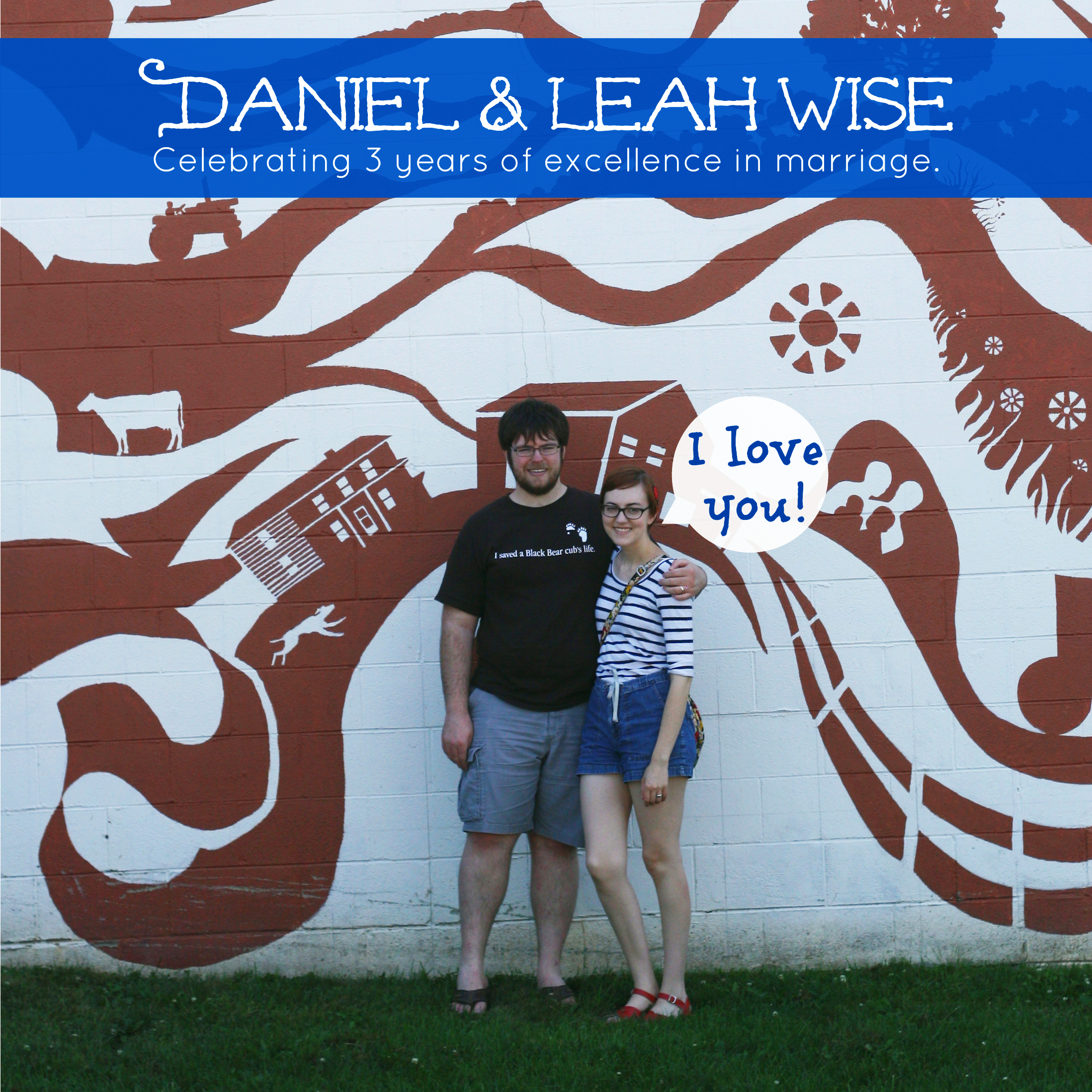
marriage anniversaryToday is Daniel’s and my 3 year wedding anniversary. I know our marriage is still young, but 3 years passed quickly. I’m glad our relationship has been (mostly) healthy and that we’ve weathered the storms of graduating, new jobs, grad school, spiritual/quarter life crisis, lost friendships, and moving to another state together. We forgot to plan anything special, but I’m sure we’ll find a way to celebrate in the next few weeks.

Below is the wedding video our photographer surprised us with a few weeks after the wedding. I post it every anniversary because I love it.


I’m saddened to have already witnessed so many young marriages disintegrate. I know there are a number of reasons (most quite legitimate) why marriages don’t work out, but I feel really lucky that Daniel and I are still just as compatible as ever. I think a lot of people get mushy gushy on the internet and gloss over the day-to-day nature of marriage. They pretend that everything is perfect and sunshiney and beautiful when it’s really just daily living with someone you chose to commit yourself to. Daniel’s and my marriage is strong, but it isn’t perfect and never will be; that’s part of being human. He’s going to roll his eyes that I wrote this post and I’m going to act sulky and complain that he doesn’t find commemorating our anniversaries as important as I do. That’s part of the ebb and flow of our relationship – it’s part of the daily act – and it’s pretty entertaining.

at home: heirloom marriage certificate

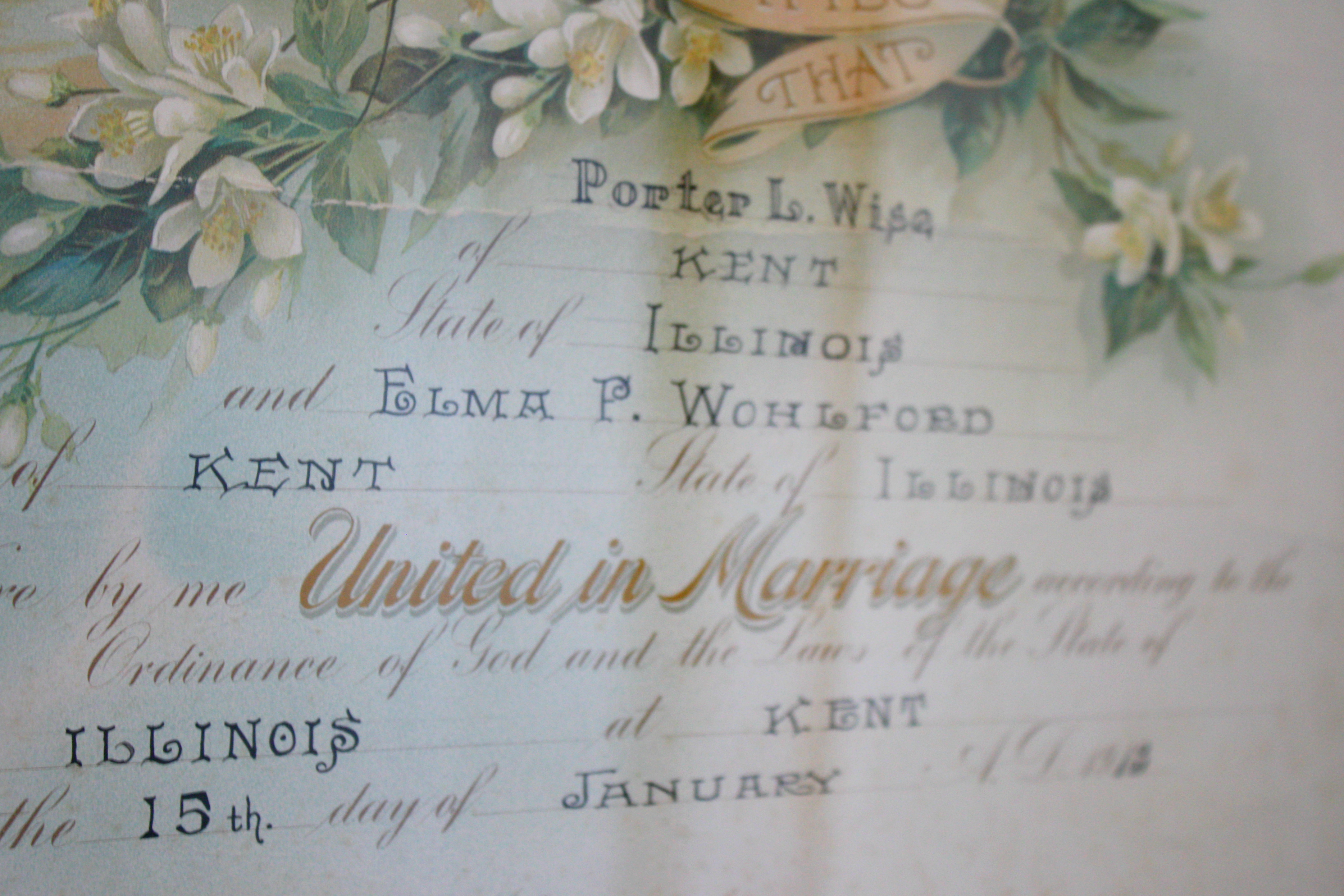
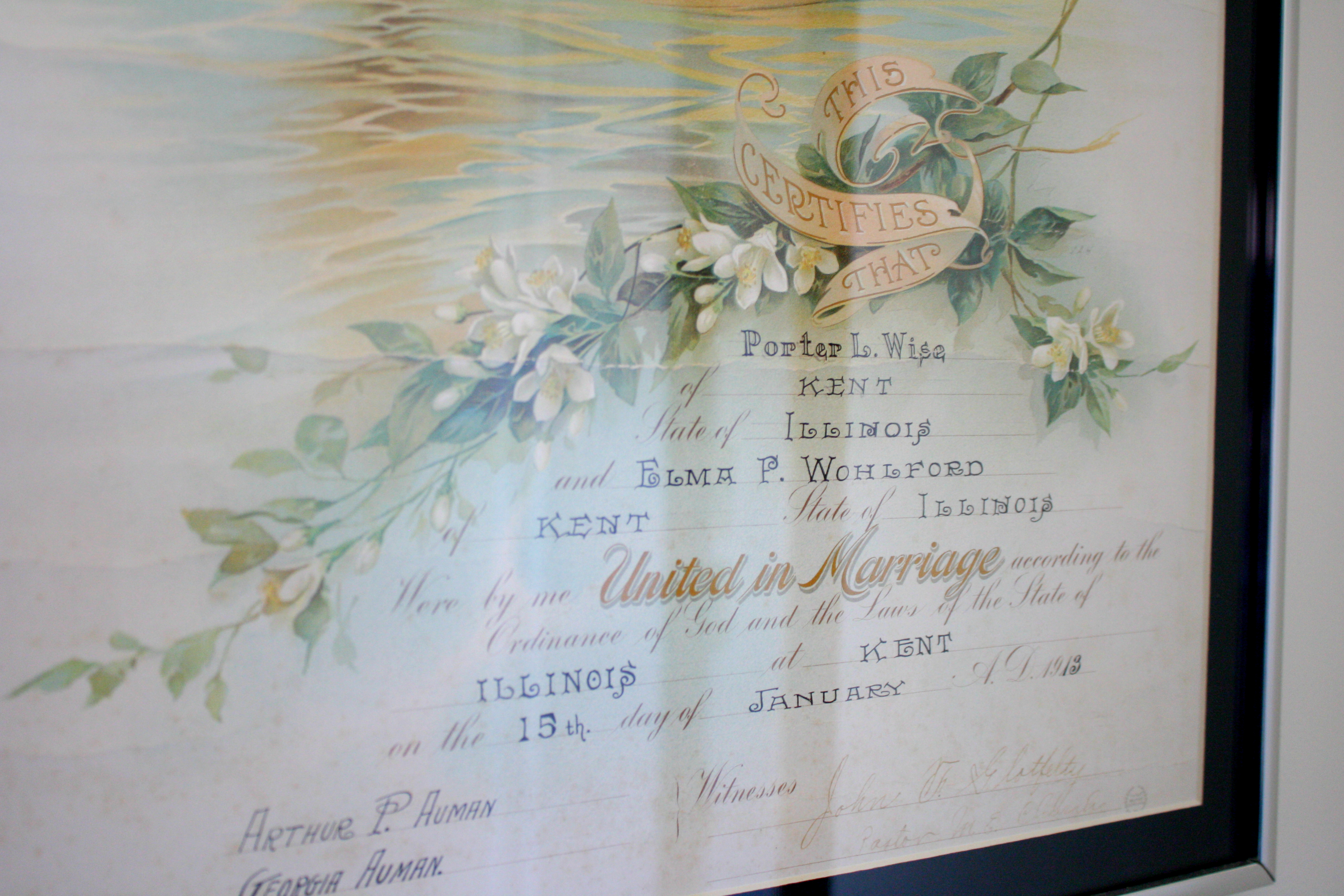
We carried home a nice assortment of family heirlooms after a visit to Daniel’s grandparents’ house last summer, including the 1913 wedding certificate of Daniel’s great grandparents.

Dated January 15, 1913, it’s the oldest personal historical item we own. I love everything about it: lovers on a calm sea at sunset, the little cherub, floralia galore, and pretty type. I don’t think Daniel met Porter or Emma Wise, so it’s lovely and a bit eerie to have this connection to them. It’s also nice – in our own, still new marriage – to feel connected to a couple who married over 100 years ago.

We keep it on display in the bedroom in a simple frame with gallery quality UV glass to deter additional fading over time.

century old marriage certificate heirloom 1913 art antique marriage certificate bedroom we5Family heirlooms have great nostalgic and historical value, even in an age when the new and innovative compete for our attention.

the storm

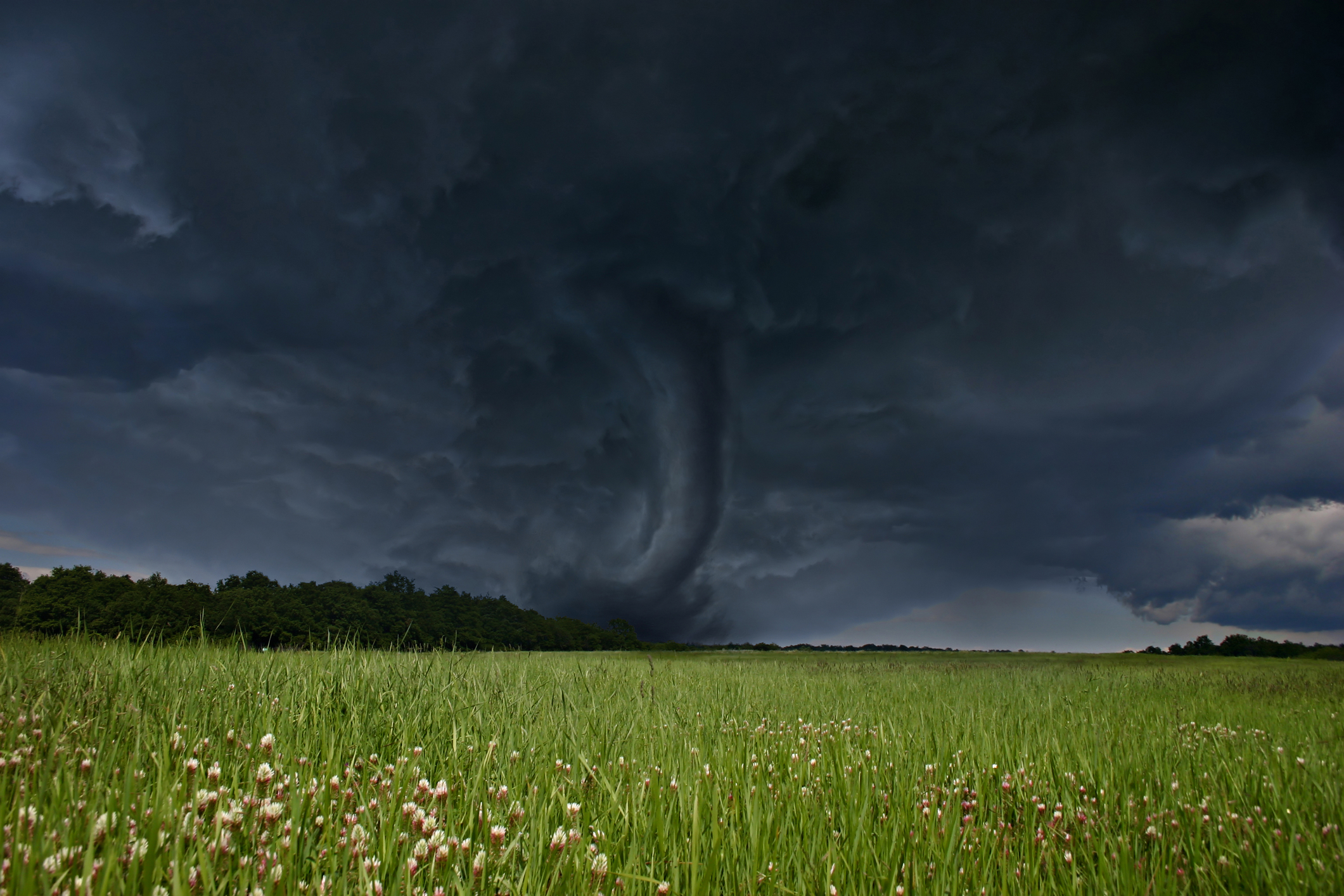
tornado dream

I was warming up for police training at a church recreational center on Virginia’s coast. There were nearly 100 of us there, all dressed in gray and navy, doing jumping jacks and anticipating the events of the day.

The sky was overcast through the large, south-facing windows, built high into the wall of the gymnasium. Someone shouted. The wind picked up in a cacophonous symphony of howls and rustling sand. My eyes grew wide in terror: an enormous tornado was headed toward the building. We sat down, some huddled together, myself apart from the group, knowing that following a safety procedure at this point was futile.

The tornado passed the building then, barring our view of the coastline for a few minutes. From the windows in the northern wall, I saw a girl in a red cape running, but it was too late. She was swept up as the winds racked and swayed the tall grass between our building and the church sanctuary. It tore through the sanctuary, demolishing the eastern wall.

I knew that it was bound to head inland, toward Daniel. I texted him:

“I hope you survive. It’s headed your way. Know that I love you very much.”

As I hit send, the howling I’d endured for close to a half hour stopped suddenly, giving way to eerie silence. The stillness was interrupted only by the sound of my heart beating furiously, high on adrenaline.

And then I woke up, convinced my dream had been prophetic, convinced the end was nigh. After several minutes of lying there, overheated and frozen in fear, I woke up Daniel, told him I was afraid, and snuggled into his side, thankful for him, thankful we were both together and alive.

*photo found here

2 years

Untitled from Lindsey Vinson on Vimeo.

Daniel and I got married just over 2 years ago. I wrote a much lengthier anniversary post over at my old blog, someone’s water lily, but I forgot to share my favorite collection of images! Our wedding photographer, Lindsey Pemberton, made a stop-motion style video using photographs she captured throughout the course of the day. I didn’t know it would come together so beautifully and I never tire of watching it or sharing it.