Someday at Christmas

And the Word became flesh and lived among us, and we have seen his glory, the glory as of a father’s only son, full of grace and truth. 

Readings here

As a lifelong choral singer,  I have always been a bit of a Christmas-song snob. And it’s only gotten worse since I became an Episcopalian, and learned about the Season of Advent. Because, as the snobbiest of Christmas-song snobs know,  it’s simply *not done* to sing Christmas music before December 25th. 

So, when Christmas songs start playing on the radio in November, I simply refuse to indulge in the merriment. Instead, I try to stop up my ears and ignore all the clatter about rocking around the Christmas tree, kissing Santa Claus, and filling the world with cheer. But this year, something shifted… 

It has been a hard year. I think I can say that without needing to qualify it. Many of us have borne witness to unimaginable loss and lived with prolonged grief.  We have seen our neighbors struggle. Some of us have lost jobs, or struggled to get one. Many of us have lost much more. 

This fall, when the Christmas music started playing, I noticed my ears perking up. In the midst of the world’s heaviness, I found myself wanting to entertain the idea of Christmas cheer, even if the songs were silly and it was, strictly speaking, not Christmas yet. I was desperate for something that would pull me out of my wallowing

So, with cautious hope – or perhaps desperation – I began really listening to Christmas songs, both secular and sacred. And I noticed that songs that had seemed silly and naive before were starting to sound different in my ear. 

But one in particular stood out… 

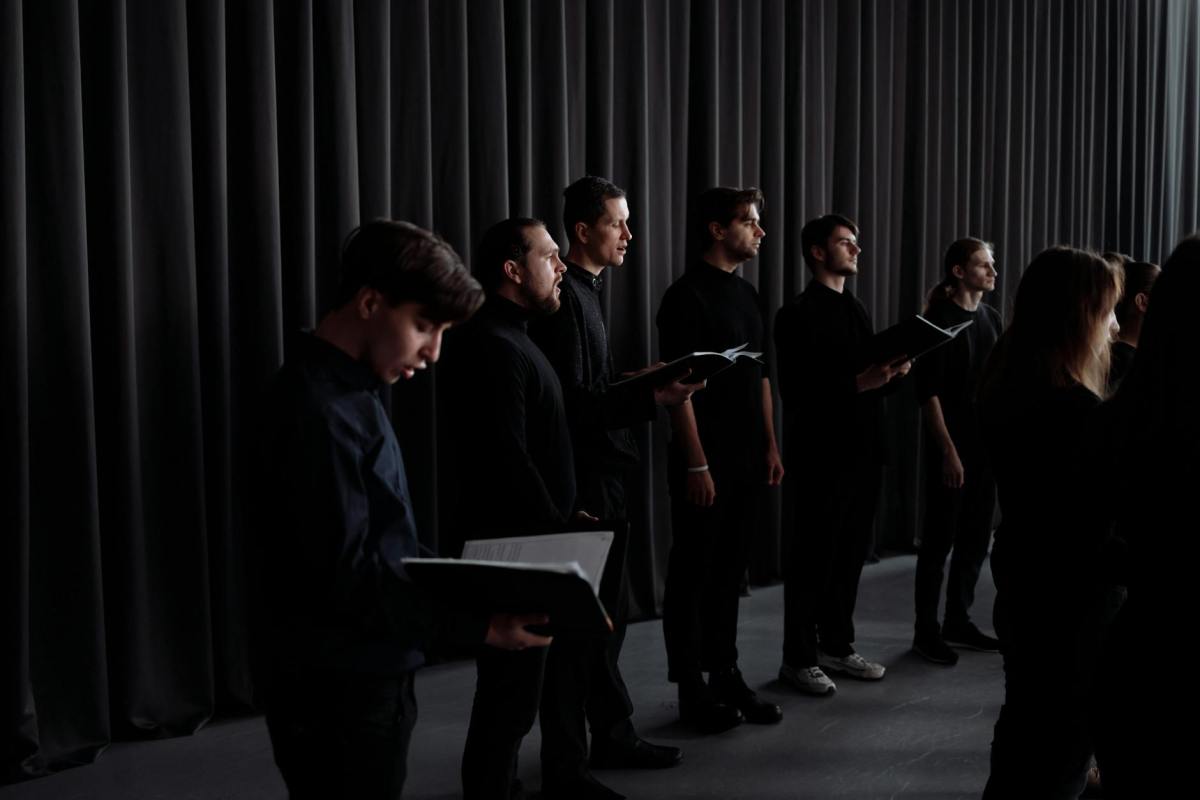
At a community choir concert earlier this month, I was fortunate enough to hear an arrangement of the Christmas classic, “Someday at Christmas.” Released by Stevie Wonder in 1967, this song was part of the soundscape of Christmas before I was born. But, I had never really paid attention to the words,  until this year, when 200 men began to sing in the big sanctuary of a church downtown: 

Someday at Christmas men won’t be boys 
Playing with bombs like kids play with toys 
One warm December our hearts will see 
A world where men are free 

Someday at Christmas there’ll be no wars 
When we have learned what Christmas is for 
When we have found what life’s really worth 
There’ll be peace on earth 

In the unified voice of 200 men, among the crowd of 300 concert goers, this shmaltzy pop song that has whined over the din of Christmas shoppers for 50 years, became something more. Each verse expanded a vision of the world just as big and beautiful as the prophecies of Isaiah: 

“Break forth together into singing, 
you ruins of Jerusalem; 

for the Lord has comforted his people, 
he has redeemed Jerusalem. 

The Lord has bared his holy arm 
before the eyes of all the nations; 

and all the ends of the earth shall see 
the salvation of our God.” 

And yet, at first, the choir sang from a tentative place: a place of desperation, or of hope nearly gone. They seemed to speak of a far-off someday. It seems that their hope had dimmed with each new grief and tragedy in our world, just as mine had

For awhile, I closed my eyes and listened to those hushed voices sing. But then, something caused me to open my eyes and re-focus my gaze. I looked up and noticed that there was a cross at the front of the sanctuary. It had been there the whole time, taking up the whole back wall behind where the singers stood. 

Suddenly, the cross and the music all came together, hitting me like a flash of light. It was as if the full spectrum of faith was being revealed in that room. The desperate prayers whispered in hard times, the cautious hope of someday, the comfort of kind voices filling the room with song. And the empty cross, rising above it all. 

The tone and tempo of the music shifted then, and those 200 voices crescendoed into a bold and forceful sound that made the wooden pews vibrate: 

Someday at Christmas man will not fail 
Hate will be gone and love will prevail 
Someday a new world that we can start 
With hope in every heart 

Quiet desperation had given way to a tangible proclamation of hope. And someday had transformed from passive prayer to bold certainty. As the sound reverberated through the room, all 500 of us gathered there could literally feel hope resonating in our bodies. In the ringing out of unified voices, over the course of many verses, hope had become incarnate

Words had become flesh. 

What was this, if not the miracle of the incarnation, playing out in our time and place? That words of hope could fill up a room and inspire everyone to believe. That things hoped for could be made real through living, breathing, singing humanity. 

This is the miracle of the incarnation, on that Christmas long ago: Jesus Christ, the Word and Lyric that made the world, came to us as a lowly human to be united with us. And to make the world around us vibrate with his tangible presence,  

In the face of life’s suffering and loss,  the incarnation reminds us that a young mother was so close to God, she could hold him in her arms, and a cross could not keep holding him. And, because of this, we will be held forever in the arms of God. 

And this is the miracle of the incarnation still: Christ came down to earth – and hope now has a fighting chance. Because the fulfillment of all our hopes lives among us, and in us. 

Against all odds, and against common sense, the hope of the world was born this day in a little, hill country town called Bethlehem. Sleeping in a food trough for animals,  delivered in the usual way, and arriving without pomp or glory. 

But, the air was thick with the singing of angels. Their glorias made the wood of that little barn vibrate. And tired shepherds carried the tune as they ran like fools to the manger. 

As time went on, the singing got louder. Until, on every tongue, in the presence of Jesus Christ, the hope of “Someday” was changed to “Today.” 

Amen. 

That We May Embrace Hope

Readings here

Blessed Lord, who caused all holy Scriptures to be written for our learning: Grant us so to hear them, read, mark, learn, and inwardly digest them, that we may embrace and ever hold fast the blessed hope of everlasting life, which you have given us in our Savior Jesus Christ; who lives and reigns with you and the Holy Spirit, one God, for ever and ever. Amen.

Every year on this Sunday, we encounter again my very favorite collect, written by my very favorite Archbishop of Canterbury: Thomas Cranmer. In truth, I don’t pay very much attention to the Archbishops of the Church of England, even though I am excited that the new one is the first woman to hold the position.

But, Cranmer will always have a special place in my heart. Not only was he the first Archbishop of the Church of England, he also compiled, composed, and edited the very first Book of Common Prayer, the book that contains the foundational liturgies, prayers, and theology of the Anglican and Episcopal Church.

The heart of Episcopal Christian identity is informed by this book, and it connects us back, not only to the moment of rupture and renewal that took place during the Reformation in the 1500s, when much of Europe declared itself Protestant. It also connects us back to the church that existed before that moment, in the processions of the medieval cathedrals, the Eucharistic Prayers of the early church, and even the sacrifices of the Roman temples and Jewish synagogues.

In this way, the Book of Common Prayer, while specific to the Anglican and Episcopal Church, actually reminds of us that we are members of the universal church, founded by Christ, and revealed to us in the Scriptures.

In a way, Cranmer’s collect on the scriptures is a kind of thesis statement for the whole tradition. Because, it points us all the way back, past tradition, to the record of our faith, belief, and practice: the Bible. It reminds us that everything we do and believe as disciples of Christ, in this Episcopal Church, is rooted in the stories of God and God’s people as they are revealed in scripture.

And, it gives us some guidance for how to engage with Scripture: “hear them, read, mark, learn, and inwardly digest them, that we may embrace and ever hold fast the blessed hope of everlasting life…”

A lot of people have used this prayer for Bible Study. I have seen it used almost as a step-by-step guide to reading scripture. But, what sometimes gets lost is the reason why we would want to engage with scripture at all. After all, we’ve already got this big, expansive tradition with all of its liturgies and practices. What are we supposed to get out of reading the Bible, that we can’t get through praying and going to church?

The collect actually answers that question for us: “that we may embrace and ever hold fast the blessed hope of everlasting life, which you have given us in our Savior Jesus Christ.” The point of Scripture is to give us a reason to embrace hope.

And we couldn’t have a better example of that, than in our passage from Isaiah 65…

For I am about to create new heavens
and a new earth;
the former things shall not be remembered
or come to mind.
But be glad and rejoice forever
in what I am creating;
for I am about to create Jerusalem as a joy, and its people as a delight.

Someone asked me this week how we can read hopeful passages like this one when the state of the world feels so hopeless? Doesn’t it give us indigestion to read something so sweet when the world around us is so bitter? When we are surrounded by fear and suffering, and our existential questions aren’t getting answered.

Borne of years of my own encounters with suffering, and my own encounters with Scripture, my response was immediate and unwavering.

I said, “Because, when you read a passage like this one, where God himself is painting a picture of paradise – in which there is no suffering, but only joy – when you read something as grand as that, you are reminded that your vision of beauty is the exact same as God’s. That God wants the same things you do. That there is, in fact, no division between the desires of your heart and God’s own heart. And suffering isn’t part of God’s design.

In this passage, God reverses the curses of Genesis: unburdening labor, disappearing pain, and rewinding all the years of layered sorrows, in a vision so bright it almost feels reckless.

A scripture passage like this one shows us that it is ok to imagine the best possible future, even in the midst of the worst possible reality. It is ok, because the people of God have traveled difficult terrain before, and they were still able to hold onto hope. It is ok, because God’s desire is to make it reality. This is a passage that hypes us up – if we let it, it can give us a reason to embrace hope.

But, what do we do with more troubling passages, like the ones from Second Thessalonians and Luke?

“Anyone unwilling to work should not eat.”

“…they will arrest you and persecute you…”

Well, if Cranmer is right that engaging with Scripture helps us “embrace hope,” then we are obligated to look for the light, even in difficult texts. This isn’t the same as manipulating scripture to suit our needs. We’re not ignoring the confusing or concerning parts of the Bible by reading hope into them. We are simply aware that a “God-breathed” scripture must include some evidence of God, who is “love.”

And when we really spend time with scripture, we discover that God’s promises are seeping into our imperfect and troubling reality…

In Second Thessalonians, a complaint about idleness is directed at a specific community that has abandoned a shared vision of the Christian community. Convinced that their own salvation means that they’re free to just “chill out” ‘til Jesus comes, the writer reminds them that there is still much work to be done to build the Kingdom of God – and that it will take everyone’s efforts. This is ultimately a democratizing vision, against the priestly hierarchies they are accustomed to. Because here, everyone matters.

In Luke, Jesus names the scary reality on the ground, where followers of Christ are targets of both state and religious violence, and where increasing tensions threaten widespread warfare. Then, he tells his people that he will be with them, guide them, and protect them unconditionally – and for all eternity.

So, we see that even troubling scriptures will crack open with hope, if we dare to tap into them.

The Bible will never gloss over the human condition. It is gritty and troubling, and sometimes prompts more questions than answers. And isn’t that just like life? Gritty, troubling, and often more confusing than clarifying.

But, the scriptures are also a record of hope already realized. And because of that, we can have hope and faith that God is present with us now.

In the midst of this mucky and murky human condition is a God lighting up the shadows, calling us out of exile, drawing us out of our self-involvement, healing broken things, troubling the powerful, and creating new heavens and a new earth to spite disaster, sin, and grief.

God grant us so to hear them, read, mark, learn, and inwardly digest the Scriptures. God grant us so to hope, trusting that God is never idle, but always at work, reversing the curses of our fallen humanity.

Amen.

Eternal Word, New Beginnings

Readings here

Today is the first Sunday in Advent.  The word Advent means arrival. But we’ll get back to that later. Today also marks the beginning of a new year for the church.  So, Happy New Year! 

When we think about typical new year’s festivities, we probably imagine raucous celebration. The ball drops, couples kiss, and fireworks go off around the world.  People crowd into streets, bars, and houses in sparkly clothing. And strangers drink and even sing together like old friends. 

The next day, people make and eat special New Years’ food, thought to bring good luck: black-eyed peas, tamales, goose, and even pickled herring make the list.  In my family, we eat corned beef and cabbage. 

All of these traditions seem to be a way to conjure optimism out of thin air. They encourage us to perform reckless and unjustified hope. The drinks and debauchery help us literally forget the old year, with its old sorrows and annoyances. And in the hazy glow of midnight, we can look forward to a limitless future. 

We tell ourselves: this year is gonna be different.  We’ll finally become who we always wanted to be. We’ll finally get the job, mend the relationship, make the move, start the workout, and get the good news.  

We have no reason at all to believe any of these things are influenced by the fact that it is a new year. But, we decide to believe things will change…at least until the end of January. 

— 

In Christian tradition, our Advent new year is also a season of hope.  But our hope looks a little different. And, unlike new year’s resolutions, it’s a pretty bad conversation starter at holiday parties. Because, Christian hope is apocalyptic. Which is to say, it has a lot to do with the end of the world. 

By now, we are well-acquainted with the apocalyptic literature of the Bible. Our scripture readings have been tracking with the apocalypse for a couple of weeks now. In Daniel, Jeremiah, Revelation, the Gospels, and even the Psalms, we have heard prophecies proclaimed about the end times. Today, we hear news of a mysterious “Son of Man” who is coming to judge the world. 

These apocalyptic predictions are kind of like New Year’s Resolutions – in that they help us imagine the future. But there’s one big difference: these scriptural resolutions are not about hoping for things you can put on your resume or brag about on Facebook. 

And they are not about forcing unjustified optimism that only lasts a month. At their core, they seek to legitimize and justify hope, and to make it more than a game of personal willpower. 

On its surface, apocalypse can seem grim. But it’s not supposed to be traumatic. It is meant to be just alarming enough to wake us up and turn us around, so we can see the big picture. 

It draws us into the mystery of our faith. And this mystery dwells in paradox. Appearing to be about the future, predictions of the final judgment are actually the story of everything, reaching back to the farthest past.  

They compel us to look forward to the final days, but when we do that, we end up being drawn back to the very beginning, when the breath of God moved over the waters before time began. With a word, God created the world. And at the end, the same Word, the Word made flesh in Jesus, “will come to judge the living and the dead.” 

The creative presence of God imbues all things, at all times and in all places. This is big news! And it is the cause for our hope. 

— 

But still, the fact remains that we are in the middle of things, and the middle is an unsettling place. What do we do with ourselves in the present tense? How do we read the signs? How do we know that Christ is coming near? 

Let’s take a closer look at today’s reading from Luke: Jesus starts with a pretty typical apocalyptic message.  There will be weird shifts in the planets, eclipses, weather events, and terrible tidal waves. A collective sense of foreboding will fall upon the face of the earth. Then, the “Son of Man,” the long-awaited Messiah, will descend from on high.  

We assumed all these signs were pointing to a terrible end. But it turns out, this Son of Man, Jesus, has come to redeem the world. 

And what does redemption mean? It means someone pays all of your debts and sets you free from bondage and obligation.  It means everything that was taken away is now given back to you and you have everything you need. 

Jesus clarifies his words with a parable… 

‘”Look at the fig tree and all the trees; as soon as they sprout leaves you can see for yourselves and know that summer is already near. So also, when you see these things taking place, you know that the kingdom of God is near. Truly I tell you, this generation will not pass away until all things have taken place. Heaven and earth will pass away, but my words will not pass away.’ 

Jesus says, this is how you know that Christ is coming near: the things you took as signs of death are being transformed into new life. 

Like fig trees sprouting new leaves, just in time for summer.  You’ll have delicious fruit to eat by August. 

The signs of Christ’s coming, even when they are foreboding, are not intended to be understood through a lens of death and destruction. Like winter turning into spring, signs of death ultimately lead to new life: the branch springing up, the new leaves on the fig tree, freedom and fresh starts. These signs of life are already present with us, and they’re just as real as death. Christ is already near. 

It is good for Christian apocalypse to be central to our faith, because it is an antidote to atrophy. We don’t accept death as the end of the story. And this means we live our lives with persistence., taking care of our neighbors, praying for restoration, and abounding in love for another. 

— 

The trials and tribulations endemic to this world wear on us. We are tired and afraid. We’d like to forget about our troubles for a little while. I think people have probably felt this way since the world began. 

But Jesus shouts, now is not the time!  Now is the time to “be alert” and pay attention!  If you don’t pay attention, you’ll miss the buds on the branches. You’ll miss the joy of the sweet, sticky figs. 

You’ll miss the fact that the Word of God is speaking into darkness, and always doing a new thing. 

— 

And that’s what Advent is really about. Whether we’re looking back to creation, or the incarnation, or looking ahead with fear and trepidation, God is always interrupting time to do a new thing. 

Advent means arrival, after all. And what is arrival but an interruption, an abrupt end of one thing and the start of a new thing? The arrival of a baby that will save the world. The arrival of a King that will make our winter spring.  

In Advent, timelines merge, worlds collide, and life on earth takes on the afterglow of Heaven. Here, darkness is always muddled with light, and endings are always new beginnings. 

Here, hope is always justified by the glorious, persistent goodness of the eternal Word, surprising us with redemption, over and over again. Happy New Year! 

Love is Lord of Heaven and Earth | Christ the King

Readings here

On November 11, 1918, World War One finally ended, after four long years. World War One is often called the first modern war. The National Park Service says: “Machine guns, poison gas, rapid-fire artillery, aerial bombardment, tanks, and submarines were all new innovations that brought about horrors never before seen on the battlefield.” 

As many as 22 million people were killed, more than any war in recorded history, up to that point. That kind of destruction doesn’t just impact one family or one community – it affects the world. The result was one big existential crisis.  

Many people asked: How could God permit this suffering? There was no easy answer. 

By 1925, countries long-considered “Christian nations” were allowing new worldviews to take root. In the communist Soviet Union and fascist Italy and Germany, God was no longer part of the equation. God was too abstract and too far away. The people wanted a king.  

Or, rather, they wanted a strongman, a no-nonsense politician who could lead people, scarred by modern war, to a modern promised land. This promised land wasn’t concerned with peace, and it wasn’t imagined through a lens of hope.  Hope was frivolous in times like these. 

Instead, it was all brute force, brute speech, fear of foreigners, scorn of minorities, fences, and locked doors. 

In large numbers, the people of Europe decided that liberty and justice for all was an old-fashioned value after all.  They had become accustomed to rationing, casualties, and adrenaline coursing through their veins.  And the strongmen told them these things were good, and right, and true – signs of their virtuous endurance. 

It was within this context that Pope Pious the Eleventh began a new tradition of the church: Christ the King Sunday. Within a few years, many other denominations had taken up the cause, including Episcopalians. 

Declaring Christ as King in that particular moment was not random. Pope Pious was making a subversive political statement against the politicians and dictators vying for the world’s thrones.  

He was reminding the church that they already had what, and who, they needed, in the person of Jesus Christ. And he was declaring that God still had something to say in these modern times: The Kingdom of God had not died on the battlefield.  God had not gone AWOL. 

Against the powers and principalities, Christ had not been moved, and would not be moved: 

His dominion is an everlasting dominion 
that shall not pass away, 
and his kingship is one 
that shall never be destroyed. 

Christ was and is and will be on his throne. 

The world’s rulers might win the day, but they had no power to bring about the kind of promised land their citizens were really looking for, beneath all their fear and despair. 

I like doing a deep dive into history, because it reminds me that the trials of our current day are not greater than those of the past. In many generations and many places, the people of God have struggled with existential crises. In hard times, we have wondered where God is. And we have desperately looked for someone to save us. 

It is hard to answer the questions of our suffering. The world’s corruption can’t be justified by trite reminders that “God is in control.” 

And, I’m sorry to say that I have yet to find a justification for suffering that provides a quick fix. 

But what I can say – because it is what our Scriptures say – is that there are spiritual realities bigger and wilder than we can understand, here on the ground. I can say that the Kingdom of God is breaking through the cracks of earthly decay, showing up now in flashes, but ever-growing toward the ambient light of paradise. 

I can say that, if the world is actually doomed, it has no business being as beautiful as it is, and people have no reason to be as kind as they often are. 

I can also say that, in my darkest moments, when I have asked God “why?” the answer has not always come in words.  But in time, hope has, eventually, come.  

And isn’t that also worth asking about? How is hope still a possibility in a suffering world? How is hope still alive? 

Our scriptures tell us hope is alive because Christ is alive. Even now, he is situated as King on his throne.  

But what makes this king so different from the crude and failing rulers of this earth? And where is the evidence of his kingdom in the middle of life’s sorrow? 

The answer arrives in the life and person of Jesus… 

In his weekly newsletter on the Gospel reading, scholar Andrew McGowan talked about the dialogue between Jesus and Pontius Pilate, the Rome-appointed governor of Judea. 

McGowan says: 

‘Pilate already knows the answer to the first fateful question, “Are you the King of the Jews?”, at least on his own terms.  This question is verbally identical in all four Gospels, which is remarkable. There is no serious possibility, however, that the homeless Galilean itinerant Jesus, is a “king” of any kind, at least in the sense that Pilate would understand that term—or how we would, normally.’ 

On Christ the King Sunday, the church proclaims that this Jesus, this homeless man, is the only true and wise king. In his humble ministry on earth and in his arrest, trial, and death, he exhibits few signs of kingship

He isn’t charming, he doesn’t grandstand, and he doesn’t make political alliances. He doesn’t rally his followers to take up arms, surround himself with “yes men,” or bribe Roman representatives to cut him a deal. Any gift he has received he has already given away. He has no possessions and no permanent home. 

Neither an effective politician nor social reformer, Jesus provides the one thing no earthly ruler has ever been able to offer without coercion: the Truth, unburdened by moral and mortal decay. 

In his humble life, self-sacrificial death, and shocking resurrection, the Son of God reveals himself as the answer to all our questions. The Truth is that worldly power will not save us – only love beyond our reckoning will save us. 

And God is Love. And Christ’s kingdom is “not from this world.”  And this is why we can have hope. 

As McGowan goes on to say:

‘“…the love of God…is the real order of the universe.  

To celebrate Jesus’ kingship is not to look away from the world we know, but to see it as it might be, ruled by the true power of love.’ 

No matter what they tell you, the kings, presidents, bishops, and rulers of this earth will never bring us to the promised land. We are not one election, one war, or one succession away from a resolution to the trials and griefs of this life. 

But, as we are reminded throughout our Scriptures, and in our history books, we are not the first generation to confuse brutality with hope. We are not the first people to be duped into believing we needed a strongman.  

We want our earthly rulers to take care of us, so we don’t have to work so hard to take care of one another. We want them to fix things for us. And too often, we accept the lie that fixing things means some people will stay broken. 

But, when we expect these things, we give them too much power. We cannot afford to make them kings, because we risk making them gods. And these false gods – these earthly rulers – will never be able to bring about the life-altering, darkness-shattering, hope-bringing, joy-giving transformation of the world we long for.  

Only Christ can do that.  Only the Kingdom of God can do that.  

Even in these modern times, in our deepest despair, the light of Christ is breaking through. In defiance of all who would justify cruelty, violence, and dehumanization as means to an end, we proclaim love as our salvation, because Christ is the only true king. Amen.

Our Times are in God’s Hand: A Sermon on Apocalypse

Blessed Lord, who caused all holy Scriptures to be written for our learning: Grant us so to hear them, read, mark, learn, and inwardly digest them, that we may embrace and ever hold fast the blessed hope of everlasting life, which you have given us in our Savior Jesus Christ; who lives and reigns with you and the Holy Spirit, one God, for ever and ever. Amen. 

Readings here.

The year was 2002. I was 13 years old.  The country had recently survived Y2K, a contentious presidential election, the September 11 terrorist attacks, 4 major hurricanes, and dozens of tropical storms, one of which was a direct hit on my home. My dad had just lost his job and had to start commuting nearly four hours roundtrip for his new one. My grandpa died. 

And then, one day in the spring, I was home alone, when the sliding glass door on my house began to shake. Suddenly, I heard a deep, resounding BOOOMMM coming from far away. I looked outside and didn’t see a soul on my cul-de-sac, even though the workday had ended. 

I came to the only, logical conclusion.  It was the end of the world. And all the Christians had been raptured – taken up to Heaven before the Great Tribulation on earth. All the Christians. Except, of course, for me. 

The apocalypse was here.  

Things had not gone as planned. Maybe I had prayed a prayer wrong, or maybe my pastor had failed to seal my Baptism in the name of the Father, the Son, and the Holy Spirit. Whatever the case, here I was, the last member of my family still earthside.  And all I could do was wait for the violence and destruction to begin. 

“There shall be a time of anguish, such as has never occurred since nations first came into existence.” 

“For nation will rise against nation, and kingdom against kingdom; there will be earthquakes in various places; there will be famines. This is but the beginning of the birthpangs.” 

A half-hour later, the kitchen door opened, and my mom and sister walked in. My dad got home from his new, faraway job, just a little later than I expected.  A neighbor called to ask if we had heard the “sonic boom,” when the space shuttle reentered earth’s atmosphere, on its route back to Kennedy Space Center. 

Ohhhh…so it wasn’t the apocalypse after all. Just a cascade of disorienting circumstances that had sent my anxiety into a tailspin. 

After hearing today’s scripture readings, maybe your heart rate went up a little, like mine did on that day in 2002. 

Our Daniel and Mark readings are undoubtedly “apocalyptic.” They prophecy a chaotic and violent end and warn their readers to stand at the ready for all that is coming. It is tempting to avoid these passages, because they are disorienting. They stress us out and make us feel bad.  And worse than that, they make us feel obligated to prepare for a future of unthinkable difficulty.  

What does apocalypse have to do with Christian hope? 

Well, I think we have often misunderstood the apocalypse. So, let’s talk about what it means for something to be apocalyptic… 

In informal conversation, when we say “the apocalypse,” we’re most likely referring to the final and complete destruction of the world, or at least, the inhabitable world. 

Scientists might speak of climate apocalypse, politicians of institutional apocalypse, and Christians throughout history have read into wars, storms, recessions, and generally bad vibes as signs of the impending final judgment. 

But in the ancient world, apocalypse had a more nuanced meaning.  The word itself comes from the Greek word, apokalypsis, which means “to uncover or reveal.” That definition ties the apocalyptic tradition to the prophets, because prophets are God’s messengers, revealing God’s active participation in human affairs. 

Not all prophecy is doom and gloom, but much if it is a warning that God’s people need to get back on track. And that’s where apocalypse comes in. While apocalyptic stories often carry a sense of foreboding, their purpose is not to make us freeze in fear and await our fate. 

As John Collins puts it: apocalypse “is intended to interpret present, earthly circumstances in light of the supernatural world and of the future, and to influence both the understanding and the behavior of the audience by means of divine authority” (1).

In other words, apocalyptic proclamations reveal the perils of losing sight of God in the short term, while declaring God’s ultimate power over all things in the long term.  In contrast to doom and gloom, they should encourage us to stay the course and carry hope through all of life’s trials.  As we say in our birthday blessing, “our times are in God’s hand.” 

It’s also good to remember that the dark future foretold is not so different from the ongoing fear and violence of our present reality. The drama of these stories casts a spotlight on the worst of the human condition so we can see it for what it really is. And in the process, we can see who we are, and who God is. 

— 

Today’s scriptures bring the trials of living, breathing, suffering people into the context of God’s power. 

They reference many cataclysms and many terrors we ourselves can recognize – when human apathy and wills to power lead to bloodshed, institutional collapse, hunger, and collective trauma that would span generations. 

This is demonstrated well in the book of Daniel, which occurs in the midst of a cycle of terror… 

At one time, the Hebrew tribes were split into two nations: the Kingdom of Israel in the North, and the Kingdom of Judah in the South. In 732 BCE, war broke out in the Northern Kingdom when Assyria invaded, killing thousands, including women and children. 

After the initial bloodshed, those who survived were systematically deported and displaced. The goal was forced assimilation of the Hebrew people, which would make it harder for them to retaliate against the Assyrian kingdom, by reducing their sense of shared identity. 

During this period, Assyria took part of the Southern Kingdom, but they didn’t gain complete control. But in 597 BCE, Babylon took the Southern Kingdom of Judah. Known as the Babylonian Exile, this period saw several phases of forced displacement of the Hebrew people, led by King Nebudchanezzar the Second.  

The war ultimately resulted in the destruction of Jerusalem and its Temple in 587 BCE. Some of the Bible’s most hauntingly beautiful literature is written about the Babylonian Exile, including the books of Daniel, Isaiah, Jeremiah, and Lamentations. 

For those whose lives had been burnt to the ground by invading armies, this was surely the apocalypse. This was surely the end of the world.  

Yet, it was within this hopeless context that Daniel’s prophecy rang out: “But at that time, your people shall be delivered.” 

The world of the ancient near east may have been consumed by “war and rumors of war,” but the people of Judah would survive. Their times were still in God’s hand. 

Fifty years later, the Judeans were permitted to go back to their homeland. They rebuilt the Temple. They rebuilt their lives. And God was with them the whole time. 

In Mark, we hear Daniel’s words echoing in the voice of Jesus. Jesus tells his followers there will be destruction and bloodshed, terror and chaos.  

And within the first months and years of the early church, Christ-followers would indeed face persecutions, executions, false prophets, and false narratives. They would be blamed for things they didn’t do, and pushed ever further to the margins of society.  

Just as in Daniel, Jesus’ words are not foretelling some distant, future darkness beyond imagination. They are a clarion call and a comfort in the present darkness. Christ followers can rest assured, in all these trials, that the good news is still worth living out, and that God will sustain them in the end. 

This is what apocalypse should teach all of us: God remains steady in the midst of our chaos, pain, and existential despair – in the very center of the worst thing that we can imagine. God doesn’t ignore evil, doesn’t celebrate injustice, and doesn’t revel in our suffering.  

Our hope comes from a deeper well than the brutality happening around us and to us.  And hope can be sustained no matter the circumstance, because it comes directly from the Creator of all things. 

If you feel today that you are standing at the edge of apocalypse, consider this: maybe it’s not the end. 

It may very well be the end of certain assumptions, communities, families, relationships, and ways of being. It may be the end of the world that you imagined, but it is not the end. 

When the chaos of this world feels apocalyptic, we can see that disorientation for what it is:  a clarion call to live like Jesus, to endure in the struggle, to love self-sacrificially, to pay attention, to rest in the care of one another, and to look for the life of the world to come.  

We do not need to fear the apocalypse. With hope in our hearts, we keep moving forward, held steady in God’s hand. 

1. Collins, John J. (1984). Daniel: With an Introduction to Apocalyptic Literature. Eerdmans.

humanity

I first heard of UVa student Hannah Graham’s disappearance through friends on facebook who know her personally. Later Monday evening in the Women’s Prayer Group offered through my church, a couple of students who are acquainted with her spoke of the difficulty they were having processing the incident.

We lit candles as we prayed for her life and the lives of others. And that visual image of light – of lives alight with concern and hope – shattered the safety net I’d placed around Charlottesville and around my life even as it helped unite us. It hit me hard. I’m not sleeping very well.

It’s every feeling, all at once.

It’s the what-ifs of a young woman who vanished, it seemed at first, without a trace. The uncertainty of what dangers await every young woman in this quiet town. The realization that our houses and our buddy systems and our routines create only a semblance of control. We have so very little control.

It’s sheer terror mixed with anxiety mixed with the desperation of hoping for her safety and fearing the worst. I feel for her and her friends. I fear for myself living in a world where someone can somehow stop being so quickly.


two post it notes

Someday, when the world begins
to darken, I’ll
walk in the silence
of early morning, peering
into empty shops with
cataract gray eyes

And I’ll remember being
young, moving fast, skin
smooth like a new bar of soap,
and wondering when I would
make it.

I’ll know then, there
is no making it.

Child, you’re already home.

At 4:00, I’ll eat my
dinner, just the basics –
salad, potato, tea.

And I’ll look out the window
near the garden and watch
the early robins feast
until my eyelids flicker,
slowly, closed.

The final act, not a drama but a lullaby.

alleluia!

easter vigil

As the sun sets, attendees are given an unlit candle. Outside, the light of Christ is lit just as the last light of the sun settles on the horizon. Parishioners process in quietly and await the coming of the light of Christ as it is solemnly paraded down the center aisle. All are aided in lighting their candles from the light of Christ at the front, passing it on, candle by candle to those within their pew. The sanctuary is unlit apart from the growing light of Christ clutched in the hands of this body of individuals, awaiting the readings in silence.

Each contained fire flickers and flares – rhythmically, chaotically, still for just a moment – as members of the congregation recount God’s victory amid despair and oppression. Psalms are chanted in a resonating baritone. The mood is somber, but a quiet hope begins to swell as words of salvation are announced, as the chanting echoes across the high ceilings and glass walls of the sanctuary.

All at once, the room comes alive with light, parishioners ring bells they hid among their belongings, and the organist begins a triumphant song. All stand and sing:

Jesus Christ is risen today, Alleluia!
our triumphant holy day, Alleluia!
who did once upon the cross, Alleluia!
suffer to redeem our loss. Alleluia!

Hymns of praise then let us sing, Alleluia!
unto Christ, our heavenly King, Alleluia!
who endured the cross and grave, Alleluia!
sinners to redeem and save. Alleluia!

But the pains which he endured, Alleluia!
our salvation have procured, Alleluia!
now above the sky he’s King, Alleluia!
where the angels ever sing. Alleluia!

For the first time since Lent began, Alleluia rings out again. The world was dark and cold as a winter night, but Christ is alive and in it and working once again!

tree blossom

The final verse of Wheat that Springeth Green, in particular, rang true for me this year:

When our hearts are wintry, grieving or in pain,
thy touch can call us back to life again,
fields of hearts that dead and bare have been:
love is come again, like wheat that springeth green.

How I needed to exhaust my lungs with the singing of those words! After a long, dark winter, after several weeks of chaos and confusion and self doubt, after 8 months of not dealing with the weight of moving away from everything familiar and comforting, I needed to acknowledge the barren winter in my heart, clear the snow away, and discover joy without limitation in Love springing up again.

He is risen! Alleluia!

first image source: Catholic News/second image: my own

meditation on fear

Observe the browning leaves:
do they worry
as they die, and fall
and fall to graying earth?
Do they fight and struggle
and scratch against
the muscled fingers of gravity?

No.
They willingly go to decay,
to shrink,
to crunch under foot and
Not return.

They green in strong winds
and spackled springtime light alike.
Then, knowing it would be so
all along,
They die.

Give their pigment up,
fearless,
joyful, willing us,
Hope.