The Work of Jesus is Undeniably Good

Readings available here

Several years ago, Daniel and I were looking for treasures at an antique store when I noticed the distinctive red border of an old Time Magazine across the room.  

The issue was dated to sometime in the 1940s. I can’t remember who was on the cover, but I do remember the cover story. It was about the remarkable success of a relatively new procedure called the lobotomy

When I turned to the story, the accompanying image was of two very normal looking white women, dressed in house dresses, perfectly coifed and standing in the living room of a mid-century house. You would never suspect that these women had been deemed “insane” in the language of the time. 

What had driven such a diagnosis?  One was a chronic shoplifter and the other had been too depressed to finish her housework. 

In response to these apparently shocking behaviors, the authorities had deemed it appropriate to drill holes in their skulls, insert a sharp, pointed instrument, and sever the connection between the frontal lobe and the thalamus, which connects to the rest of the brain.  

To bystanders, lobotomized individuals became calmer and more compliant. They were easier to “deal with.” 

But eventually, critics of the procedure pointed out that these individuals had become shells of their former selves. They were apathetic, disengaged, and unable to socialize, leaving them permanently ostracized from society. And they had lost access to the skills and passions that had made their life worth living. 

How could lobotomies ever have been deemed ok? 

Easy. The general public was so obsessed with conformity that they attributed noncompliance to a moral or psychological disease. 

If you refused to color inside the lines, that was obviously your “personal demons” controlling you. That radical impulse needed to be literally cut out before you could reenter polite society.  

Throughout the 1930s, 40s, and 50s, thousands of patients received lobotomies. Overwhelmingly these patients were women.  Others included gay men, African Americans, the elderly, and others deemed mentally ill. 

Their issues may have been attributed to personal demons. But in hindsight, it seems clear that these demons were created, not conjured. 

Whatever issues these people may have had, they represented, not a moral failing on the part of the patient, but a moral failing on the part of a society who rejected them and failed to honor their dignity. 

All this leads us to our Gospel reading… 

Today we continue in Mark’s story of Jesus’ early ministry. Just as in last week’s reading, Jesus is meandering around the country, encountering increasing numbers of people in need of a cure from physical illness and demonic possession. 

In the section just before this one, which our lectionary skipped, we learn that Jesus is getting a bit overwhelmed by the sheer volume of that need. 

After a brief excursion up a mountain, where he names his 12 disciples, they return home for a little rest and relaxation. 

But Jesus can’t catch a break. This is where our reading begins today: 

“…the crowd came together again, so that Jesus and his disciples could not even eat.” 

Hungry, tired, sore from the journey, and desperate for a moment to hear himself think, he jumps up from the table and walks outside to confront the crowd. 

The author of Mark doesn’t tell us what Jesus does once he gets outside, but we get the sense that he’s acting a bit erratic. Because people have begun muttering among themselves, “He has gone out of his mind.” 

And even his family thinks so. They rush out the door and try to restrain him. 

It’s the perfect opportunity for an intervention. Lucky for him, a group of self-identified experts are waiting in the wings. These religious professionals, known as scribes, offer a diagnosis: 

That guy is the possessed by “Beelzebul,” Satan’s head honcho! He’s using forbidden magic to cast out demons! 

Like Time Magazine’s shoplifter and sad housewife, in this moment, Jesus is deemed insane.  But in the language of his time, they call it “demon possessed.” 

You see, in the Biblical world, just as today, demonic possession wasn’t so simple to diagnose. It tended to be a catch-all for a set of behaviors. 

Symptoms of mental illness, repeated moral transgressions, physical disabilities, and even nutritional deficiencies might lead one to be called “demon possessed.” Historically, people called “demon possessed” were more likely to be women, and more likely to be poor. 

The impacts of such a diagnosis could be significant. You were often forced to leave your family and community, to live in isolation without community care. 

So, when Jesus invites those called “demon possessed” to come to him for healing, he is not only demonstrating his divine power, he is boldly and publicly correcting a social evil.  He is calling out anyone who thinks some people don’t deserve to live with dignity.

No wonder the scribes are mad. 

In their eyes, Jesus has been crossing the line for weeks now, inviting the so-called “demon possessed” to the very center of the crowd, claiming that they deserve to be known, loved, and cared for. Now, they question Jesus’ legitimacy by suggesting he is just as crazy as the people he’s healing. 

Eventually, Jesus will pay the ultimate price for welcoming the outcasts. But not yet.  

Right now, Jesus has something to say.  He argues that he can’t possibly be possessed by Satanic forces, because Satan would never cast out Satan’s own minions.  

Evil forces would never use their power for good. And the work of Jesus is undeniably good.  

In inviting the oppressed, marginalized, and tormented to rejoin the community, Jesus reveals the generous and expansive Kingdom of God he is building.  This is the very same Kingdom of God we are called to build.

And now is a good time to continue the work…

We are in the midst of Pride Month, and in some circles, accusations of Pride as “demonic” are reaching a fever pitch.  Meanwhile, accusations of LGBTQ+ people as “mentally ill” or “insane” continue at a steady beat. 

While members of the LGBTQ+ community and their allies declare that everyone is worthy of belonging, self-named religious “experts” point their fingers and cry “Satan!” into the rainbow-colored crowd. 

But we know better, because we know Jesus. 

Using his own life as an example, at the risk of being ostracized himself, Jesus teaches us how to judge what is truly right, by showing us the difference between good and evil, between God and the Devil. 

He reminds us that he is present in movements and actions that bring about belonging, not marginalization. 

He compels us not to demonize the nonconformists, because the Holy Spirit is often most present at the margins and in the liminal spaces. 

He implores us to act on the will of God, which is that all people are fed, housed, and nourished – never, ever denied their humanity. 

From first century exorcisms to twentieth century lobotomies, in so many cases, it seems that society’s demons are created, not conjured. 

They represent, not a moral failing on the part of the individual, but a moral failing on the part of a society who rejects them, denies their dignity, and refuses their humanity. 

Jesus invites all of us to himself. And here, everyone belongs. Amen.

Not to Hurt Us, But to Heal Us

Lectionary readings linked here

O God, your never-failing providence sets in order all things both in heaven and earth: Put away from us, we entreat you, all hurtful things, and give us those things which are profitable for us; through Jesus Christ our Lord, who lives and reigns with you and the Holy Spirit, one God, for ever and ever. Amen. 

On Pentecost Sunday, in St. Cloud, Florida, a priest bit a woman during communion.  

Now, this wasn’t just another case of so-called “Florida Man” doing something erratic under the influence of a novel new street drug. In fact, if the priest could be said to be high on anything, he was high on his religious principles… 

Here’s a portion of the press release from the Catholic Diocese of Orlando, shared by ABC News

The incident between the priest and a female parishioner began at approximately 10 a.m. on Sunday during Mass at St. Thomas Aquinas Church in St. Cloud, Florida, when a woman “came through Father Fidel Rodriguez’s Holy Communion line and appeared unaware of the proper procedure,”… 

The same woman is said to have arrived at 12 p.m. for Mass on Sunday and stood in Father Rodriguez’s Communion line when he asked her if she had been to the Sacrament of the Penance (Confession) to which she replied that “it was not his business,”… “Father Rodriguez offered the woman Holy Communion on the tongue,” church officials said. “At that point, the woman forcefully placed her hand in the vessel and grabbed some sacred Communion hosts, crushing them.  

Having only one hand free, Father Rodriguez struggled to restrain the woman as she refused to let go of the hosts. When the woman pushed him, and reacting to a perceived act of aggression, Father Rodriguez bit her hand so she would let go of the hosts she grabbed.” 

Honestly, when I read that story, I am a little sympathetic to Father Rodriguez. Not because I think that what he did was right. But because, in some ways, I can imagine myself in his shoes.  

I can almost feel the horror he must have felt in that split second before he took action.  

I can imagine a scenario where the remaining consecrated wafers fly out of their container as the woman lunges for it. They fall onto the dirty floor,  where they’re scattered and crushed by the feet of people coming forward for communion.  The Body of Christ bruised and broken, now lies desecrated on the ground. 

And then, the priest looks up, only to meet the judging faces of those around him. His parishioners condemn him for failing in his most important task.  His clergy colleagues’ eyes drill into him. 

The stakes are high. If he doesn’t act quickly, people will act as if Father Rodriguez himself crucified Christ. 

Under immense pressure, he did what he thought he needed to do.  To protect the Body of Christ, he bit a woman.  

Ironically, in doing so, he hurt the Body of Christ, embodied in that woman. And, he scandalized the Body of Christ, gathered there in the church. 

It was Father Rodriguez’ very commitment to God, and his very love for God, that led him to do the unthinkable.  

It led him to forget that Christ gave his body for us as a living sacrifice, in order to heal us, not hurt us. It led him to prioritize the image of God in sterile and uniform communion wafers, instead of the image of God in an erratic and noncompliant human. 

The incident is a powerful object lesson for Christians.  

It forces us to grapple with how we respond when our ordered ceremonies and straightforward principles are disrupted by humans…being human

In a choice between principles and people, haven’t we sometimes landed on the side of Father Rodriguez? 

Haven’t we been tempted to refuse the messy, fragile, annoying, and weird people who stretch out their hands to us for care, choosing instead those who are safe, reasonable, and poised? Haven’t we scowled at the disruptive, avoided the eccentric, or turned away the person asking for help?  Haven’t we decided it might not be worth the trouble to do the humane thing, if that means being judged by people whose opinions carry consequences for us? 

And to the extent that we have done these things, I doubt we have done them out of malice. In many cases, we have done them out of a desire to love God in exactly the right way. But we lost our way somehow… 

And in that regard, we’re an awful lot like the Pharisees… 

In today’s Gospel reading, Jesus gets into it with some fellow Jewish theologians known as Pharisees. They are condemning him for not taking his religious principles seriously.  

It was the Sabbath day – a day set aside for rest from all labor – but the disciples were hungry. The story indicates that they were gleaning grain from a field. According to Jewish law, farmers were obligated to leave a certain amount of grain behind, so that those who needed it could sustain themselves. The disciples were basically using an ancient version of Social Services. 

Shortly after, Jesus performs a healing miracle in the synagogue. The man stretches out his hand, and Jesus gives of himself, healing the man in front of the gathered community. 

The Pharisees don’t even bat an eye at this miracle! In fact, they seem to expect it! In the presence of Jesus, miracles have apparently become commonplace. 

They don’t doubt Jesus – they doubt his interpretation of sabbath law. Somewhere along the way, they forgot that their religious principles were intended for the benefit of people. So, Jesus reminds them: “The sabbath was made for humankind, and not humankind for the sabbath.” 

In interpreting this passage, it can be tempting for Christians to suggest that Jesus is “doing away with all that legalism” and “bending the rules” in response to human need. 

But, I want to be clear that Jesus is not rejecting Jewish religious principles. Jesus is reminding those first witnesses, and now us, that our religious principles are intended to make us more generous, not more hard-hearted. 

Put another way, our liturgies, theologies, and rituals are not the ends of our worship.  They are the means to true worship.  And true worship is our enthusiastic participation in God’s loving transformation of the world. 

The problem has never been our principles – it’s that our attempts at reverence can so quickly turn into idolatry.  It’s that our desire for God to be glorified becomes a source of personal pride rather than public solidarity. 

As a church, we’re not always good at remembering that, in the Eucharist, we don’t only receive the Body of Christ – we become a part of it.  

Communion points us to sacredness by revealing the living Christ here at the table, and then boldly insisting that we, made in the image of God, are part of that sacredness

And this gift, of the Body of Christ, is not only for those of us gathered here – it is for all people. Because, in Christ’s giving of himself, we have become consecrated to be the hands and feet of Jesus in the world. 

Our religious principles should always lead us closer to each other, and closer to all of humanity. They should persuade us to proclaim the good news of God’s unconditional love to weird, imperfect, beautiful people, even at the risk of judgment from those who prefer a sterile and uniform Christianity. 

Christ has come, not to hurt us, but to heal us. 

Amen. 

An Act of God: Pentecost Sermon

Readings available here

Today is the day of Pentecost.  

The story we just read in Acts reveals a chaotic scene:  

Jesus has ascended into Heaven, and the disciples are hunkered in a house, not sure what to do next. Suddenly, violent wind and flames of fire invade every room. 

Down below, in the streets, Jews from all over the Greco-Roman world are gathered in the capital city for the Feast of Weeks,  This is a time to bless the wheat harvest, and remember God’s gift of the Ten Commandments given to Moses on Mount Sanai. 

The ruckus in the house seems to have compelled the disciples over the threshold and out into the street. There, the crowd meets them with alarm.  

Something strange is happening.  The disciples, who should be speaking their native Aramaic, are somehow understood by festival goers from all over the Greco-Roman world.  The chosen people of God – torn apart by centuries of displacement and war – are brought back together in this moment, united in common understanding. 

United, also, in confusion. Desperate to make meaning of the event, many in the crowd dismiss the disciples, as we might have done:  

“They are filled with new wine,” they said.  

In other words, they’re drunk. 

And then, perhaps the biggest surprise of all:  The timid, bumbling Peter, who denied Christ three times at the crucifixion, steps forward, without fear, and begins proclaiming the Gospel. 

Wind and fire, and wild chaos in the street. Pentecost had the trappings of a natural disaster.  But instead, it was an act of God.

orange flames of fire go out into dark night
Photo by Francesco Paggiaro on Pexels.com

The after-effects of this spiritual storm were like nothing the world had seen before. Within months, Christian communities started cropping up everywhere.  And they certainly weren’t drunk, but they were acting pretty strange.  

They were caring for rich and poor, tending to the sick, sharing in communion, giving their money away, and even dying for the Truth. And they were spreading infectious joy along the way. 

These first Christians were changing people’s lives, because their own lives had changed. They had become fearless. 

That day, the church was born. And the Holy Spirit has been keeping us on our toes ever since. 

— 

A funny thing about preaching is that you start to mentally file away stories in case you need to use them in a sermon someday. 

As I was going through my mental files this week for a story about Pentecost, various natural disasters kept coming to mind. 

Here’s one: In 1997, my little Indiana town was readying itself for a tornado. My parents tucked my sister and me into sleeping bags, and lowered us into the crawl space through an opening in the coat closet.  The tornado hit a street over, and we were spared. 

Here’s another one: In 2005, my coastal Florida town was supposed to get hit with five hurricanes, but all of them diverted at the last minute.  The high school senior t-shirt that year read: “I survived 2005.” 

Then, last week, my friend’s daughter was driving home when a tornado ripped through her apartment complex in Houston. She said that the wind came like a solid wall, going 80 miles per hour. My friend’s daughter and granddaughter escaped, unscathed. 

I’m thankful for my brain for trying to help. But none of these stories even come close to paralleling the after-effects of Pentecost. 

These aren’t the kinds of cataclysms that set new things into motion. They are simply natural disasters. A bad thing you try to avoid. 

It seems that, when I try to think of moments of profound disruption in my life, my head doesn’t jump to positive transformation.  Instead, it jumps to stories of survival These stories are about safety, near-misses,  and that final, heaving sigh of relief.  

The best thing I can say for them is that they hint at “the calm after the storm,” which is maybe something like “peace.”  But, given the liveliness of Pentecost, it doesn’t seem like the Holy Spirit came to bring us peace 

In the musical, Rent, which takes place in the context of the AIDS epidemic, one line that has always stuck with me is:  “The opposite of war isn’t peace; it’s creation.” 

I think Pentecost reveals the Truth of that statement. While there is an alternative to the brokenness and discord we see all around us, it isn’t the temporary relief of “the calm after the storm” – it’s the new creation.  It’s new life, bubbling over, spreading out, and unstoppable. 

In the Pentecost story, we finally see how the saving love of Christ is not only available to all, but actively growing and putting its tendrils out into the world. 

  • The Spirit of God calls to each of us in our own language, and from our own experience. We are known. 
  • The Advocate calls us home to Jesus, and to one another. We are loved. 
  • The Divine Wind burns away the chaff in our hearts. We are becoming fearless. 

Like Peter, once afraid to speak, we are emboldened to rush out into the world and proclaim the Good News: Love is here, for everyone! Love, trivialized in pop songs and scorned by politicians, is not a trivial thing after all.  Like wildfire, if given a chance to spark, it will cover the world.  

It’s not a natural disaster, but a creative act of God. 

As theologian Will Willimon puts it, Pentecost reminds us that the Spirit is not “an exotic phenomenon of mainly interior and purely personal significance…the Spirit is the power which enables the church to ‘go public’ with its good news, to attract a crowd and…to have something to say worth hearing” (Interpretation Commentary on Acts, 33). 

In all this, Pentecost offers us revolutionary hope.  

But hope is hard to hold onto.  

  • It is more sensible to decide that survival is all we can hope for. 
  • It is more expedient to resign ourselves to “good enough.” 
  • In the face of the world’s grief, and our own, it is more comforting to stay hunkered down inside that house in Jerusalem. 

But, our Scriptures testify that we are Pentecost People. We are possessed with the Holy Spirit, who calls us to be sober, but strange: caring for rich and poor, tending to the sick, sharing in communion, giving our money away, dying, and living, in the Truth.  

The Spirit calls us to defy the status quo, by living as though hope is our birthright. 

And, we can live in hope, because we know that Pentecost is True. Because, 2,000 years later, 7,000 miles from Jerusalem, living on a continent the disciples didn’t even know existed,  we are worshipping God and sharing in Christ’s communion. 

The Holy Spirit set the world on fire. 

And we, Christ’s disciples, are the still here, carrying – within us and among us – the flame of love that lights up the world. 

(The Paschal Candle is blown out.) 

Amen. 

Courage to Believe: Sermon for Easter 3

As a young kid, I attended a Christian school run by the Church of Christ denomination.  When I was in the second grade, my teacher, Miss Terrell, taught us about guardian angels. 

I’ll never forget what she said:  “Wherever you go and whatever you do, your guardian angel is always with you, watching you.” 

The reason I’ll never forget what she said is because it absolutely terrified me!  What she was describing was some kind of supernatural surveillance state! 

It was made worse by the fact that, when you’re 7 years old, you suddenly become very body aware. I spent countless hours worrying that my guardian angel was watching me use the bathroom

As the weeks passed, it got even worse. I started having nightmares about stoney-faced angels glaring at me, with swords in their hand.  I was convinced angels were hiding in my dark closet, ready to crawl out and get me as soon as I fell asleep. I can’t even count the number of times I ran to my parents’ room and crowded in between them on the bed.  

But even there, I couldn’t get relief. The angels were following me. Always scowling and always threatening to cause me harm.  

There was no escape. “Wherever you go and whatever you do, your guardian angel is always with you, watching you.” 

One evening, I finally fell asleep in my own bed. In the middle of the night, I woke up and noticed a warm light emanating from the end of my bed.  

There at my feet was what appeared to be a little girl, about my age. She was dressed in a white chiffon robe, and glowing like the sunlight at golden hour from head to toe. Though appearing like a child, she had an intense, warm presence. 

I sat up in bed and looked into her face. She didn’t say anything, but looked back at me knowingly. Suddenly, an overwhelming sense of peace washed over me. I laid back down and fell asleep.  

After that encounter, I was a different person. I was never afraid of angels again.  

The next morning, I told my parents what I had seen. Though skeptical at first, they kept an open mind. When they realized I was cured of my terror, they came to accept that something really had happened

At school that day, I drew a picture of myself sitting up in bed, with the angel standing at the foot of the bed.  When Miss Terrell asked me to describe my drawing, I told her about my night. 

And you know what’s funny?  She didn’t believe me. 

At the time, I was incredulous! How could the person who told me about angels not believe what I had seen and experienced? 

— 

Now, as an adult, I understand it better. I can muster more sympathy for Miss Terrell. 

The truth is, I think most of us have trouble believing that unlikely or miraculous events really happened, even when they happened to us. 

We don’t trust our instincts. We think we must have gotten something wrong: maybe we misunderstood or misremembered. Maybe we were too young or too tired or too gullible.  

And even if we do leave room for the possibility, what does that mean for all the times the thing we prayed for didn’t happen? 

In a culture dominated by rationalism, denial seems like our best option. Because, if we actually dare to believe in a miracle, people will think we’ve lost our minds! 

— 

Today we meet the disciples as they grapple with their own tangled up feelings of joy, fear, and doubt in the face of a very unlikely event. 

And we watch, as they try to muster the courage to believe, and then proclaim, that something miraculous has really happened

— 

To get a better understanding of what’s going on, let’s put this passage in context: 

At this point in Luke’s story, the women have talked to angels at an empty tomb, and two men have encountered a strange man on the road to Emmaus. 

After breaking bread with this apparent stranger, Luke tells us that “their eyes were opened, and they recognized” that it was Jesus. ‘They said to each other, “Were not our hearts burning within us while he was talking to us on the road.’”  

Even before they consciously recognized that it was Jesus, they sensed his presence in their heart. But, in the space between their heart and their rational mind, doubt wedged its way in. And in the time it took to interpret their experience, the story was already starting to get fuzzy. 

So, when the two men tell their friends about their dinner with Jesus, it is easy for everyone in that room to be skeptical. 

Even after Jesus shows up, in the flesh, still bearing wounds, they’re not convinced. They’re still afraid to trust themselves. They’re still afraid of what everyone else will think. 

It’s easier, in some ways, to tell themselves they’re losing their minds, than it is to admit that their friend came back from the dead.  

Sometimes, it’s easier to believe in ghosts than in God. 

— 

Like those first Christians, we catch glimpses of the Divine, but we’re so quick to shut our eyes again. We hear stories of miracles, but we’re so eager to chalk them up to coincidence. 

We come to church each week for communion, praying for Christ to be “known to us in the breaking of the bread.”  But then we leave, not expecting this divine encounter to fundamentally change our lives. 

Whether you have personally had a mystical experience or remarkable vision, you have been invited to come to the table, where Jesus offers himself. 

Here at the communion table, Jesus says,  “Look! It’s me, bread made flesh, wine made blood. Look! It’s you, the Body of Christ, still transforming the world.” 

Like the disciples, we encounter the resurrected Christ whenever we reach out our hands and accept the bread of heaven.   

Our first task is simply to show up and experience this gift of Christ’s presence.  

Our next task, as the disciples will attest, is the harder one: to take the risk of believing that Jesus is present with us, and capable of changing our lives. 

— 

Our Scriptures speak to the timelessness of doubt – they remind us that skepticism is so very human. And Jesus, who lived and died as one of us, knows what it feels like to be human.   

He knows that believing in a miracle is just as anxiety-inducing as it is wondrous.  He knows that proclaiming resurrection puts us at terrible risk in a society more bent on death than on life. 

And the truth is, we can’t explain the mechanics of the Kingdom of God. Try as we might, we can’t rationalize divine encounter or divine transformation.  

The life of faith can’t be wrapped up in a tidy proof. That doesn’t mean it isn’t true

Here, at the table, Christ calls us to leave a little room for possibility. He challenges us to expect a divine encounter. And to trust that God is near when our hearts begin to burn within us. 

Each week as we gather, we are learning how to believe in the miracle of resurrection. 

With our minds broadened to the possibility of hope, we have the strength to venture back out into a world of so many unknowns, and trust that God is transforming it. 

— 

Eat this bread, drink this cup. Leave a little room for a divine encounter. As the disciples can tell you, it might just change the world. 

I Demand to See the Body: Sermon for Easter 2

When I first looked at this week’s scripture readings, I struggled to understand exactly how they fit together.  

At first glance, our Acts reading and our John reading don’t draw out one particular theme.  

How does “Doubting Thomas” fit together with…starting a commune? Like most things, it turns out that these scriptures don’t benefit from oversimplification!

So I kept thinking… 

It’s the Easter season, so it’s customary to continue in our story with the now resurrected Jesus visiting his disciples and friends. 

And on this day, we hear the story of Thomas, who, apparently, lost his invitation to the dinner party.  And thought he had missed his chance to see Jesus, in all his resurrected glory.  

Ok, so, that story’s squared away for now. 

But the tricky part of the way we read scriptures in the Episcopal Church is that, even though Thomas is always right here, waiting for us, on the Second Sunday in Easter, the other passages move around in a three-year cycle.  

That means that this is the only time in three years that today’s Acts passage is paired with the story of Thomas. Though a bit complicated, the lectionary cycle gives us several ways to encounter the unfolding story of Christ and his church. And to make connections we may not have noticed before. 

All that to say: when I dug deeper into today’s readings, the thing that stuck out to me was the fixation on bodies

Not dead bodies, but living ones. And, not just any body, but the Body of Christ. 

— 

With that in mind, let’s get back to Thomas… 

Thomas is an important part of the resurrection narrative, because he’s just like us. 

He says what everyone is thinking, even if they won’t admit it:  “I’m not gonna believe that Jesus rose from the dead, until I see it for myself! Show me the evidence!” 

And Jesus readily complies. A week later, Jesus returns and immediately tells Thomas: “Put your finger here and see my hands. Reach out your hand and put it in my side. Do not doubt but believe.” 

Thomas doesn’t need to touch Jesus after all.  

In the presence of Jesus’ living, breathing, resurrected body, this body that still holds the battle wounds of death, in that moment, Thomas believes. 

And Jesus is more than willing to help him believe. 

Jesus goes on to say: “Have you believed because you have seen me? Blessed are those who have not seen and yet have come to believe.” 

Because of that statement, Thomas has been forced to bear the nickname, Doubting Thomas, for the last 2,000 years.  

But it seems clear that Jesus isn’t condemning him for wanting to see the body. 

Rather, Jesus is graciously acknowledging that it is hard to believe in him without any evidence. 

Jesus gets it.  

If the Gospel of John were turned into a play, this would be the moment where Jesus breaks the fourth wall.  It’s almost as if he’s looking out into the future and speaking directly to us. 

We are the ones who “have not seen and yet have come to believe.”  

But can’t there more than that? Like Thomas, I want evidence: 

  • I want proof that Jesus is who he says he is.  
  • I want examples of how God is acting in the world, now.  
  • I want Jesus to show up and start pointing to all the things he’s up to,  
  • So that I can believe that he really is paying attention. 

And I wouldn’t say I want any of these things because I don’t have faith. 

It’s just that the world is a tragic place.  

It is full of horrific violence that never seems to end.  Of illness, grief, fear, and so much anxiety.  There are too many people struggling to survive.  And too many people making their survival impossible. 

Sometimes it seems like nothing will get better. 

But, Thomas demanded to see the body of Christ and Jesus consented. In doing so, they both taught us that it is ok to make that demand. 

Well then, I demand to see the body.  

— 

Where is Christ’s body for us, today?  

Our Collect, which paraphrases the Scriptures, says that we have “been reborn into the fellowship of Christ’s Body.”  

If we are part of Christ’s body, that means that we encounter Jesus, quite literally, in one another. 

In other words, WE are the living, breathing, resurrected body of Christ, for one another.  We bear the battle wounds of our own difficult lives,  and we allow one another to witness those vulnerabilities.  

— 

At first glance, this strange proposition doesn’t feel the same as Jesus showing up for Thomas. 

But, when I think about it, I can honestly say that the reason I’m still a Christian is because people in the church kept showing up and loving me. 

When I felt abandoned, they stepped forward and said, “here I am.” 

And every time I have demanded to see evidence of God working in the world,  I have only needed to turn to my right or to my left,  and observe my siblings in Christ doing that work. 

The church at its best makes believing in Jesus not only easier, but compelling.  Because we actually do catch glimpses of Christ when we reach out our hands in care for one another. 

— 

And that’s why the Acts passage has something to say about our Gospel. 

In Acts, we see how the early church showed up as Christ’s body for one another. They participated in a radical experiment to give up their personal property and share “everything in common.” In doing so, they ensured that no one in their community struggled to survive.  

As theologian Will Willimon puts it, this community showed the surrounding culture that: “The church takes care of its own, thus creating in its life together a kind of vignette, a paradigm of the sort of world God intends for all” (Interpretation Commentary on Acts, 53). 

While the church has never managed to broadly sustain this kind of communal living situation, this passage reminds us that being Christ’s body in the world is a serious undertaking. Just as we have received love from others, we must make it our job to share that love with others. 

It’s not always easy.  

In fact, this job of caring for one another as Christ’s Body is both the heart of our faith, and the hardest thing to do. It requires us to see ourselves as one part of the bigger whole.  It forces us to always imagine what is possible, instead of giving up when things feel too hard. It puts us in situations of risk and discomfort, because to be like Jesus in this world means showing up, even if the doors are locked. 

Caring for one another as Christ cares for us means we can’t give up on each other. And we can’t give up on building a better world. 

— 

The good news is, we’re not giving up. 

Just this week, I have spent hours learning about the history and hopes of this place. And I have been energized by your faithful labor and persistent care for one another.  

Limb by limb, the Body of Christ is being made visible. And the Holy Spirit is urging us to continue the work. 

Of course, the church has never been perfect. The Body of Christ has, perhaps, never been as visible to us as it was to Thomas. Because of this, there will be struggles and disagreements and roadblocks. We will have our doubts.  

But we can demand to see the Body. We can ask for Jesus to reveal himself, and expect to see him, quite literally, in one another. 

So, look for Jesus and expect him to show up. He’s already here. 

Amen. 

Divine Reassurances and Difficult Questions: A Sermon on Mary

Advent 4, Year BReadings here

For the past couple of months, I’ve have been slowly making my way through a book series about Jesuit priests who travel through space to meet singing aliens.

While these books, The Sparrow and Children of God, sound pretty lighthearted in their premise, they are actually extremely intense. They follow a Jesuit and linguist named Emilio Sandoz through the thrill of discovering alien life, the tedium of the long journey to another planet, the awe of taking that first step into completely foreign territory, and the surprising joy of engaging meaningfully with another sentient species.

Throughout the books, Sandoz is depicted as a person of wavering faith. Though he has devoted his life to God, he still grapples with life’s most difficult existential questions.

Questions like: Am I really doing what God wants me to do? Where is God in all this suffering? How can beauty and pain exist simultaneously?

But here’s the question the story seems to ask more than any other: If I had known what I know now, would I have followed God’s call on my life?

Early on in the first book, Sandoz has an experience of God so profound that those witnessing it say his face was shining like a saint. But that moment of spiritual certainty is overshadowed by years of tragedy, loss, and physical disability. Sandoz spends the rest of his life wondering what it could mean to have received divine reassurance that God has a plan for him, but to still be grappling with the confusion, doubt, and discomfort of not really knowing what will happen next.


Because I have been living in this alien world with Emilio Sandoz for so long, I can’t help but imagine Mary grappling with the same divine reassurances, and the same difficult questions.

But before I get into that, let me give you a bit of background on what we might call the “Mary Discourse.”

For the past few years, it has been trendy for preachers to riff on the popular Christmas song: “Mary, did you know?”

The song, which we’ll actually hear during the Offertory, goes like this:

Mary did you know
That your baby boy
Would one day walk on water?
Mary did you know
That your baby boy
Would save our sons and daughters?

Did you know
That your baby boy
Has come to make you new?
This child that you’ve delivered
Will soon deliver you.

Though the song was released in 1991, a parody called “Yes, I freaking knew” was shared online in 2019. That song uses all the same words from the original, except each repetition of “Mary did you know?” turns into an exasperated declaration: “Yes, I freaking knew.”

The parody song set off an ongoing conversation about what, exactly, Mary knew when she consented to God’s call on her life. We know that almost immediately after Gabriel’s visit, Mary sings a song about empires falling, and God keeping God’s promises. We call it the Magnificat.

But even though her words are forceful and prophetic, we often talk about Mary as meek, mild, and mostly silent. In other words, there is a disparity between her own words and the church’s historical characterization of Mary.

I mean, look at the hymn we just sang (“The angel Gabriel from heaven came”):

Out of 4 verses, Mary only gets one verse with a speaking part. This, despite being the one who bore Jesus Christ, the Savior of the World, in her own body! The fourth verse has the nerve to give us a speaking part, which doesn’t really seem fair to Mary, since we weren’t there for any of it.

I think the “Yes, I freaking knew” parody is right to point out that Mary wasn’t just a passive part of the story. At some level, of course she knew that saying yes was a big responsibility, with world-changing repercussions.

For us today, Mary is not a “most highly favored lady” because God sent the angel Gabriel to have a little chat with her. We remember her today because she boldy said YES to God’s call on her life.


Today’s passage is all about what it looks, sounds, and feels like for God to call us to something, and for us to respond.

The narrative follows the structure of a classic call narrative. Like the Old Testament prophets and patriarchs, Mary is brought into the terrifying presence of God’s messenger, who shares a bewildering and improbable message:

You will bear the son of God. You, little old Mary, from a region about the size of Houston, Texas, are being asked to consent to something that will risk your future, for the sake of the whole world.

This experience must have been unlike anything Mary could have imagined for herself, a young, poor woman from a marginalized religious group. Like Emilio Sandoz encountering an alien world for the first time, I imagine that Mary felt equal parts joy and wonder as Gabriel told her that the story of salvation was, at last, coming to pass.

She knew, in that moment, that God was at work in the world. And everything would be different.

In the near presence of God, of course she said yes: “Here am I, the servant of the Lord; let it be with me according to your word.”

So, it seems clear that Mary freaking knew, at the moment of her call, that she would play a part in God’s plan. Jesus was coming and nothing would ever be the same.


But could Mary have possibly known…everything?

Could she have known the jumbled beauty and pain of childbirth? Could she have known that Jesus, once he was grown, would put her own people at odds with one another, almost immediately? Could she have known the intricacies of his ministry, and the difficulty of navigating the needy crowds? Could she have known the intense horror and grief she would feel when her son was murdered by the empire?

As Mary sat at the foot of the cross, her son gasping his presumed last breath, do you think she really knew what saying yes to God would mean? Do you think she wondered if she had lost the plot somewhere along the way?

Indeed, even after Jesus’ resurrection, the fledgling church looked nothing like the empire-destroying world Mary sang about in her Magnificat.

Are you there, God? It’s me, Mary.

At the end of Christ’s earthly ministry, I wonder if Mary secretly pondered a question she dared not say out loud: If I had known what I know now, would I have followed God’s call on my life?


I don’t mean to be bleak, but in this last reflective moment of Advent, I do mean to be honest.

When we, like Mary, say yes to where God is leading us, we can never really know what that means for our future. In following Jesus, we are not promised a roadmap. We are not guaranteed glory or safety or a simple life. We are not even promised rational answers to our existential questions.

But, what we are promised is that everything will change, for the better.

As we look forward to celebrating God coming near to us, in the form of a human named Jesus, what we can know is this: It wasn’t enough for God to be at work in the world, in a vague and distant way. It wasn’t enough for God to be just out of arm’s length.

No! For our sake, God wanted to be a baby we could hold, a person we could embrace, a fellow citizen in an unjust empire, a cousin who cries with you at your kitchen table, a friend who tells jokes and calls you on your crap, a son who loves his mom.

We worship an incarnate, em-bodied Savior who calls us, like Mary, to use our own body, mind, and spirit for the sake of the transformation of the world.

He reminds us that, even in our human frailty, we are stronger than we know. Empires will be toppled, and the lowly will be lifted up. And God is, truly, with us.

When we answer the call of the Gospel, we can never really know where Christ will lead us.

But I hope, when Jesus’ tiny hands reach out to you from the manger this Christmas, you can hold him close to your heart, and say: YES.

Amen.

on suffering

If you’re trying to resolve the problem of suffering and wrap it up in a neat little package, you’ll only be disappointed by Christianity.

Christianity doesn’t answer that question. It dwells in the suffering. It acknowledges it, laments it, and looks for ways to reduce it, but it doesn’t tell you why.

A friend recently said that what strikes him most about Christianity is the image of the Suffering Christ. When tragedy strikes, Christ suffers. He dies again and again. Immeasurably deep empathy for the human condition.

Christianity doesn’t answer the why; it asks us to turn from our inward need to understand and look out to help alleviate suffering in the world. I can sit here and shout “Why?!” or I can go out and do something to end it, even while I knowing it will not end.

Christianity asks me to sit with the questions, but not alone. I am increasingly convinced that Christianity is a communal religion; it must be done with others; we acknowledge what we do not know, together.

Nothing can be wrapped up in a neat little package.

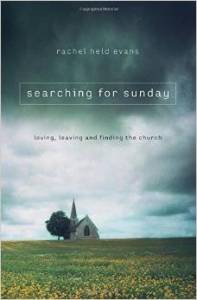
review: Rachel Held Evans’ Searching for Sunday

searching for sunday review

Rachel Held Evan’s Searching for Sunday is about church: its triumphs and failings, its hypocrisy and grace. Rachel, like me, grew up in a well-intentioned Evangelical community where the Bible is accepted as fact and the “plain truth” is within easy reach. It’s a culture of black and white morality, where spiritual cliches are a dime a dozen, rolling off the tongue the second something happens that doesn’t jive with the accepted worldview. Naturally, it has its limitations. Suffering is not easily alleviated with a dismissive utterance of “it’s all in God’s plan.” Rachel, like me, was encouraged to have a sense of ownership over her personal relationship with Jesus and, when the questions she wrestled with in the quiet started to gain momentum – when she started to ask them out loud – the church was unequipped to answer in anything but cliches.

Rachel, like me, flailed around, trying out new churches and new denominations, but the questions burned unanswered still, and she left.

Searching for Sunday‘s framework, quite fittingly, is the Sacraments: Baptism, Confession, Holy Orders, Communion, Confirmation, Anointing the Sick, and Marriage. These themes, like the Sacraments themselves, act as a jumping off point for a journey of faith. They encourage exploration and mystery; they don’t operate in spiritual cliches. One begins to realize that sometimes, the best answer to our questions is simply the space to wrestle with them. Rachel deals eloquently with this wrestling, acknowledging that the hurt sometimes makes it impossible to be in community, but always seeking the Truth of Christ’s unconditional love. She never gives up on that, and I think that’s the key to learning from the dark times in our spiritual lives. You may feel directionless, but you are moving forward if you are oriented toward love.

Searching for Sunday is memoir, but it is more than that. It’s theology. Steeped in the Gospel narratives, deeply respectful of those first disciples, and appreciative of the long, tumultuous years of violence perpetrated by and against the institutionalized church, it seeks to explore and understand what it looks like to do church now. It reminds us that Christian community was essential from the very beginning, that we don’t get to do Christian life on our own. 

Searching for Sunday gave me closure. I’d been hurt so badly by the church years ago, and I thought I’d moved on. But the truth is that I needed this reassurance that my pain was real, that my concerns were legitimate, and that the dark path I trudged through in the aftermath of leaving was not in vain. I needed someone to say, simply, “me too.”

As I sit here now with the sunshine streaming through the window and the birds singing and a cool spring breeze hitting my legs, I can tell you that I’m no longer searching for Sunday. I have found home in church community again. I am thankful for the path, and the hands that held me in the darkness, nudging me forward. I am thankful for space for the questions. I am thankful that God gave Rachel Held Evans the voice, and the heart, to tell her story, because it is my story, too.

I received an advance copy ofSearching for Sunday Searching for Sunday for review. Searching for Sunday is available for preorder here. It’ll hit store shelves this Tuesday, April 14.

*Artwork: Baptism by Ruth Catherine Meharg; used with permission.

Good Friday

In 2011, God was silent. I didn’t stop believing, but I was numb. Numb like cold fingers in the middle of winter: on the brink of frostbite. I was terrified of losing the religion, the community, and the language of faith that had been central to my life as a child and young adult. The stillness made me feel unhinged.

Perhaps as a way of coping with not knowing what the future of my faith looked like, I found other practices – other rituals – to fill the void. And in retrospect, the quiet cleared the clutter, opening up space for new ways of thinking and being.

I also read Still by Lauren Winner, a book I’d recommend to anyone feeling existentially lost. I realized I’d been waiting for my faith to return or to grow back to just the way it was before the silence when I should have understood this dark period as part of the path.

There is nothing wrong with feeling numb. There is nothing wrong with stillness. Nothing is lost in the process – you are still you, God is still God (much different and much more complicated than we can imagine, I’m sure), a community is waiting somewhere to love you for who you are, not what you profess on any given day.

Today I feel stable, but not always certain. I feel loved, but I’m not always sure it’s unconditional. But what I know is that living with grace and intention will never be the wrong path. See people and love them anyway. Forgive. Work toward justice. Leave yourself vulnerable to the fulfillment and pain of love.

open arms

church

I stopped going to church for nearly a year for a variety of reasons. I didn’t feel that my academic knowledge was appreciated, I was limited by my gender, I wasn’t at all comfortable with opening up about real struggle, I didn’t fit in. I think Daniel and I feared that we would never really feel at home in any church despite wanting to fellowship with other Christians, despite having chosen our majors because of our faith, despite it being a daily topic of conversation and reflection.

When we got to Charlottesville, we went to a few churches and sat in on a few small groups and just didn’t feel it. I grew up in various evangelical churches, so I know the whole rhetoric about not leeching off the church, about how “feeling” it isn’t enough. But, honestly, after struggling so much to fit into a church in college, I think that mentality covers up a real problem. People in the church, very often, are exclusive in their friendships, judgmental, and afraid to engage issues they deem too controversial. Even for two, born-and-raised Christians, the church began to feel foreign.

But we put in the effort to stick it out somewhere. We started going to an Episcopal Church, a denomination neither one of us grew up in. Known for its progressive/liberal (you choose the connotation) policies, we didn’t really consider it until we sort of fell into it. We found a group of young people who are willing to deal with controversy, doubt, and all the complexities of Christian thought head-on. We found thoughtful, compassionate, loving people who welcomed us in. We found community.

I realized last weekend, as a large group of us sat around the table at a local restaurant sipping drinks and talking about theologians, Russian television, feeling accepted, and avoiding cynicism, that I feel unencumbered – accepted – at last. Really, I laugh without inhibition, I listen, I reply, I learn something new, I think about things in a different light. I feel weightless and unimposing. I become a part of the moment instead of an acutely self-aware bystander. I realize that I’m finally fitting in. I’m at home. I don’t have to fight anymore.

The church needs to stop crossing its collective arms and start opening them to embrace all who enter in. I really believe that there is a place for doubt and skepticism in the church, that it’s a part of everyone’s spiritual journey. Without transition and struggle and stagnancy, there is no incentive to push forward and keep developing as a follower of Christ. I’ve found a group of people who know that, who walk with me in that, who lead me forward to hope and faith again.

I encourage you to seek out a community of followers who love without inhibition.

faith and feminism, part 1

I attended college in North Florida, the southernmost point of the true south. As a Religious Studies major, I learned about my Christian faith and its heritage within a much wider scope than my evangelical upbringing had provided. I studied history, literature, ancient languages, and ethics. At some (I suppose, inevitable) point, I found that I possessed more academic knowledge than many pastors who had lead my congregations growing up, and that I was respected for my thoughts and given a voice within academia.

I attended a conservative Protestant denomination affiliated with the Stone-Campbell Restoration Movement. They followed the Bible literally, which included not using instruments in the main service and not allowing women to take part, by speaking or leading, in the main service, or assembly. I ignored the obvious tension between my undergraduate expertise and the church’s interpretation of the Biblical text for nearly a year. But when women (and men) within the church began to discuss giving greater leadership privileges to women openly, I could no longer ignore their stance. When the elders ruled that it was best not to forsake tradition and stir up controversy just to let women pass the offering plate, the tectonic plates within my chest began to crunch together, grinding and sparking, forcing words and cries and change out of me. Something had cracked and I couldn’t stay silent.

That being said, I didn’t begin prophesying in the assembly or tearing my garments. I really liked the friends I’d made and the a Capella singing and the fun weekly hangouts. I tried to move past the pain, and the anger, by venting to those within the group who would willingly, and lovingly, provide a listening ear. One night, we invited several people over to our apartment to learn some new hymns. After the worship portion of the evening was done, we began to casually chat. Someone mentioned that “where two or three are gathered” there Christ is also. I remarked that our group, in effect, was an assembly. Yet women were speaking! A few female long-time attendees began to argue that women could speak, lead, and participate within this context, but not within the context of the larger, whole church assembly. I couldn’t face the contradiction, the injustice, the lack of critical thought. I blew up. I shouted that I couldn’t stand the denomination, began to weep, then ran to my room like a small child. Within the week, I had been formally chastised for my behavior on the grounds that it could discourage newcomers’ in their faith.

I couldn’t help thinking that my faith had been manipulated and shattered by the undercurrent of sexism labeled as Biblical adherence, and that no one cared. I mentally disconnected myself from the congregation after that talk. Although I worked to forgive those who believed they had spoken the truth in love, those who had meant me no harm, I could never go back with an open and full heart. Near the end of my attendance there, the worship leader sang the wrong part, and I recalled that there were formally trained female vocalists in the congregation who could have lead with both heart and knowledge. But they weren’t allowed. Implicitly – and there’s no satisfactory way to get around this – women were secondary to men. I got up and ran out of the building, down to a creek on the church property. I cried, and felt at peace, away from the church. I felt God. Away from the church.

I didn’t attend church again for almost a year. And my faith grew.

This is the first part of a series on faith and feminism.